Countdown

Image

Countdown

Eighteen more days of school. Eighteen more days of school. Eighteen more days of school. Eighteen more days of school. Eighteen more days of school. Eighteen more days of school. Eighteen more days of school. Eighteen more days of school. Eighteen more days of school. Eighteen more days of school. Eighteen more days of school. Eighteen more days of school. Eighteen more days of school. Eighteen more days of school. Eighteen more days of school. Eighteen more days of school. Eighteen more days of school. Eighteen more days of school.

Can a Public School Student Read a Bible in Class?

Image

Can a public school student read a Bible in class?

Yes, but not loudly, waving it around, while I am explaining the safety protocols for laboratory use of silver nitrate in chemistry class.

It’s dangerous stuff, as you can see here: http://www.sciencelab.com/msds.php?msdsId=9927411.

Did this actually happen? Of course — I don’t think I could make up a story like that. It happened in a different class than the one I am teaching this year, though. The student’s name is being withheld, to protect his identity (and my job).

My Wikipedia Userboxen Collection, Part V

Image

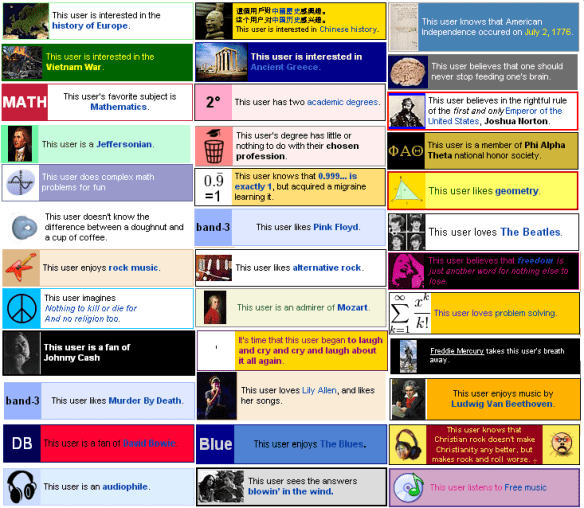
My Wikipedia Userboxen Collection, Part V

Finally: the last installment!

My Wikipedia Userboxen Collection, Part III

Image

My Wikipedia Userboxen Collection, Part III

And, yes, there are even more….

My Wikipedia Userboxen Collection, Part II

Image

My Wikipedia Userboxen Collection, Part II

Collecting userboxen on Wikipedia is fun, but almost no one (except other Wikipedians) ever sees such collections. Since you can learn a lot about a given Wikipedian by their collection of userboxen, my blog seems like a good place to re-post my collection. It’s being done in pieces, simply to maintain legibility.

My Wikipedia Userboxen Collection, Part I

Image

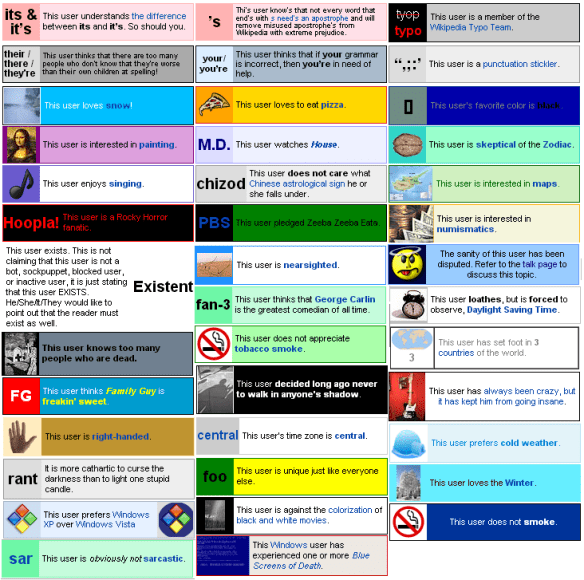
My Wikipedia Userboxen Collection, Part I

I’ve been editing Wikipedia under my own (legal) name for years, although I just submitted a request to have my Wikipedia-name changed to match the name of this blog. Every Wikipedia user has a user page, and can put these userboxen on it. Here’s the first part of my collection.

Something You Likely Did Not Know, About the “Pledge of Allegiance”

Image

I thought I knew the (rather complicated) history of the “Pledge of Allegiance” well — until I saw this picture. This was the original “flag salute” pose American students were taught to use, nationwide, until World War II was well underway. It had been in use since 1892, and was called the “Bellamy salute.”

The current “hand over the heart” gesture didn’t go into effect until 1942, and was changed in reaction to the Nazis using essentially the same salute which you see American schoolchildren displaying in this (circa 1941) photograph. From where did this gesture really originate? A common belief is that it started in ancient Rome, but the article at http://en.wikipedia.org/wiki/Roman_salute — and the sources cited there — throw doubt on this idea. It seems that, instead, this gesture was depicted in an 1874 painting of an ancient Roman scene, spread into other neoclassical artworks, then plays and other performances, until it was well-established in the public consciousness as something the ancient Romans did — but that belief appears to be unsupported by the relatively small number of actual writings, or works of art, which have survived from ancient times.

It was twelve years after the change in the civilian American flag-salute gesture that Congress made another, much better-known change — the 1954 addition (unconstitutional, in my opinion) of the words “under God.” Just as the early gesture-change was made, in wartime, as a reaction against the practices of an enemy, arguments have been made that this change in the wording of the Pledge was made for similar reasons, given that we were then in the early years of the Cold War, with America’s enemies, in that long struggle, being what were often called the “Godless Communists.”

[Additional source, beyond the one given above: http://en.wikipedia.org/wiki/Pledge_of_Allegiance (with more sources cited at the bottom of that article)].

Which State Is South of Arkansas?

Image

Which State Is South of Arkansas?

This really happened, in a geography class I took, long ago, in an Arkansas elementary school.

Teacher: “Which state is south of Arkansas?”

Me: “There are six: Oklahoma, Missouri, Tennessee, Mississippi, Louisiana, and Texas.”

Teacher: “No, Robert, that’s wrong.”

Me: “No, YOU’RE wrong. I’m right, and I’ll prove it.” I then got up, walked to the large classroom map of Arkansas, and ran my finger downwards on the map, six times, along the arrows you see above, while shouting, “South! South! South! South! South! South!” It’s true: from some point in Arkansas, you can travel, due South, into some part of any of the six adjacent states.

The teacher called my mother. Her response? “What’s the problem? He was RIGHT, wasn’t he?”

A Proof

Image

A Proof

I ran into a problem at a meeting of teachers, yesterday, which exposed an embarrassing hole in my geometrical knowledge — and so I quickly became obsessed with filling it. In the diagram, the large triangle is right, and the leg lengths were given; the problem was to find the length of the hypotenuse (also the diameter of the circle centered at B). The median seen here was not shown, however, and no right angle was identified. Were the triangle not a right triangle, this would be an impossible problem, so I knew it had to be a right triangle . . . but that didn’t satisfy me. I had to have a proof, so I wrote one.

Here it is: in the diagram shown, segment AC is a diameter of a circle with center B, while D is any point on the triangle distinct from A and C. Segments BA, BD, and BC are all radii of the same circle, and therefore have the same length, making triangles ABD and CBD isosceles with bases, respectively, of AD and CD.

Let the measure of angle ABD be some number x. Since it forms a linear pair with angle CBD, angle CBD’s measure must be 180 – x.

Angles BAD and BDA are the base angles of isosceles triangle ABD, which has a vertex angle measure already chosen as x. Since these base angles must be congruent, it follows from the triangle sum theorem that each of these angles must measure (180 – x)/2.

Angles BCD and BDC are the base angles of isosceles triangle CBD, which has a vertex angle measure already determines to be 180 – x. Since these base angles must be congruent, it follows from the triangle sum theorem that each of these angles must measure (180 – (180 – x))/2.

By the angle sum theorem, the measure of angle ADC must equal the sum of the measures of angles BDC and BDA, already shown, respectively, to be (180 – (180 – x))/2 and (180 – x)/2.

Angle ADC’s measure therefore equals (180 – (180 – x))/2 + (180 – x)/2, which simplifies to (180 – 180 + x)/2 + (180 – x)/2, which further simplifies to x/2 + (180 – x)/2. Adding these two fractions yields the sum (x + 180 – x)/2, and then the “x”s cancel, leaving only 180/2, or 90 degrees, for the measure of angle ADC. Therefore. triangle ADC, the large triangle in the diagram, must be a right triangle — QED.

I’m rather embarrassed that I didn’t already know this property of inscribed triangles with one side being the diameter of the triangle’s circumscribed circle — but at least I figured the proof out myself, and that, in turn, made the faculty meeting easily the least boring one I have ever attended.
Every American Who Is Old Enough Remembers 9/11/2001

Here’s the main thing I remember about that day. I was teaching 9th graders when the attacks occurred.

Student, 12 years ago today: “Mr Austin! Mr. Austin! Turn on the TV! Someone just flew an airplane into the World Trader Center!”

Me: “Yeah, RIGHT.” I was finally convinced to turn it on — just in time to see the second plane hit the other tower.

I don’t think I’ll ever live THAT one down. I had to spend the rest of the workday trying to reassure my students that Mayflower, Arkansas had zero strategic importance, and that they could relax about their fears of their small town being the next target. This was not easy.

The boiling anger set in after I no longer had to take care of students, and remained with me for days. Many (or most) Americans experienced this same emotion.