On Life, and Death, in the Marvel Comics Universe

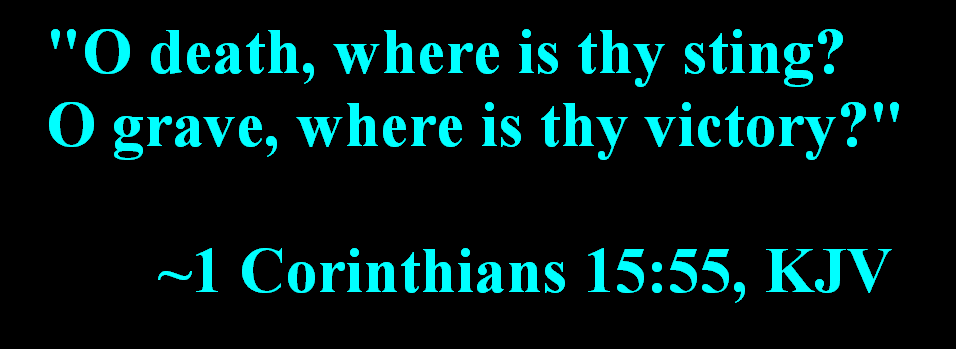
o death

To write this, I did a lot of research, and had much help from friends. One of them, Craig Deaton, gave permission for his name to be used, but the others have not. I am grateful to them all.

This is a compilation of three lists, for purposes of comparison and analysis, and concerns life, death, being “unkilled,” then “re-killed” after being unkilled, and then, sometimes, being “re-unkilled,” and so on. In other words, the topic here is bad writing, and a terribly overused plot device. To (try to) keep this simple, I’m limiting this survey to the primary Marvel Comics universe, in which Earth is called, for reasons I do not understand, Earth-616. I started this yesterday, by simply posting some questions on Facebook, and watched, with growing amazement, as the information started pouring in.

The shortest of these lists includes only comic book characters who are currently dead, but whom I have high confidence Marvel will unkill, before too long.

  1. Wolverine, a/k/a James “Logan” Howlett
  2. Uatu, a/k/a The Watcher
  3. Charles Xavier, a/k/a Professor X

At least two of these characters (Wolverine and Professor X) have been killed, and then resurrrected, before, and I will be shocked if this process is not repeated, again (and again, and again, and again…).

The next list includes characters who have been killed, have actually remained dead, so far, and whose resurrections I do not (at least not fully) expect.

  1. The Abomination
  2. The Ancient One (associated with Dr. Strange)
  3. Hector Ayala, the Black, Hispanic, male version of the White Tiger, killed after Matt Murdock failed to secure his acquittal on a murder charge, of which Ayala was innocent
  4. Blink, of the X-Men
  5. Daken, son of Wolverine
  6. Jean DeWolf, a police detective who used to work with Spider-Man
  7. Dr. Doom’s mother
  8. Leland Drummond, a corrupt FBI man involved in “outing” Daredevil’s secret identity
  9. Richard Fisk, son of the Kingpin (Wilson Fisk)
  10. Flashback, a little-known mutant killed in a weird time-travel scenario created by his own superpowers
  11. Bill Foster, a/k/a Goliath, a/k/a Black Goliath
  12. Adolf Hitler, a/k/a Hate Monger (brought back from the dead, and then re-killed)
  13. Karen Page, the primary love interest of Matt Murdock’s (Daredevil’s) life
  14. Mar-Vell, a Kree warrior who went by the name “Captain Marvel”
  15. Microbe, of the New Warriors
  16. “Battlin’ Jack” Murdock, best-known as Daredevil’s father
  17. Namorita, of the New Warriors
  18. Night Thrasher, of the New Warriors
  19. Scott Perkins, a police officer whom Hector Ayala (see above) was falsely convicted of killing, despite Matt Murdock’s best efforts, as his lawyer, to secure Ayala’s acquittal
  20. Pyro, one of many foes of the X-Men, who was killed, brought back as a zombie, and then killed again
  21. Spider-Man’s father
  22. Spider-Man’s mother
  23. Spider-Man’s Uncle Ben
  24. Gwen Stacy, former girlfriend of Spider-Man
  25. Katherine Anne Summers, the mother of the mutants Cyclops, Havok, and Vulcan
  26. Turbo (the original one)
  27. The chain of unnamed criminals who first got Daredevil’s secret identity from Karen Page to Wilson Fisk, the Kingpin of crime, and were then ordered killed by Fisk
  28. Numerous unnamed people who lack superpowers, and also lack connections to superheroes who are neither Daredevil, nor Spider-Man
  29. The unnamed woman whom Daredevil’s wife Milla, under the influence of mind control, pushed in front of an oncoming subway train, leading to Milla’s institutionalization
  30. At least one person affected by the Wendigo curse (killed by the Red Hulk)

What can we learn from the list above? Well, for one thing, characters in the Marvel Universe who have no superpowers should stay far away from both Daredevil and Spider-Man.

The last list, and easily the longest, includes characters who have recovered from death at least once, and are currently alive in this fictional universe — one where death obviously “has a very loose grip,” as one of my friends on Facebook phrased it.

  1. Bucky Barnes / The Winter Soldier, and, briefly, Captain America
  2. Bullseye
  3. Cannonball
  4. Captain America / Steve Rogers
  5. Colossus, of the X-Men
  6. Cyclops / Scott Summers, of the X-Men
  7. Cypher / Doug Ramsey, of the New Mutants
  8. Daredevil / Matt Murdock
  9. Darwin, of the X-Men
  10. Dead Girl (except that she’s still sort of dead, being, after all, Dead Girl)
  11. Elektra
  12. Firebrand
  13. Vanessa Fisk, estranged wife of Wilson Fisk, the Kingpin
  14. Galactus
  15. Jean Grey (not exactly the same as Phoenix)
  16. The Grim Reaper (brother of Wonder Man)
  17. Havok / Alex Summers
  18. Hawkeye / Clint Barton / Ronin
  19. The Human Torch (original android version)
  20. Loki, Norse God of Mischief
  21. Longshot, of the X-Men
  22. Moira McTaggert, friend of the X-Men
  23. Mockingbird, ex-wife of Hawkeye
  24. Mysterio / Quintin Beck
  25. Nightcrawler, of the X-Men
  26. The Owl / Leland Owlsley
  27. Petra, of the X-Men
  28. Phoenix (not exactly the same as Jean Grey)
  29. Agent Preston
  30. Kathryn “Kitty” Pryde, of the X-Men
  31. Madelyne Pryor, estranged wife of Cyclops / Scott Summers
  32. Psylocke, of the X-Men
  33. The Punisher / Frank Castle
  34. The Red Skull
  35. Rogue, of the X-Men
  36. The Sentry
  37. Speed, of the Young Avengers
  38. Spider-Man / Peter Parker
  39. Spider-Man’s Aunt May
  40. Spider-Man’s clone
  41. Storm / Ororo Munroe, of the X-Men
  42. Hope Summers, of the X-Men
  43. Sway, of the X-Men
  44. Tarot
  45. The Thing / Benjamin Grimm
  46. Thunderbird, of the X-Men
  47. Toro, the original (android) version of the Human Torch
  48. Trickshot
  49. The Vision
  50. Vulcan, of the X-Men (brother of Cyclops and Havok)
  51. Wiccan, of the Young Avengers
  52. Wonder Man
  53. Wong, associated with Dr. Strange
  54. Zzzax

It is clear that the most effective way to cheat death, in the Marvel Universe, is simply to be one of the X-Men. Are there more characters who should be on this list? Yes, but we all got tired after several hours of this, and moved on to other things.

Seriously, though, Marvel needs to stop doing this.

However . . . they won’t.

The Five Fictional Characters Who Have Most Strongly Influenced My Life

These five fictional characters have strongly influenced me, and I will always be grateful to the brilliant people who created them. I am presenting them in chronological order — using the time when this influence started, rather than their date of creation.

#1: Snoopy

Snoopy2

When I was very young — before my memory-record begins, actually — I was given Peanuts books. They were simply left in my possession, as far as I know; no explanation was necessary. The antics of Snoopy, in particular, were extremely entertaining to the little-kid version of me. Since I could see Snoopy dancing around, playing baseball, typing, irritating Lucy, etc., I wanted to understand what was actually going on with all this activity — and this provided the necessary motivation for me to teach myself how to read. There wasn’t any other way for me to tell what was going on in these comic strips!

The fact that I learned to read in this manner led to some very funny moments, due to the fact that the number of words whose meaning I understood, generally from context, exceeded the number of words I knew how to pronounce — and, no doubt, still does. Once, in elementary school, I was laughed at by an entire class, after saying something about the “Eeffel Tower” (yes, that’s how I pronounced it). I also remember pronouncing the “b” in “doubt,” much to the amusement of my parents. Even in graduate school, I made a history professor groan in agony when I made a reference to the Weimar Republic — and pronounced the “W” as it is pronounced in English, rather than German.

#2: Mr. Spock

Spock

A scientist aboard a starship, exploring the galaxy, who uses logic to try to understand two things:  the nature of the universe (much of which he understood), and the behavior of illogical humans (something which confuses me to this day, just as it often confounded him). The first person I remember seeing on television had pointed ears, and there were several of them in that episode, “Amok Time.” In other episodes, of course, few Vulcans other than Mr. Spock appeared, and I always found him, to use one of his favorite words, “fascinating.” He influenced me in several ways, and still does, to this day. I am grateful to the creators of this character for inspiring my passion for science, ability to use logic, appreciation of diversity, and strong desire to maintain control of my emotions.

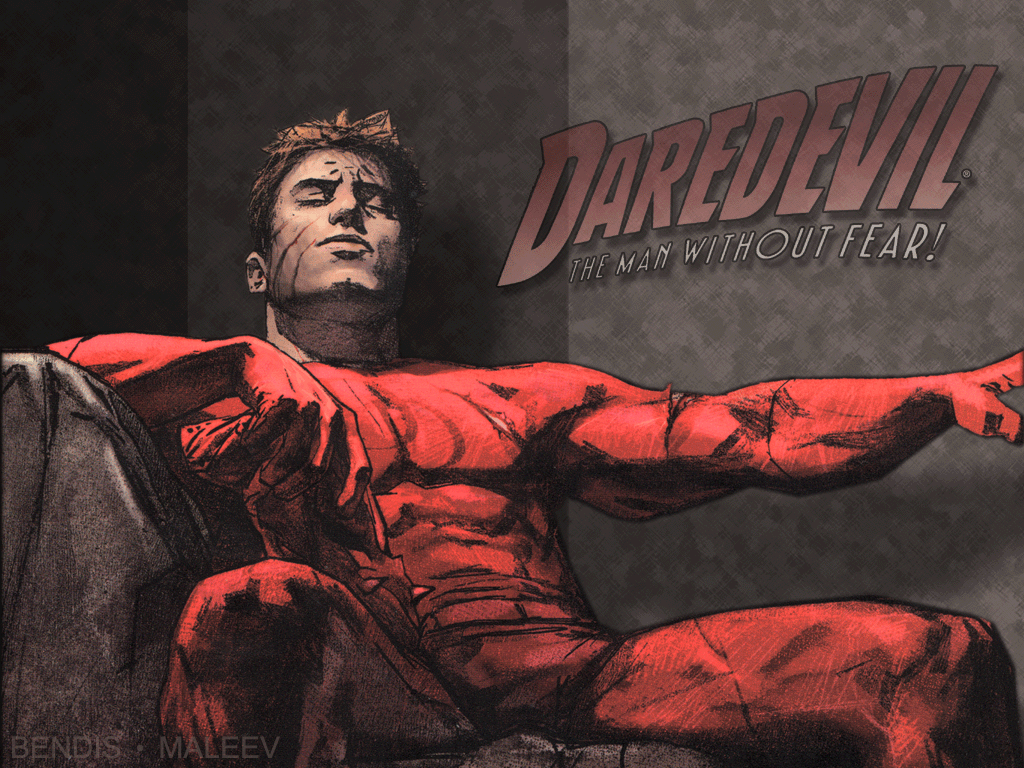
#3: Matt Murdock / Daredevil

daredevil

I may not have red hair, but I share many other characteristics with Daredevil — and I mean the character from comic books, not that disappointing B-movie (which deserves no further mention). Other than amplified senses — which I experience (unpleasantly) when I get migraines — Daredevil has no superpowers, yet he faces, and does battle with, super-powered villains, and usually wins. He is also a study in contradictions: a lapsed Catholic, who spends a lot of time dressed in a devil costume; a lawyer, with a second “career” as a costumed vigilante; and a blind man, who nonetheless perceives the world around him more clearly than anyone else. Matt Murdock has inspired me to respect the concept of justice, has influenced me to study what laws I need to understand, and, most importantly, has shown me, by example, how to face down those who would do harm to those I care about — and do it, as Daredevil does, without fear. I have also developed my “never give up” attitude, toward my adversaries (bullies, mostly), with inspiration from this character.

Matt Murdock and I have also had very rocky histories when it comes to romantic relationships. I have (finally) found happiness in this aspect of life, and am writing this next to my beloved, sleeping wife. Unfortunately, the writers of Daredevil, while they will let Matt Murdock enjoy temporary happiness in relationships with women, will never allow him to keep it.

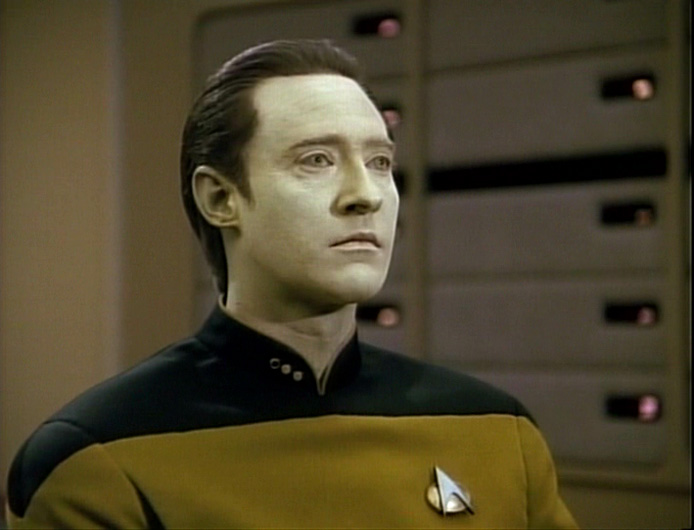
#4: Data

Data2366

Data is amazing to me:  a sentient android, and an artificial person. He actually had to go on trial to assert his rights to personhood, and, with the aid of Captain Picard, won the case. He has a lightning-speed calculator, built right in to his positronic brain, which far exceeds the abilities of my own, not-too-shabby mental calculator. I have long had the ambition to gain the ability to reprogram my own brain’s “software,” and have written, on this blog, about how I finally gained that ability, after working on developing it for roughly thirty years. Data, of course, had this ability from the moment he was activated, but, unlike me, he does not have to sleep for it to work.

Despite his claim to experience no emotions, Data often expressed a feeling of being perpetually alone, for there was no one else like him anywhere — until he met his brother, another android, who turned out to be malicious. That feeling of being unlike everyone else is quite familiar to me.

Both Data, and Mr. Spock, display many characteristics of Asperger’s Syndrome, and my study of these two characters helped me figure out that I am, myself, an “Aspie” — our nickname for ourselves.

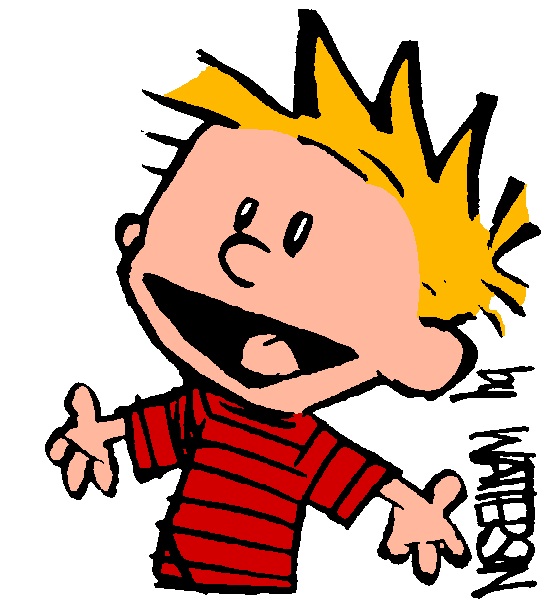
#5: Calvin

Calvin_by_Watterson

When I am playing (and, yes, I play a lot, especially with mathematics), and someone asks me why I, an adult, am playing, I have a standard reply: “Because I’m six.” This is a reference to Calvin, who was six years old during the entire ten-year run of Calvin and Hobbes, the best comic strip ever created. I read it from the first day it appeared in newspapers, and have the boxed set of the complete collection of these comic strips only a meter away, as I write this. Calvin is a six-year old prodigy, as one can tell from his expansive vocabulary, but is prone to making social errors, due to a lack of understanding of social conventions — and both of these things mirror my own life. (I grew up, literally, in science laboratories, unsupervised for hours at a time, designing and conducting my own experiments, and that sort of thing simply doesn’t happen without having profound effects on a child’s development — but, then again, why would I want to be normal?) Calvin, like myself, found elementary school boring in the extreme, and so he slipped, frequently, into his own inner life of fantasy. The fact that, being socially isolated (no siblings, and no friends, other than his stuffed tiger), he is usually alone, never stopped Calvin from having fun. Just like Calvin, I can have unlimited fun, in solitude — because I choose to be this way. Some adults lose the child within them, but, thanks to Calvin’s inspiration, that will never happen to me. I’m actually 46 years old now — so I’m pretty sure that, if I was ever going to lose the ability to have fun, it would have happened already.

To those brilliant people who invented these five characters: thank you.

Top 100 Banned/Challenged Books: 2000-2009

censorship

The best ways to celebrate Banned Books Week (which is going on now) are to read/buy/give away banned books, and/or donate money to libraries which deliberately put banned books in the circulating collection, as all good libraries do.

I’ve color-coded the list below. Books in red, I have read in their entirety. Books in blue, I have read some of, but have not (yet) finished. Also, now that I know they’re on this list, I’m likely to add some of the books in black, which I have not yet read, to my “books-to-read” list. There are few things I hate as much as censorship.

1. Harry Potter (series), by J.K. Rowling

2. Alice series, by Phyllis Reynolds Naylor

3. The Chocolate War, by Robert Cormier

4. And Tango Makes Three, by Justin Richardson/Peter Parnell

5. Of Mice and Men, by John Steinbeck

6. I Know Why the Caged Bird Sings, by Maya Angelou

7. Scary Stories (series), by Alvin Schwartz

8. His Dark Materials (series), by Philip Pullman

9. ttyl; ttfn; l8r g8r (series), by Lauren Myracle

10. The Perks of Being a Wallflower, by Stephen Chbosky

11. Fallen Angels, by Walter Dean Myers

12. It’s Perfectly Normal, by Robie Harris

13. Captain Underpants (series), by Dav Pilkey

14. The Adventures of Huckleberry Finn, by Mark Twain

15. The Bluest Eye, by Toni Morrison

16. Forever, by Judy Blume

17. The Color Purple, by Alice Walker

18. Go Ask Alice, by Anonymous

19. Catcher in the Rye, by J.D. Salinger

20. King and King, by Linda de Haan

21. To Kill A Mockingbird, by Harper Lee

22. Gossip Girl (series), by Cecily von Ziegesar

23. The Giver, by Lois Lowry

24. In the Night Kitchen, by Maurice Sendak

25. Killing Mr. Griffen, by Lois Duncan

26. Beloved, by Toni Morrison

27. My Brother Sam Is Dead, by James Lincoln Collier

28. Bridge To Terabithia, by Katherine Paterson

29. The Face on the Milk Carton, by Caroline B. Cooney

30. We All Fall Down, by Robert Cormier

31. What My Mother Doesn’t Know, by Sonya Sones

32. Bless Me, Ultima, by Rudolfo Anaya

33. Snow Falling on Cedars, by David Guterson

34. The Earth, My Butt, and Other Big, Round Things, by Carolyn Mackler

35. Angus, Thongs, and Full Frontal Snogging, by Louise Rennison

36. Brave New World, by Aldous Huxley

37. It’s So Amazing, by Robie Harris

38. Arming America, by Michael Bellasiles

39. Kaffir Boy, by Mark Mathabane

40. Life is Funny, by E.R. Frank

41. Whale Talk, by Chris Crutcher

42. The Fighting Ground, by Avi

43. Blubber, by Judy Blume

44. Athletic Shorts, by Chris Crutcher

45. Crazy Lady, by Jane Leslie Conly

46. Slaughterhouse-Five, by Kurt Vonnegut

47. The Adventures of Super Diaper Baby: The First Graphic Novel by George Beard and Harold Hutchins, the creators of Captain Underpants, by Dav Pilkey

48. Rainbow Boys, by Alex Sanchez

49. One Flew Over the Cuckoo’s Nest, by Ken Kesey

50. The Kite Runner, by Khaled Hosseini

51. Daughters of Eve, by Lois Duncan

52. The Great Gilly Hopkins, by Katherine Paterson

53. You Hear Me?, by Betsy Franco

54. The Facts Speak for Themselves, by Brock Cole

55. Summer of My German Soldier, by Bette Green

56. When Dad Killed Mom, by Julius Lester

57. Blood and Chocolate, by Annette Curtis Klause

58. Fat Kid Rules the World, by K.L. Going

59. Olive’s Ocean, by Kevin Henkes

60. Speak, by Laurie Halse Anderson

61. Draw Me A Star, by Eric Carle

62. The Stupids (series), by Harry Allard

63. The Terrorist, by Caroline B. Cooney

64. Mick Harte Was Here, by Barbara Park

65. The Things They Carried, by Tim O’Brien

66. Roll of Thunder, Hear My Cry, by Mildred Taylor

67. A Time to Kill, by John Grisham

68. Always Running, by Luis Rodriguez

69. Fahrenheit 451, by Ray Bradbury

70. Harris and Me, by Gary Paulsen

71. Junie B. Jones (series), by Barbara Park

72. Song of Solomon, by Toni Morrison

73. What’s Happening to My Body Book, by Lynda Madaras

74. The Lovely Bones, by Alice Sebold

75. Anastasia (series), by Lois Lowry

76. A Prayer for Owen Meany, by John Irving

77. Crazy: A Novel, by Benjamin Lebert

78. The Joy of Gay Sex, by Dr. Charles Silverstein

79. The Upstairs Room, by Johanna Reiss

80. A Day No Pigs Would Die, by Robert Newton Peck

81. Black Boy, by Richard Wright

82. Deal With It!, by Esther Drill

83. Detour for Emmy, by Marilyn Reynolds

84. So Far From the Bamboo Grove, by Yoko Watkins

85. Staying Fat for Sarah Byrnes, by Chris Crutcher

86. Cut, by Patricia McCormick

87. Tiger Eyes, by Judy Blume

88. The Handmaid’s Tale, by Margaret Atwood

89. Friday Night Lights, by H.G. Bissenger

90. A Wrinkle in Time, by Madeline L’Engle

91. Julie of the Wolves, by Jean Craighead George

92. The Boy Who Lost His Face, by Louis Sachar

93. Bumps in the Night, by Harry Allard

94. Goosebumps (series), by R.L. Stine

95. Shade’s Children, by Garth Nix

96. Grendel, by John Gardner

97. The House of the Spirits, by Isabel Allende

98. I Saw Esau, by Iona Opte

99. Are You There, God?  It’s Me, Margaret, by Judy Blume

100. America: A Novel, by E.R. Frank

Source:  http://www.ala.org/bbooks/top-100-bannedchallenged-books-2000-2009

Finally, what I am reading, myself, during Banned Books Week is Sam Harris’s latest, Waking Up. It’s a safe bet that all books by Sam Harris are banned in quite a few places.

Important Safety Guidelines from Your Gravity Company, GravCorp, Inc.

floating-people-068

Please read these safety guidelines carefully. Also, we recommend displaying them prominently, securely fastened to the sturdiest wall in your home, in the event that your gravitational service is ever shut off for non-payment of your GravCorp gravity bill.

Because your friends at GravCorp care about you and your family’s safety, GravCorp will never shut your gravity off abrupty, but does so gradually, over the 24-hour period following the end of the shut-off date (prominently printed in red, bold type) on your gravity shut-off notice. It is best to evacuate early during this period. [Tip:  when you notice that you weigh noticeably less than you did the day before, that is your signal to leave.] We are not responsible for anything that happens if you fail to heed this advice, but we do have some safety guidelines to help those who, through no fault of ours, fail to leave their homes in a timely manner.

Once gravity shut-off is complete, if you are still inside your home, follow these safety rules carefully:

1. Be certain to keep moving at all times. Stationary humans have been known to die from lack of oxygen in the absence of gravity, due to the buildup of a spherical cloud of exhaled carbon dioxide, centered in the region of their mouths and noses. If you still have electrical service while your gravity is shut off, however, you can also avoid this danger by turning on all the electric fans in your home, such as the ceiling fan in the picture above. 

2. Should you choose to go outside, exercise extreme caution to avoid serious accidents (most of which are likely to be fatal). If you still have telephone or Internet service, we recommend paying your past due GravCorp account balance (plus the $135 reconnect fee) by phone or Internet, from inside your home.

3. Keep all liquids inside containers, for inhalation of even part of a floating ball of water, or other liquid, can cause death by drowning.  [Tip:  don’t forget to seal all toilets — both bowl and tank — using approved, waterproof sealing methods and materials.]

4. Act quickly to pay your past due bill, plus the $135 reconnect fee, or have a pressure suit on and pressurized, for the air above you is already beginning to escape into space.

5. Remain calm, do not panic, and consider setting up automatic bank drafts to pay your gravity bill, effortlessly, each month. It’s convenient, safe, and saves you money on postage. (An annual $3.14 convenience fee will be charged to your GravCorp account, on or near July 1st each year, for this optional service.)


[Image credit:  The picture above was found at http://www.thedistractionnetwork.com/going-to-bed/.]

My Four Favorite Authors

favorite authors

Whenever people ask me to name my favorite author, I always have to ask them to be more specific, for I cannot bring myself to choose just one. If gender is specified, and either fiction or non-fiction is, as well, then I am able to choose a favorite author in each of the resulting four categories.

My two favorite writers of fiction, Flannery O’Connor and Robert A. Heinlein, are shown at the top. Flannery O’Connor was often described as a Southern gothic writer with an excellent ability to describe the grotesque, mostly with short stories, while Robert Heinlein was often called the greatest of all writers in the genre of science fiction. I wish it were possible for them to write even more, but, unlike the two authors described next, they are no longer living.

Shown below O’Connor and Heinlein are my two favorite authors of non-fiction, Jung Chang and Sam Harris. Jung Chang writes about Chinese history, eloquently, from the perspective of someone who actually was a Red Guard during the utterly insane period known as the Chinese Cultural Revolution, as a teenager, but later managed to get out of the People’s Republic — and, crucially, she was also able to mentally escape the powerful cult of personality which surrounded that nation’s leader for over two decades, Chairman Mao Zedong. She has gone on to become one of Mao’s harshest critics.

Sam Harris, a neuroscientist, began his career as an author by writing books criticizing religion, in the wake of the 9/11 terrorist attacks of 2001. He has since moved on to other topics (and writing better books than his earlier work, in my opinion), such as the corrosive effects of lying, the question of the existence or non-existence of free will, and a scientific approach to dealing with issues involving good and evil. He also has a new book coming out in September.

Other than their amazing skill at the difficult craft of writing, these four have little in common . . . but who wants to read the same sort of books all the time? If you aren’t familiar with their work already, I recommend giving each of them a read, and seeing what you think of their books. For one of them, Sam Harris, you can even give some of his writing a try for free, for he maintains a blog you can check out for yourself, at http://www.samharris.org.

For the other three, it isn’t quite that easy to get started, but their books may still be found in any decent public library, or, of course, websites such as Amazon. For O’Connor, the best place to start is with her collected short stories (Amazon link: http://www.amazon.com/The-Complete-Stories-Flannery-OConnor/dp/0374515360/ref=sr_1_2?ie=UTF8&qid=1405366654&sr=8-2&keywords=collected+short+stories+of+flannery+o%27connor). For Jung Chang, I recommend starting with the story of what happened, against the tumultuous backdrop of Chinese history, to her grandmother, mother, and finally herself, in Wild Swans:  Three Daughters of China (see http://www.amazon.com/Wild-Swans-Three-Daughters-China/dp/0743246985/ref=sr_1_1?s=books&ie=UTF8&qid=1405366792&sr=1-1&keywords=wild+swans). Heinlein’s works are numerous, and there are many good starting places to be found. Among the best books with which to start reading Heinlein are Stranger in a Strange Land (his most famous work), Friday, The Moon Is a Harsh Mistress, and Job:  A Comedy of Justice. Amazon’s Robert Heinlein page may be found at http://www.amazon.com/Robert-Heinlein/e/B005GDIOHM/ref=sr_tc_2_0?qid=1405367065&sr=1-2-ent.

Enjoy, and, if you have book recommendations of your own, I invite you to leave them in a comment to this post.

The Origin of an Interplanetary War: Itaumiped vs. Almausoped

Image

The Origin of an Interplanetary War:  Itaumiped vs. Almausoped

Itaumiped and Almausoped are artificial rogue planets, each an identical member of a double-planet system bound into orbit, and tidally-locked, by gravity. The energy source used by the planets’ inhabitants, which uses a radioactive isotope with a very long half-life, causes the faces of these hollow polyhedral planets to radiate heat and light, both on the inside and outside, which is why you can see them here, but do not see a “night” side on either planet.

Long ago, the common ancestors of the Itaumipedeans and the Almausopedeans, living on the natural planet Loorohmude where their species evolved, built each of these planets as a heavily-populated, multi-generational, interstellar colony-ship. They built two, using materials from large asteroids, and launched them together, for a perfectly good reason: if something happened to one of the planet-ships, the survivors could find refuge in the other one. A large pentagonal hole was even built into each planet’s polyhedral design, and set to face the other one, simply to allow ease of communication, and travel, between them. Their journey was to last “only” twelve generations . . . but things don’t always go as planned.

An idea took root, and spread during the long journey, that viewed the old stories of Loorohmude as primitive, dangerous superstitions, with no evidence to support their veracity — other than ancient written records, which the anti-Loorohmudeans viewed as dangerous fabrications. Civil war broke out on each planet, and the anti-Loorohmudeans achieved two of their goals: they killed a lot of their enemies (who returned the favor in kind), and they destroyed the ancient records, despite the attempts of their enemies to save them. On each planet, some of the inhabitants on each side survived — but, on both, the old records were utterly obliterated.

The information lost wasn’t all mere history for history’s sake, but also included essential technical material, such as instructions for building the device, while in transit, which would allow Itaumiped and Almausoped to slow their velocity in time to achieve orbit when they reached their destination, the distant planet Stidennatio. For this reason, this planned deceleration never happened, and the twin war-ravaged planets flew right past Stidennatio at a high fraction of the speed of light. Inertia carried them right through Stidennatio’s solar system, and into the uncharted space beyond. With civil wars still raging on each planet, however, the combatants took little notice of the solar system they rapidly flew through, and those few who did notice any of it did not understand what they were seeing.

The reduced populations of each planet, simply due to their smaller numbers, now had supplies for a much longer journey, and eventually, the civil wars stopped . . . because both sides ran out of long-range weapons. They could have continued fighting without weapons, or with such things as knives and clubs . . . but by that time, the population was so reduced, so dispersed, and so war-weary, that hostilities on each side simply dwindled slowly away.

It took a long time — just under three generations — for the smoke to clear, and the population to start to rebound. By this time, no one thought of themselves as pro- or anti-Loorohmudeans anymore, but simply as the descendants of the survivors of a terrible war.

Naturally, and gradually, everyone started looking for someone to blame for the atrocities that always accompany warfare. By this time, the ravages of war had rendered the exterior surfaces of both Itaumiped and Almausoped uninhabitable, so everyone lived in the hollow interiors of each planet-ship. From this inside vantage point, thanks to the pentagonal holes which were part of the original design, everyone could see one convenient scapegoat: the other planet, always in view, and close enough that evidence of habitatation could be seen with telescopes.

Lasers aren’t all that difficult to make, and so the first shot fired in the new, second period of warfare, between the planets this time, took the form of an intense pulse-laser blast exiting one pentagonal hole, and entering its counterpart. It destroyed the top of an abandoned building, and killed no one . . . but it was noticed, and so a retaliatory strike soon took the same path, but in the opposite direction. This time, there were fatalities. More weapons were built, and immediately deployed. Soon, full-scale interplanetary war was raging.

This new war won’t last forever. It may stop when supplies run out, to be followed by famine, or the supplies might hold out until everyone simply kills each other. Does it matter which of these outcomes happens? No, not really. Itaumiped and Almausoped passed their destination generations ago, and now they’re going nowhere, at a high rate of speed . . . in more than one way.

Unlike their inhabitants, though, the planet-ships Itaumiped and Almausoped, soon to be devoid of life, will continue much longer. Just as they have since their construction, they will keep orbiting their common center of mass, and keep getting further away from their original, long-forgotten launch point, as well as their intended destination, until the heat death of the universe finally catches up with them, as well.

###

Notes: Itaumiped (anagram for “I made it up”) and Almausoped (anagram for “also made up”) have different characteristics every time they appear. This is one of the nicer things about having my own imaginary astronomical objects — I don’t have to memorize things like planetary radius, mass, etc., because, since they’re mine to play with as I please, I can change their features according to my whims. For example, Almausoped was always previously depicted as the star orbited by Itaumiped. In this incarnation, however, there’s no star around. Also, Loorohmude is an anagram for “our old home,” and Stidennatio is an anagram for “destination.” The image that accompanies this story was created using Stella 4d, which you may try or buy at http://www.software3d.com/Stella.php.

The Obelisk from “2001: A Space Odyssey”

Image

Software credit: just visit http://www.software3d.com/Stella.php to try or buy the software, Stella 4d, which I used to make this 1 x 4 x 9 virtual recreation of the mysterious obelisk from one of my favorite films/novels, 2001: A Space Odyssey.

Is Wayne Coyne the Burger King King?

Image

Is Wayne Coyne the Burger King King?

Of course he is. Just look at these pictures. They clearly depict the same person.

The only logical conclusion is that Wayne Coyne, lead singer of the Flaming Lips, has developed a sleep disorder wherein he, while completely asleep, lives a double life, unknown to himself, where he is the King of Burger King.

Wayne, if you read this, please see a doctor!

The Story of the Void, Chapter Three

Image

The Story of the Void, Chapter Three

Previous chapters:

Ch. 2 — https://robertlovespi.wordpress.com/2014/01/19/the-story-of-the-void-chapter-two/

Ch. 1 — https://robertlovespi.wordpress.com/2014/01/18/the-story-of-the-void-chapter-one/

* * *

By the time Richard realized he was losing the details of his existence, he’d already forgotten his middle name. It wasn’t long before his last name was gone as well. Scared, it took Richard a long time, one night, after an unknown number of “nights” or “days” in solar orbit, where there is no true night nor day, for him to fall asleep.

When he slept, he rarely remembered his dreams. This one, he remembered.

He was plummeting to his doom, from a great height. As he got closer to the ground, he wished he were not there. And then he wasn’t. He fell right into the ground, and then kept going. What in hell is going on, he thought? He thought of his last science class, for the first time years.

He was trying to figure out what was going on when the direction of his fall reversed itself. It was an odd sensation. He felt as though he’d turned inside-out. However, he wasn’t too disoriented to think, and he realized he must be inside the earth. He didn’t know what would happen if he returned to his normal state while inside liquid or solid rock, but he didn’t want to find out, either. He waited, therefore, until he came flying out of the ocean on the other side of the earth.

He woke up. Earth was recognizable in front of him. Soon, it was larger in his field of view. He reasoned that he must be moving very fast. How fast, he thought? He didn’t know.

Richard didn’t want to come out the other side, above — what, the Indian Ocean? — some ocean, apparently, he thought, as he tried his best to picture all sides of a globe in his mind.

In the dream, he remembered having the idea that his density were under his conscious control. He had lowered it to essentially nothing, and had passed right into the ground. No longer dreaming, he raised a hand and looked at at.

Rather, he tried. It wasn’t there.

Panicked, he ran. On what? There didn’t seem to be a floor below him. A door did appear after a time, though, and he opened it, reasoning that what lay on the other side must be better than what there was here, where he apparently didn’t exist.

He opened the door, and saw two corridors before him. On the left, a bright light shone, but was very far away– he couldn’t tell how far. On the right, the passageway became darker as it receded from him, until an absolute darkness appeared, in which no detail could be seen.

He stepped just inside the passageway on the left, choosing light, at least for now, over darkness. He closed the door behind him, after passing through it, whereupon it promptly vanished. The earth grabbed his attention, which wasn’t difficult, considering that it appeared larger than before.

The corridors could no longer be seen, but they could be felt. He could control his density. The singularity had . . . had . . . told him this. So they knew. Wait — they? Who are we, he thought, and where did the singularity go?

It was then that he realized no one had told him about a singularity. He didn’t even know the word. The idea had been communicated to him, but not by anyone he could see. By the singularity itself, conscious, apparently, only from the time he, and his small space pod, had fallen into it.

The space pod had been destroyed — ripped apart. Richard remembered that. He did not remember losing his hand, nor the rest of his body. But, wait, there it was now — but faded. He could see stars through it.

With a thought, he increased his density. The stars vanished. He stayed that way for a time. He slept, and woke again. Earth was larger still. He could see South America, and remembered studying it in school.

He was obviously moving quickly, and chose to reduce his density to a very low amount (making the stars appear though him again) before encountering the atmosphere. It would be good, he reasoned, to slow down, and not repeat his dream with his actual life.

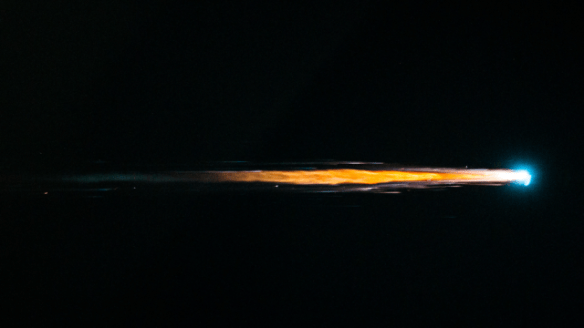
When the atmosphere came, he knew right away, for the thin bits of matter he was permitting into his body’s normal, human-shaped volume lit up, flaming from the friction. He became aware of the heat, but it did not hurt him. Arriving at sunrise, some from the unlit side of the earth thought they saw a meteor. On the sunlight side of earth, no one noticed, for the light of his re-entry was indistinguishable from the sunlit clouds watched in that morning’s sunrise.

For a time, Richard saw little but flame, but it began to fade once friction had slowed him down enough that the heat radiation produced was no longer visible. He could still perceive it, as a color he had never seen before (and would be helpless to explain), but he could use the parts of the spectrum normal humans can see to look “above” it.

He puzzled over his seeming to intuitively understand physics, which he had never studied, while he used this knowledge to slow himself down, and land, slowly, at normal density for a human. He was glowing red-hot, still, from the heat of re-entry, but did not feel uncomfortable. A lone tree nearby caught fire, and burned up quickly, but there were no other trees to which the fire could quickly spread. There was dried grass and leaves burning, though, and that could spread — just more slowly. Richard felt compelled by conscience (a completely new feeling for him, and he didn’t know why he had one now, but not before) to put the fire out. As soon as he had cooled off enough to do so, he put the fire out by stomping it out with his boots.

Boots? When had he put boots on, he wondered? How did they survive re-entry, as had, mysteriously, the clothes he had on, including a favorite t-shirt from when he had been a teenager, lost, in a move, years ago? He tried, but could not figure out how this was possible.

He wondered one thing, above everything else: where was he?

The question “What was he?” was a better question, but that didn’t occur to him for about twenty minutes after he stomped the last of the fire out.

Once he was sure it was extinguished, he started walking forward through a grassy area, along a gentle upward slope, following his shadow to keep himself going the same direction, and practicing his density-control as he walked, which caused his shadow to fade, disappear, and then gradually reappear, over and over. He found that he preferred walking at about half his normal density, simply because he didn’t weigh as much in that condition. He walked for many hours; later that day, he was walking away from his shadow, because the sun had passed overhead, and was now behind him in the sky. Later, the sun set. Richard then stopped walking, until a dozen or so stars were visible. Richard set his gaze on the brightest star he could see, near the horizon, that was in the general direction he was going, for he didn’t want to double back by mistake and come back to the burned remains of the tree near his landing-spot. He walked all night.

[to be continued]

The Story of the Void, Chapter Two

Image

The Story of the Void, Chapter Two

For chapter one: https://robertlovespi.wordpress.com/2014/01/18/the-story-of-the-void-chapter-one/

* * *

Richard had no way to know how long he’d been flat on his back, in a bed, in a dark, locked, otherwise-empty room. He was angered when the lights came on. They were bright. The door opened. A man in an expensive suit walked in.

Richard’s brain went into “attack mode,” and told his body to kill this intruder. Having recently undergone major abdominal surgery, though, his body wasn’t up to the task. He collapsed in a heap at the man’s feet.

“That wasn’t very smart, Richard. However, we don’t need you for your mind. You’ll work fine.” The man turned to speak more loudly, in the direction of the open door. “This one will work! Have him ready to launch in a week!”

“Launch? What launch?” Richard hadn’t been conscious since being shot by police after a killing spree. He was furious, but powerless to do anything about it. “Who are you? Don’t I get a lawyer or something?”

“You killed twenty-two people. You were captured and shot by the police. A doctor worked for hours to save you. As far as anyone knows, though, he failed. The world thinks you’re dead, and absolutely no one misses you, or will look for you. Don’t expect a lawyer. Yes, you’ll be perfect.” The man left before Richard could gather the strength to attempt attack again. The lights stayed on — for the rest of the time Richard was in the room.

Richard received drugs through an IV tube. He got angry at one point, and ripped the IV out of his arm, spraying blood all over the place. Gas then entered the room through a panel in the ceiling, and, when he could finally hold his breath no more, he inhaled a small amount, and it knocked him out.

When he next regained consciousness, he was held motionless by restraints. A new IV was in his other arm, and a feeding tube had been placed down his throat. He was surprised he didn’t gag, for he had no way to know that one of the drugs entering his body through the IV tube suppressed his gag reflex. His fury filled his thoughts, after only a little while, but it made no difference. He could do nothing except heal. A week later, he was judged healthy enough to survive a launch into space — maybe — by a team of doctors whom he never saw. Most of them had medical and/or ethical reservations, of course, and expressed them. These objections were ignored.

One doctor never voiced objections. He was the one who was monitoring this unusual patient when he had a strong sedative administered, and then taken to a small space probe, atop a tall rocket. By that point, the other doctors had all been reassigned, and some were already dead, seemingly from natural causes. The rest followed soon thereafter, by “disease” or “accident.”

Richard was still heavily sedated when the rocket was launched. Accelerating him into space nearly killed him, but that didn’t bother the computer which piloted the space probe. It didn’t need Richard’s assistance, and simply monitored his vital signs, relaying them back to Houston Space Central. He had no viewport, and so did not know that he had been placed into orbit around the sun, in earth’s orbit, but in the opposite direction.

Months earlier, a powerful, automated telescope, in solar orbit, had detected something no one in NASA had been able to explain. It was located in earth’s orbit, also, on the far side of the sun, where the earth would be or was, six months into the future or past. It revolved around the sun at the same speed as the earth, and in the same direction. It might have just appeared there, or it might have been there for billions of years. There was no way to tell, for the simple reason that no one had looked at that region of space before.

After it was discovered that the object’s x-ray signature resembled that of a black hole, the decision was quickly made to keep the anomaly a secret, lest a panic begin. In other wavelengths, though, it appeared as a planet-sized object of the expected temperature, or didn’t appear at all. The distribution of readings along the electromagnetic spectrum baffled all who were allowed access to this discovery. It wasn’t perturbing any orbits with the gravitational pull it would have if it had, say, the mass of the earth, or even of earth’s moon. As far as NASA’s scientists could tell, it had no gravitational effect on anything.

A robotic probe was sent to the far side of the sun, equipped with observational and communications equipment. It sent signals, right up to the point when it had encountered the anomaly. At that moment, it fell permanently silent.

The loss of a $950,000,000 space probe would be hard to hide from Congress, so the second probe, the one containing Richard Wayne Dahmer, was stripped down, and less expensive. It did not have the sophisticated sensing equipment on the first probe. It was sent simply to learn what effect, if any, close proximity, and then an actual encounter with, the enigma in earth’s orbit would have on a human being, and then send that medical data back to earth. No well-known, expensively-trained astronaut was needed; what was, rather, was someone deemed completely expendable. Richard, therefore, fit the criteria for this mission perfectly. No one connected to the mission saw any reason to inform Richard, himself, of any of this, and so he had no idea what awaited him. But, then again, neither did those people who merely thought they were controlling his mission.

He got furious, repeatedly, but that didn’t matter. After three months, his windowless probe encountered the anomaly. Once again, mission monitors for NASA saw all communications from a probe go dark, all at the same time. The conclusion was that the anomaly was incompatible with human life, and that the involuntary passenger on the probe had died.

Richard wasn’t dead, however. He, and his probe, fell into the mysterious singularity. Like a black hole, it had an event horizon. The probe passed through it, entering a void out of which it could send no signals back to earth, and inside which it detected, just as it vanished, the first, purely-robotic probe NASA had sent. The message about this discovery could not escape the event horizon, however, and so there it stayed.

The singularity woke up. It was conscious now. It had reversed direction, acquiring the momentum of Richard’s probe, in its entirety, as if the singularity itself had no mass. It was headed toward earth, along that planet’s orbit. It also vanished from the view of the sun-orbiting telescope which had first detected it. No one on earth knew it was coming.

Richard Wayne — no, just Richard, that was enough, he needed no other name now — was awake, and undrugged, now. There was no evidence of the probe that had held him for the last three months. He saw only the void. He didn’t see the singularity. He was the singularity, and the singularity was him.

The brain tumor that had been exerting ever-increasing pressure on that part of the brain responsible for moral reasoning — for ethical behavior — was now gone, along with Richard’s physical brain, itself. Only his consciousness remained, unimpaired by the undiscovered tumor which had turned him into a raging psychopath.

He wasn’t angry any longer, and, although he didn’t know it, he was now heading towards home.

* * *

The Story of the Void continues here: https://robertlovespi.wordpress.com/2014/02/01/the-story-of-the-void-chapter-three/.