Category Archives: Life
Older Birthday Stars, From When I Was Younger
I started this blog in July of 2012, so the birthday stars I made in January 2012 (when I turned 44) and January 2011 (when I turned 43) did not appear here in those years. I found them, though, and will post them now.
The first two are different colorings of a 44-pointed star, from January 12, 2012, the day I turned 44:


These three are different color-versions of 43-pointed stars, from a year earlier — January 12, 2011:


I turn 48 today, so please visit the post right before this one, if you’d like to see this year’s birthday stars. =)
My Birthday Stars for 2016
This year, I’m continuing my personal tradition of making stars on my birthday with numbers of points which increase each year. I’ve done this for years, and it’s based on a game I started when I turned three, and claimed the three stars of Orion’s belt as my personal property, on the grounds that they were obviously put in the sky for my benefit. Most recently, a year ago, when I turned 47, I posted a 47-pointed star on this blog.
I’m turning 48 today, so here are a couple of different colorings of 48-pointed stars containing segments through the center, {6/2} compound-triangle stars, and {8/3) star octagons, made possible by the fact that 48 = (6)(8).


Of course, I am turning 48 on my 49th birthday (and if that makes no sense to you, here’s the explanation), so this year I also made 49-pointed stars. They are based on 49 being the square of seven, and so contain seven each of the two types of star heptagram possible, in two different colors. For this star, also, I made two versions.


On Convex, Dodecahedral “Fair Dice”
One of my early introductions to polyhedra came through playing the game Advanced Dungeons and Dragons (AD&D), which uses a standard seven-die set which includes the five Platonic Solids, plus two “d10s” (either ten-faced dipyramids or trapezohedra) which are used as a pair to generate random numbers from 1 to 100.

Assuming they are made with uniform density, these polyhedral dice are all “fair dice” — meaning that, for example, the d12 at the top of the picture has an equal chance of rolling any of 12 results, every time it is rolled.
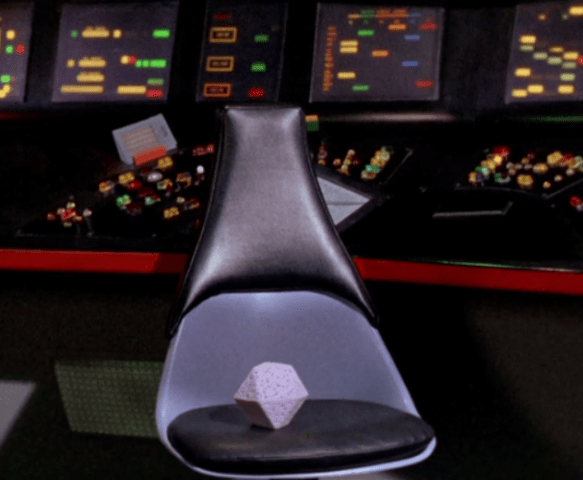
I had also encountered, even earlier, a polyhedron which I believed (correctly) would not work as a fair die, since there is no reason to assume that rolling a cuboctahedron would result in equal probabilities for each face, given that some of the faces are squares, while others are triangles. This shape was familiar to me long before I heard (or even read) the word “cuboctahedron,” though, because I learned about it while watching “By Any Other Name,” an episode of the original Star Trek television series. At no point in this episode is the word “cuboctahedron” used, even though the entire crew of the USS Enterprise (with four exceptions) spend most of the episode in cuboctahedral form, as Lt. Uhura appears, at her bridge station, in this screenshot:
When examining uniform-density polyhedra to look for “fair dice,” therefore, one of the first things I look for is isohedrality — all faces must have the same shape, unlike the case of the cuboctahedron, but like the cases of AD&D dice. The next thing I examine is symmetry, hoping to find that a particular polyhedron’s symmetry gives no probability-advantage to any face(s). With these two tests in mind, I decided to see how many different fair, dodecahedral d12s I could find, including polyhedra which could work, whether or not such shapes had actually been used as real dice, at any time, by anyone.
When looking for dodecahedral “fair dice,” anyone with a familiarity with AD&D, or polyhedra, is likely to identify, first, the one with this shape:

The word “dodecahedron” literally refers simply to any polyhedra with twelve faces, but, in practice, most references to dodecahedra concern this twelve-faced polyhedron — the one found immediately above, and at the top of the photograph of a standard set of AD&D dice. When it is necessary to distinguish it from other twelve-faced polyhedra, this can be called, instead, the “Platonic dodecahedron.” It is the only dodecahedron to be both regular and convex; it also possesses icosidodecahedral symmetry, also known as icosahedral symmetry.
Although the pentagons in the Platonic dodecahedron are regular, it is also possible to make a fair-die polyhedron with irregular pentagons. Such a shape appears, occasionally, in the mineral pyrite, or FeS2, explaining the origin of the term “pyritohedral symmetry,” which is the symmetry-type of this particular dodecahedron: the pyritohedral dodecahedron.

There are actually an infinite number of slightly-different pyritohedral dodecahedra, as one can easily picture, by imagining a change in the length of the longest edges in the image directly above. However, for purposes of this survey, all possible pyritohedral dodecahedra are viewed as a single answer — the second, after the Platonic dodecahedron — to the question, “Which twelve-faced polyhedra would work as ‘fair dice?'”
The third answer to this question is provided by a completely different polyhedron, rather than a “warping” of the Platonic dodecahedron. In this third dodecahedron, the faces are rhombi, explaining why it is called the rhombic dodecahedron. Johannes Kepler studied this polyhedron extensively. Not just any rhombus will work, as a face, to make this polyhedron; it must be a specific type — one with diagonal-lengths in a ratio of one, to the square root of two.

This particular “fair die” occurs in nature, as crystals of the mineral garnet. There are also twelve-sided dice of this type now being sold, although finding them isn’t the easiest thing to do; one such retail outlet (in case you’d like to buy some rhombic dodecahedral dice) is The Dice Lab, which sells such dice at this website.
The rhombic dodecahedron, unlike the other dodecahedra shown above or below, has cuboctahedral symmetry, also known as octahedral symmetry. It is also the dual of the cuboctahedron — the same polyhedron about which I first learned as a young child, watching Star Trek.
Just as the first solution to this twelve-faced “fair dice” quest (the Platonic dodecahedron) can be “stretched” to find a second solution (the pyritohedral dodecahedron), this third solution (the rhombic dodecahedron) can be altered slightly to give a fourth solution, which I call the strombic dodecahedron, although it has other names as well (one, for example, is the “deltoidal dodecahedron”). To make this shape, one keeps the overall pattern of the rhombic dodecahedron, but allows the rhombi to be stretched into non-equilateral kites, as shown here:

As far as I know, no one has actually made such dice — but that doesn’t matter, for the point is that such dice could be made, and would be fair, given uniform density. This is actually a family of possible solutions, as was the case with the pyritohedral dodecahedron, because different versions of the strombic dodecahedron can be created by varying the length-ratio of the long and short edges of the figure. Such variants would still have the same name and symmetry-type, however, and that symmetry-type is tetrahedral.
At least one other twelve-faced “fair die” can be made which also has tetrahedral symmetry: the Catalan solid known as the triakis tetrahedron, dual of the Archimedean truncated tetrahedron:
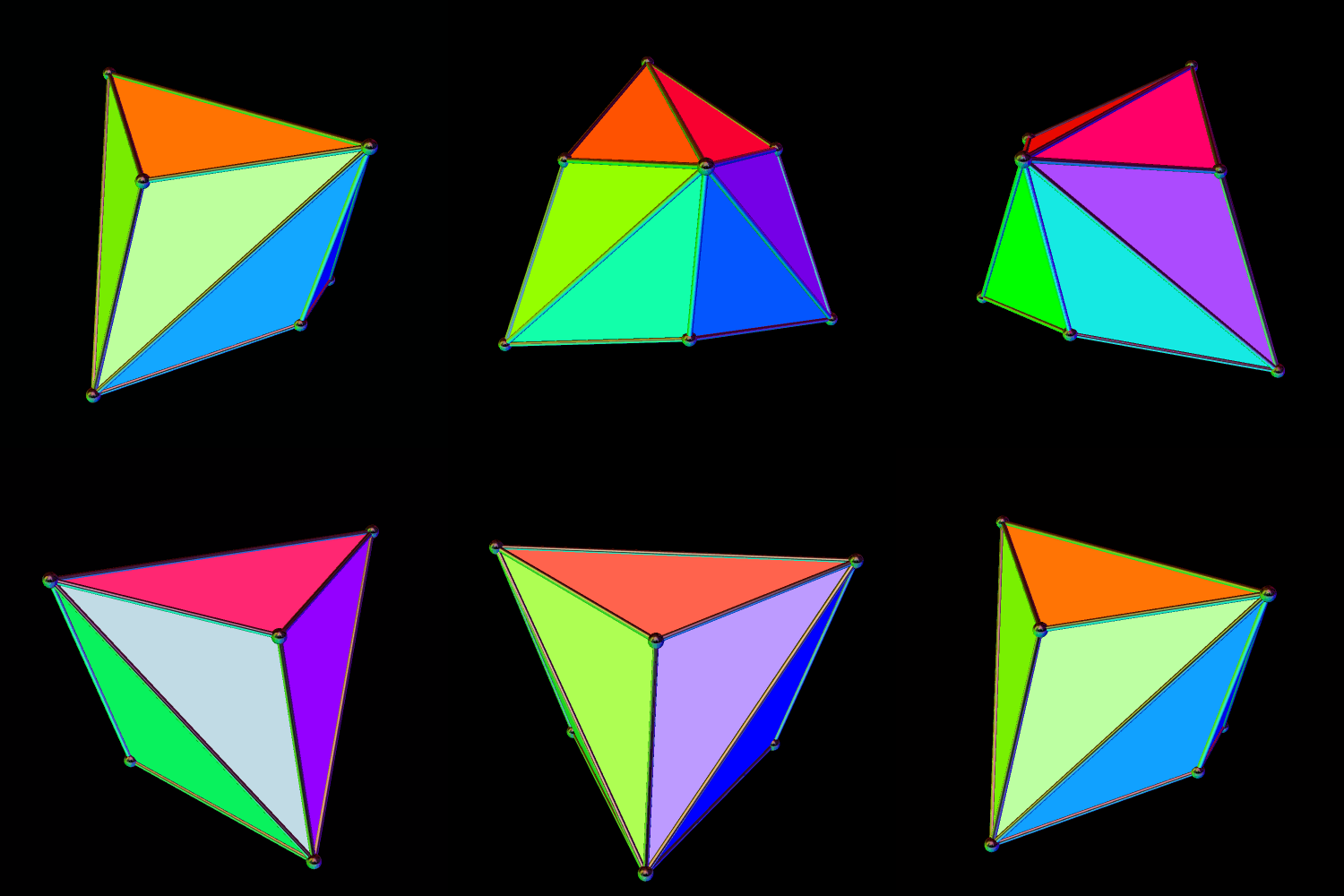
The triakis tetrahedron can be viewed as a Platonic tetrahedron, with each of its faces augmented by short, triangular pyramids which have lateral faces which are obtuse, isosceles triangles. The height of these short pyramids can be changed, while still leaving the overall polyhedron convex, over a range of heights; such altered versions, if not true duals of the Archimedean truncated tetrahedron, could simply be called non-Catalan tetrakis tetrahedra. The Catalan (and various convex non-Catalan) tetrakis tetrahedra are here collectively offered as the fifth type of twelve-faced polyhedra which can serve as fair dice.
The fourth and fifth solutions do have a problem, due to their tetrahedral symmetry: as a physical die, when rolled on a horizontal surface, the various strombic dodecahedra and triakis tetrahedra would land without a face pointing straight up, since they do not have parallel faces. This, however, merely means that, as fair dice, they wouldn’t be as convenient as the others; one might, for example, number their faces, and then pick up the die after it is rolled, to see which number ended up pointing straight down, rather than straight up. Other “workarounds” could also be devised. The need for such extra work, however, does not negate the fact that these polyhedra can be used as fair dice, for the problem was not set up with a convenience-requirement.
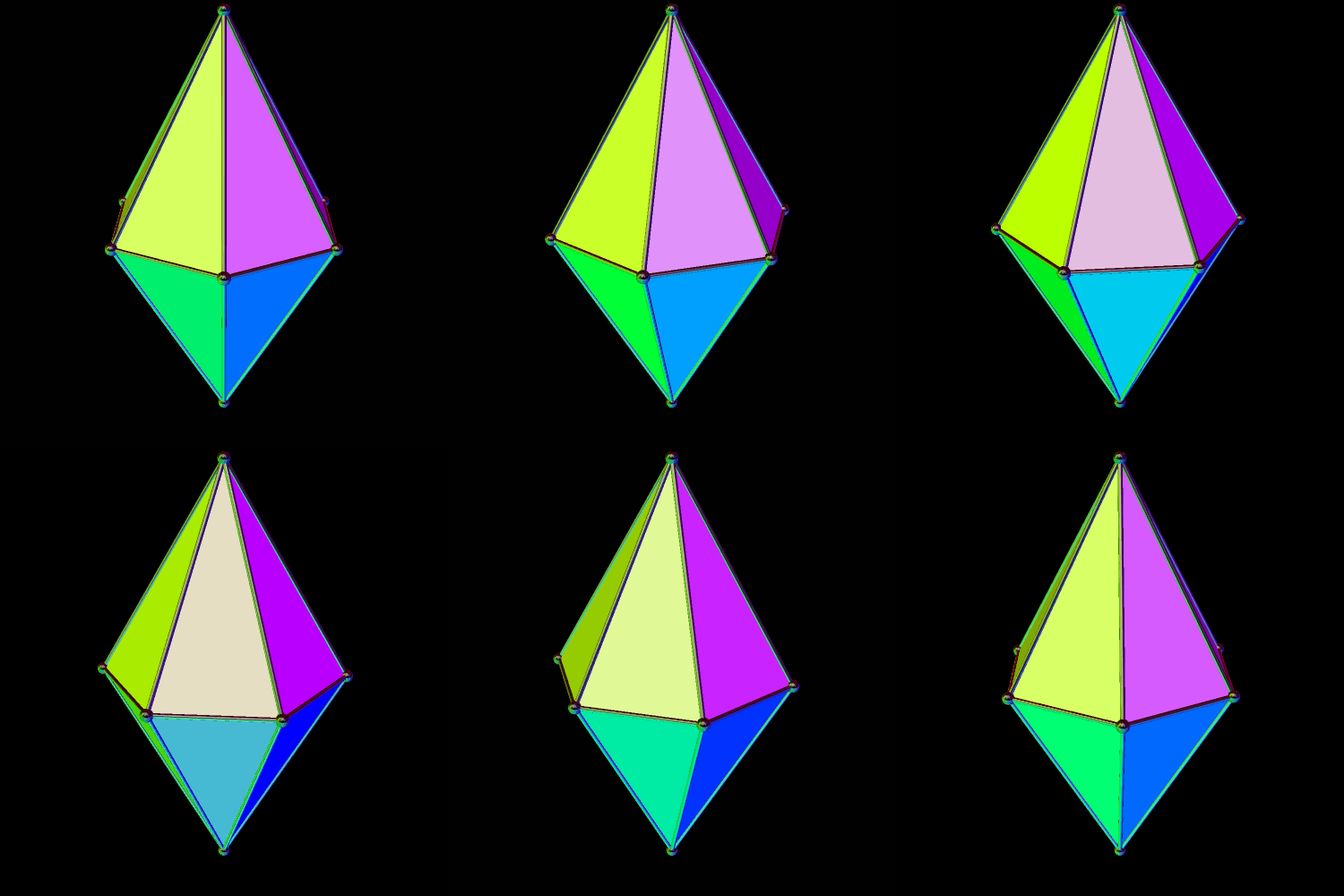
Further examination of a standard seven-piece AD&D dice set can lead to still more “fair d12s,” due to the presence of the d10s, also known, when used in pairs, as percentile dice. Most AD&D d10s have kites as faces (as seen in the metal dice set above), and are duals of pentagonal antiprisms, and so are themselves known as pentagonal trapezohedra (also known as “pentagonal deltohedra,” among other names). To get a similar fair die with twelve faces, rather than ten, one can simply start with a hexagonal antiprism, and then examine its dual: the hexagonal trapezohedron, which has six-fold dihedral symmetry:

By varying the long-to-short edge length ratio of the kite-faces in this polyhedron, the overall height of this polyhedron, as a function of its width, can be changed. This sixth solution is, therefore, another “infinite family” solution — as is the seventh solution, shown below, which can be easily made from the sixth solution (immediately above). To do so, mentally hold in place the bottom half of the hexagonal trapezohedra — but let the top half rotate for another 1/12 of a rotation before also “freezing” it. There is no need, now, for the zig-zagging “equator” in the polyhedron seen above — it can now be replaced with the coplanar edges of a hexagon, hidden inside the polyhedron, with the result that the twelve kites are replaced by a dozen isosceles triangles, turning the overall shape into a hexagonal dipyramid. These isosceles triangles must have vertex angles which measure less than 60° — in order to keep the figure from collapsing into something with no height, or with many edges which do not meet. Like the sixth solution before it, this seventh solution also has six-fold dihedral symmetry.
Next, here is a table which summarizes information about these seven possible dodecahedral “fair d12s.”
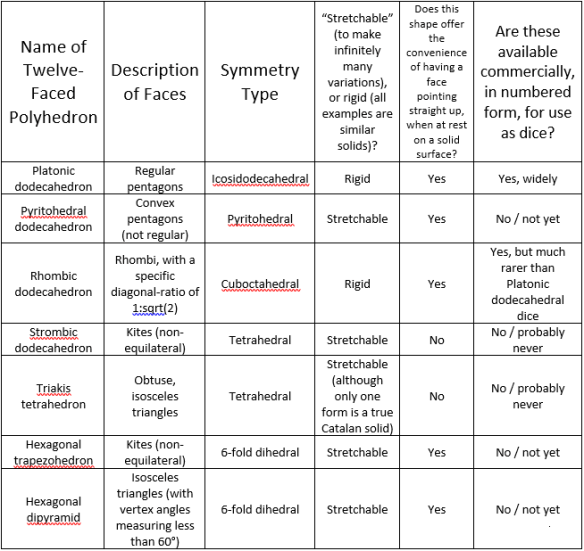
It is important to point out that this collection of seven solutions may not be complete, and I make no claim that it is. In fact, I strongly suspect it is not complete. It is simply the set of all solutions which have occurred to me — so far.
Some may wonder why I did not include the “barrel”-style d12s, which are also commercially available. This omission is no oversight. This particular style of d12 is not actually dodecahedral; it really has more than 12 faces, but is designed in such a way that it only has 12 faces which such dice can land on, and stay on — and that is not the same thing, at all. Also, I’m only looking for d12s here, which is why I did not include the “barrel”-style d4, even though it is a polyhedron which does have twelve faces.
Lastly, of the pictures in this post, the seven which feature rotating polyhedra were created using Stella 4d: Polyhedron Navigator, software which may be purchased, or tried for free, at this website.
What do you mean, you “can’t wait?” Obviously, you can!

Why do people so often, and completely incorrectly, say they “can’t wait” for things? No one ever says this, it seems, unless they already are waiting for whatever they are talking about.
A seasonal example: “I can’t wait for Christmas!”
When I hear this, I generally point out to people that they are already waiting, and therefore, obviously, they can do so.
What is it with this? Why do so many people say this thing that clearly makes no sense at all?
Purple: Connecting Fiction, and Personal Trauma
Purple is not my favorite color (black is, but that’s another story), but it is a significant color for me, for complicated reasons I shall try to explain here. In some regards, this blog-post can be seen as a review of Netflix’s new series, Jessica Jones. My opinion of the series, in brief: five stars — watch it!
Do not expect watching this show to be easy, though. Like Flannery O’Connor’s fiction, it plumbs the depth of human depravity, through the character of Killgrave, also known as The Purple Man, a character who has existed in comic books since 1964, when he appeared in issue #4 of Daredevil.

[Art by Tom Grummett; image found here, and from a comic book cover other than Daredevil #4.]
Killgrave’s skin is not purple in the new TV series, but he’s every bit as horrible a person as in comic book stories. He has one superpower, but it’s a nearly-impossible one to overcome: when he tells people to do things, they immediately do what he says, even to the point of killing themselves or others.
I was interested in Killgrave (and Jessica Jones) from the first time I saw either of them in a comic book, long before this TV series was planned. However, about halfway through the first season, I suddenly realized why Killgrave held such personal fascination for me as a truly horrible character — and why I hated him so intensely. It’s the fact that he controls the minds of other people, using his voice.
My father did the same thing, although he certainly did not have purple skin, and never, to my knowledge, killed anyone (but he did leave a string of damaged people in his wake). His voice had a hypnotic quality. There are people, to this day, who will claim to have seen him float straight up into the air — because they were told to see him levitate. I never saw that, but I do have faint memories, from a very early age, of seeing other unreal things, at his verbal suggestion, such as four or five finger-to-finger “ribbons of energy” called “orgone” connecting my hands, held in front of me, at night. Other children my age were with me; they saw these “orgone energy ribbons,” and more. I got away from this insanity as quickly, and as often, as I was able to do. Avoiding my father became my habit early, and often.
Many people have had horrible things done to them, due to abuse of this ability. In fiction, Killgrave, The Purple Man, is the best example of such a monster using his voice as a mind-control weapon. In reality, my father (and others with a similar ability, such as leaders of religious cults, a role my father did play, more than once) is another example.
When I realized the similarity between Killgrave and my now-deceased father, I had to stop watching Jessica Jones for about 24 hours. Having been a survivor of mind control left me (in real life) and Jessica Jones (in fiction) with PTSD, and I had to have a break from watching the show for this reason.
During this 24 hours, I remembered something about my father (who died in 2010) and my mother (who died less than two weeks ago): a story my mother told me, many years later.
Apparently my father hated the color purple, although I have no idea why. She was under his voice-control for years. So was I. We broke completely free of this manipulative monster at about the same time, in the mid-1980s. She left, and then divorced, him. I came up with my own way to “divorce” him as a parent, myself: I legally changed my last name to my mother’s maiden name. These things I knew already; the new thing Mom told me was what she did to celebrate her breaking free of his influence: buying a purple dress, and going out, wearing it, to celebrate her freedom.
After remembering this, I was able to watch the rest of the first season of Jessica Jones. I will not leave specific spoilers here, but I will say this: watching the rest of it helped with the ongoing process of recovering from my own “purple trauma.”
On your nth birthday, you turn n – 1 years old.

As a teacher, I have had variants of this conversation many times. The specific details, however, are fictional, for this changes, somewhat, each time it happens.
- Student: Guess what? It’s my birthday!
- Me: Congratulations! How old are you?
- Student: I’m seventeen!
- Me: Well, happy 18th birthday, then!
- Student: Huh?
- Me: Look, on that one day, 17 years ago, when you were born, that was your birthday. That day has a better claim on being your birthday than any other day, because it’s the day you were born. That was your first birthday. But you weren’t one year old yet. You turned one year old a year later, on your next birthday . . . your second birthday. A year later, on your third birthday, you turned two years old. Do I need to continue?
- Student: So I’m 18? I can buy cigarettes without a fake ID, and vote, and stuff?
- Me: No, not for another year, because you’re only 17 years old — but you have had 18 birthdays. Say, here come some of your friends. Use this bit yourself, if you want to, and have fun with it.
- Student, to other students: Hey, guys, it’s my birthday! I’m 18 today!
…At least I try. Also, sometimes, the educational outcome is better than in this fictionalized example.
[Image source: http://www.decorationnako.tk/birthday-cake/]
John Lennon: Who Do You Want to Save?
A Poem Written by My Cousin Sara, in Honor of My Mother
[This poem was written by Sara Bray McClain, after the recent funeral of my mother, Mina Jo Marsh, who was her aunt. I am grateful to Sara for writing it, and for giving me permission to post it here. I am also grateful that reading it helped me feel better, in light of recent events.]
I love the change in seasons,
when the night takes on the work
of a world that’s worn of summer,
lying down to rest its head
only when the sunrise lights…
I crave the peace at dawn
of a town whose jobs awaken
making good on the toil that for months
rolled on in the hope of a rich, ripe harvest.
I breathe in the crisp fall air
along with the scent of labor,
the fresh, sweet smell of firewood
and the smoke of my neighbor’s stove;
the birds all abuzz with the knowledge
that winter is coming soon, taking flight to their homes more southern
as we look to the star in the north.
I search for the words to comfort
those who grieve at this time of wonder
who, faced with life’s blessed turning,
can only look behind.
And, strangely, the winds of change
keep afloat my meandering mind,
rustling now through the branches of family
gone before to a winter their own.
My heart isn’t cold or lonely,
though the chill might have touched my skin,
for I know with the break of the first snow
comes the green of the spring just ahead.
Goodbye, Mom
Soon, the Arkansas Democrat-Gazette will run my mother’s obituary. However, it would not be right for me to allow the obituary they print to be her only one.
Mom’s name when she was born, on January 4, 1942, was Mina Jo Austin. Later, she was known professionally as Mina Marsh. However, I chose to legally change my last name to her maiden name, in 1989, after my parents divorced. I did this so that I could have a last name I associated only with my good parent, for I only had one — the one now in this hospice room with me, as I write this, with little time remaining to her.
This is an old photograph of her, and her two younger sisters, taken when my mother was a teenager.
Her father, whom I knew (all too briefly) as “Daddy Buck,” taught her many things, very early in life, just as Mom did, much later, for me. He taught her about justice, and its opposite, using as one example of injustice the internment camps for Japanese-Americans which were then operating, here in Arkansas, when my mother was a little girl. Even in the wake of Pearl Harbor, and in complete disagreement with the masses, my grandfather thought it an obscenity that people had been herded into these camps simply because of their ethnicity, and, in a world where evil does exist, he decided his daughter needed to know about it. Only with knowledge of evil can one stand up to it, oppose it, and speak truth to it, even when that evil is mixed with power, as happens all too often. He instilled in her a strong sense of justice, and taught her courage, at the same time.
Mom started college at Harding University, in Searcy, Arkansas, and demonstrated her courage, and refusal to tolerate injustice, there, during the 1960 presidential election campaign. The assembled students of Harding were told, in chapel, that it was their duty, as Christians, to go forth on election day, and cast their votes for Richard Nixon, because allowing John F. Kennedy, a Catholic, to become president would be a horrible, sinful thing to do. She found this offensive, in much the same way that her father had found America’s treatment of Japanese-Americans offensive during World War II. On principle, therefore, she withdrew from Harding, and transferred to the University of Arkansas (in Fayetteville) to complete her college coursework. She also, later, left the denomination associated with Harding, eventually becoming a member of the Episcopal Church. I am grateful to her church here in Fayetteville, Arkansas, for the many comforts they have given her over the years. They even went so far as to raise the funds needed, in 2010, for her emergency transportation, by air, to a Mayo Clinic in Minnesota, where surgery was performed to save her from a rare adrenal-gland tumor called a pheochromocytoma. Without this help from them, her life would have been shortened by over five years.
Mom is survived by two children. I came along in 1968, and my sister (who had three children herself — my mother’s three grandchildren) was born the following year. Mom is also survived by three step-grandchildren, and two step-great-grandchildren. Mom began to teach both my sister and myself, as early as she could, what her father had taught her, early in life. Strangely enough, one of my earliest memories of her doing this also involved Richard Nixon, for the first news event I clearly remember seeing on television was Nixon’s 1974 resignation speech. At that young age, and with my parents clearly disgusted with America’s most disgraced president to date, I blurted forth, “I wish he was dead!” Mom wasn’t about to let that pass without comment, and did not. I remember the lesson she taught me quite well: there was nothing wrong with wishing for him to lose his position of power, as he was doing — but to wish for the man to die was to cross a line that should not be crossed. One was right; the other was wrong. It is my mother who taught me how to distinguish right from wrong. From this point forward, I now have a new reason to try, in every situation, to do the right thing: anything less would dishonor my mother’s memory.
It was around this time that my sister and I started school, and to say Mom was deeply involved in our experiences at school would be to understate the issue. In a conservative state where many schools openly (and illegally) do such insane things as teach young-earth Creationism in “science” classes, and anti-intellectualism is sometimes actually seen as a virtue, our entry into the school system was not unlike entering a battleground. At this time, education specifically designed for gifted and talented students simply did not exist in Arkansas. Mom had already had some teaching experience herself, although she had since moved on to other work. She was often appalled by the inane things that happened in our schools, when we were students, such as this from the fifth grade, and this (also from elementary school), and this especially-awful example from the seventh grade. Never one to tolerate injustice, Mom was deeply involved, from the beginning, in the formation of an organization called AGATE (Arkansans for Gifted and Talented Education), which fought a long, uphill, but ultimately successful battle to bring special programs for the education of gifted and talented students into the public schools of our state. She did this for her own two children, true — I consider forcing someone (who already understands it) to “practice” long division, year after year, to be a form of torture, and she was trying to save me from such torture — but she also did it for thousands of other Arkansas students, and tens of thousands have since benefited from her work in this area.
Mom was never content to fight in just one struggle at a time, for there is too much important work to do for such an approach. She was also a dedicated naturalist, a Master Gardener, and served as the Deputy Director of the Arkansas Natural Heritage Commission for 25 years, seeking ways to protect and preserve areas of natural beauty, and scientific significance, in our state. After retiring from that position, she later served on the board of directors of the Botanical Garden of the Ozarks, and also became the Development Director of the Ozark Natural Science Center.
My mother affected the lives of a great many people in her 73 years of life, including many who do not even know her name — but neither gaining credit, nor fame, was ever her goal. She will be deeply missed.
# # #
[About the rotating image: the picture of the banded agate, a reference to AGATE, the organization, on the faces of Mom’s dodecahedron, at the top of this post, came from here. The rotating dodecahedron itself, which the ancient Greeks associated with the heavens, was created using Stella 4d, software available at this website.]