Not “Dead Presidents”

Image

Not Dead Presidents

Attention, Americans:

These two men, Alexander Hamilton and Benjamin Franklin, are, indeed, dead. However, neither of them ever served as president. Therefore, please stop calling money “dead presidents,” unless you are excluding these two denominations, and, moreover, please stop this immediately.

Your cooperation is appreciated.

The Strange American Custom of Holiday Observance

Image

The Strange American Custom of Holiday Observance

Today is not Dr. Martin Luther King, Jr.’s actual birthday. The anniversary of his birth came, this year, last Wednesday. As you can see above, that’s January 15. However, it’s being observed today — the date circled above — to give people a three-day weekend.

That’s related to something else, apart from the sheer inaccuracy of moving a date on the calendar, that bugs me about “MLK Day,” as it is often called. It’s essentially the same thing that bothers me about Memorial Day, and Veteran’s Day. To honor people we respect and admire for their hard work — for civil rights, defending the nation in battle, or anything else — what do we often do, as a nation? We close schools, many businesses, the stock market, mail service, etc., all to give as many people as possible a day without work. How does a day off, of all things, honor the hard work of anyone?

Stephen Hawking, on His Own IQ, and IQs in General

Image

I have had my IQ tested, but, like Stephen Hawking, I have no idea what it is. The people conducting the test did not share the results with me.

This does not bother me in the slightest. Why? Because I agree with Hawking on this subject, that’s why!

Something You Likely Did Not Know, About the “Pledge of Allegiance”

Image

I thought I knew the (rather complicated) history of the “Pledge of Allegiance” well — until I saw this picture. This was the original “flag salute” pose American students were taught to use, nationwide, until World War II was well underway. It had been in use since 1892, and was called the “Bellamy salute.”

The current “hand over the heart” gesture didn’t go into effect until 1942, and was changed in reaction to the Nazis using essentially the same salute which you see American schoolchildren displaying in this (circa 1941) photograph. From where did this gesture really originate? A common belief is that it started in ancient Rome, but the article at http://en.wikipedia.org/wiki/Roman_salute — and the sources cited there — throw doubt on this idea. It seems that, instead, this gesture was depicted in an 1874 painting of an ancient Roman scene, spread into other neoclassical artworks, then plays and other performances, until it was well-established in the public consciousness as something the ancient Romans did — but that belief appears to be unsupported by the relatively small number of actual writings, or works of art, which have survived from ancient times.

It was twelve years after the change in the civilian American flag-salute gesture that Congress made another, much better-known change — the 1954 addition (unconstitutional, in my opinion) of the words “under God.” Just as the early gesture-change was made, in wartime, as a reaction against the practices of an enemy, arguments have been made that this change in the wording of the Pledge was made for similar reasons, given that we were then in the early years of the Cold War, with America’s enemies, in that long struggle, being what were often called the “Godless Communists.”

[Additional source, beyond the one given above: http://en.wikipedia.org/wiki/Pledge_of_Allegiance (with more sources cited at the bottom of that article)].

“Strong Grape Juice”

Image


My earliest memory of a church service involves a trip to visit relatives, and I started discovering how different from others I was at a very young age. This is one of the episodes which played a major role in that discovery.

I was only four or five years old, and had already developed an intense hatred of being bored. Ignoring the sermon seemed like an even more boring prospect that actually paying attention to it, so I consciously chose the latter, which I’ve observed is often not the choice young children make.

This church’s denomination is one of those that teaches that drinking alcohol is sinful. They are also Biblical literalists. This, of course, poses a problem, for there is a lot of drinking of wine to be found in the Bible. This preacher didn’t avoid the contradiction, though. His task, that Sunday morning, was to deal with it head-on, and he did so with the following claim: when Jesus, his disciples, and numerous other people from the Bible are described as drinking wine, that wine actually contained no alcohol. It was not wine as we know it today. It was, rather, merely “strong grape juice.” Those were his exact words.

Even at that young age, I had already started working on building, in my own mind, the best crap-detector I could possibly create. (Improving it is still something I work on today.) I didn’t yet realize that real wine would be far safer, before refrigeration existed, than grape juice, simply because alcohol, at the concentrations found in wine, kills lots of disease-causing bacteria. However, that morning, I had learned enough to instantly recognize this “strong grape juice” claim as absolute crap.

Dismissing the preacher as not worthy of further attention, I stood up in our pew, and turned around to face the back of the church. We were sitting near the front, so this let me see most of the congregation. I didn’t need to speak to them — I just wanted to look at them. I remember being stunned by what I saw. Nearly everyone appeared quite attentive to the sermon. Some mouths were half-open, and numerous heads were nodding in agreement with the preacher’s droning nonsense. I figured it out: they were actually accepting what this man was saying as the truth, and were doing so without question! They believed him! At first, I felt dizzy, and then, later, I felt sick. The more I thought about the experience, the worse I felt, and I could think about nothing else for a long time after that church service finally ended.

I’d been exposed to religion many times before, but it always seemed to me that adults didn’t really believe what they were saying, any more than when they told children my age about the Tooth Fairy or Santa Claus. At that moment, though, I realized I had been mistaken. This was no act. These people, in that church that day, actually believed what they were told. Why? I didn’t know. I still don’t. If that man told them that two plus two equals six, would they believe that? I suspected they would.

I was surrounded by a herd of sheep. That moment of clarity, when I realized this fact, scared me. It made me wonder, and not for the last nor first time, if I had been secretly planted on earth by aliens, as a baby, and without a guidebook.

This is only one of many experiences that convinced me of the importance of skepticism. The fact that it is so clear, in my memory, leads me to think it was one of the more important of those experiences. It cemented, in my mind, a scary truth: the world is infested with large numbers of incredibly gullible, deluded people. They weren’t like me. I didn’t understand them. They were everywhere. I wasn’t anything like them, and didn’t want to be, either. I was, however, stuck here with them.

I was stranded on the wrong planet, with no prospect for escape, any time soon. That was over forty years ago, and I’m still here.

How Far Have I Traveled?

Image

How Far Have I Traveled?

Earth’s average orbital speed is a mind-blowing 108,000 kilometers per hour — fast enough to travel one earth-diameter in just seven minutes or so. At that speed, surviving on this ball of rock for 46 years, as of today, means that I have traveled roughly 43 billion kilometers in my lifetime, just due to earth’s motion around the sun. Also, by the way, NO, I will not convert this speed, nor this distance, into those annoying non-metric units!

Star 46

Image

Star 46

I started a personal tradition 43 years ago, on the day I turned three years old, of associating stars with my birthday. On that day, I looked up in the sky, and saw the three stars of Orion’s Belt: Alnitak, Alnilam, and Mintaka. Given that these three stars were bright, and formed a fairly straight line, and given that I was turning three that day, it seemed perfectly obvious that those three stars had been placed there, in the sky, specifically for me — and so, that day, I claimed them as my personal property. (No one has ever accused me of lacking ego, nor self-confidence.)

As a young child, the science that most fascinated me was astronomy. In more recent years, my interest in stars has become more focused on the geometrical figures called stars, or star polygons — and so, now, rather than looking for my birthday stars in the sky, I always use geometry to construct some star, or starlike pattern, based on the number of years I have survived, to date. This is the one for the number 46, my age as of today.

On Sharing a Birthday

Image

On Sharing a Birthday

Something strange happened to me, once, on January 12, in a year in the early 1990s. Until that day, I knew of no one who shared the same birthday as myself. Then, that day, I happened to flip on my car radio, which was already tuned to a news/talk radio station. I was completely stunned by what happened next, for I had accidentally stumbled upon The Rush Limbaugh Show on his birthday — and mine. I learned this almost immediately, for one of Limbaugh’s callers said, right after I turned the radio on, “Hi, Rush! Happy birthday dittoes!”

Limbaugh laughed, and thanked the caller. I screamed, and then I yelled, “Noooooo! I can’t have the same birthday as Rush Limbaugh!” However, like it or not, I had to admit that this coincidence was, indeed, true. Also, since Limbaugh is older than I am, I also had to face up to the fact that he had this birthday first.

I wanted to have someone else to know I shared a birthday with — someone I could respect — so I did some research to find other people who also shared the same birthday as myself. In those days, of glacially-slow dial-up Internet with much, much less of value to be found there, this meant actually going to a physical library, looking in actual, bound-paper books (how primitive, right?), and spending a few hours to do what can now be done, with Google and Wikipedia, in seconds. I learned, in those hours, that I also share the birthday of January 12 with none other than John Hancock, the first person to sign the Declaration of Independence, according to the old-style system for the date of his birth. (The difference between old- and new-style dates is caused by the discrepancies between the Julian and Gregorian calendars.) Given that the primary author of that document was my all-time favorite president, Thomas Jefferson, that was something of which I could be proud.

In later years, I learned that Wikipedeans (a group to which I belong) have constructed pages there where anyone can quickly and easily learn with whom they share a birthday. The one for my birthday is here: http://en.wikipedia.org/wiki/January_12. By looking at the corresponding page for your own birthday, you, too, can find out whom you share a birthday. No matter what day that is, you’re quite likely to find, as I did, both people you like and dislike. After all, there are only 366 birthdays to go around, so sharing birthdays with famous (and infamous) people is inevitable for us all.

Obedience Is Not a Virtue

Image

Obedience Is Not a Virtue

No brilliant discovery, nor invention, was ever made by those who compulsively follow rules, demonstrate immense respect for authority, and make a habit of unquestioning obedience.

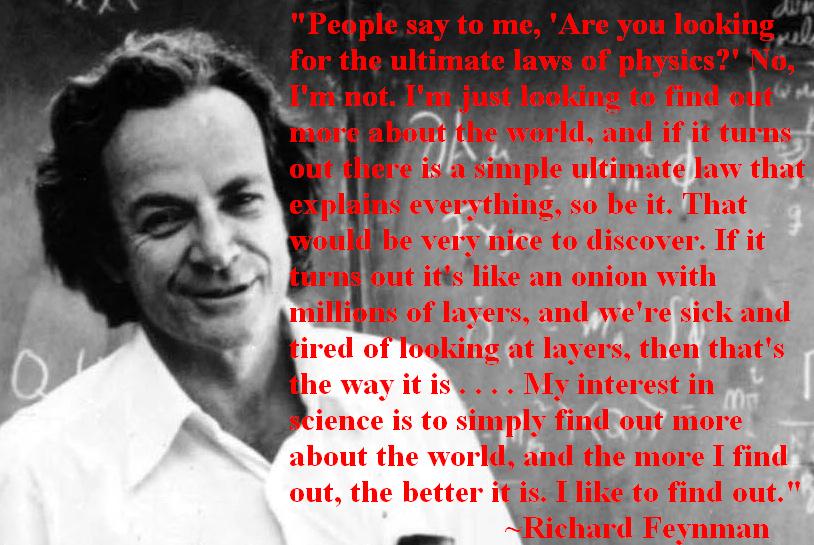
Richard Feynman: “I like to find out.”

Image