A Second Version of My New Near-Miss to the Johnson Solids

Image

A Second Version of My New Near-Miss

A few days ago, I found a new near-miss to the 92 Johnson Solids. It appears on this blog, five posts ago, and looks a lot like what you see above — the differences are subtle, and will be explained below, after “near-miss” has been clarified.

A near-miss is a polyhedron which is almost a Johnson Solid. So what’s a Johnson Solid?

Well, consider all possible convex polyhedra which have only regular polygons as faces. Remove from this set the five Platonic Solids:

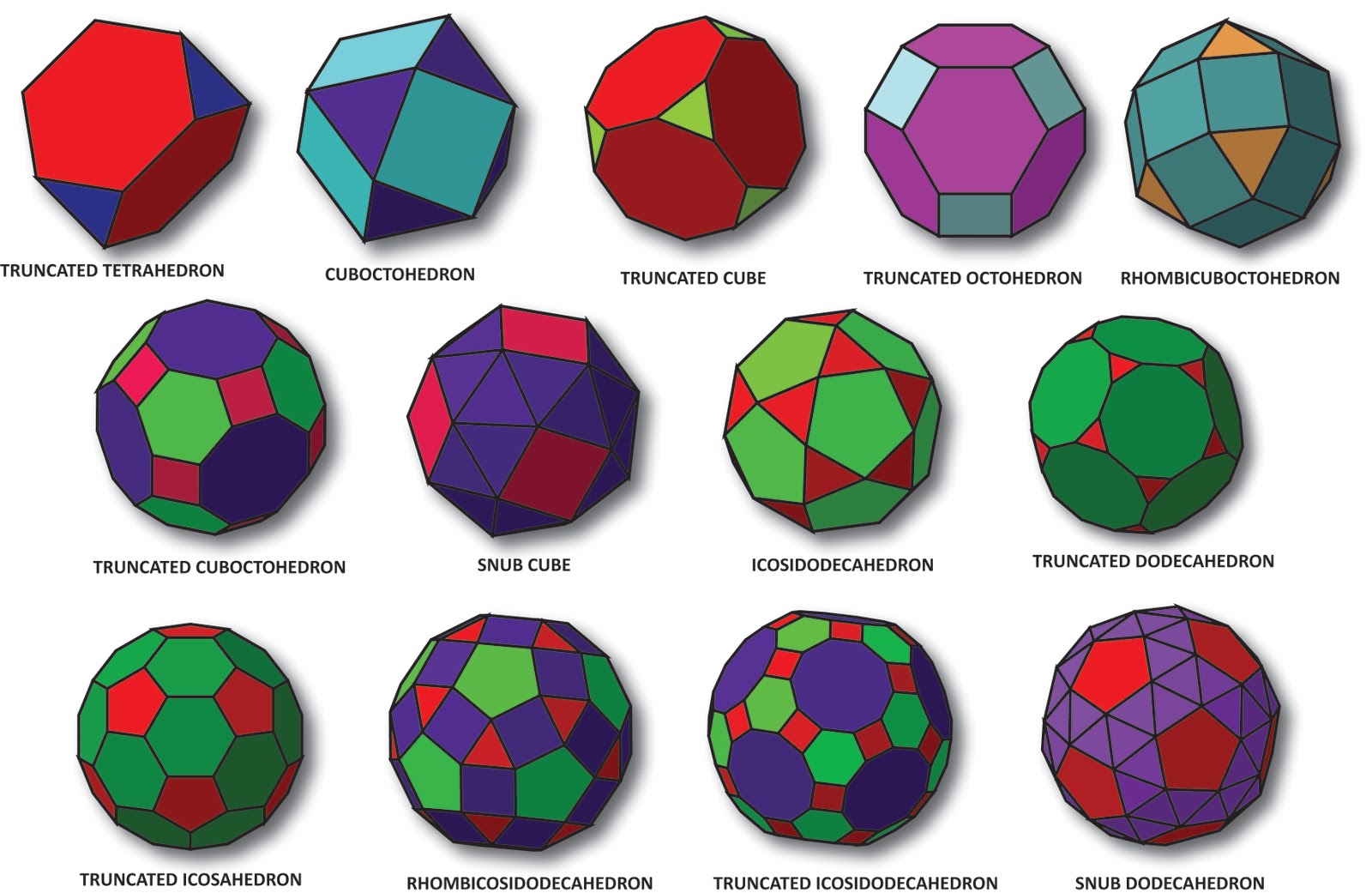
Next, remove the thirteen Archimedean Solids:
Now remove the infinite sets of prisms and antiprisms, the beginning of which are shown here:
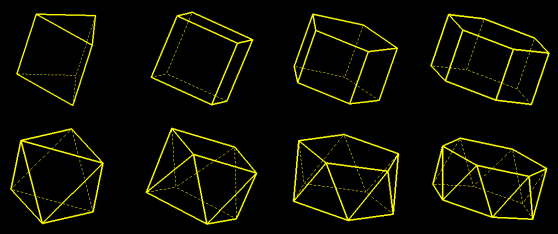
What’s left? The answer to this question is known; it’s the set of Johnson Solids. It has been proven that there are exactly 92 of them:

When Norman Johnson systematically found all of these, and named them, in the late 1960s, he found a number of other polyhedra which were extremely close to being in this set. These are called the “near misses.” An example of a near-miss is the tetrated dodecahedron, which I co-discovered, and named, about a decade ago:

If you go to http://www.software3d.com/Stella.php, you can download a free trial version of software, Stella 4d, written by a friend of mine, Robert Webb (RW), which I used to generate this last image, as well as the rotating .gif which starts this post. (The still pictures were simply found using Google image-searches.) Stella 4d has a built-in library of near-misses, including the tetrated dodecahedron . . . but it doesn’t have all of them.

Well, why not? The reason is simple: the near-misses have no precise definition. They are simply “almost,” but not quite, Johnson Solids. In the case of the tetrated dodecahedron, what keeps it from being a Johnson Solid is the edges where yellow triangles meet other yellow triangles. These edges must be ~7% longer than the other edges, so the yellow triangles, unlike the other faces, are not quite regular — merely close.

There is no way to justify an arbitrary rule for just how close a near-miss must be to “Johnsonhood” be considered an “official” near-miss, so mathematicians have made no such rule. Research to find more near-misses is ongoing, and, due to the “fuzziness” of the definition, may never stop.

My informal test for a proposed near-miss is simple:  I show it to RW, and if he thinks it’s close enough to include in the near-miss library in Stella 4d, then it passes. This new one did, but not until RW found a way to improve it, using something I don’t really understand called a “spring model.” What you see at the top of this post is the result. Unlike in the previous version, the green decagons here are regular, but at the expense of regularity in the (former) blue squares, now near-squarish trapezoids, as well as the yellow hexagons. The pink hexagons are slightly irregular in both versions, and the red pentagons are regular in both.

I’m eagerly anticipating the release of the next version of Stella 4d, for this near-miss will be in it.  If I tell my students about this new discovery, they’ll want to know how much I got paid for it, which is, of course, nothing. I don’t know how to explain to them what it feels like to participate in the discovery of something — anything — which will survive me by a very long time. There’s nothing else quite like that feeling.

Now I just need to think of a good name for this thing!

[Update:   the new version of Stella is now out, and this polyhedron is now included in it. As it turns out, I no longer need to think of a name for this polyhedron, for RW took care of that for me, naming it the “zonish truncated icosahedron” in Stella‘s built-in library of polyhedra.]

A New Near-Miss to the 92 Johnson Solids

Image

A New Near-Miss to the 92 Johnson Solids

This is a face-based zonish truncated icosahedron.

I’ve only been looking for a new near-miss for a decade!

Software credit: see www.software3d.com/Stella.php.

If you shoot for the moon….

Image

If you shoot for the moon....

Itaumiped Has No Moon

Image

Itaumiped Has No Moon

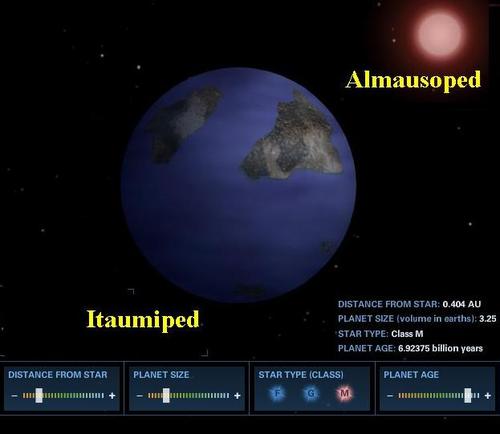
You can make your own planet here, but you can’t have my name for it: http://planetquest.jpl.nasa.gov/system/interactable/1/index.html

This is simply one incarnation of Itaumiped, my own imaginary planet. Any time I need an imaginary planet, I use this anagram for “I made it up” as its name. Itaumiped’s star’s name, “Almausoped,” comes from “Also made up.”

I try to be prepared. After all, one never knows when one might need an imaginary planet — or star.

Facebook Freaks Me Out Sometimes

Image

Facebook Freaks Me Out Sometimes

The Tetrated Dodecahedron

Image

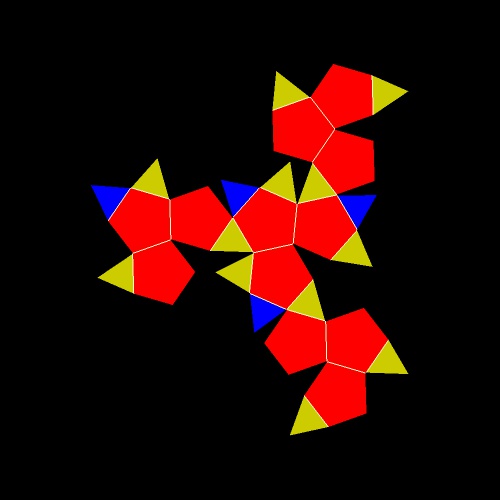
The tetrated dodecahedron is a near-miss Johnson solid. It was first discovered in 2002 by Alex Doskey. I then independently rediscovered it in 2003, and named it, not learning of Doskey’s original discovery for several years after that.

It has 28 faces: twelve regular pentagons, arranged in four panels of three pentagons each; four equilateral triangles (shown in blue); and six pairs of isosceles triangles (shown in yellow). All edges of the tetrated dodecahedron have the same length, except for the shared bases of these isosceles triangles, which are approximately 1.07 times as long as the other edges. This polyhedron has tetrahedral symmetry.

Tetrated Dodecanet

(All images here were produced using Stella 4d, which you may try for free, after downloading the trial version from this website: www.software3d.com/Stella.php.)

The Erdős-Bacon Number

Image

What do Carl Sagan, Richard Feynman, and Natalie Portman have in common?

They all have the same Erdős-Bacon number:  six.

Natalie Portman collaborated (as Natalie Hershlag) with Abigail A. Baird, who wrote mathematical papers in a further collaborative path which leads to Joseph Gillis. Gillis, having co-written a paper with Paul Erdős himself, has an Erdős number of one. This gives Portman an Erdös number of five. Bacon and Portman both appear a movie (which one?  See the details in this Wikipedia article: http://en.wikipedia.org/wiki/Erd%C5%91s%E2%80%93Bacon_number), which gives Portman a Bacon number of one.

The Erdős-Bacon number is simply the sum of these two numbers — hence Natalie Portman’s six:  five plus one.

Feynman’s and Sagan’s sixes are more balanced. Richard Feynman’s is the most so, since his Erdős and Bacon numbers are both three.

I haven’t been able to determine who first thought of an Erdős-Bacon number, but . . . wow. It came from the blogosphere (Where else?) — Wikipedia reveals that much.

Some blogger might be obsessive enough, someday, to exhaustively determine exactly how many people even have such numbers. However, that person will not be me.

The Pegasus Crude Oil Pipeline

Image

The Pegasus Crude Oil Pipeline

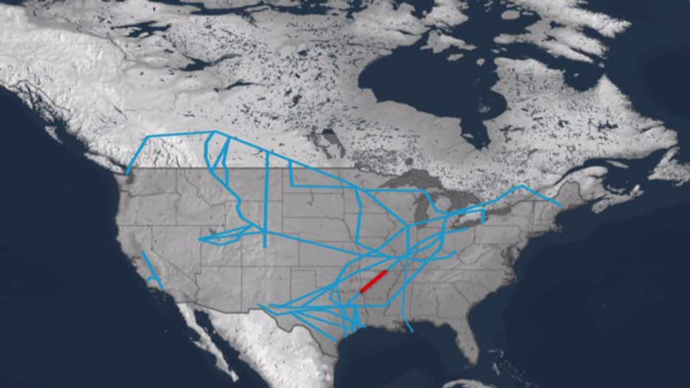
I live quite near Mayflower, Arkansas, site of an oil spill and ongoing cleanup efforts. You’ve probably seen it in the news.

Living in a landlocked state, we did not have “oil spill” on our worry-lists here.

You may live near this pipeline, too, and not even know it. That’s why I’m posting this map (which I did not create, but simply found with a Google image-search). There may be other such pipelines here, as well. Few people notice them — until one breaks.

Richard Feynman, on Respect and Authority

Image

Richard Feynman, On Respect and Authority

Mark Twain, on Idiots and Lightning

Image

Mark Twain On Idiots and Lightning

[Later edit, in October 2015: a friend of mine questions the authenticity of this quote, but did find a source for Mark Twain saying this: “The trouble ain’t that there is too many fools, but that the lightning ain’t distributed right.” He may well be correct; my friend is an expert at detecting false quotations. If anyone knows of a source for the quote in the pic above, please leave a note about it in a comment to this post.]