The Pain Is Gone (but not without cost)

Every day for almost 25 years, my vertebrae from mid-neck to torso have been jammed together, by a fall I had at age 20. It hurt like hell, at times, or it just hurt, but it never, ever stopped completely, until all of this happened.

Eyes closed, I attacked the pain as if it were an inanimate thing, laying backward on the corner of the mattress with the one point of contact being a bit above the spot between my shoulder blades, centered horizontally West-East, while facing North. It moved to the left. I followed, pursuing it — and then we shifted to it and me stretching myself in opposite directions, then with the forces in the same direction again, then the reverse again, with this cycle repeated many times.

Pain, my enemy, then made a rapid jump to an entirely new quadrant. The focus line of movement, in reaction, shifted at my center of mass. I rotated by a right angle counter-clockwise, and was now facing West with my hands on a line South-North, lined up with my shoulders. I pointed my fingers up-down and stretched that way as well, and had therefore identified three mutually perpendicular directions, in each case coming up with some way to reverse the direction of force (having my arms both curled tightly in front of my face and beyond, in the second case, and then touching my toes and holding them for the reversal of up-down.

At that point, I stood straight up. I was shocked. I still am. This hasn’t worn off, as I write this. As long as I stand straight up — but only then — the pain is gone.

Gone.  And that damned thing had me going to doctors and chiropractors for years.  Gone, just like that.  I had no idea this would result from my spontaneous and protracted, intense exercise session, but it did.

If I slouch in any way, though, I get immediate and intense pain, which quickly trained me to stand and sit up straight. I don’t know, yet, how or if sleep will work, and haven’t tested the perfectly horizontal. If I want anything more casual than full attention, I have to tolerate pain for as long as the deviation persists, pain with intensity proportional to the deviation.

I’ve created my own Skinner Box, although I didn’t realize that was what I was doing. I can lie in it, but I wonder if I can sleep in it?

I don’t recommend trying this yourself, unless you first consult with, and obtain the approval of, a physician. Further updates as events warrant.

“What are we ever going to use geometry for, anyway?”

I teach geometry, so I get asked this question a lot.

Of course, the subject has many uses, from architecture to the study of ziggurats, but I don’t like to focus on tawdry, real-world uses for it. Geometry is far too important to me for its value to be measured in terms of mere utility.

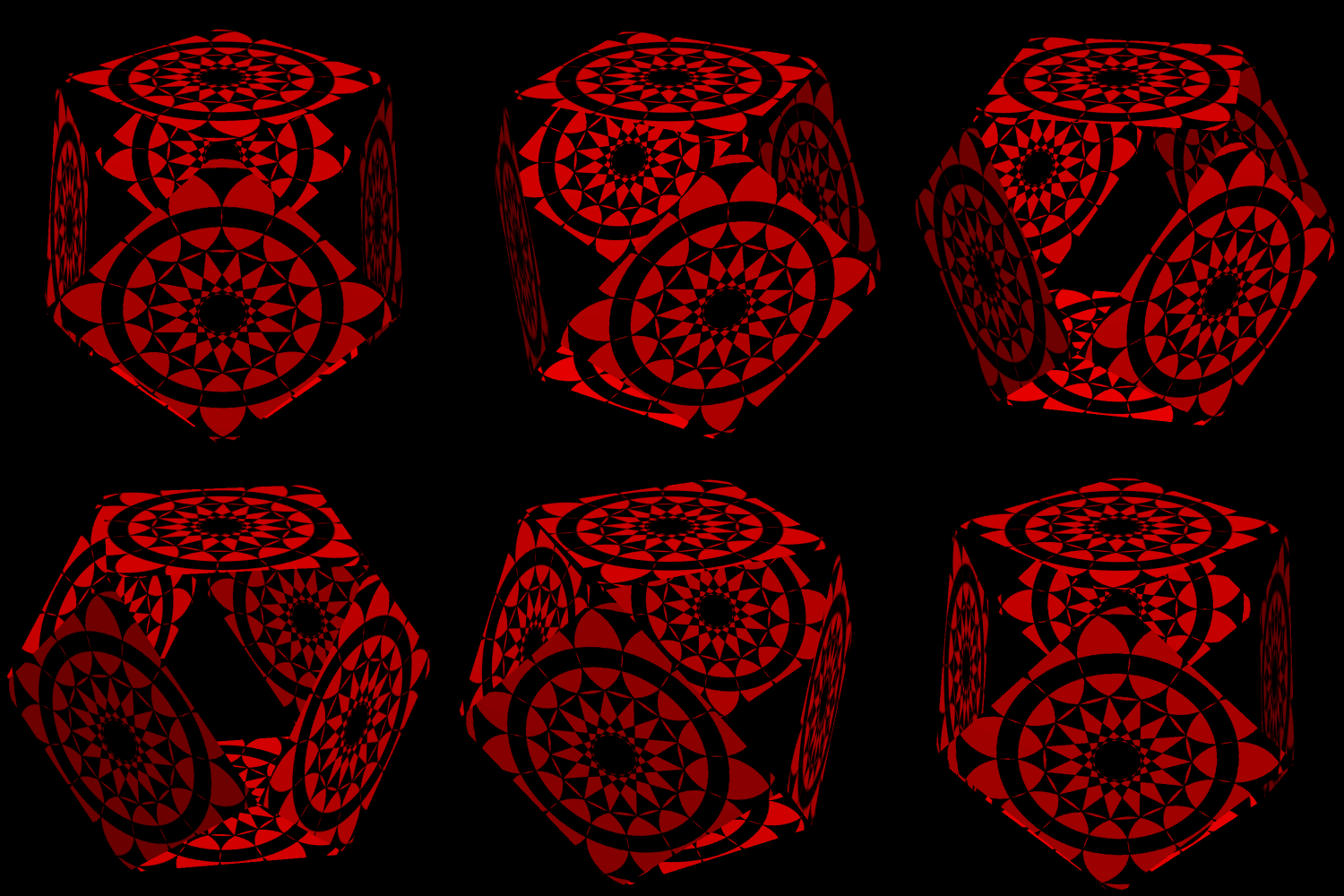
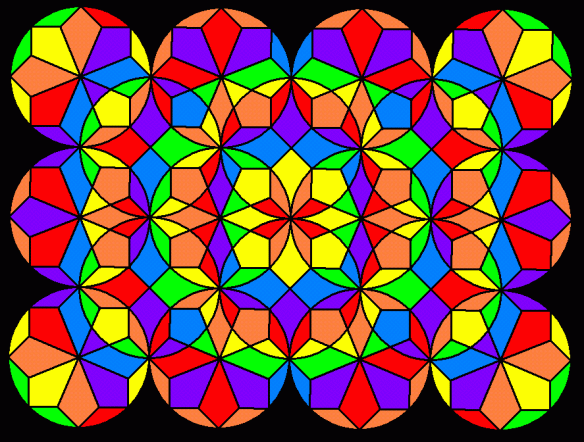
Without the octadecagon and the nonagon, and my curiosity about them, for example, I never would have come up with this pattern:

Image

Was it useful for me to do this? Such a question would miss the point completely. It was FUN to make this, and that’s why I did it. While I worked on it, I thought about absolutely nothing that bothers me. The rest of the world vanished, leaving only a mathematical pattern, and I was completely happy.

I guess one could look at this as a “use,” but — yuck — I certainly do not want to.

Speculation Related to the Johnson Solids

Consider all possible convex polyhedra which have regular polygons as faces. Remove from this set the five Platonic Solids:

Next, remove the thirteen Archimedean Solids:

Now remove the infinite sets of prisms and antiprisms, the beginning of which are shown here:

What’s left? The answer to this question is known; it’s the set of Johnson Solids. It has been proven that there are exactly 92 of them:

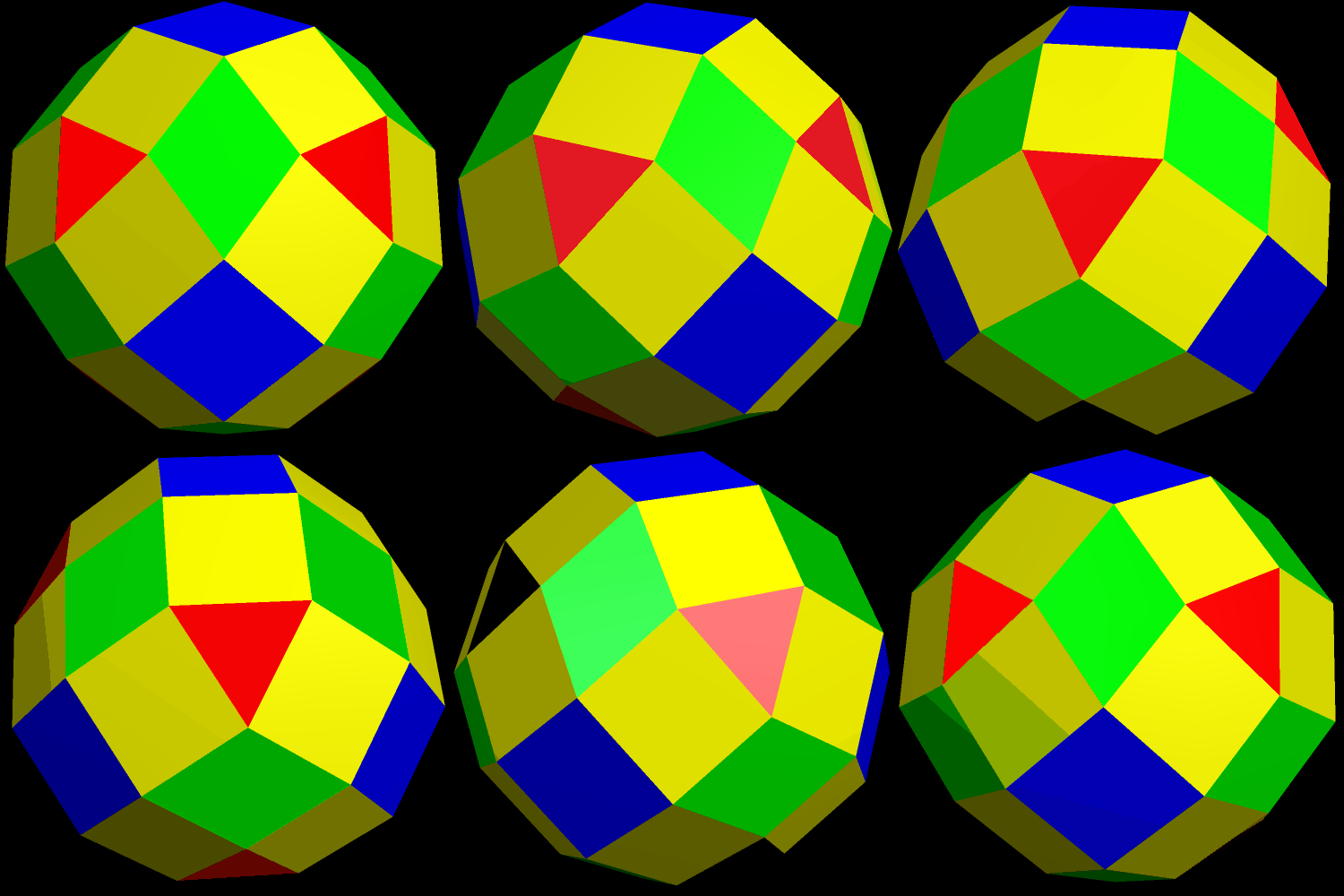
When Norman Johnson systematically found all of these, and named them, in the late 1960s, he found a number of other polyhedra which were extremely close to being in this set. These are called the “near misses.” An example of a near-miss is the tetrated dodecahedron:

If you go to http://www.software3d.com/Stella.php, you can download a free trial version of software, Stella 4d, written by a friend of mine, Robert Webb, which I used to generate this last image. This program has a built-in library of near-misses . . . but it doesn’t have all of them.

Well, why not? The reason is simple: the near-misses have no precise definition. They are simply “almost,” but not quite, Johnson Solids. In the case of the tetrated dodecahedron, what keeps it from being a Johnson Solid is the edges where yellow triangles meet other yellow triangles. These edges must be ~7% longer than the other edges, so the yellow triangles, unlike the other faces, are not quite regular — merely close.

There is no way to justify an arbitrary rule for just how close a near-miss must be to “Johnsonhood” be considered an “official” near-miss, so mathematicians have made no such rule. Research to find more near-misses is ongoing, and, due to the “fuzziness” of the definition, may never stop.

I’ve played a small part in such research, myself. I’ve also been asked how much I’ve been paid for doing this work, but that question misses the point. I’ve collected no money from this, and nobody gets involved in such research in order to get rich. Those of us who do such things are motivated by the desire to have fun through indulgence of mathematical curiosity. Our reward is the pure enjoyment of trying to figure things out, and, on really good days, actually doing so.

I’m having a good day. I’m looking at the Johnson Solids in a different way, purely for fun. I have found something that may be a blind alley, but, if my fellow geometricians show me that it is, that won’t erase the fun I have already had.

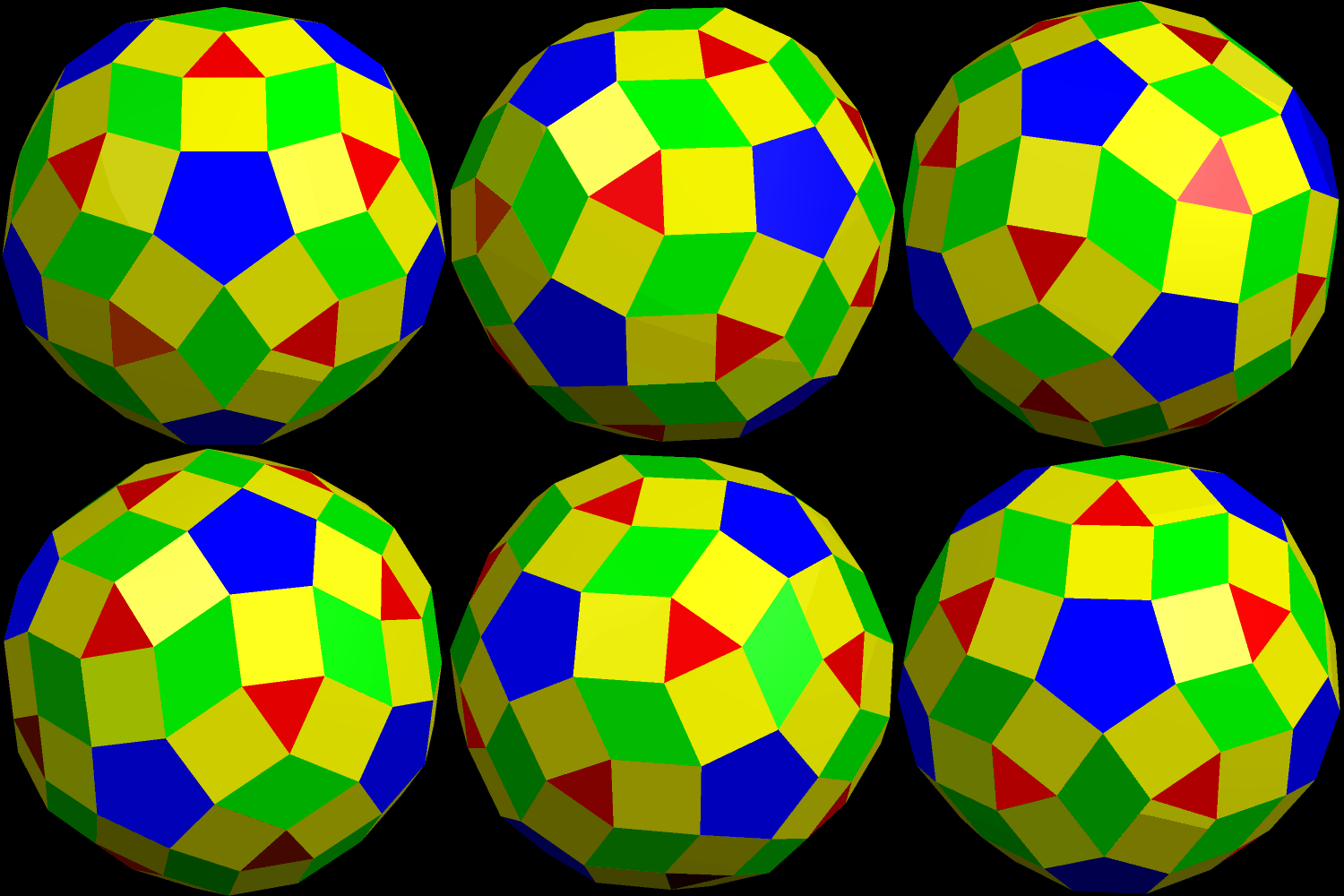
Here’s what I have found today. It is not a near-miss in the same way as the tetrated dodecahedron, but is related to the Johnson Solids in a different way. Other than a “heptadecahedron” (for its seventeen faces) it has no name, as of yet:

How is this different from traditional near-misses? Please examine the net (third image). In this heptadecahedron, all of these triangles, pentagons, and the one decagon are perfectly regular, unlike the situation with traditional near-misses. However, some faces, as you can see in the 3-d model, are made of multiple, coplanar equilateral triangles, joined together. In the blue faces, two such triangles form a rhombus; in the yellow faces, three such triangles form an isosceles trapezoid. Since they are coplanar and adjacent, they are one face each, not two, nor three. The dashed lines are not folded in the 3-d model, but merely show where the equilateral triangles are.

Traditional near-misses involve relaxation of the rules for Johnson Solids to permit polyhedra with not-quite-regular faces to join a new “club.”

Well, this heptadecahedron is in a different “club.” To join it, a polyhedron must  fit the criteria for “Johnsonhood,” except that some faces may be formed by amalgamation of multiple, coplanar regular polygons.

My current subject of speculation is this: would this new club have an infinite or a finite number of members? If finite, it will, I think, be a larger number than 92. If finite, it will also be a more interesting topic to study.

I don’t know, yet, what answer this new problem has. I do know I am having fun, though. Also known: no one will pay me for this.  No one needs to, either.

My Tattoo of Pi

This is my tattoo of pi, my favorite number. The circle which surrounds pi does not close because it is only three times as long as the diameter of the circle, in “deference” to the infamous “pi is exactly 3” verse of the Bible (I Kings 7:23).

Mathematical Therapy

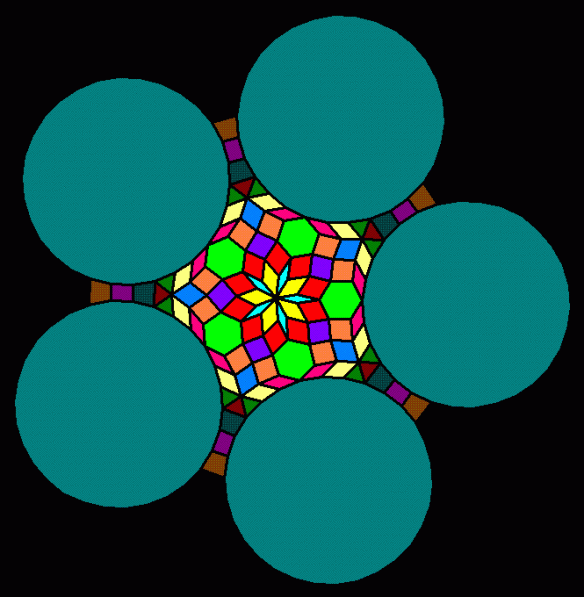
When I need to, I make mathematical images to improve my mood. For me, it works. These are three I created yesterday, using MS-Paint and Geometer’s Sketchpad.

I have a hunch this sort of thing would only work for a very few people, and we’re probably all Aspies, whether diagnosed or not.

I also call this sort of thing “recreational mathematics.” It’s better than Prozac, at least for me.

I’ve been doing this sort of thing for far longer than I’ve been on WordPress. These are just the latest such images.

Hi there. I’m RobertLovesPi.

RobertLovesPi is the name I use on the Internet, and I come to WordPress as a refugee from Tumblr, where I have grown tired of what I call the “reblogging-virus.” I am here to get a fresh start.

I am interested in a great many things. It would be silly for me to try to list all these topics here and now, so I won’t do that. My interests will become apparent as this blog progresses.

Regarding demographic basics, I was born in 30 B.G. (“Before Google”), but have become so accustomed to life in cyberspace that it now seems, to an almost scary degree, as if I am a native. I am 44 years old at the time of this blog’s inception, and work as a teacher of science (as well, sometimes, other subjects, varying from year to year) at a high school in Arkansas. It doesn’t take much math to figure out that this blog is starting in the year 14 A.G. (“Age of Google”) on my preferred calendar — if one knows that, unlike with the conventional calendar most Americans use, there is a Google Year Zero, also known as 1998 CE. And, yes, I invented the Google-based calendar myself. Why not?

As for my cyberspace name, it isn’t a joke. I really do love pi. Just don’t spell it with an “e,” please. If you do, that refers to someone else.

Also, my favorite number isn’t 3.14, no matter what your geometry teacher told you. And, no matter what I Kings 7:23 says, it certainly isn’t exactly 3. This can be proven with nothing more than a coffee can and some string.

Evidence is important to me, for I have been fooled before. I try my best to keep myself from being fooled again. If you want to persuade me of anything, be prepared to show me the evidence.

RAprofilepic