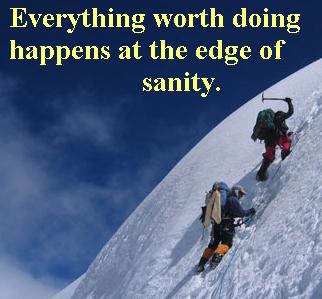
Feynman’s First Principle

Image

Feynman's First Principle

Everything worth doing….

Image

Everything worth doing....

How To Age Slowly

This is the day I turn 45, and I still get carded when I buy beer. Those are my qualifications to write on this subject.

My first pieces of advice are to avoid tobacco altogether, and to moderate use of alcohol. I’ve seen people age prematurely, due to both factors, right in front of me (over a period of years), and it’s frightening. It’s also unnecessary, since these are both choices.

We also choose what we eat. My choices are limited by food allergies, though, forcing me lower on the food chain. I cannot eat mammals (nor shrimp) with becoming seriously ill, so I simply don’t eat beef, pork, etc. Perhaps this helps. It certainly cannot hurt.

Dysfunctional relationships make people unhappy, and unhappy people seem to age more quickly. I have found leaving bad relationships to be a most effective way of initiating (temporary, I hope) apparent reverse-aging, with the result that I look younger now than I did five or ten years ago.

I also feel younger. Are there aches and pains? Yes, there are, but they were worse at 35. I have chronic pain from a fall, and the resulting neck injury. Ten years ago, I was begging doctors for prescriptions for painkillers. Now, ibuprofen, stretching, and the occasional visit to my chiropractor give me the relief I need.

I think I would look 65 (or be dead) if I had not sought mental health treatment years ago, so getting such help, if you need it, is part of my advice. The problem here is often that people fear the stigma of mental illness, and delay seeking help, or avoid it altogether. Fighting back, to weaken that stigma, is the reason I write publicly on such subjects.

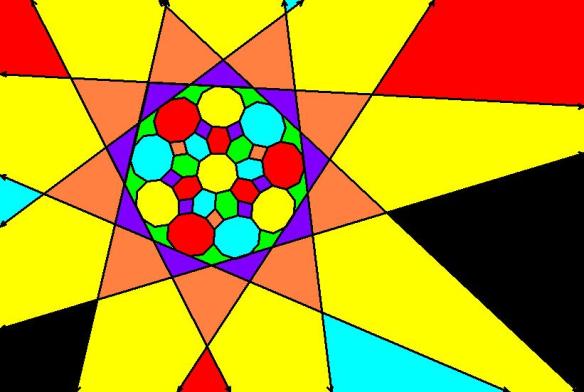
Another idea is a birthday ritual I have which, I must admit, can’t seriously be suggested as something that helps me age slowly, but it can’t hurt, either, and it’s fun. I make a star-design every year on my birthday, based on my new age. Here, therefore, is a star-design with 45 points:

Image

There is also an anti-aging attitude some people adopt, and I am one of them. This is a voluntary, deliberate refusal to stop being, in some senses (if not others), young. This can manifest itself in many ways; perhaps my star-ritual is one of them. Life is a game, of course, and I happen to like games — a lot.

Off-Center Mandala

Image

Off-Center Mandala

Snowflake in Primary Colors

Image

Snowflake in Primary Colors

Golden Spectral Crystallization

Image

Golden Spectral Crystallization

Created using Geometer’s Sketchpad and MS-Paint.

Asperger’s and Social Conventions

A common misconception about Aspies, in my opinion, is that we simply are not capable of understanding many social conventions, and that’s why we’re known for “failure” to follow them.

In some cases from my life, it is exactly that simple, but not most of the time. The whole of reality is messy and complicated, and there’s another explanation that accounts for more of this phenomenon.

Remember, Aspies think differently from other people, by definition. Sometimes, we have analyzed a set of social conventions carefully — for how else are we going to understand them? — and see them, therefore, for what they really are.

What are they, really? Well, some are insidious and evil. Consider, for example, the social conventions which have played strong roles in creating eating disorders. What good do those memes do anyone? Would we not all be better off without them? In a sense, then, some Aspies know some social conventions too well to follow them, and we do this on purpose. If you see through something, you’ll notice if it’s idiotic, and, if it is, then it’s perfectly natural to want nothing to do with it.

Not all social conventions are without merit, but many are not only that, but are actively pernicious. The ability to often identify which these are, and then avoid them, is not something I would quickly trade away.

Thoughts On Asperger’s


Image

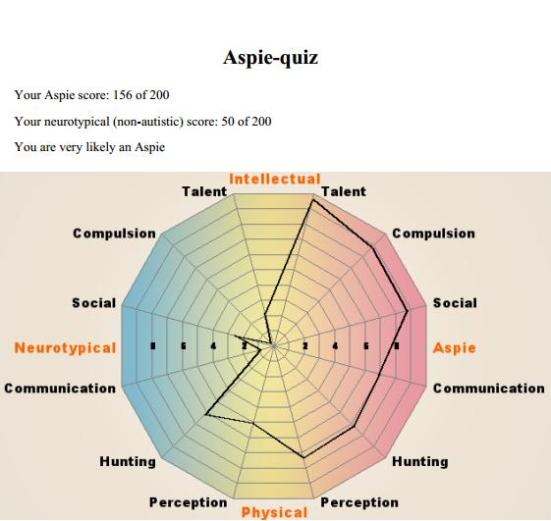
After many years of curiosity, I took a detailed Asperger’s test on-line. This graph shows the results. When I discussed the possibility with my psychiatrist, he said “It’s entirely possible,” but shied away from a definitive diagnosis, for that takes a team, and has a high cost, in terms of time and money, as well.

Many (I’m one) view Asperger’s as a difference, not a disorder, nor disease, in need of treatment or cure. (What we need is for the rest of the world to begin behaving logically, but that’s a separate rant.) I suspect my doctor agrees with this, which would be an additional, understandable reason for him not to liberally hand out “Asperger’s” labels.

I know this much: I either have it, or I share a lot of characteristics with those who do. I also know that a difference which makes no difference is not a real difference. I therefore see no reason to shell out thousands of dollars for a useless diagnosis. Why would it be useless? Well, there is no treatment, and I wouldn’t want one if it became available, anyway. I’m used to being this way, I like who I am, and am not remotely interested in being more like most people.

Other people (many of them, anyway) drive me nuts, for more reasons than I could easily list, but “they care what others think” is near the top, and is surely the most baffling of these reasons, to me.

Most diagnosed Aspies I’ve met are, by contrast, comforting for me to talk to. Since we find the same things about social life bizarre, it’s much like talking to people from the same planet as my own who have found themselves on this alien world called Earth, uncertain how we got here. It’s a lonely existence (no matter how many friends surround you, for you’re still trapped in your own head), and it helps, somehow, to talk to others with similar perceptions.

I have run into a small number of Aspies who dislike those who consider themselves to be part of the Aspie community, as I do, yet have not had a formal diagnosis. One benefit of being like I am, though, is that it is incredibly easy for me to disregard what particular people think, feel, or say — if I simply choose to — and that is what I have done with the small number of “Aspie Exclusives.” Their attitudes only affect me if I allow that to happen, and I simply choose not to do that.

The bottom line is this: so far, studying Asperger’s helps me understand myself. It clears up many long-standing puzzles when I see that my years of talk about “the normals” is a excellent match for the way Aspies describe, and discuss, what they call “neurotypicals.” I’m not a big fan of the term “neurotypical,” though, for it seems like a condescending and vaguely-insulting term to me, and I do not see that as helpful to anyone, inside or outside the Aspie community. (I do understand the motivation for it, though, for my motives were similar when I talked about “the normals,” in years long past.) My proposal for an alternative term is non-judgmental, and non-insulting, but remains accurate, and is simple in the extreme: I refer to the people who are not Aspies by the clear, concise, easy-to-understand term, “non-Aspies,” or, when a more formal term is called for, “people without Asperger’s.”

I also don’t care to seek an official diagnosis — because that whole enterprise completely misses the point. Aspies aren’t defective, except in the sense that all people are, with the defects (and strengths) simply in different areas. There could simply be an Asperger’s mutation, which could be the beginning of a long process of speciation. If homo aspergerus is coming, it won’t be here for a long time — speciation takes a long time to happen, but happen it does. Evolution doesn’t stop. Evolution also doesn’t guarantee improvement. New species (of any animal) will be different (or they wouldn’t be new species), but that doesn’t make them “superior” or “more evolved.” Every living thing on earth, after all, has been evolving for the same amount of time: ~3.85 billion years.

I will oppose any efforts to “cure” Asperger’s because, well, that would be genocide. I will also oppose any who try to label hypothetical new species as inherently superior, or inferior. We’ve been down that road enough times, throughout history, to see where it leads, and no sane person, Aspie or not, would want to venture further in that direction.

A Polyhedral Journey

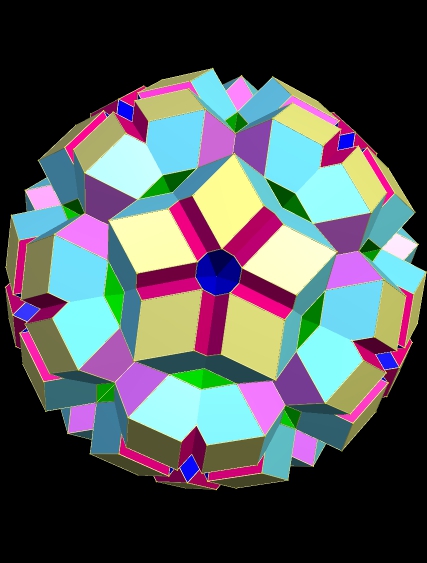
So I wondered, what would happen if I took rhombic dodecahedra…

Image

…and then affixed them to the sixty wider faces of a rhombic enneacontahedron?

Image

Well, it turns out that this is what you get:

Image

It’s at time like these — urgent situations in recreational mathematics — that I am most glad I bought Stella 4d, the program with which I made these images (and which you can try, for free, at http://www.software3d.com/stella.php). This would have taken months to figure out without the proper software! The next thing that occurred to me was to take the convex hull of the last polyhedron. That’s like draping a sheet around it and then pulling it tight. Here’s the result:

Image


Stella owes its name, in part, to a complex operation involving extensions of edges into lines, or faces into planes, called stellation. Stellating the above figure gave me something I didn’t like, but stellating it again gave me this:

Image 

And then, after six more stellations, I arrived at the end of this particular polyhedral journey.

Image


How to Lucid Dream

Have you ever been dreaming, and actually knew you were dreaming? Did you get to have at least partial control over what happened in this dream? If so, that’s lucid dreaming. If you’ve done it before, you can easily train yourself to do it again. If you haven’t, this same exercise might let you experience lucid dreaming for the first time.

You will need a visible reminder, such as an unusual bracelet or ring. I usually, based on advice I read thirty-plus years ago, simply write a “c” on my hand, a reminder to Consciously Check to determine if I am Conscious. I can attest that written “c”s can work, but there’s no reason it can’t be something else.

Next step: as you go about your day, you will occasionally see your reminder. Each time you do, stop whatever you are doing, and carefully check for consciousness. Can you remember what you’ve been doing, in sequence, for the last 15 minutes? Does gravity work correctly? I prefer to perform this last check by simply jumping up into the air, at which point I either fall directly back down, quickly, to the amusement of those present, or I flutter slowly downward as a leaf, or I hover at the top of the jump, or just keep going up — and any of these unusual results indicate, to me, that I am dreaming. If, on the other hand, my body acts consistently with Newton’s Laws of Motion, that provides evidence supporting the idea that I am awake.

If you do these checks often enough, it will become a habit, to the point where you will do such checks in your sleep, while dreaming. Once you figure it out, while dreaming, that you are dreaming, then you’re there — you are dreaming lucidly. You can then join those of us who know what it feels like to fly under your own power, or anything else your mind can imagine.

Image

(Image credit: dyrmdaily)