Flashing Semicircles

Image

semicircles

494 Circles, Each, Adorning Two Great Rhombcuboctahedra, with Different (Apparent) Levels of Anxiety


Trunc Cubocta

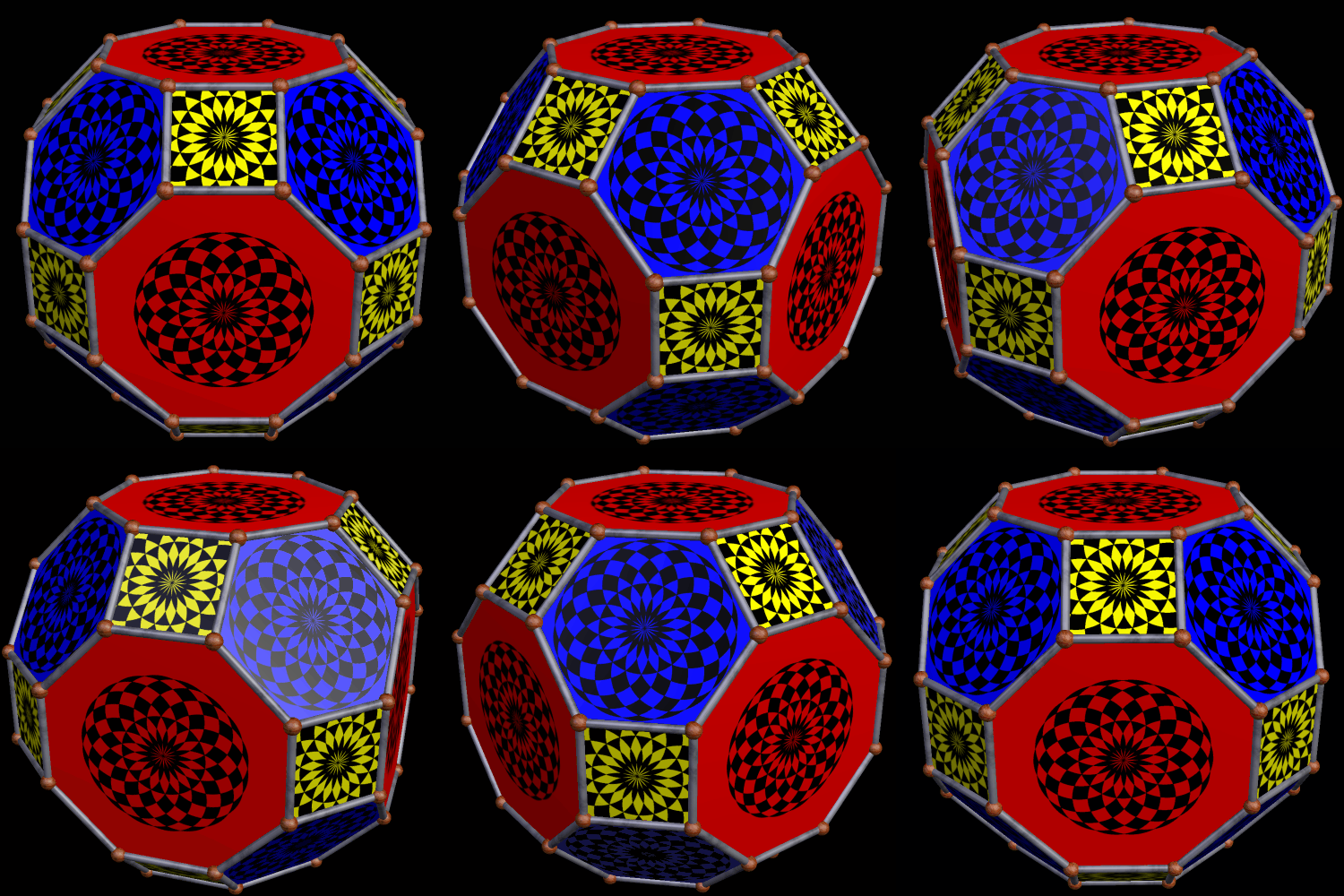
The design on each face of these great rhombcuboctahedra is made from 19 circles, and was created using both Geometer’s Sketchpad and MS-Paint. I then used a third program, Stella 4d (available here), to project this image on each of a great rhombcuboctahedron’s 26 faces, creating the image above.

If you watch carefully, you should notice an odd “jumping” effect on the red, octagonal faces in the polyhedron above, almost as if this polyhedron is suffering from an anxiety disorder, but trying to conceal it. Since I like that effect, I’m leaving it in the picture above, and then creating a new image, below, with no “jumpiness.” Bragging rights go to the first person who, in a comment to this post, figures out how I eliminated this anxiety-mimicking effect, and what caused it in the first place. 
Trunc Cubocta

Your first hint is that no anti-anxiety medications were used. After all, these polyhedra do not have prescriptions for anything. How does one “calm down” an “anxious” great rhombcuboctahedron, then?

On a related note, it is amazing, to me, that simply writing about anxiety serves the purpose of reducing my own anxiety-levels. It is an effect I’ve noticed before, so I call it “therapeutic writing.” That helped me, as it has helped me before. (It is, of course, no substitute for getting therapy from a licensed therapist, and following that therapist.) However, therapeutic writing can’t explain how this “anxious polyhedron” was helped, for polyhedra can’t write.

For a second hint, see below.

.

.

[Scroll down….]

.

.

Second hint: the second image uses approximately twice as much memory-storage space as the first image used.

Nineteen Circles II

Image

19 circles

An Illusion of Spin

an_illusion_of_spin.gif

I used three things to make this: Geometer’s Sketchpad (to make one black and white version; the whole thing is made of semicircles), MS-Paint (to color the six different versions which appear here), and the website http://www.makeagif.com (to assemble the six separate still images into one .gif file, with the illusion of motion). The surprising thing to me was how fast the process was, once I had the idea of my goal for a finished product.

Circumparabolic Regions Inside a Unit Circle

circumparabolic regions

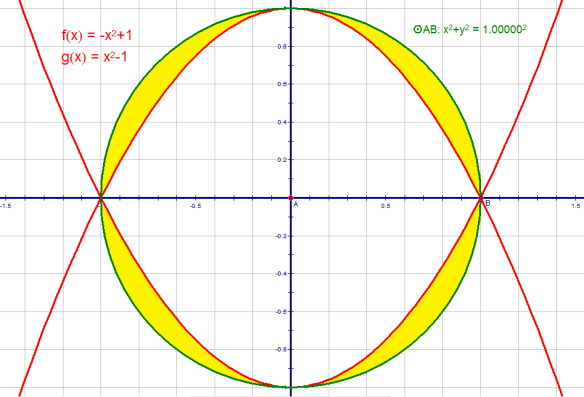
A circumparabolic region is found between a circle and a parabola, with the circle being chosen to include the vertex and x-intercepts of the parabola used, with the circle, to define the two circumparabolic regions for a given parabola-circle pair. There are four such regions shown above, rather than only two, because two parabolas are used above. The formulae for the parabolas, as well as the circle, are shown.

A puzzle which I will not be solving, I suspect, until I learn more integral calculus: what fraction of the circle’s area is shown in yellow?

Op Art from 2010

op art from 2010

I recently found this “lost artwork” I made in 2010, two years before starting this blog. Traditionally, “op art” is black and white, only — but “traditionally” is a word seldom applied to anything I do, and I see no reason to change that now.

Geometry Problem Involving Two Circles (See Comments for Solution)

This is a puzzle I made up not long ago. After trying to solve it for a bit (no success yet, but I haven’t given up), I decided to share the fun.

A small circle of radius r is centered on a large circle of radius R. It is a given that 0 < r < R. In terms of r and R, what fraction of the smaller circle’s circumference lies outside the larger circle?

two circles

I am 90% certain there is an extremely simple way to do this, using only things I already know. It’s frustrating that the answer isn’t simply leaping out of the computer screen, at me. For simple math problems, that’s what usually happens . . . so either this is merely deceptively simple, or I am missing something.

Hex

hex

Spectral Flower

spectral flower

Is It Moving?

is it moving