Augmenting, then Reaugmenting, the Octahedron

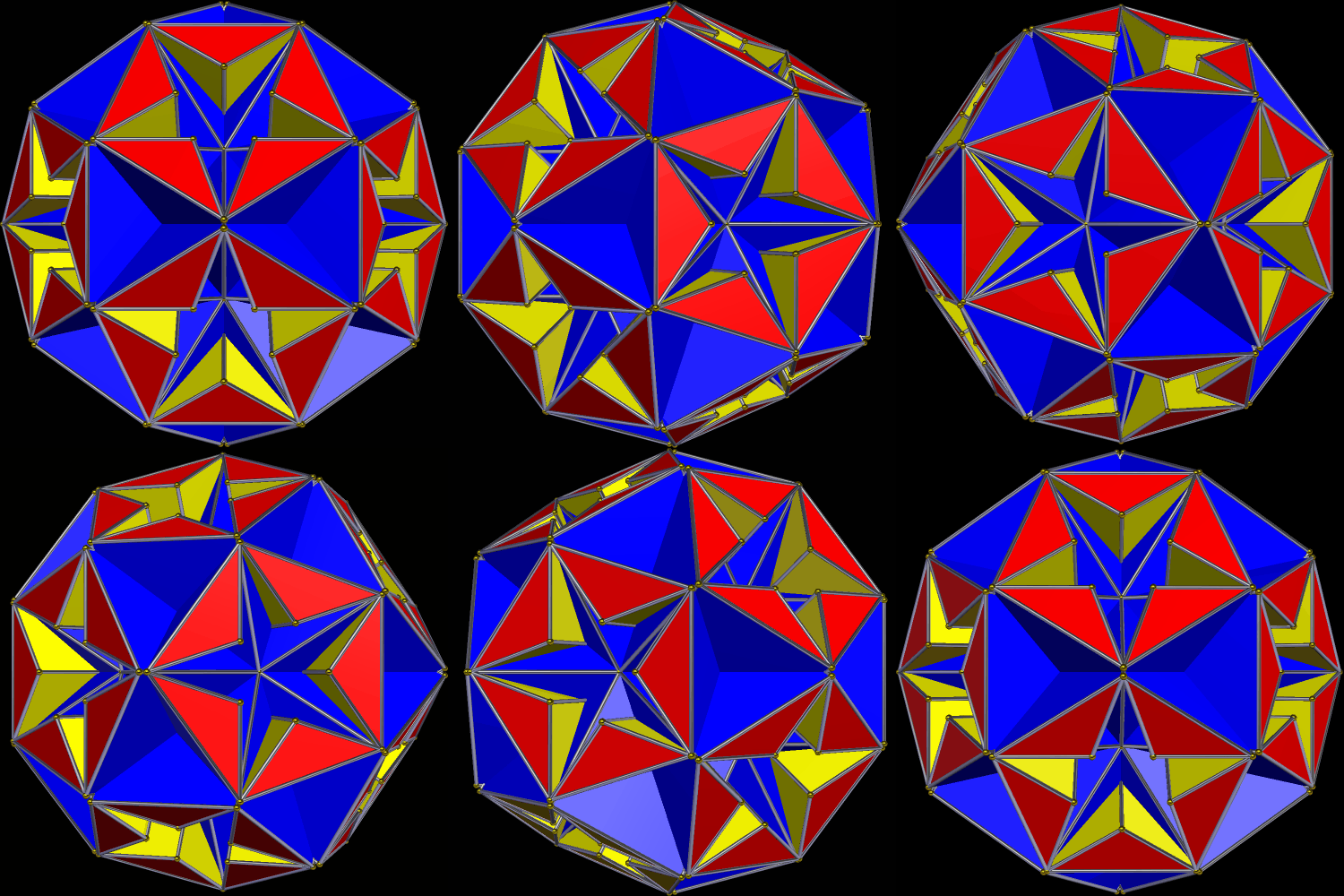
The blue figure above is an octahedron. The next image shows what happens if red octahedra are used to augment each of the blue octahedron’s faces.

The third image shows what happens if yellow octahedra are used to augment each red face in the second figure.

These polyhedral images were created using Stella 4d: Polyhedron Navigator, which you can try for free at http://www.software3d.com/Stella.php.

Eight Golden Rectangles

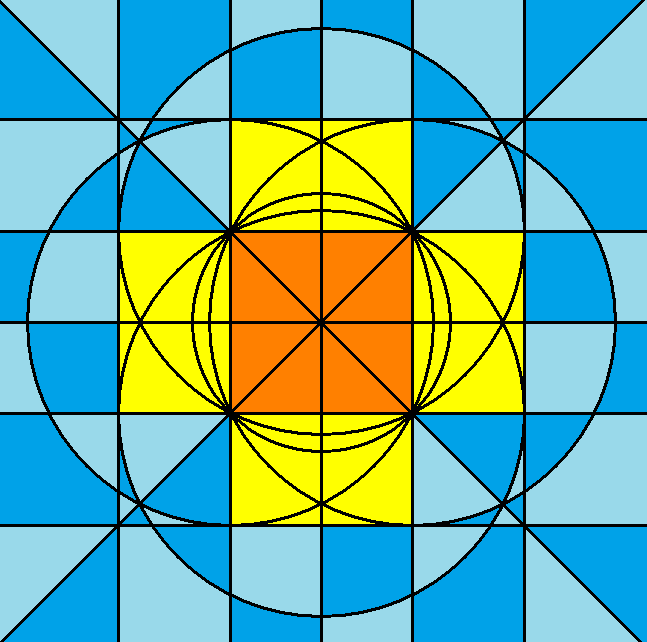
This Euclidean construction was made using Geometer’s Sketchpad, and colored using that program, as well as MS-Paint.

A Euclidean Construction of the Golden Rectangle

Start with points A and B. Construct a circle, centered on A, with radius AB. Draw line AB, which intersects this circle at B and C. Construct a second line which is perpendicular to the first line, intersecting it at A. Let the two intersections of the circle and this second be named points D and E.

Bisect segment AB, and call its midpoint F. Construct a line containing D and F. If the circle’s radius is two, then AF = FB = 1, while AD = 2. By the Pythagorean Theorem applied to right triangle DAF, then, DF = sqrt(5). Construct a second circle centered on F, with radius DF. Construct point G where this circle intersects segment AC. It follows that FG, being another radius of this second circle, has a length of sqrt(5). This makes BG = FB + FG = 1 + sqrt(5).

Construct the line which is perpendicular to line AE and passes through point E. Next, construct the two lines perpendicular to line AB and passing through points G and B. These two lines intersect the first line described in this paragraph at two points: H (below G) and I (below B). ABIE is a square with edge length two, and both GBIH and AEHG are golden rectangles.

A Polystar, Made of Golden Triangles and Golden Gnomons

Image

A Tessellation of Regular Hexagons, Golden Triangles, and Rhombi

The rhombi’s interior angles measure 84 and 96 degrees.

Two Versions of a Tessellation Featuring Regular Hexagons, Regular Pentagons, and Tetraconcave, Equilateral Octagons

The octagons appear as four-pointed stars, with the narrowest angles measuring 12 degrees, and the next-narrowest measuring 24 degrees.

An Augmented Great Dodecahedron

To make this polyhedron, I started with a great dodecahedron, and then augmented each of its facelets with a prism, using a program called Stella 4d. You can try this program for free at this website.

A Tessellation Featuring Regular Hexagons and Two Types of Rhombi

This tessellation is made of blue regular hexagons, as well as rhombi containing 40 and 140 degree angles (red), and rhombi containing 80 and 100 degree angles (yellow).

36 Rhombi in an Octadecagon

Image

A Pentadecagon and Its Diagonals

Image