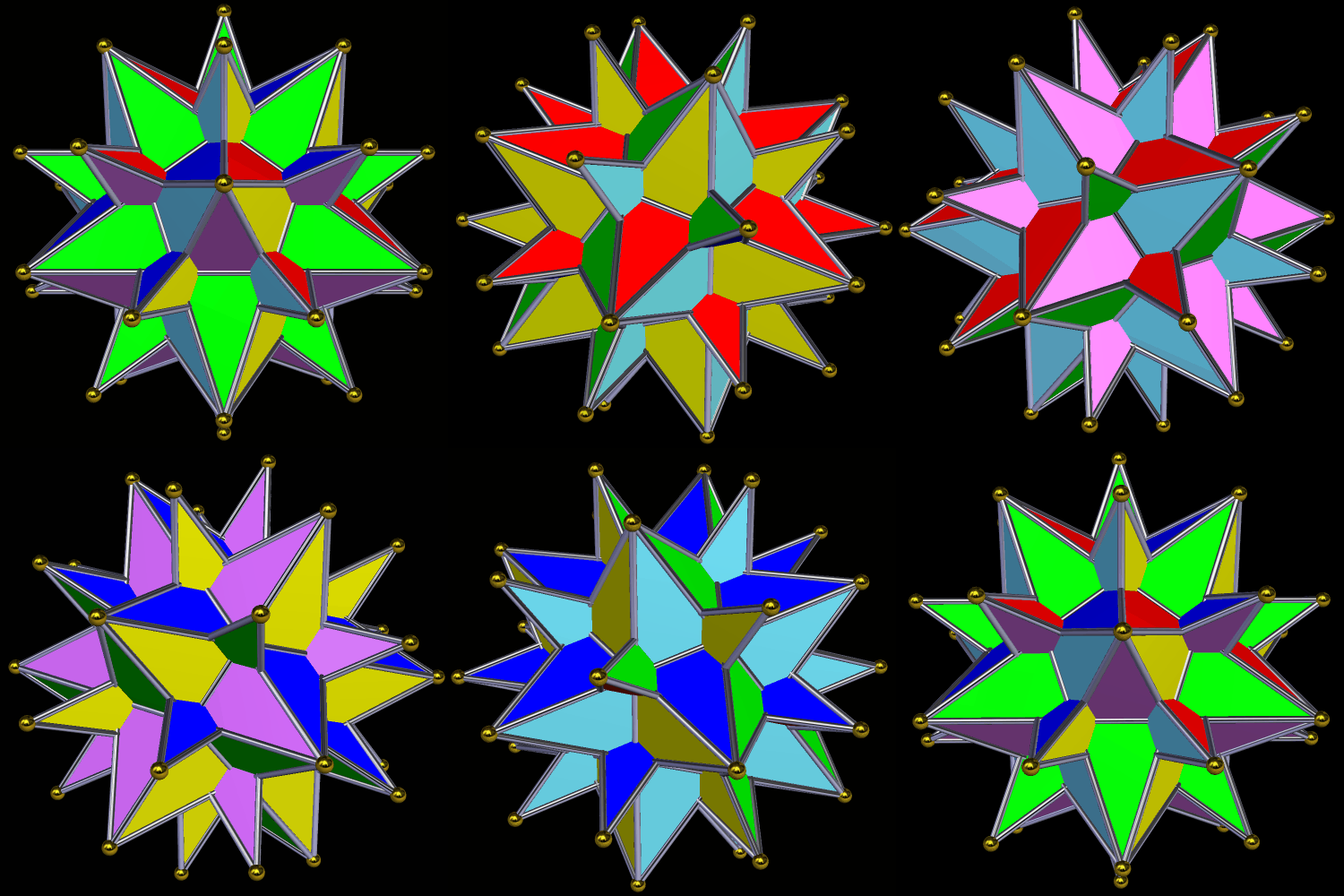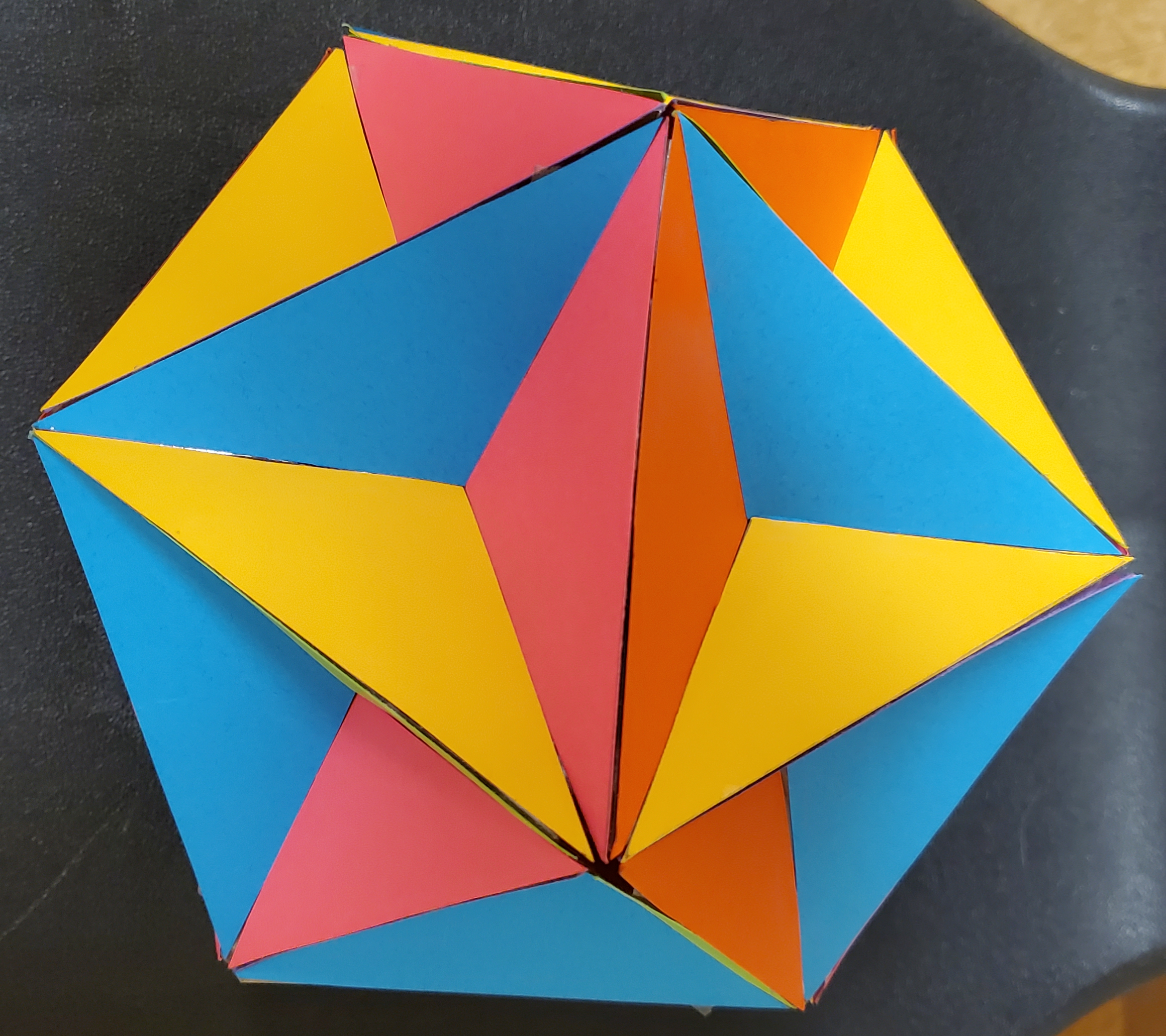
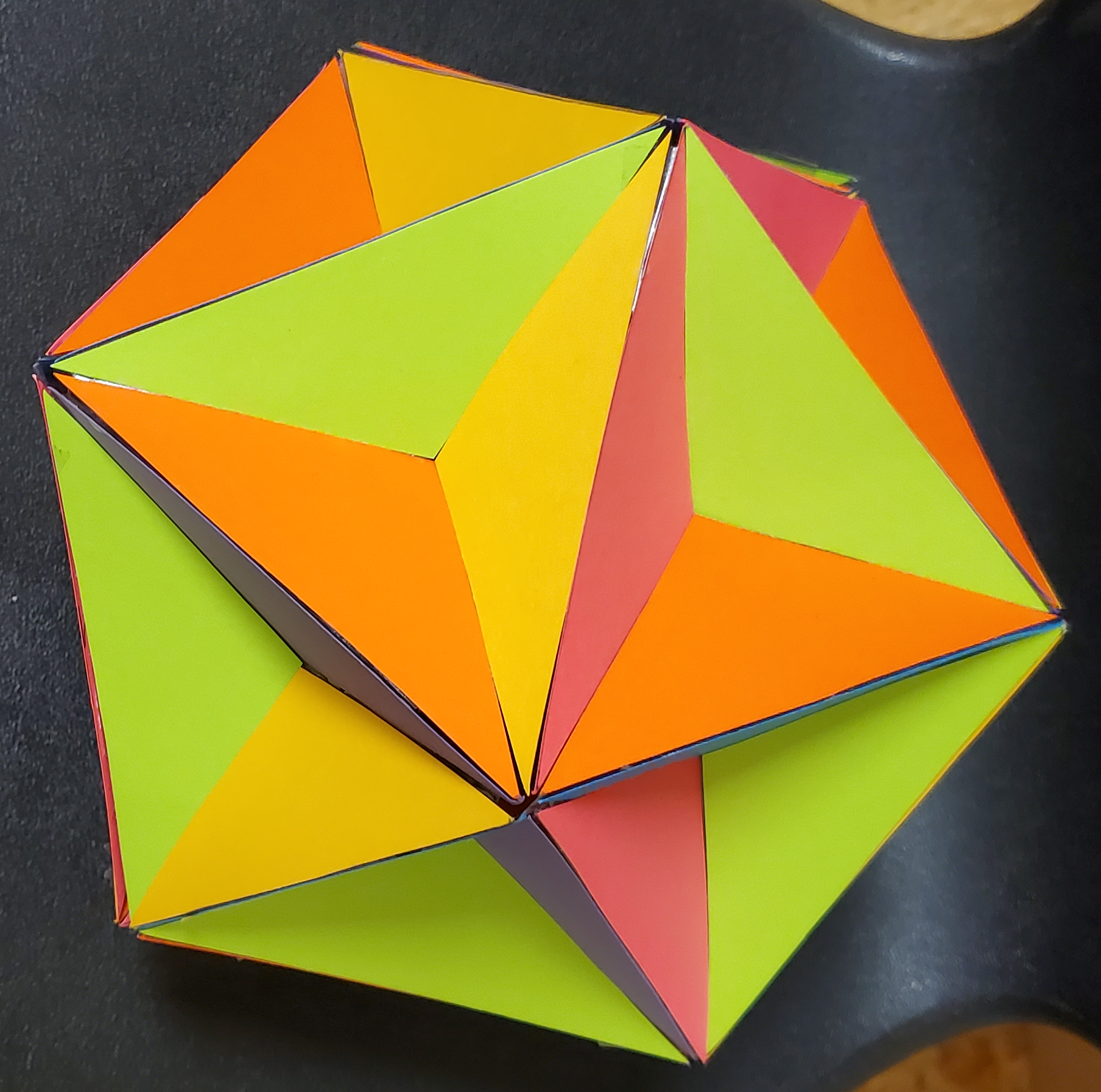
Two Views of a Paper Model of the Great Dodecahedron

The obtuse triangles here are golden gnomons, which are isosceles triangles with vertex angles of 108 degrees, as well as base-to-leg ratios which are golden. These triangles are facelets; the actual, much larger faces are the regular pentagons of which the golden gnomons are parts. In this model, all facelets which are part of the same (or parallel) faces are all one color, with six colors of paper used, in all, for this non-convex, twelve-faced, regular polyhedron, which is one of the Kepler-Poinsot solids.

Much of each face is hidden from view in this polyhedron’s interior — or rather, this is the case for the mathematical construct called the great dodecahedron. This physical model, on the other hand, is hollow on the inside. One is made only of ideas, while the other is made of atoms.

No computer programs were involved in the construction of this model. It was made using compass, straight edge, scissors, card stock, pencils, and tape.
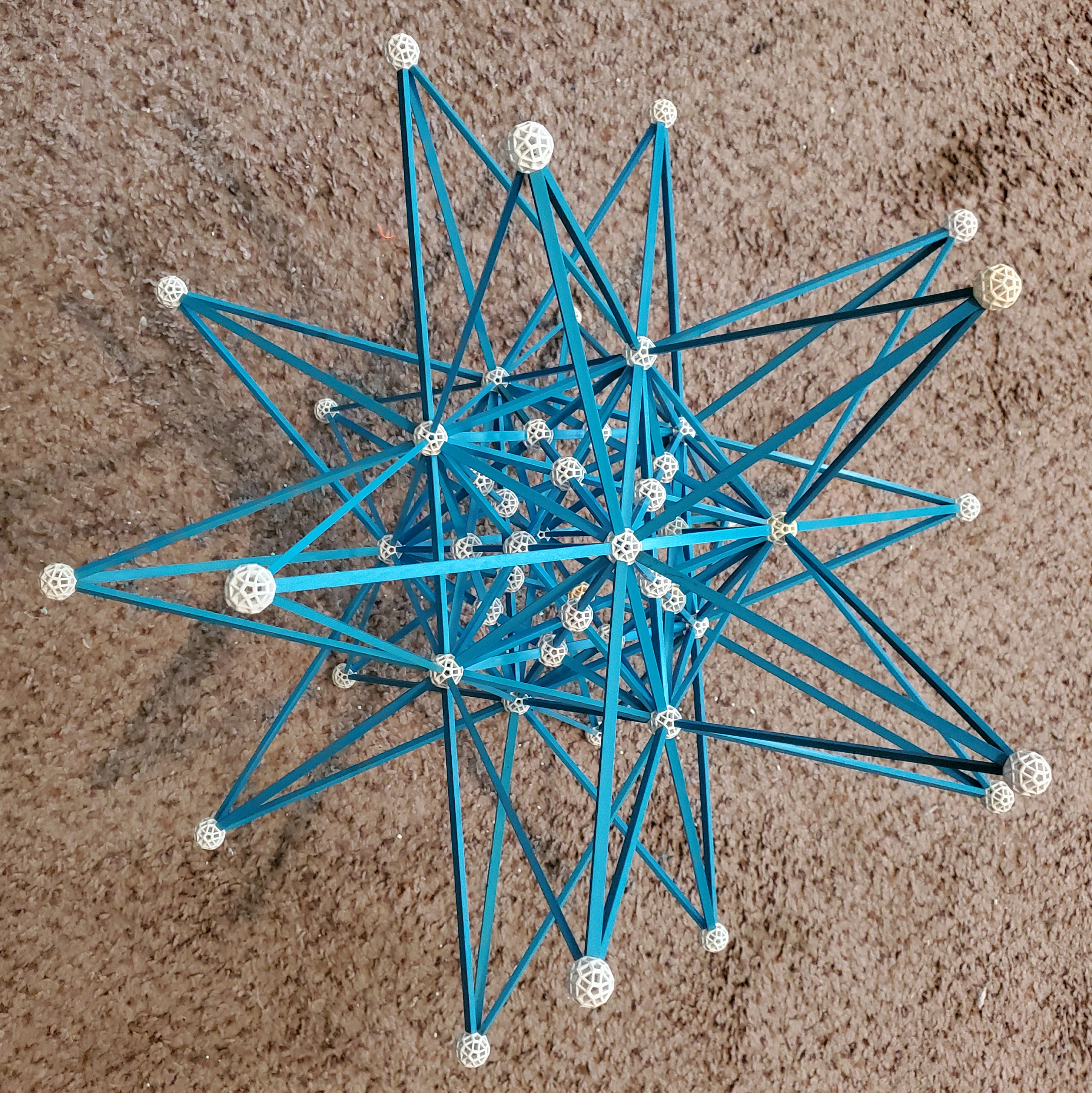
Some Concentric, All-Blue Zome Polyhedra

In the center of this figure is a regular dodecahedron, but it’s hard to spot. It is then stellated to form a small stellated dodecahedron. Next, its outer vertices are joined by new edges: those of an icosahedron. This also results in the formation of a great dodecahedron. Finally, the icosahedron is stellated to form the great stellated dodecahedron. To take this further, one could connect the outer vertices with new edges: those of a dodecahedron. The entire process can begin again, then, and this could continue without limit, filling all of space.

Here’s a closer view of the interior:

Zometools may be purchased at http://www.zometool.com.

A Compound of the Small and Great Stellated Dodecahedra

I made these compounds using Stella 4d, which you can try for free at http;//www.software3d.com/Stella.php.

The Great Dodecahemiicosahedron, With Two of Its Stellations

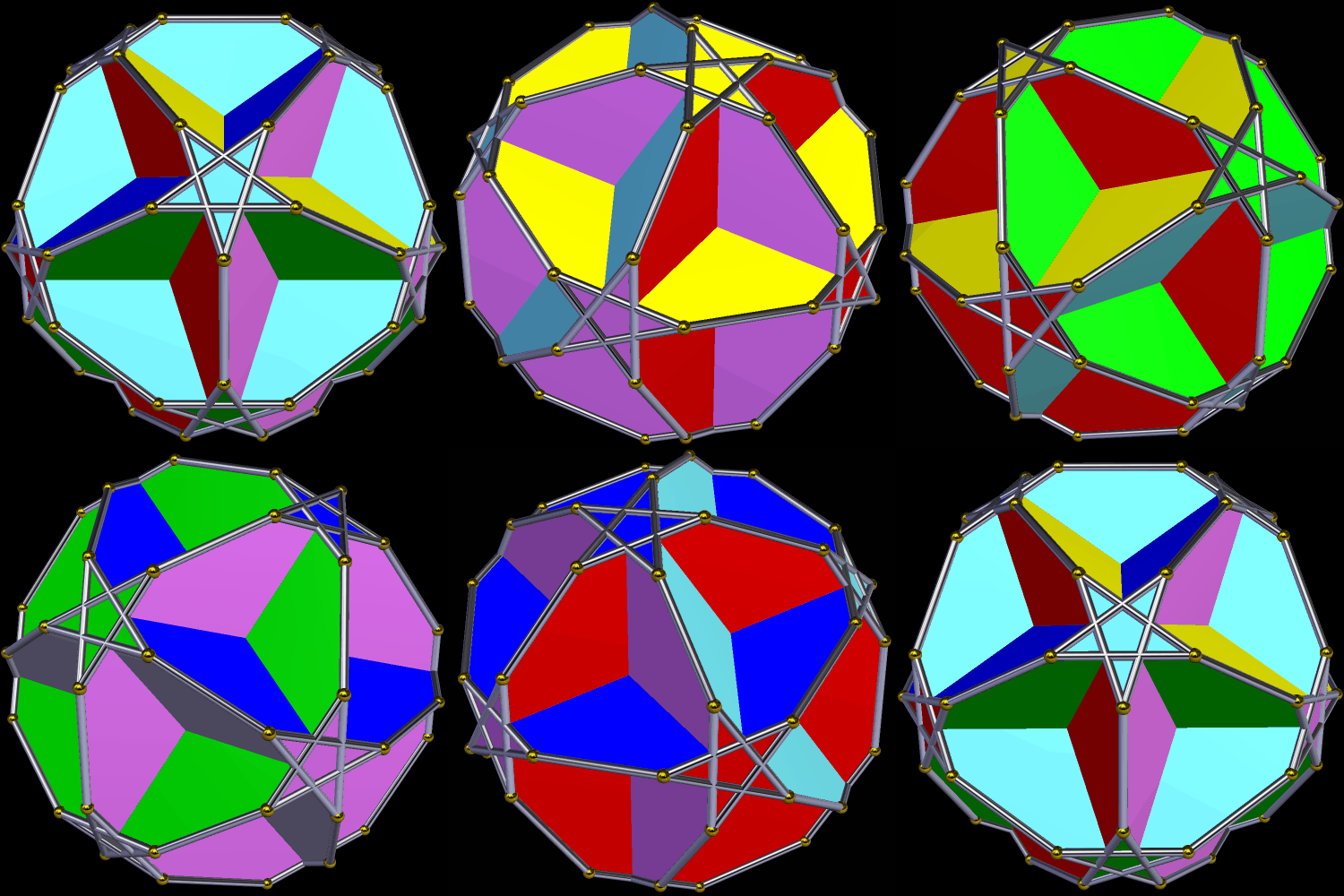
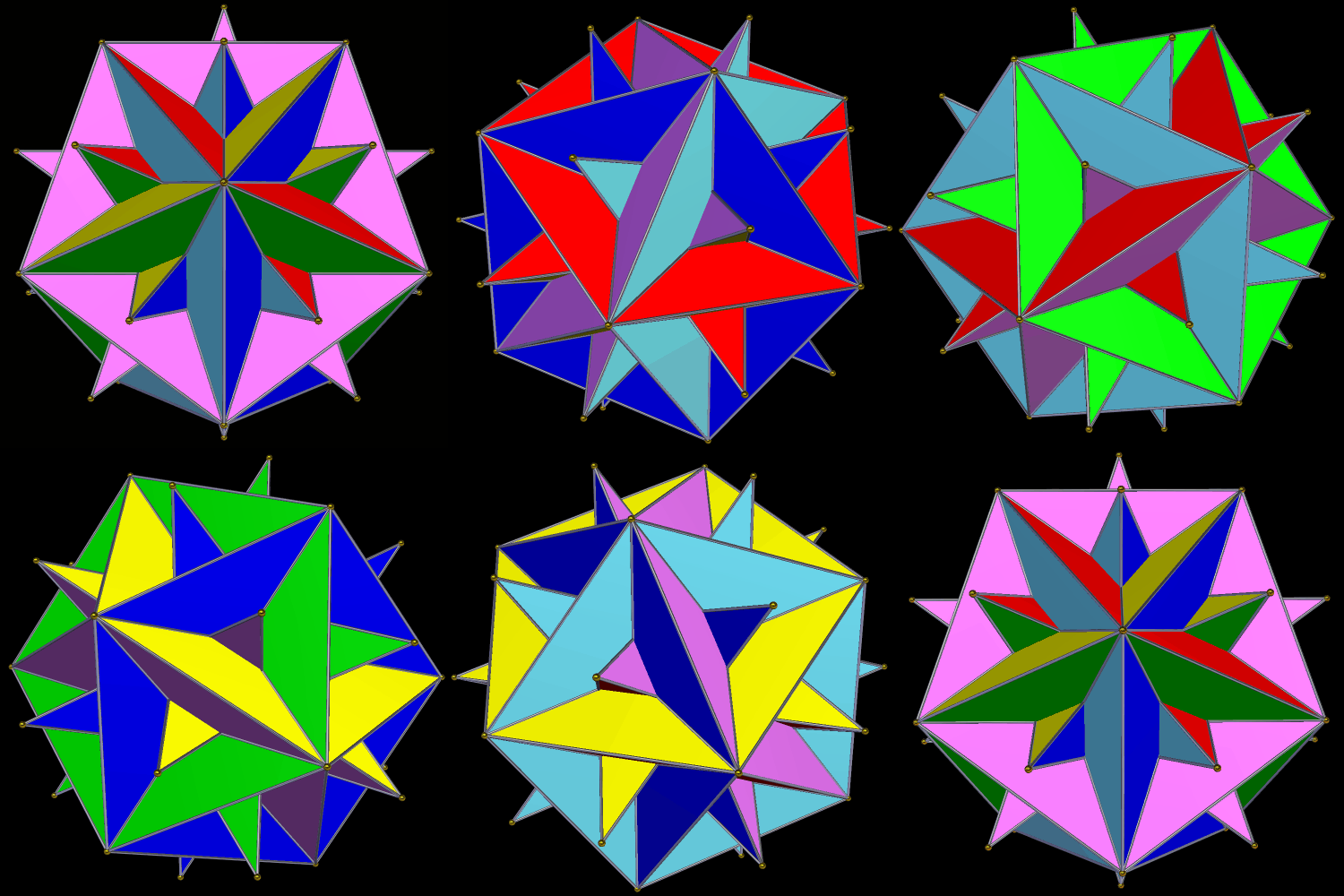
Recently (here and here), I blogged about the small dodecahemiicosahedron, along with several of its stellations. Today, I got curious about it’s “big brother,” the great dodecahemiicosahedron, so I looked up the latter with Stella 4d (free trial download available here), examined some of its stellations, and made virtual models of what I found.

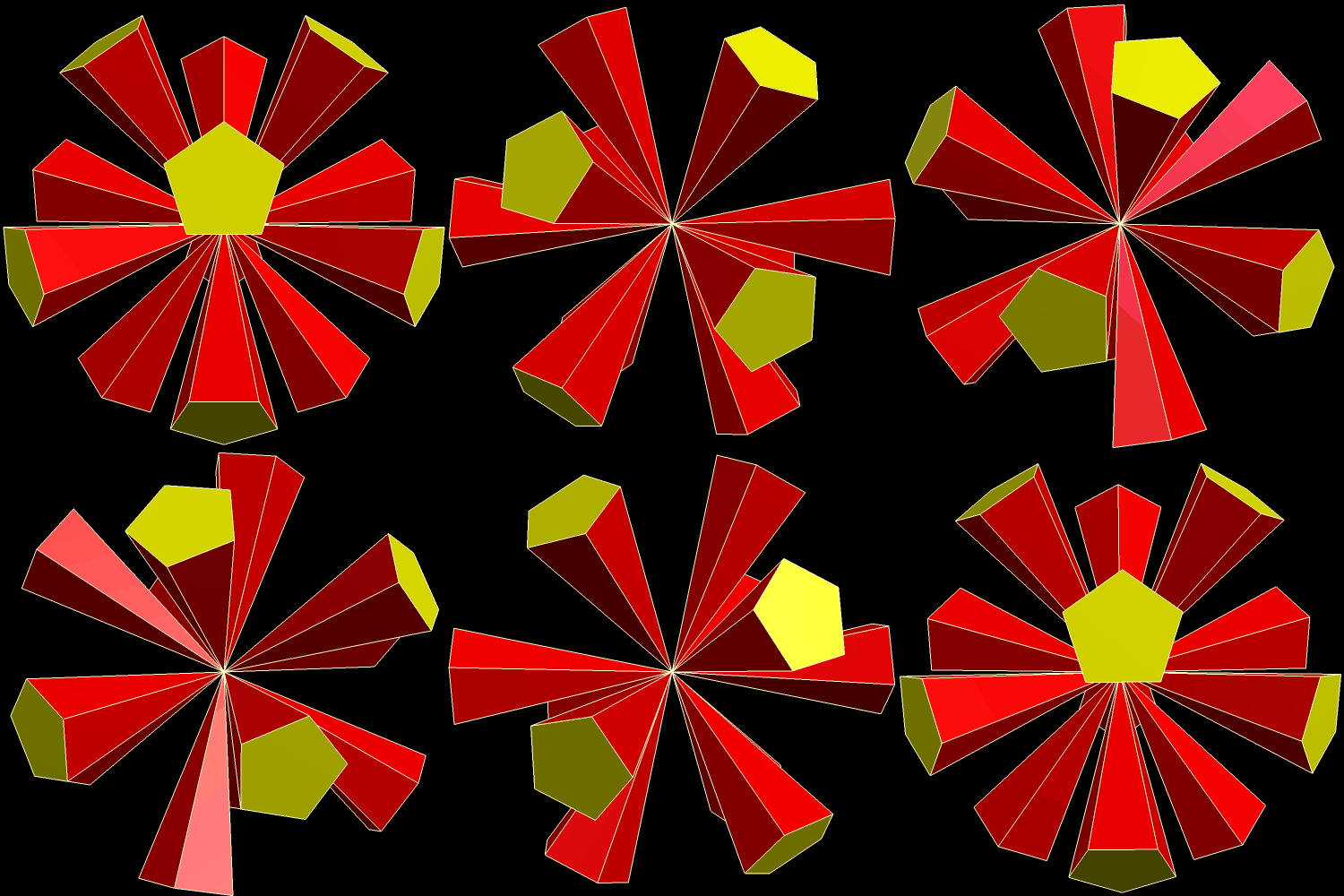
First, the great dodecahemiicosahedron itself. The 22 faces of this uniform polyhedron are twelve regular pentagons (shown in yellow) and twenty regular hexagons (shown in red).

Next, its 30th stellation:

Lastly, the 88th stellation:

When creating polyhedral models, I usually use gold spheres for vertices, and silver cylinders for edges. However, in this case, that decoration is getting in the way — so here’s the 88th stellation again, without the spheres and cylinders. This way, it really looks like what it is: a dozen tall pentagonal pyramids meeting only at their common vertex.

Two Views of the Compound of the Great Dodecahedron and the Platonic Dodecahedron

I made this using Stella 4d, which you can try for free right here. In the image above, the two components of this compound are given separate colors. In the second picture, below, the coloring is per face, except for parallel faces, which have the same color.

The Truncated Great Dodecahedron

To get from the last image posted to this one, I used Stella 4d‘s “try to make faces regular” function. (You can get a free trial download of this program right here.)

Stellar Array

A great dodecahedron (red) sits in the middle of this polyhedral cluster. The polyhedra touching the one in the center are blue small stellated dodecahedra. Finally, there are yellow great stellated dodecahedra on the outside.

I assembled this polyhedral cluster using Stella 4d, which you can try for yourself at http://www.software3d.com/Stella.php.

A Compound of the Great Stellated Dodecahedron and the Great Dodecahedron

Compound of Great Stellated Dodeca and Great Dodeca.gif

In the picture above, each component of this compound has its own color. In the one below, each set of parallel faces is given a color of its own.

Compound of Great Stellated Dodeca and Great Dodeca 2

These images were made using Stella 4d, software you may try for yourself at this website.

Three Versions of a Compound of the Great and Small Stellated Dodecahedra

In the first version of this compound shown here, the great stellated dodecahedron is shown in yellow, while the small stellated dodecahedron is shown in red.

Small Stellated Dodeca and Great Stellated Dodeca.gif

In the next version, each face has its own color, except for those in parallel planes, which have the same color.

Small Stellated Dodeca and Great Stellated Dodeca 2

Finally, the third version is shown in “rainbow color mode.”

Small Stellated Dodeca and Great Stellated Dodeca 3

All three of these images were created using Stella 4d: Polyhedron Navigator, software you can try for free right here.

Augmenting the Dodecahedron with Great Dodecahedra

These two polyhedra are the dodecahedron (left), and the great dodecahedron (right).

Since the faces of both of these polyhedra are regular pentagons, it is possible to augment each of the dodecahedron’s twelve faces with a great dodecahedron. Here is the result.

Augmented Dodeca.gif

I used Stella 4d to make these images. You may try this program for yourself at http://www.software3d.com/Stella.php.