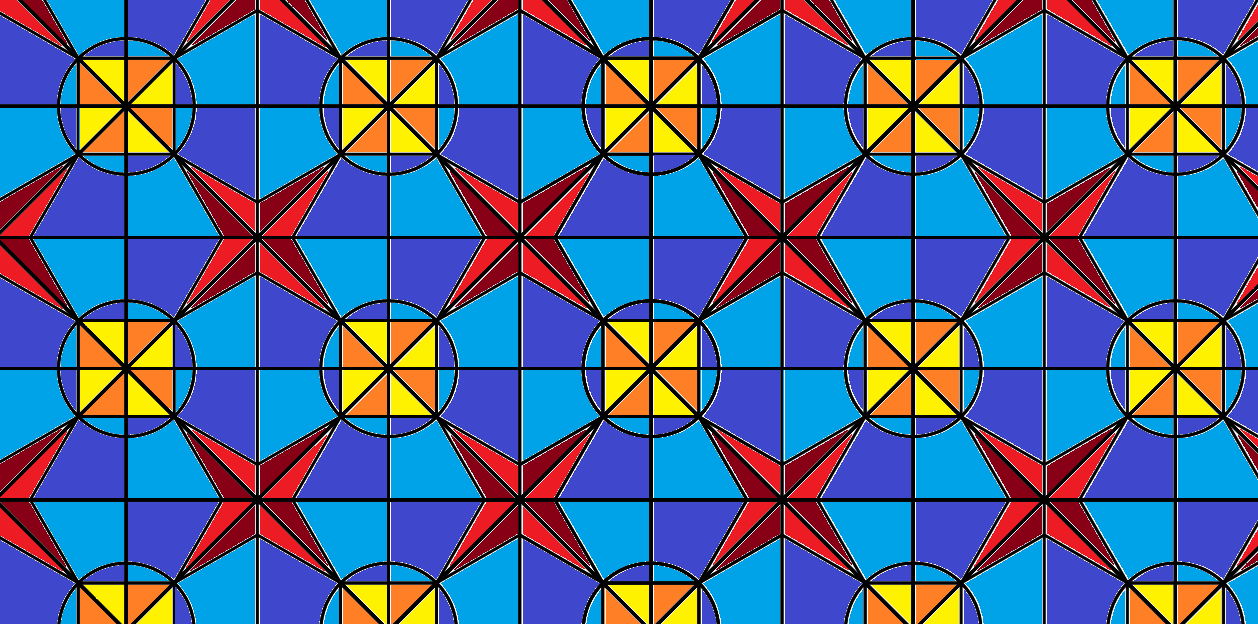
If you’d like to see the first version of this tessellation, made over a decade ago, this is where you’ll find it. https://robertlovespi.net/2014/06/08/tessellation-of-the-plane-with-regular-hexagons-squares-and-tetraconcave-equilateral-octagons/
If you’d like to see the first version of this tessellation, made over a decade ago, this is where you’ll find it. https://robertlovespi.net/2014/06/08/tessellation-of-the-plane-with-regular-hexagons-squares-and-tetraconcave-equilateral-octagons/
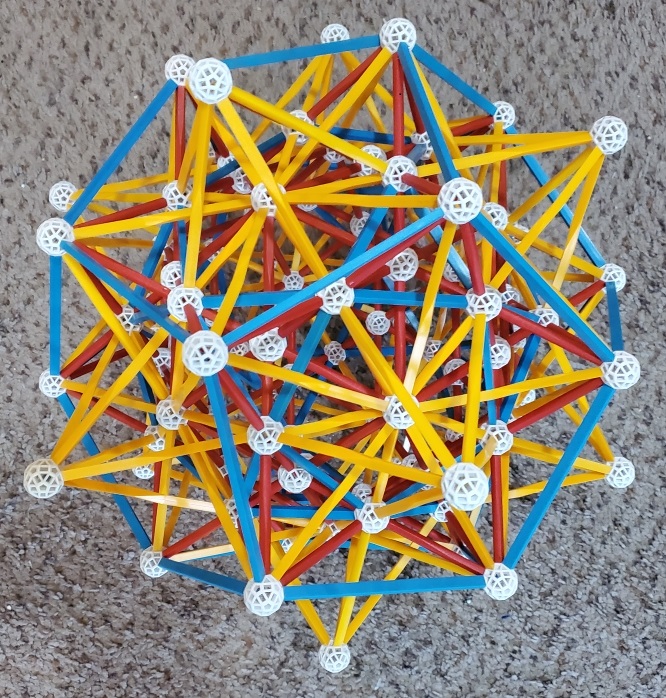
This isn’t exactly a polyhedron, or even a polyhedral compound, although it does contain several polyhedra in it. There’s a red rhombic triacontahedron in the center, a blue icosidodecahedron just outside that, and a blue dodecahedron closer to the outside. There are also twelve blue-and-yellow pentagonal pyramids, as well as twenty smaller blue-and-red triangular pyramids. That may not be a complete list, although I did try to include them all. I didn’t build it with the goal of making anything in particular — I was just having fun with Zome. In other words, I was playing.
Zome is available at http://www.zometool.com, if you’d like to try playing with it, or giving it as a gift to someone who would appreciate it. The small parts could cause a choking hazard for babies or toddlers, but they will delight and amaze school-age kids, as well as older people (like me) who still enjoy play for the sake of playing, and doing math for the sake of doing math.
Math jokes are almost universally awful — or, at least, it seems that way to me, since I spend a lot of time around ninth graders. Hearing “Gee, I’m a tree” or “Pi are square? No, pies are round, and cake are square!” will generally elicit a groan from me, and each new cadre of students seems to think they invented these fossilized puns. An even worse “joke” is the giggling one should expect from, say, 7th graders, if one squares the number thirteen in their presence.
I do know exactly one good math joke, though. I didn’t hear it from a student. If you’re curious, read on. Only the embellishments are original; I didn’t make up the joke, itself, though, nor do I know who did.
My source for the image below is this fellow WordPress blogger’s photography blog.

So a physicist, chemist, and a lawyer enter a balloon race together. Theirs is the last balloon to leave, because the lawyer had been in court, arrived late, and caused a short delay in departure. The consequences of this were serious, though, for a sudden cross-wind blew them off course, right after takeoff. Soon, they couldn’t even see any of the other balloons in the race, and none of them recognized any landmarks in the landscape below.
Soon, they had no idea where they were, and started getting worried about making it to their next classes on time — or back to court, in the case of the lawyer. The chemist was particularly worried. “What are we going to do?” asked the chemist.
The physicist replies, “I have an idea!” He cups his hands, leans out, and yells, as loud as he can, “Hello! Where are we?”
The balloon flies on for at least two long, anxious minutes as the trio waits, silently, for an answer. Eventually, they hear, from a great distance, a voice. “Hello! You’re lost!”
The physicist looks at the other two, and says, “That, my friend, was a mathematician.”
“How,” asked the lawyer, “could you possibly know that?”
“Three things,” replied the physicist. He held up one finger. “First, it took him a long time to answer.”
“Second,” he continued, holding up two fingers, “the answer, when it finally came, was absolutely correct.”
A third finger joined the first two. “Third, the answer, when it finally came, was completely useless!”
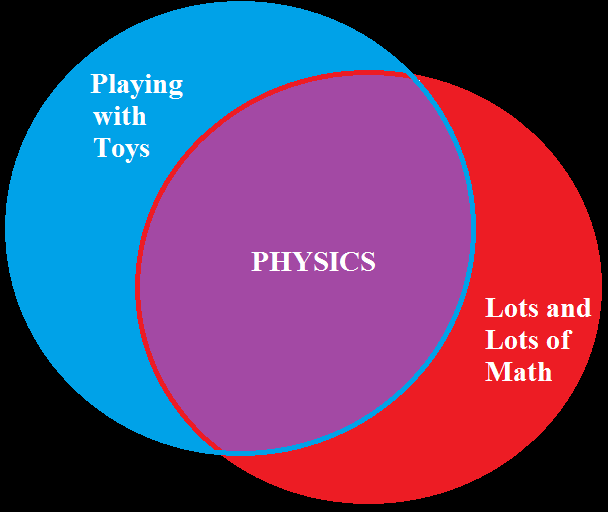
With my metaphorical “mathematics of sets” hat on, this is what physics looks like, to me. The further you go in the field, the more challenging the mathematics gets; also, the better (and more expensive) the toys become.
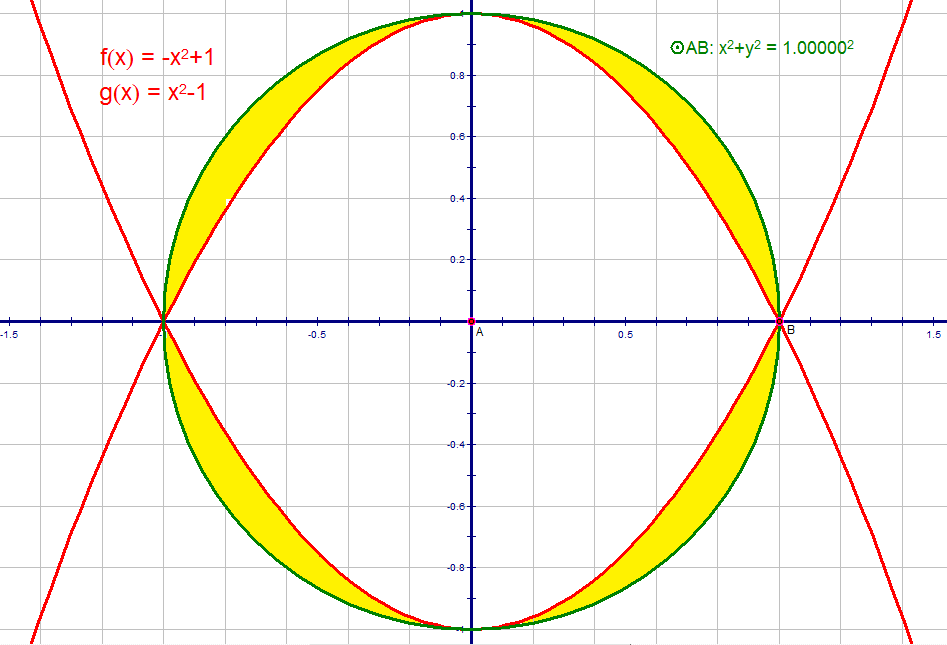
A circumparabolic region is found between a circle and a parabola, with the circle being chosen to include the vertex and x-intercepts of the parabola used, with the circle, to define the two circumparabolic regions for a given parabola-circle pair. There are four such regions shown above, rather than only two, because two parabolas are used above. The formulae for the parabolas, as well as the circle, are shown.
A puzzle which I will not be solving, I suspect, until I learn more integral calculus: what fraction of the circle’s area is shown in yellow?

I don’t usually post the work of others here, but, since I am now using this as my blog’s header-image (in slightly altered form), it seemed appropriate to make an exception for this cartoon, in its original format. I didn’t know that the cartoonists at Cyanide and Happiness monitored my life, but, clearly, that guy in the blue shirt is me!
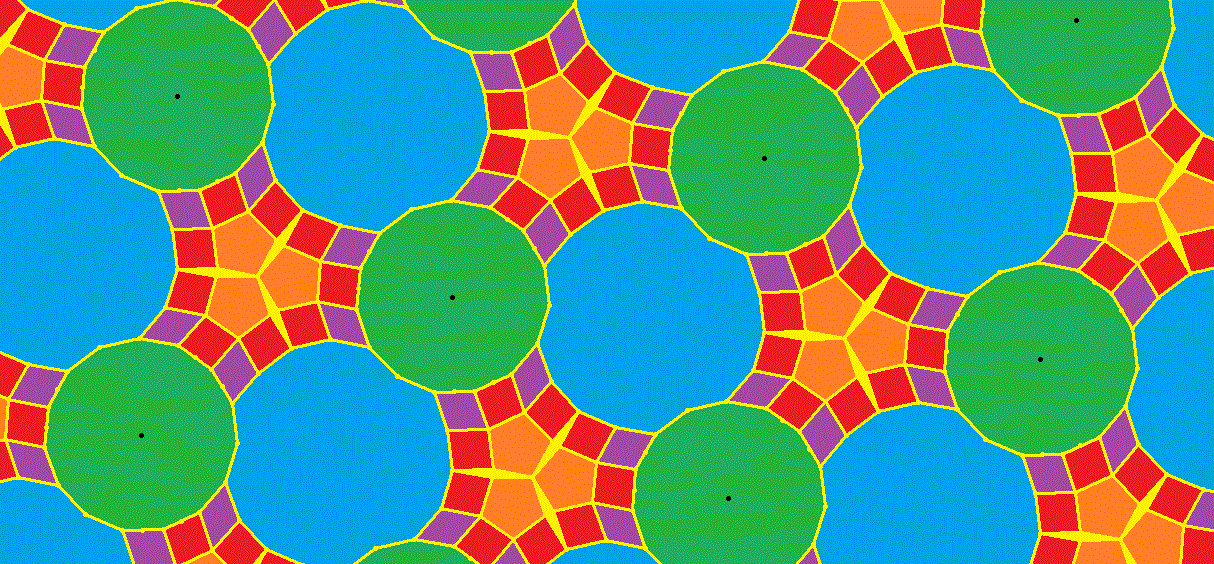
Other polygons included in this tessellation include several types of rhombi, as well as triconcave octadecagons. The pattern is chiral, but the chirality is subtle. (Hint: look near the pentagons.)
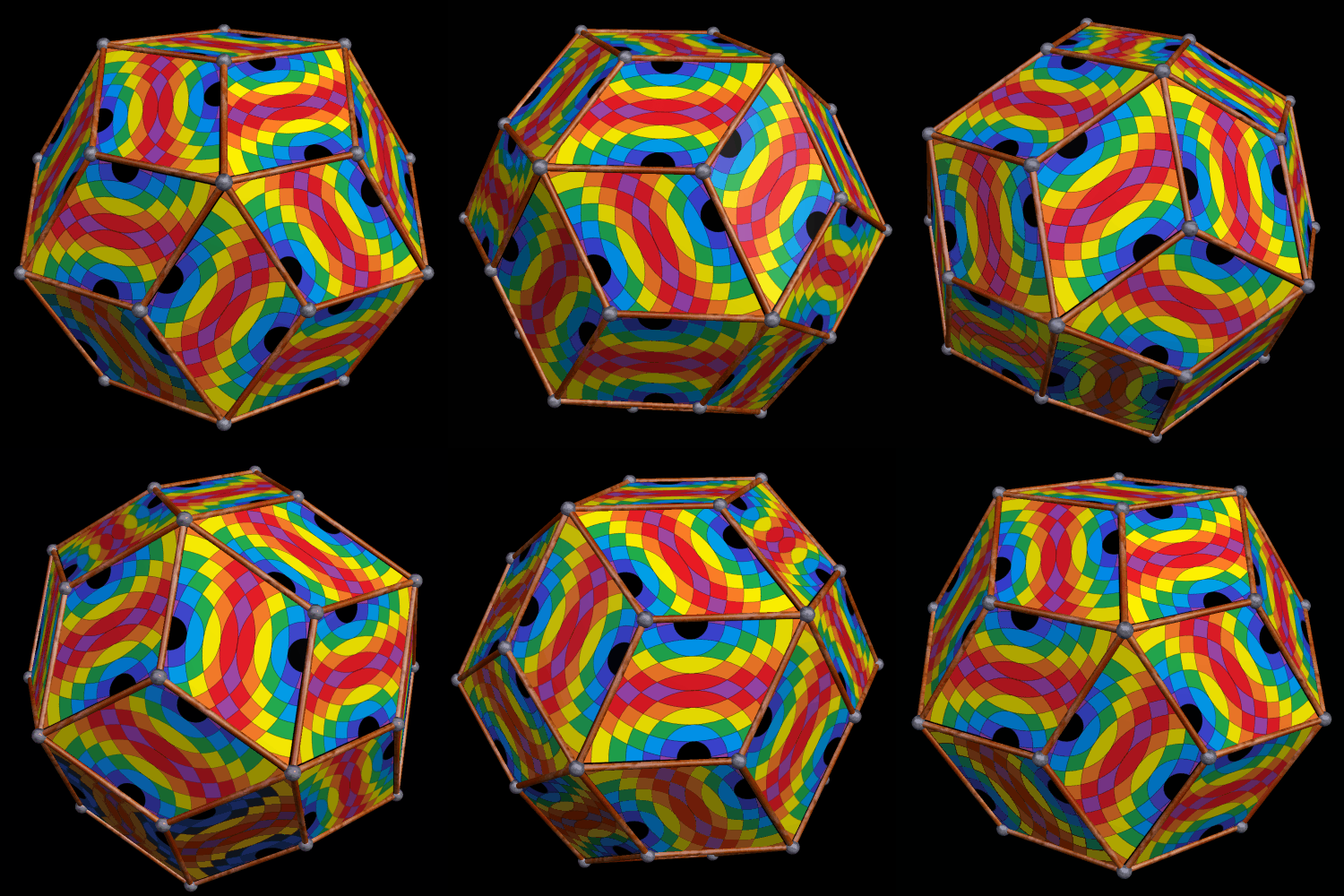
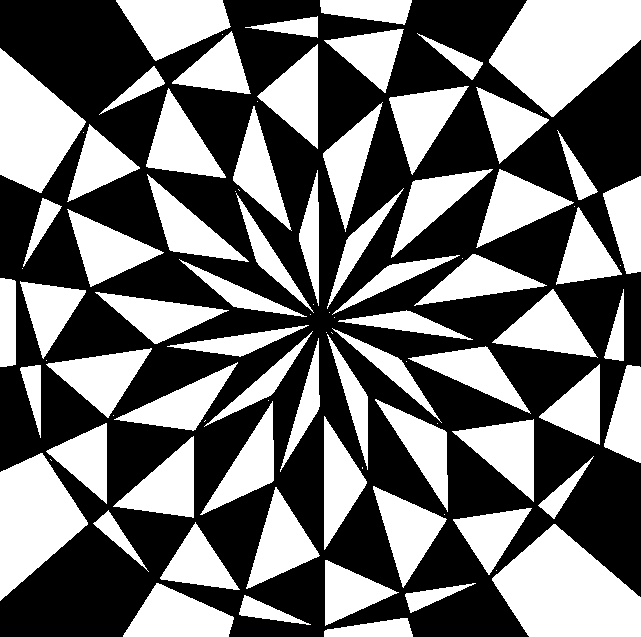
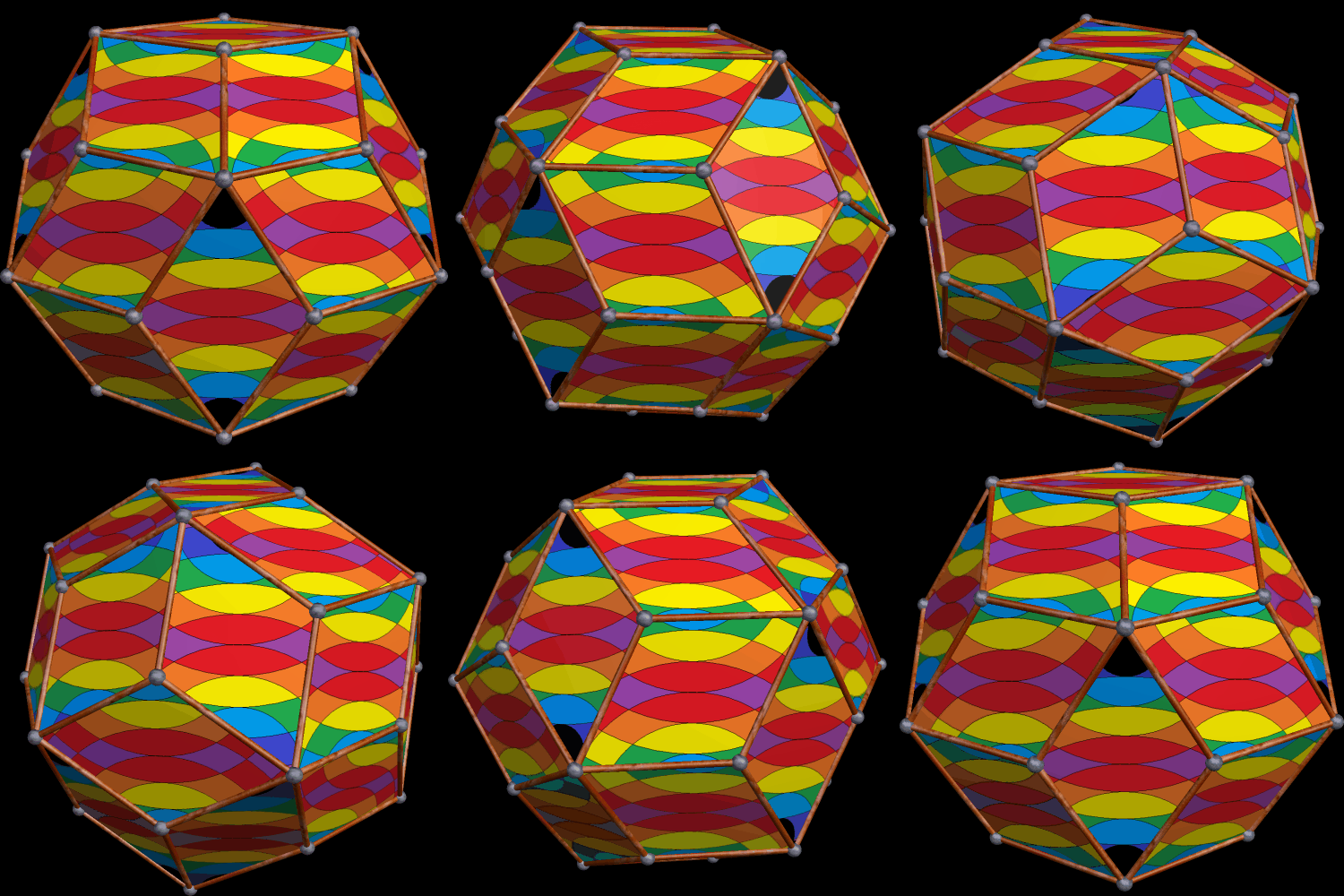
It took three programs to make this. First, outlines of the “double rainbow” patterns on each face were constructed using Geometer’s Sketchpad. A screenshot from that program was then pasted into MS-Paint, which was used to add color to the outline of the pattern on each face. Next, the colorized image was projected onto each face of a rhombic triacontahedron, using Stella 4d: Polyhedron Navigator — the program that put this all together, and what I used to generate the rotating .gif above. Stella is available at http://www.software3d.com/Stella.php, with a free trial download available.
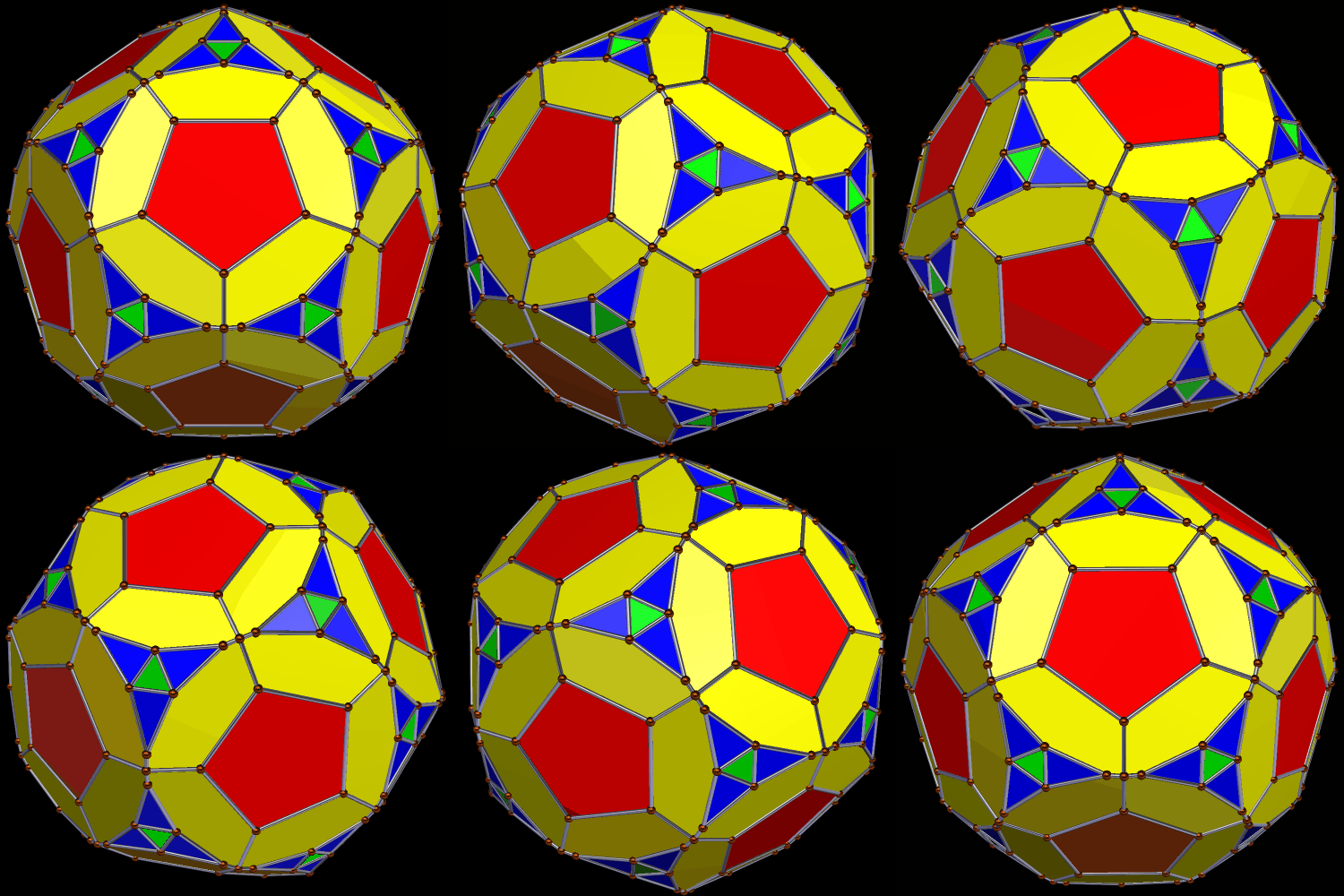
Interestingly, while this polyhedron itself is not chiral, the coloring-pattern of it, shown above, is.
With only small modifications, Stella can produce a very different version:
Which one do you like better?
 RobertLovesPi.net