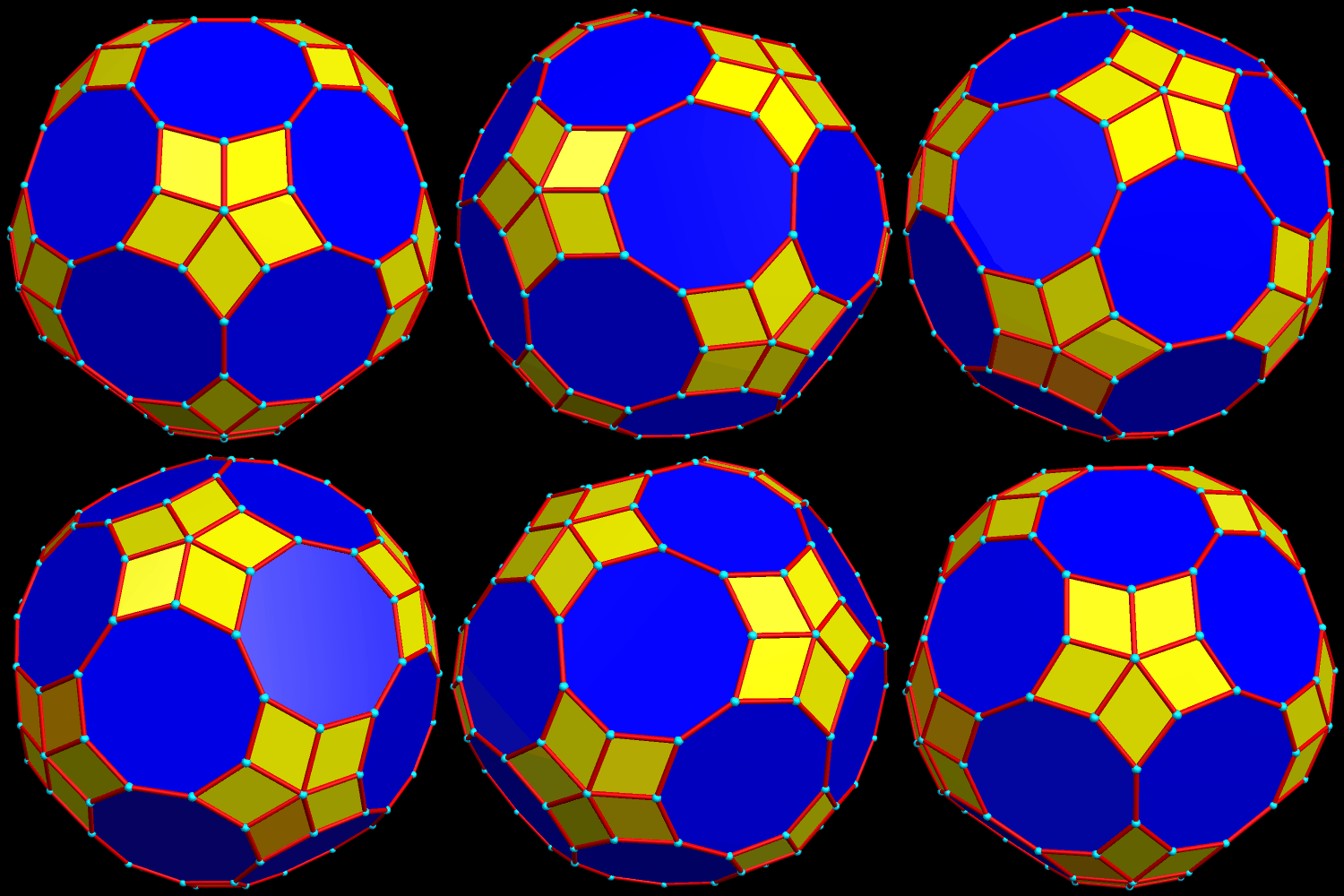
Compound of the Rhombic Triacontahedron and a Truncated Icosahedron

Image

Compound of the Rhombic Triacontahedron and a Truncated Icosahedron

I stumbled across this while manipulating polyhedra with Stella 4d, which you can try for free at http://www.software3d.com/stella.php.

The title describes the blue and yellow figure as “a” truncated icosahedron, rather than “the” truncated icosahedron, because of the slight irregularity of the hexagonal faces, a result of the truncation-planes being slightly closer to the center than is the case for the true Archimedean solid. It should be possible to fix this, but that may be beyond my abilities.

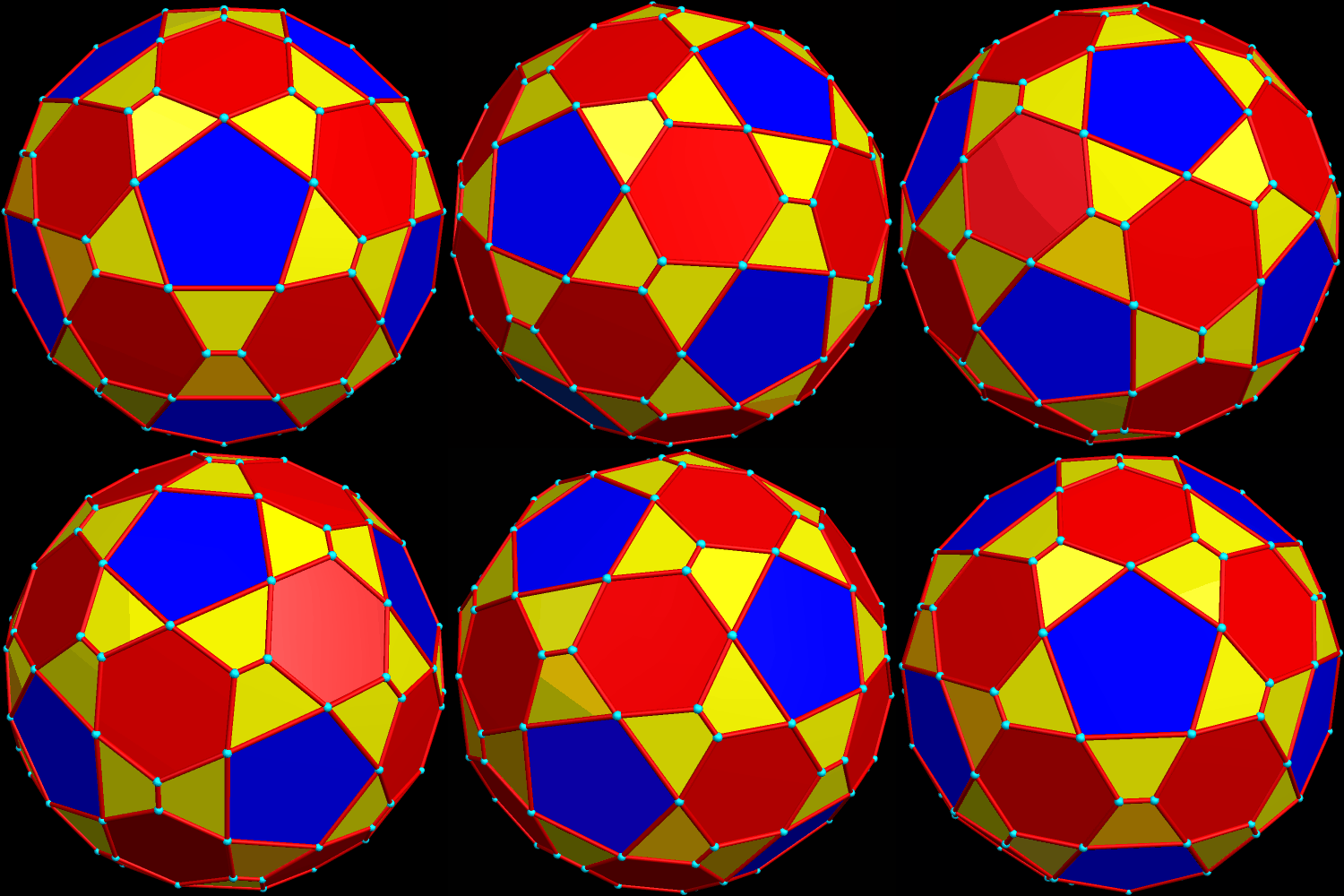
Sixty Irregular Pentagons in a Regular Pattern

Image

Sixty Irregular Pentagon in a Regular Pattern

Another accidental discovery made while manipulating polyhedra with Stella 4d, which you can try for free at http://www.software3d.com/stella.php.

Polyhedron Featuring Nonagons and Rhombi

Image

Polyhedron Featuring Nonagons and Rhombi

I stumbled across this while manipulating polyhedra with Stella 4d, which you can try for free at http://www.software3d.com/stella.php.

I don’t think the nonagons are quite regular, and the yellow figures may be near-rhomboidal kites, rather than true rhombi. Nevertheless, I find it an interesting figure, and am posting it here so I can find it for further investigations later.

A “Bowtie” Variant of the Truncated Icosahedron

Image

This has the twelve regular pentagons and twenty regular hexagons of a truncated icosahedron (most familiar to the world as the shape upon which most soccer balls are based), but also has pairs of trapezoids in “bowtie” configurations. I discovered this polyhedron using Stella 4d, which you can try for free at http://www.software3d.com/stella.php.

The 27-63-90 Triangle

Image

The 27-63-90 Triangle

I’m not as pleased about finding this special right triangle as I was with the previous ones. For one thing, I didn’t use a regular polygon to derive it, but instead used the 36-54-90 triangle I had previously found, and applied a half-angle trigonometric identity to find the tangent of 27 degrees, as the tangent of half of 54 degrees. According to this identity, tan(27⁰) = (1 – cos(54⁰))/sin(54⁰). Once this gave me the leg lengths, I simply used the Pythagorean Theorem to determine the length of the hypotenuse. Finally, I checked all of this using decimal approximations.

The triple-nested radical in the expression for the hypotenuse is no cause for celebration, either. If anyone knows of a way to put this in simpler exact terms, please let me know.

The 15-75-90 Triangle

Image

The 15-75-90 Triangle

As the 30-60-90 triangle is based on an equilateral triangle, the 45-45-90 triangle is based on a square, the 18-72-90 and 36-54-90 triangles are based on the regular pentagon (see https://robertlovespi.wordpress.com/2013/03/12/the-18-72-90-and-36-54-90-triangles/), and the 22.5-67.5-90 triangle is based on the regular octagon (see previous post), so the 15-75-90 triangle is based on the regular dodecagon, shown here with three radii (red) and a single diagonal (purple). The 15-75-90 triangle is shown in yellow. An argument from symmetry is sufficient to show that angle EFC is the right triangle in this triangle, and the larger of its two acute angles (angle FCE) is one-half of an interior angle of this dodecagon. The interior angle of a regular decagon measures 150 degrees (the proof of this is trivial), and so angle FCE must measure half that amount, or 75 degrees. This leaves 15 degrees for angle CEF, via the triangle sum theorem.

What about the side lengths of the 15-75-90 triangle, though? First, consider the red diagonals shown, and let them each have a length of 2. Angles DAF and FAE each measure 30 degrees, since 360/12 = 30, and they are central angles between adjacent radii. This makes angle DAE 60 degrees by angle addition, and triangle DAE is known to be isosceles, since the two red sides are radii of the same regular dodecagon, and therefore are congruent. By the isosceles triangle theorem and triangle sum theorem, then, angles ADE and AED each also measure (180-60)/2 = 60 degrees, so triangle ADE is therefore equilateral, with the purple side, DE, also having a length of two. Symmetry is sufficient to see that DE is bisected by radius AC, which leads to the conclusion that EF, the long leg of the 15-75-90 triangle, has a length of 1.

Segment AF is a median, and therefore also an altitude, of equilateral triangle ADE, and splits it into two 30-60-90 triangles, one of which is triangle AEF. Its hypotenuse, AE, is already known to have a length of 2, while its short leg, EF, is already known to have a length of 1. Segment AF is therefore the long leg of this 30-60-90 triangle, with a length of √3.

AF, length √3, and FC, the short leg of the 15-75-90 triangle, together form dodecagon radius AC, already set at length 2. By length subtraction, then, FC, the 15-75-90 triangle’s short leg, has a length of 2 – √3. A test is prudent at this point, by taking the tangent of the 15 degree angle FEC in the yellow triangle. Tan(15 degrees) is equal to 0.26794919…, which is also the decimal approximation for FC/EF, or (2 – √3)/1.

All that remains to know the length ratios for the sides of the 15-75-90 triangle is to determine the length of EC, its hypotenuse, via the Pythagorean Theorem. The square of length EC must equal the square of 1 plus the square of (2 – √3), so EC, squared, equals 1 + 4 – 4√3 + 3, or 8 – 4√3. The hypotenuse (EC) must therefore be the square root of 8 – 4√3, which is √(8-4√3)) = 2√(2-√3)).

The short leg:long leg:hypotenuse ratio in a 15-75-90 triangle is, therefore, (2-√3):1:2√(2-√3)).

A Proof

Image

A Proof

I ran into a problem at a meeting of teachers, yesterday, which exposed an embarrassing hole in my geometrical knowledge — and so I quickly became obsessed with filling it. In the diagram, the large triangle is right, and the leg lengths were given; the problem was to find the length of the hypotenuse (also the diameter of the circle centered at B). The median seen here was not shown, however, and no right angle was identified. Were the triangle not a right triangle, this would be an impossible problem, so I knew it had to be a right triangle . . . but that didn’t satisfy me. I had to have a proof, so I wrote one.

Here it is: in the diagram shown, segment AC is a diameter of a circle with center B, while D is any point on the triangle distinct from A and C. Segments BA, BD, and BC are all radii of the same circle, and therefore have the same length, making triangles ABD and CBD isosceles with bases, respectively, of AD and CD.

Let the measure of angle ABD be some number x. Since it forms a linear pair with angle CBD, angle CBD’s measure must be 180 – x.

Angles BAD and BDA are the base angles of isosceles triangle ABD, which has a vertex angle measure already chosen as x. Since these base angles must be congruent, it follows from the triangle sum theorem that each of these angles must measure (180 – x)/2.

Angles BCD and BDC are the base angles of isosceles triangle CBD, which has a vertex angle measure already determines to be 180 – x. Since these base angles must be congruent, it follows from the triangle sum theorem that each of these angles must measure (180 – (180 – x))/2.

By the angle sum theorem, the measure of angle ADC must equal the sum of the measures of angles BDC and BDA, already shown, respectively, to be (180 – (180 – x))/2 and (180 – x)/2.

Angle ADC’s measure therefore equals (180 – (180 – x))/2 + (180 – x)/2, which simplifies to (180 – 180 + x)/2 + (180 – x)/2, which further simplifies to x/2 + (180 – x)/2. Adding these two fractions yields the sum (x + 180 – x)/2, and then the “x”s cancel, leaving only 180/2, or 90 degrees, for the measure of angle ADC. Therefore. triangle ADC, the large triangle in the diagram, must be a right triangle — QED.

I’m rather embarrassed that I didn’t already know this property of inscribed triangles with one side being the diameter of the triangle’s circumscribed circle — but at least I figured the proof out myself, and that, in turn, made the faculty meeting easily the least boring one I have ever attended.

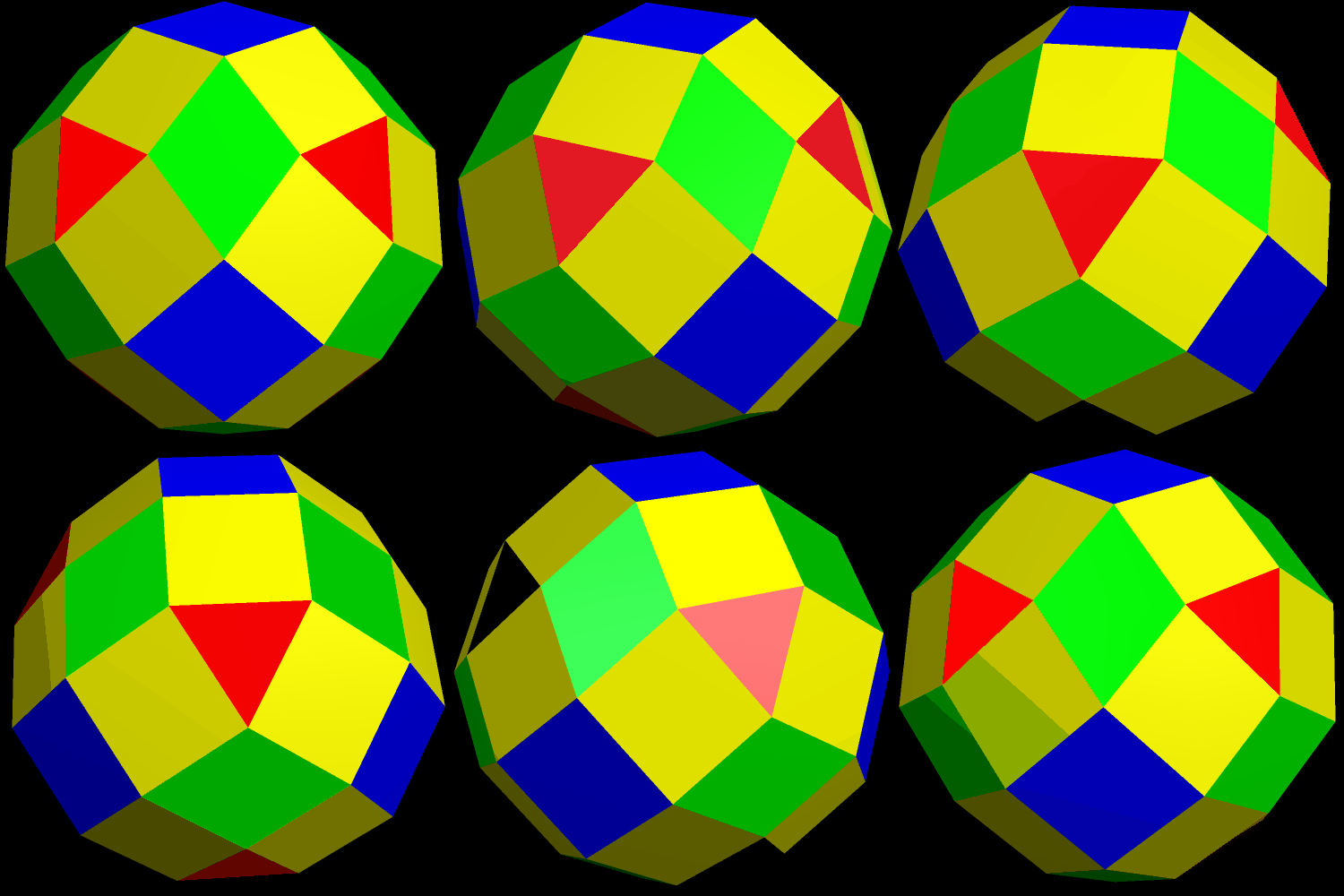
An Intermediate Form Between the Cuboctahedron and Its Dual, the Rhombic Dodecahedron

Image

An Intermediate Form Between the Cuboctahedron and Its Dual, the Rhombic Dodecahedron

There are many ways to make intermediate forms between dual polyhedra. This was made using the expansion method. The faces of the cuboctahedron (red and blue) were moved outward, as were the green faces of the rhombic dodecahedron, until the meeting of all possible vertices. The yellow rectangles were the spaces created between faces by this expansion.

(Software credit: see http://www.software3d.com/stella.php)

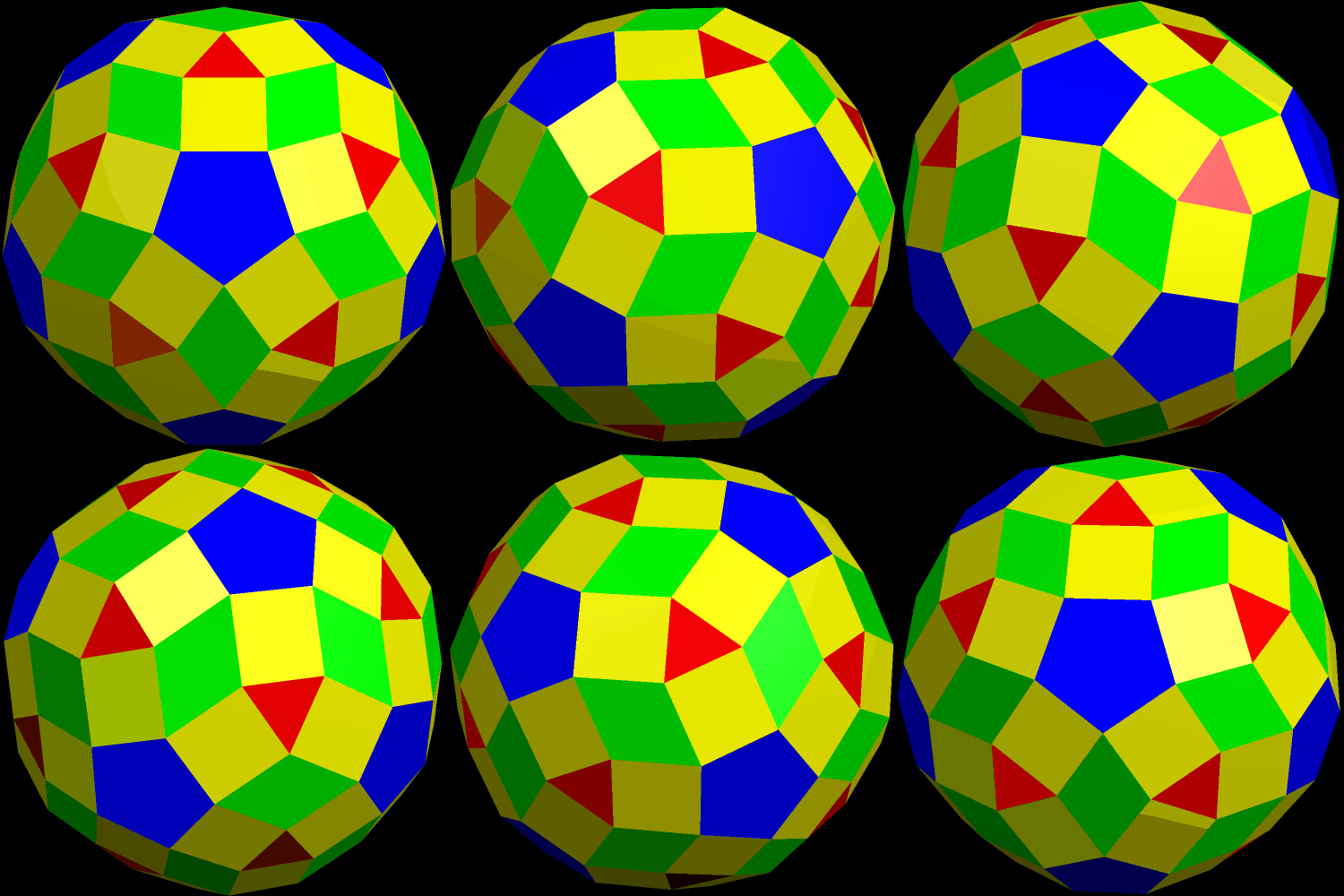
An Intermediate Form Between the Icosidodecahedron and Its Dual, the Rhombic Triacontahedron

Image

An Intermediate Form Between the Icosidodecahedron and Its Dual, the Rhombic Triacontahedron

There are many ways to make intermediate forms between dual polyhedra. This was made using the expansion method. The faces of the icosidodecahedron (red and blue) were moved outward, as were the green faces of the rhombic triacontahedron, until the meeting of all possible vertices. The yellow rectangles were the spaces created between faces by this expansion.

(Software credit: see http://www.software3d.com/stella.php)

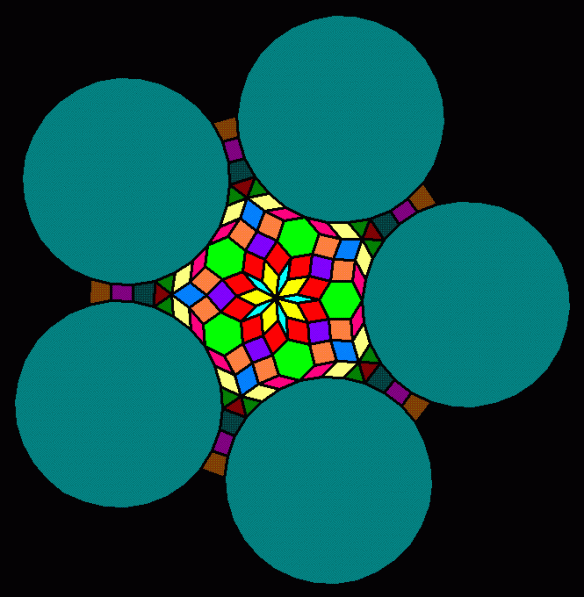
Five Times Six Is Thirty

Image

Five Times Six Is Thirty

Those big round things aren’t circles. They are regular thirty-sided polygons, or triacontagons.