Is the Moon a Magnet for Ignorance?

is the moon

Google’s search-suggestions for “is the moon,” shown above, clearly indicate support for the “magnet for ignorance” conjecture.

My favorite one from this list: “is the moon real”? I’ve looked into this, and there are apparently quite a few people utterly convinced that the Moon is a hologram, created by NASA, for reasons I have not been able to discern.

On Binary Planets, and Binary Polyhedra

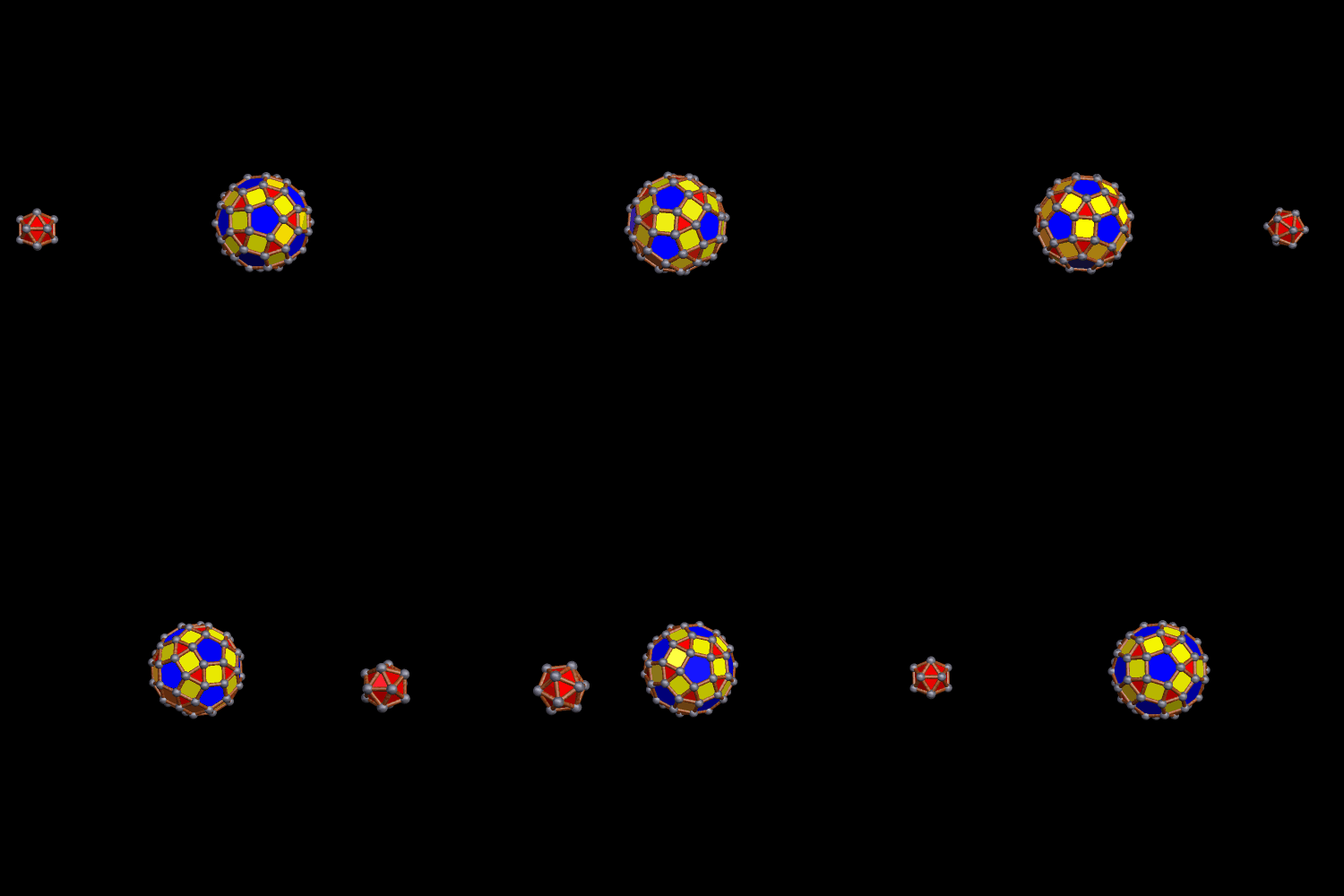
Faceted Augmented Icosa

This image of binary polyhedra of unequal size was, obviously, inspired by the double dwarf planet at the center of the Pluto / Charon system. The outer satellites also orbit Pluto and Charon’s common center of mass, or barycenter, which lies above Pluto’s surface. In the similar case of the Earth / Moon system, the barycenter stays within the interior of the larger body, the Earth.

I know of one other quasi-binary system in this solar system which involves a barycenter outside the larger body, but it isn’t one many would expect: it’s the Sun / Jupiter system. Both orbit their barycenter (or that of the whole solar system, more properly, but they are pretty much in the same place), Jupiter doing so at an average orbital radius of 5.2 AU — and the Sun doing so, staying opposite Jupiter, with an orbital radius which is slightly larger than the visible Sun itself. The Sun, therefore, orbits a point outside itself which is the gravitational center of the entire solar system.

Why don’t we notice this “wobble” in the Sun’s motion? Well, orbiting binary objects orbit their barycenters with equal orbital periods, as seen in the image above, where the orbital period of both the large, tightly-orbiting rhombicosidodecahedron, and the small, large-orbit icosahedron, is precisely eight seconds. In the case of the Sun / Jupiter system, the sun completes one complete Jupiter-induced wobble, in a tight ellipse, with their barycenter at one focus, but with an orbital period of one jovian year, which is just under twelve Earth years. If the Jovian-induced solar wobble were faster, it would be much more noticeable.

[Image credit: the picture of the orbiting polyhedra above was made with software called Stella 4d, available at this website.]

How to Distinguish Between the Waxing and Waning Moon, At a Glance

DC

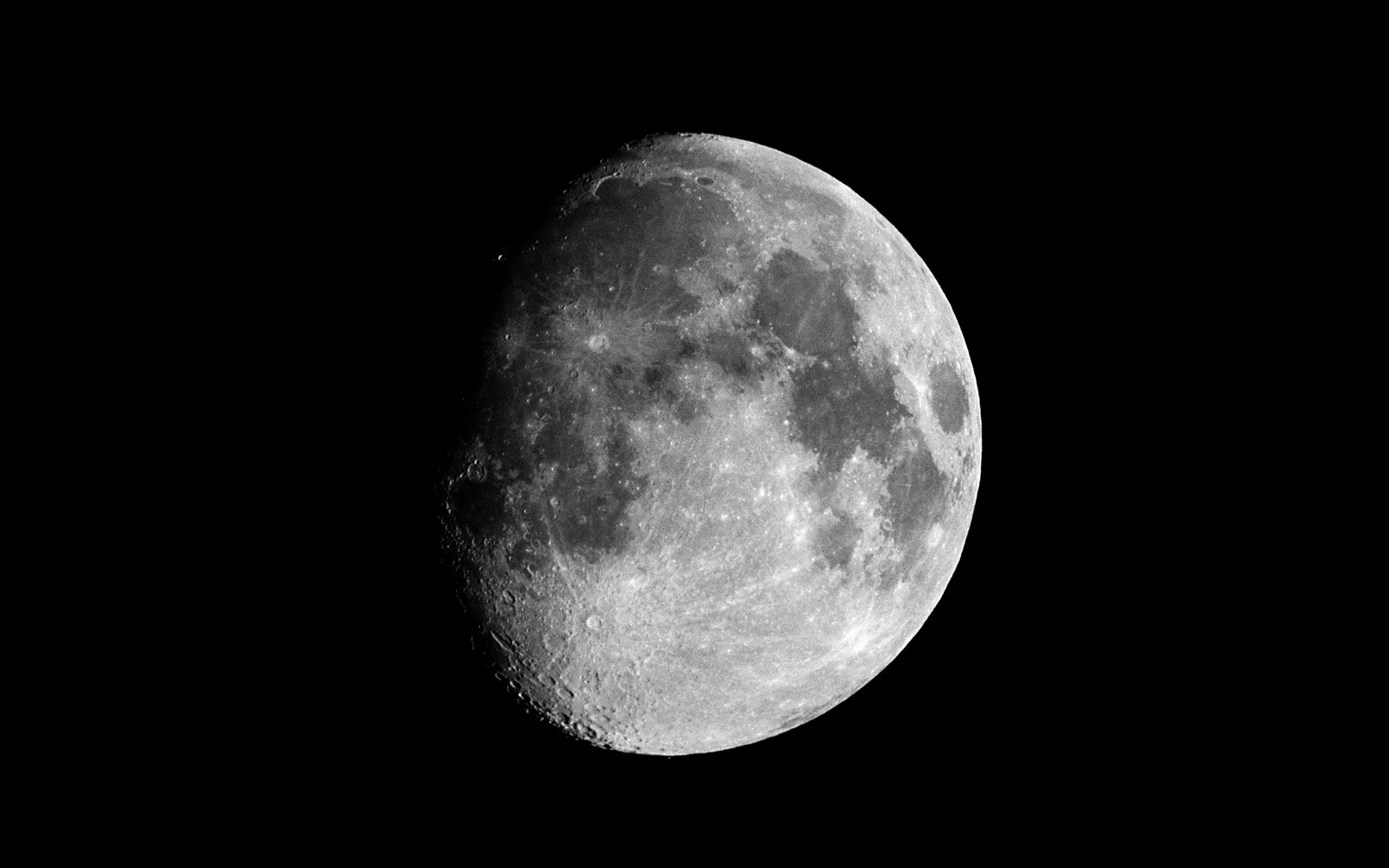
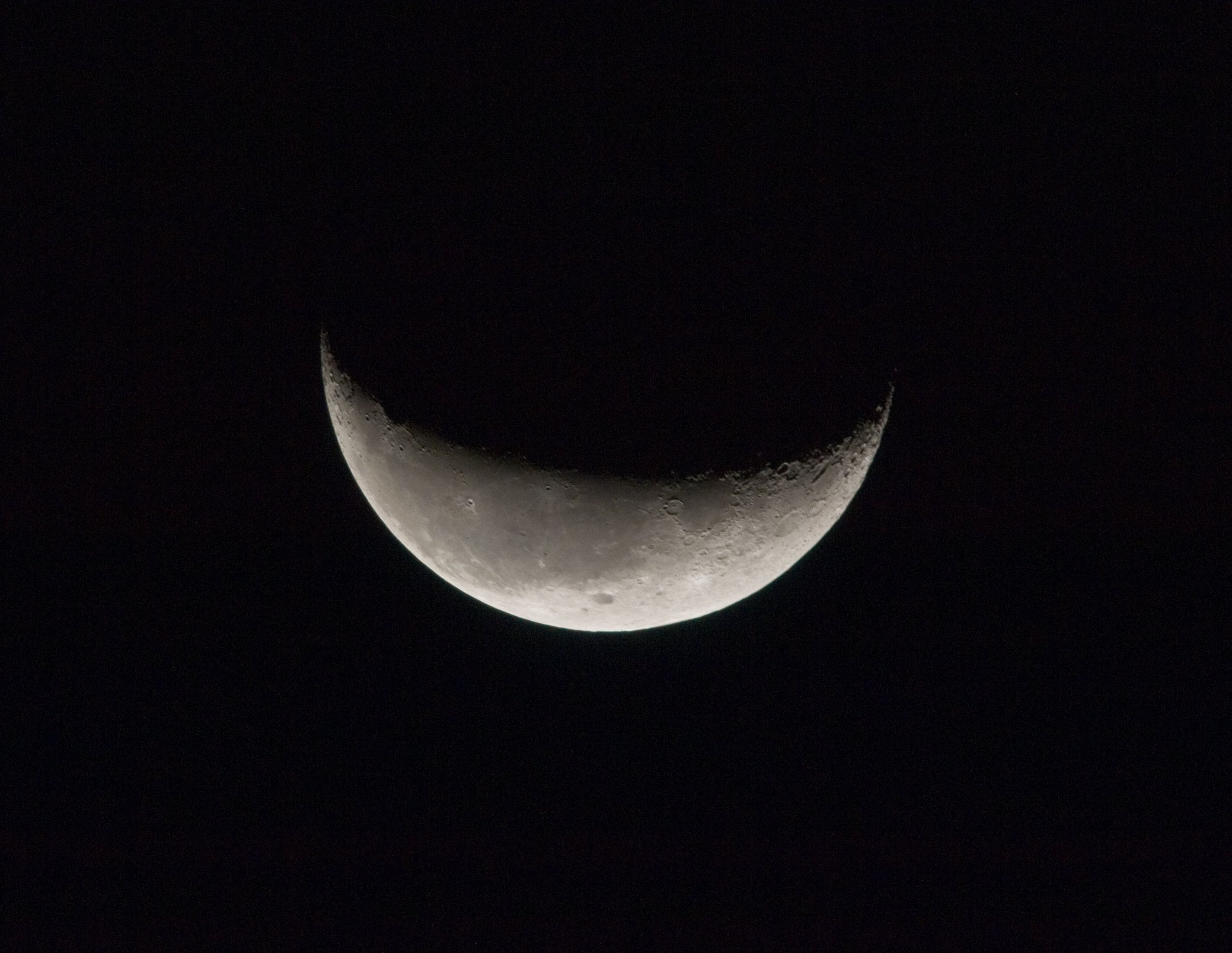
This is a waxing moon, meaning the sunlit portion we can see is growing. The outer curve also makes this view of the moon shaped more like the letter “D,” compared to the letter “C.” For the useful mnemonic here, remember that “D” stands for “developing.” D-shaped moons are in the waxing part of their cycle of phases, growing larger for about two weeks.

DGLater in the waxing portion of the moon’s cycle of phases, it becomes a gibbous moon — but retains its “D-like” shape. It is still slowly getting larger, approaching the full moon state.

CG

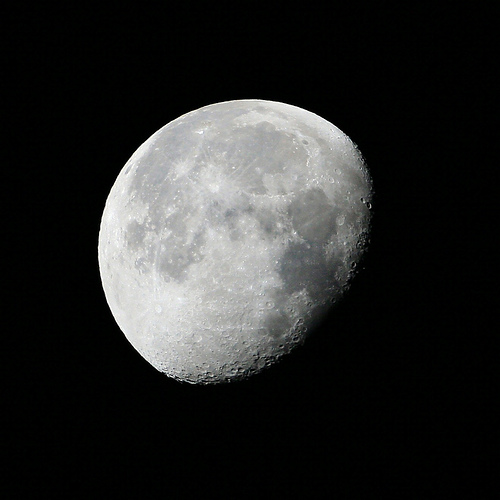
Here is another gibbous moon, but it is shaped more like the letter “C” than the letter “D,” and, in this mnemonic, “C” stands for “concluding.” This moon’s sunlit portion is shrinking, moving away from fullness, towards the new moon state — in other words, it is a waning moon. All “C-shaped” moons, as viewed from Earth’s Northern hemisphere, are waning moons.

CC

This crescent moon more closely resembles a “C” than a “D,” which is how I know, at a glance, that its phase cycle is concluding, and it is a waning crescent, soon to become invisible as a new moon.

AC

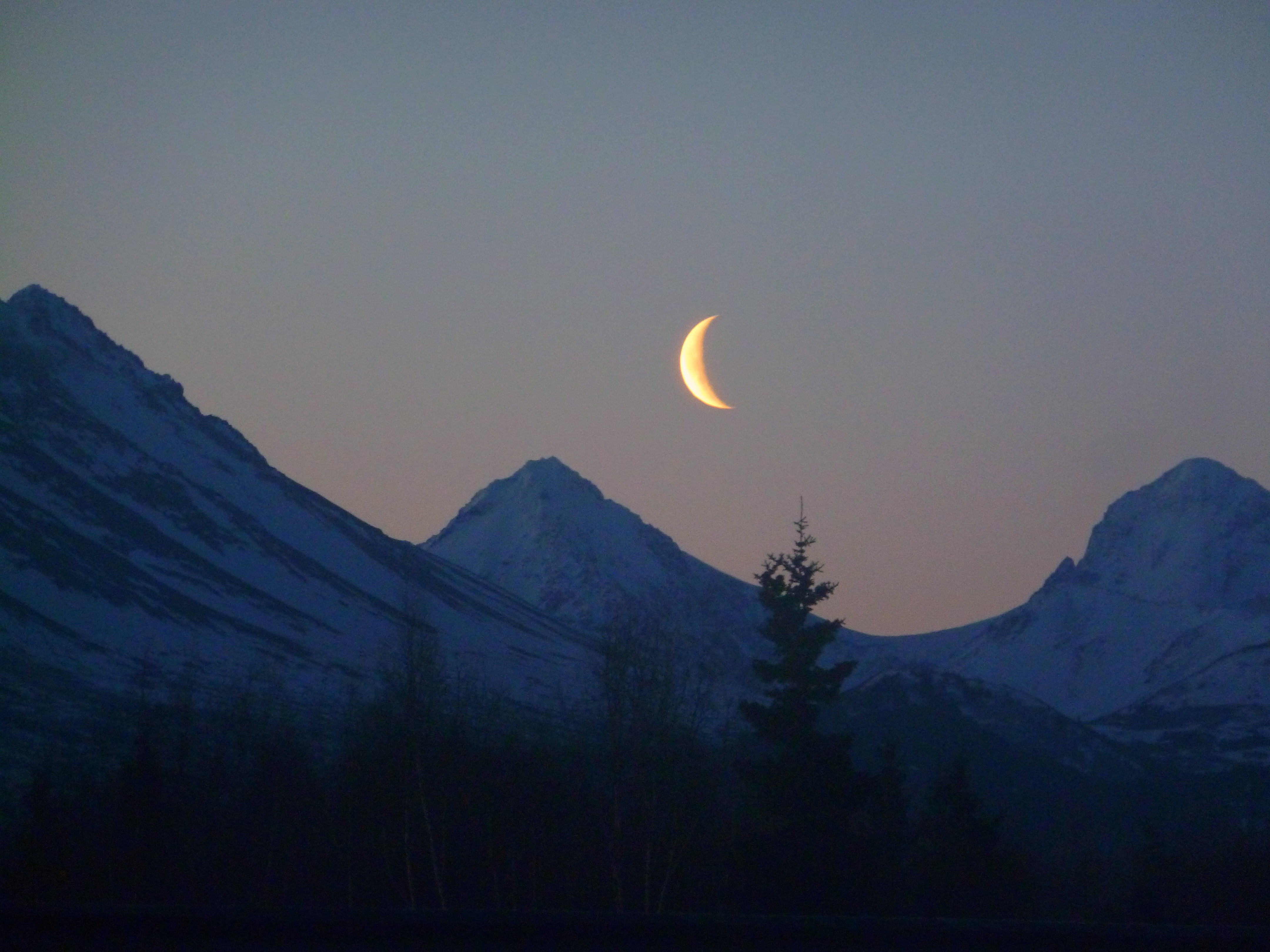
This last picture shows the most difficult configuration to figure out:  the points of the crescent near the moon’s North and South poles both point up. Having them both point down would pose the same problem. Here’s the solution, though:  check to see which crescent-tip appears higher in the sky. In this case, it is the one on the left. That shifts the curve at the bottom of the moon (the one that is an actual moon-edge, rather than the terminator) slightly left-of-center, making the visible moon-edge more closely resemble a “C” than a “D.” This crescent moon, therefore, is a waning crescent.

Later addition:  as a commenter pointed out, below, this method does not work from Earth’s Southern hemisphere — in fact, in that half of the world, the “D”/”C” rule must be completely reversed, in order to work. To accomplish this, “D” could stand for “diminishing,” and “C” could stand for “commencing,” instead.

[Image/copyright note:  I did not take these photographs of the moon. They were found with a Google-search, and I chose images with no apparent signs of copyright. I am assuming, on that basis, that these images are not copyrighted — but, if I am wrong, I will replace them with other images, upon request.]

Craters and Slopes Near the South Pole of the Moon Adorn the Faces of a Rhombic Enneacontahedron

Zonohedrified Dodeca

The images on the faces of this polyhedron are based on information sent from NASA’s Lunar Reconnaisance Orbiter, as seen at http://lunar.gsfc.nasa.gov/lola/feature-20110705.html and tweeted by @LRO_NASA, which has been happily tweeting about its fifth anniversary in a polar lunar orbit recently. I have no idea whether this is actually an A.I. onboard the LRO, or simply someone at NASA getting paid to have fun on Twitter.

To get these images from near the Lunar South Pole onto the faces of a rhombic enneacontahedron, and then create this rotating image, I used Stella 4d:  Polyhedron Navigator. There is no better tool available for polyhedral research. To check this program out for yourself, simply visit www.software3d.com/Stella.php.

Surface Gravitational Field Strengths for Numerous Solar System Objects

It isn’t difficult to find rankings for the most massive objects in the solar system, rankings of objects in terms of increasing distance from the sun, or rankings of objects by radius. However, ranking objects by surface gravitational field strength is another matter, and is more complicated, for it is affected by both the mass and radius of the object in question, but in different ways. If two objects have different masses, but the same radius, the gravitational field strength will be greater for the more massive object. However, increasing the radius of an object decreases its surface gravitational field strength, in an inverse-square relationship.

Gravitational field strength is measured in N/kg, which are equivalent to m/s², the units for acceleration. The terms “gravitational field strength” and “acceleration due to gravity,” both of which are symbolized “g,” are actually synonymous. I prefer “gravitational field strength” because referring to acceleration, when discussing the weight of a stationary object on the surface of a planet, can cause confusion.

Use of the numbers given below is easy:  given the mass of a thing (an imaginary astronaut, for example), in kilograms, simply multiply this figure by the given gravitational field strength, and you’ll have the weight of the thing, in newtons, on the surface of that planet (or other solar system object).  If, for some odd reason, you want the weight in the popular non-metric unit known as the “pound,” simply divide the weight (in newtons) by 4.45, and then change the units to pounds.

How is surface gravitational field strength determined? To explain that, a diagram is helpful.

gravity

The large green circle represents a planet, or some other solar system object, and the blue thing on its surface, which I’ll call object x, can be pretty much anything on the solar system object’s surface. There are two formulas for Fg, the force of gravity pulling the planet and the thing on its surface toward each other. One is simply Fg= mxg, a form of Newton’s Second Law of Motion, where “g” is the gravitational field strength, and mx is the mass of the object at the surface. The other formula is more complicated:  Fg= (Gmxmp)/r².  This is Newton’s Law of Universal Gravitation, where “G” (not to be confused with “g”) is the universal gravitational constant, 6.67259 x 10⁻¹¹ Nm²/kg², and mp and r are the mass and radius of the planet (or other solar system object). Because they each equal Fg, the expressions mxg and (Gmxmp)/r² can be set equal to each other, yielding the equation mxg = (Gmxmp)/r², which becomes g = (Gmp)/r² after mis cancelled. The mass of the object on the surface is not needed — “g” is simply a function of mp and r.

There is a problem, however, with the idea of “surface” gravitational field strength — and that is the fact that the five largest objects in the solar system, the sun and the gas giants, all lack visible solid surfaces. One cannot stand on Jupiter — if you tried, you’d simply fall inside the planet. Therefore, for Jupiter, picture a solid platform floating at the top of the visible clouds there, and place the test object on this solid platform. Under those conditions, multiplying the test object’s mass by the Jovian value of “g” will, indeed, yield the weight of the object there, as it could be measured by placing it on a bathroom scale, at rest on the floating platform. For the other gas giants, as well as the sun, the idea is the same.

The objects included in the list below are the sun, all eight major planets, all dwarf planets (and dwarf planet candidates) with known values of “g,” all major satellites, some minor satellites, and a few of the largest asteroids. Many more objects exist, of course, but most have values for “g” which are not yet known.

Here are the top five:

Sun/Sol,      274.0 N/kg

Jupiter,          24.79 N/kg

Neptune,       11.15 N/kg

Saturn,          10.44 N/kg

Earth/Terra,    9.806 65 N/kg

The top five, alone, make me glad I undertook this project, for I did not realize, before doing this, that our planet has the highest surface gravitational field strength of any object in the solar system with a visible solid surface.

The next five include the rest of the major planets, plus one Jovian moon.

Venus,    8.87 N/kg

Uranus,   8.69 N/kg

Mars,      3.711 N/kg

Mercury, 3.7 N/kg

Io,           1.796 N/kg

The third set of five are all planetary moons, starting with earth’s own moon. The others are Jovian moons, except for Titan, which orbits Saturn.

Moon/Luna, 1.622 N/kg

Ganymede,  1.428 N/kg

Titan,           1.352 N/kg

Europa,        1.314 N/kg

Callisto,        1.235 N/kg

The fourth set of five begins with the largest dwarf planet, Eris, and includes two other dwarf planets as well.

Eris,        0.827 N/kg           (dwarf planet)

Triton,     0.779 N/kg          (Neptune’s largest moon)

Pluto,      0.658 N/kg           (dwarf planet)

Haumea, 0.63 N/kg             (dwarf planet)

Titania,   0.38 N/kg             (largest moon of Uranus)

The fifth set of five includes the remaining dwarf planets with known values of “g.”

Oberon,          0.348 N/kg   (moon of Uranus)

1 Ceres,         0.28 N/kg       (dually classfied:  dwarf planet and largest asteroid)

Charon,          0.278 N/kg    (largest moon of Pluto)

Ariel,               0.27 N/kg      (moon of Uranus)

90482 Orcus, 0.27 N/kg      (probable dwarf planet)

The sixth set of five are dominated by Saturnian moons.

Rhea,          0.265 N/kg         (Saturnian moon)

4 Vesta,      0.25 N/kg           (2nd largest asteroid)

Dione,         0.233 N/kg        (Saturnian moon)

Iapetus,     0.224 N/kg         (Saturnian moon)

Umbriel,    0.2 N/kg             (moon of Uranus)

The seventh set of five are mostly asteroids.

704 Interamnia,  0.186 N/kg          (5th most massive asteroid)

2 Pallas,                0.18 N/kg            (3rd most massive asteroid)

Tethys,                 0.147 N/kg          (Saturnian moon)

52 Europa,           0.14 N/kg            (7th most massive asteroid)

3 Juno,                 0.12 N/kg            (large asteroid, w/~1% of mass of the asteroid belt)

Starting with the eighth group of five, I have much less certainty that something may have been omitted, although I did try to be thorough. My guess is that most future revisions of this list will be necessitated by the discovery of additional dwarf planets. Dwarf planets are hard to find, and there may be hundreds of them awaiting discovery.

Enceladus,    0.114 N/kg          (Saturnian moon)

Vanth,           0.11 N/kg             (moon of probable dwarf planet 90482 Orcus)

10 Hygiea,    0.091 N/kg          (4th most massive asteroid)

15 Eunomia, 0.08 N/kg            (large asteroid, with ~1% of mass of asteroid belt)

Miranda,       0.079 N/kg          (moon of Uranus)

Here is the ninth group of five:

Nereid,      0.072 N/kg  (Neptunian moon; irregular in shape)

Proteus,    0.07 N/kg    (Neptunian moon; irregular in shape)

Mimas,      0.064 N/kg  (Saturnian moon / smallest gravitationally-rounded object in                                                                                the solar system)

Puck,         0.028 N/kg  (6th largest moon of Uranus)

Amalthea, 0.020 N/kg  (5th largest Jovian moon)

Finally, here are “g” values for the two tiny moons of Mars, included because they are nearby, and are the only moons Mars has to offer. A more exhaustive search would reveal many asteroids and minor satellites with “g” values greater than either Martian moon, but smaller than Amalthea, the last solar system object shown in the last set of five.

Phobos, 0.0057 N/kg

Deimos, 0.003 N/kg

The Galilean Moons of Jupiter on a Rotating Dodecahedron

Image

The Galilean Moons of Jupiter On a Rotating Dodecahedron

Software credit: see http://www.software3d.com/stella.php

Moonrise

Image

Moonrise

Sol, Terra, and Luna On a Rhombicosidodecahedron

Image

Sol, Terra, and Luna On a Rhombicosidodecahedron

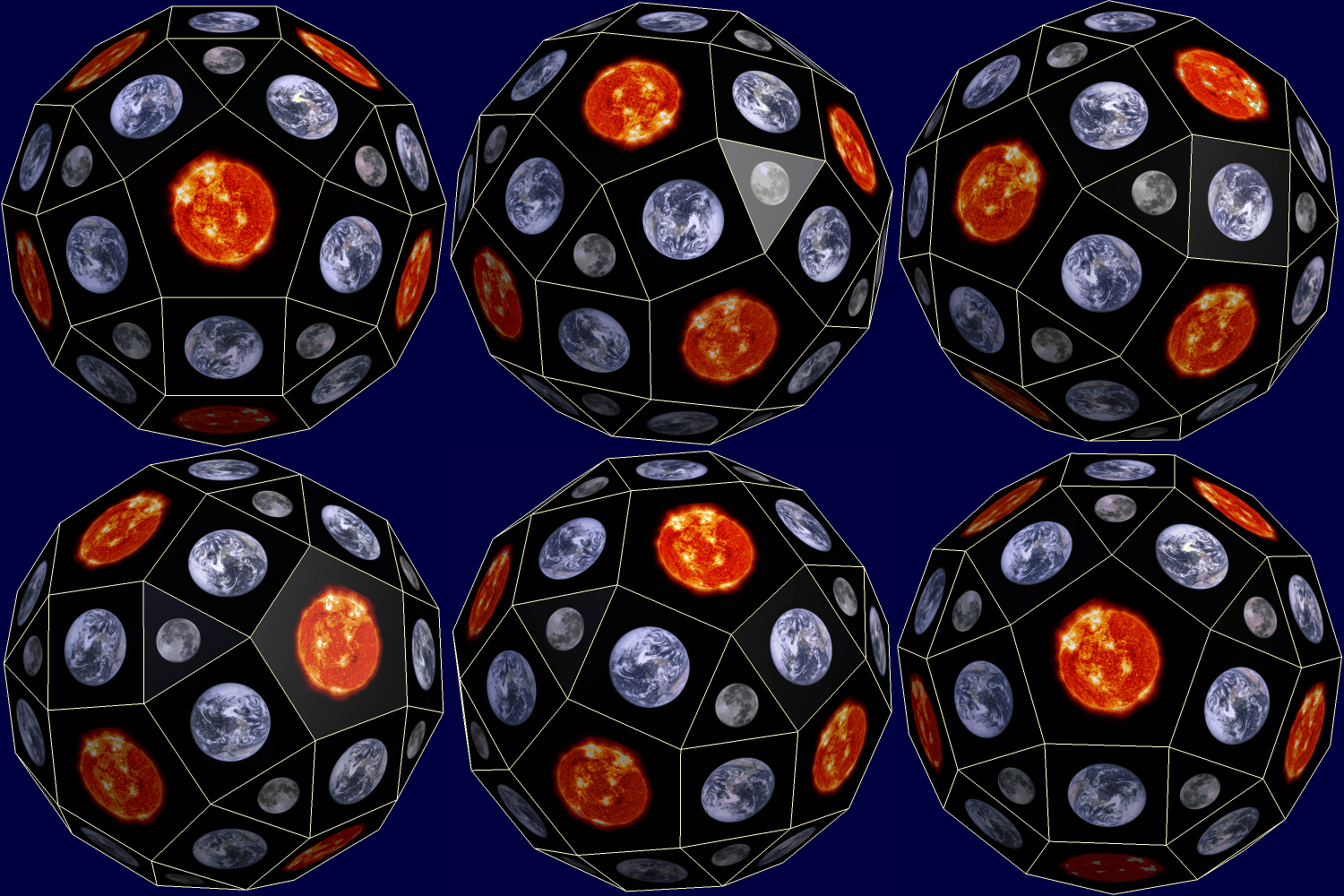
Projecting images on the sun, earth, and moon onto the faces of a rhombicosidodecahedron was accomplished with Stella 4d, software you may try for free at http://www.software3d.com/Stella.php.

Two Saturnian Moons Adorning a Rhombic Dodecahedron

Image

Two Saturnian Moons Adorning a Rhombic Dodecahedron

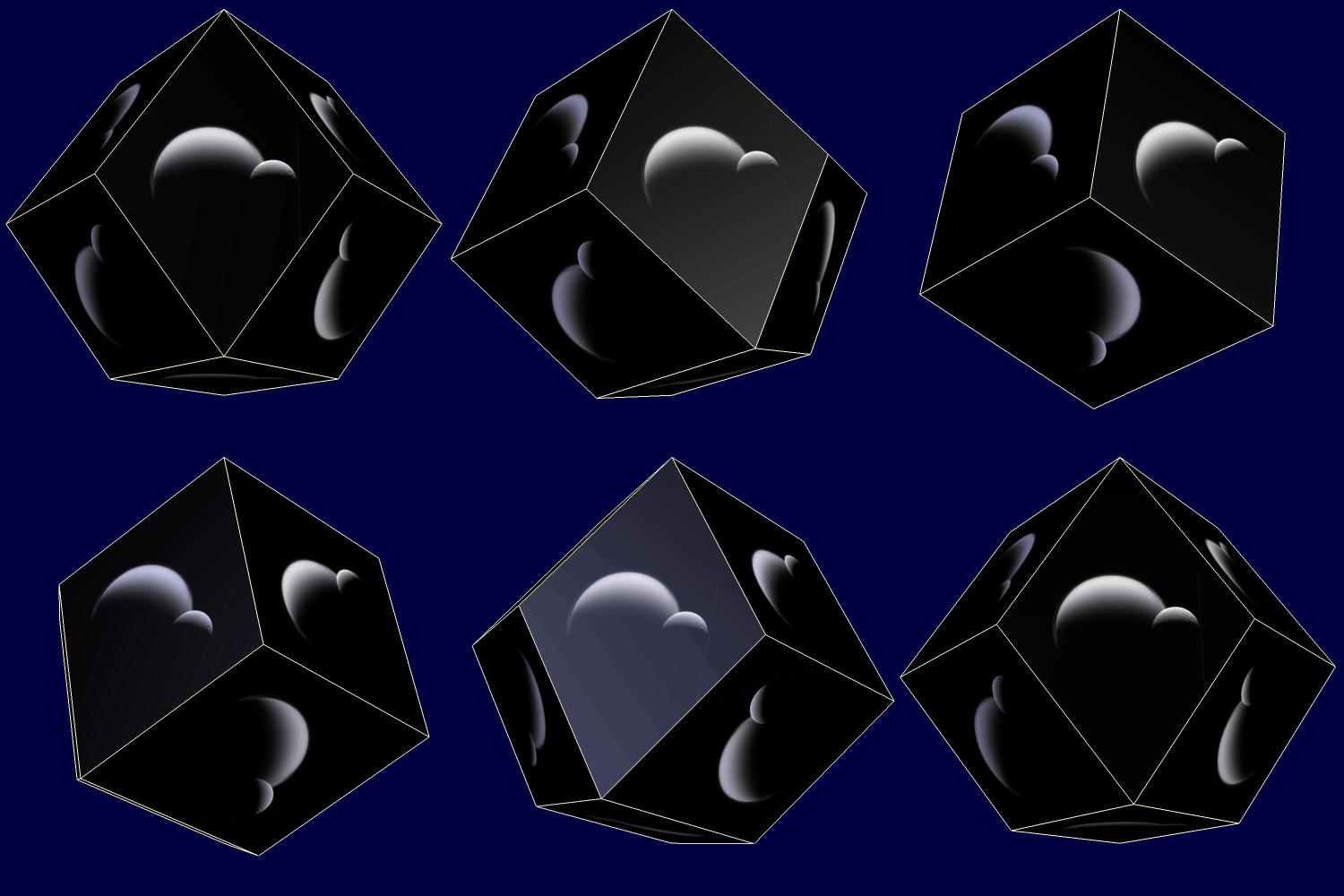
The larger moon shown, Saturn’s largest, is Titan, recognizable by its hazy atmosphere. The smaller one, which looks more like our own moon, is Rhea.

This image was captured by the Cassini spacecraft, which has been investigating the Saturnian system now for years.

Projecting the images onto the faces of a rhombic dodecahedron was done with Stella 4d, software you may try for free at http://www.software3d.com/stella.php.

If you shoot for the moon….

Image

If you shoot for the moon....