The Vacuum Cleaner Enigma

Image

The Vacuum Cleaner Enigma

A vacuum is, by definition, a region of space devoid of matter. While a perfect vacuum is a physical impossibility, very good approximations exist. Interplanetary space is good, especially far from the sun. Interstellar space is better, and intergalactic space is even better than that.

Along come humans, then, and they invent these things:

vacuum-cleaner-upright

. . . and call them “vacuum cleaners.”

Now, this makes absolutely no sense. There isn’t anything cleaner than a vacuum — and the closer to an ideal vacuum a real vacuum comes, the cleaner it gets. Since vacuums are the cleanest regions of space around already, why would anyone pay good money for a machine that supposedly cleans them? They’re already clean!

Even cleaning in general is a puzzle, without vacuums being involved at all. To attempt to clean something — anything — is, by definition, an attempt to fight the Second Law of Thermodynamics. Isn’t it obvious that any such effort is, in the long run, doomed from the outset?

—–

[Image note:  I didn’t create the images for this post, but found them using Google. I assume they are in the public domain.]


An Alphabetical Listing of Known Exotic Atoms

  • Antiprotonic helium:  an atom of helium, with one electron replaced by an antiproton.
  • Antiprotonic lithium:  an atom of lithium, with one electron replaced by an antiproton.
  • Exciton:  a bound state of an electron and an electron hole.
  • Hypernuclear atoms:  any of several observed atoms with a hypernucleus.  Hypernuclei are any nuclei which contain (in addition to protons and neutrons) at least one hyperon, a subclass of baryons which contain strange quarks. These atoms are studied primarily for their nuclear behavior, and so fall better into the subfield of nuclear physics, rather than atomic physics or chemistry.
  • Kaonic helium:  a helium atom, with one electron replaced by a negative kaon, which is a meson composed of a strange quark, and an antiup quark.
  • Kaonic hydrogen:  a hydrogen atom, with the electron replaced by a negative kaon, a meson composed of a strange quark and an antiup quark.
  • Kaonium:  a bound state of a positive and negative kaon. Positive kaons are mesons composed of up and antistrange quarks, while negative kaons are mesons composed of a strange quark, and an antiup quark.
  • Muonic helium:  an atom of helium, with one electron replaced by a muon.
  • Muonic hydrogen:  an atom of hydrogen, with the electron replaced by a muon.
  • Muonium:  a bound state of a positive muon (also known an an antimuon) and an electron. There is also predicted to exist what is called “true muonium,” a bound state of a muon on an antimuon, but it has yet to be observed.
  • Onium:  this is the general term for the bound state of a particle with its own antiparticle. Pionium and positronium are examples.
  • Pionic helium:  an atom of helium, with one electron replaced by a negative pion. Pions are mesons, and the negative pion is composed of an up and an antidown quark.
  • Pionic hydrogen:  an atom of hydrogen, with one electron replaced by a negative pion, a meson composed of an up and an antidown quark.
  • Pionium:  a bound state of two pions, one positive and one negative. The negative pion is described above, and the positive pion, also a meson, is composed of a down and an antiup quark.
  • Positronium:  a bound state of a positron and an electron. This exotic atom can form an exotic molecule, together with a hydrogen atom; such an exotic molecule is called positronium hydride, and has the formula PsH. Another exotic molecule involving positronium is a bound state of two positronium atoms; it is called di-positronium. Positronium also forms halides and a cyanide.
  • Protonium:  a bound state of a proton and an antiproton.
  • Quarkonium:  a term for a meson which is the bound state of any quark and its own antiquark.  While one can find examples in the literature where various forms of quarkonium are discussed as though they are exotic atoms, I prefer to view them simply as a subset of mesons, not a category of exotic atom.
  • Sigmaonic atoms are thought to be possible, via such methods as replacing an electron in a hydrogen or helium atoms with a negatively-charged sigma baryon. However, I have found no evidence of actual observation of such particles.
  • Tau-containing exotic atoms are predicted to occur, but have not been observed, yet, due to the short lifetime (less than a trillionth of a second) of the tau particle, a lepton. “Tauonium” is a term which has been used for these hypothetical exotic atoms.

A Conjecture About Dark Matter and Dark Energy

Image

A Conjecture About Dark Matter and Dark Energy

If inflation moves point A so far from point B right after the Big Bang that you can’t get to A from B now, then could the matter and energy in all the parts of the universe that we can’t access (because they’re too far away) provide the missing 90+% of the universe that we can’t account for?

Your Toes Are Younger Than Your Head

Image

Your Toes Are Younger Than Your Head

Unless, like a bat, you sleep upside-down, your toes are younger than your head.

Why?

Because, having spent more time slightly closer to the center of the earth, they have endured a slightly stronger gravitational field strength. This, in turn, due to relativistic time dilation, slows time down for your toes, relative to your head. With a slower passage of time during all periods when you were upright, less time has passed for them — and so they are younger.

Image credit: http://www.bestpodiatristnyc.com/british-hammertoes-are-wonky-toes/#sthash.xKDfxbgJ.dpbs

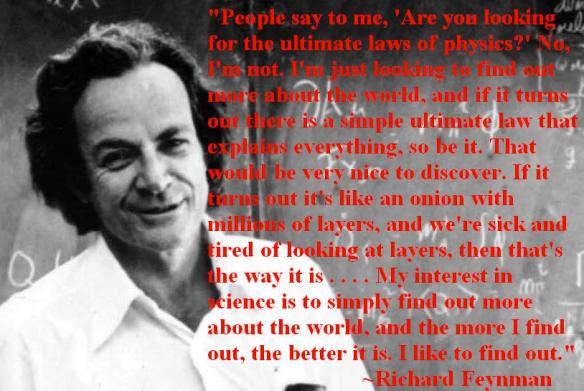
Richard Feynman: “I like to find out.”

Image