Tetrakaiicosagon with Diagonals

Image

Tetrakaiicosagon with Diagonals

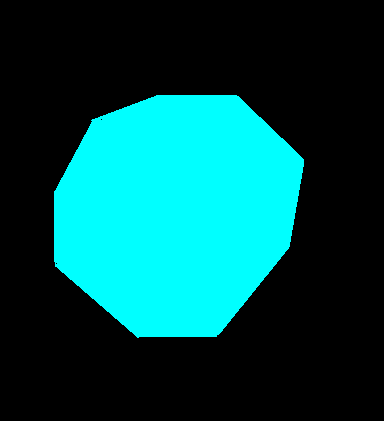
How many diagonals does a polygon with 24 sides have?

First, consider that there are 24 vertices for diagonals to come from, and they each have 21 places to go, since they can’t go to themselves, or to the adjacent vertices. (24)(21) therefore equals twice the number of diagonals, since I just counted each one twice (once per endpoint). There are therefore (24)(21)/2 = 252 diagonals.

Another View of the Regular Henkaipentacontagon

Image

Another View of the Regular Henkaipentacontahedron

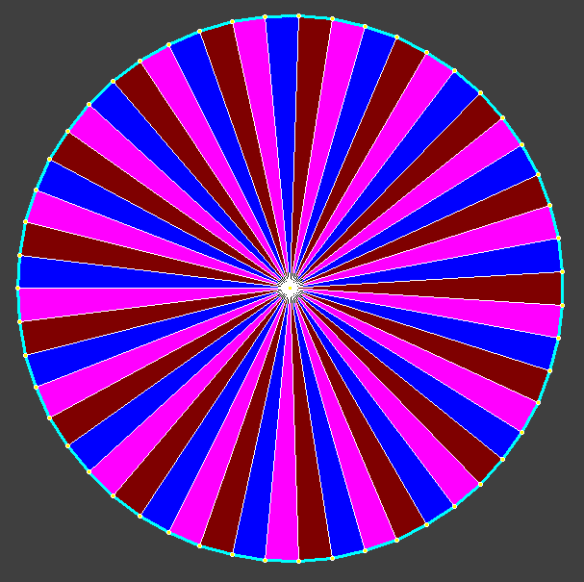
This is simply the inverted-color version of the second image in the last post on this blog, where I explain how to construct this 51-sided polygon using compass and straightedge, starting with the heptadecagon, which has 17 sides.

Constructing the Henkaipentacontagon: A Regular Polygon with 51 Sides

Constructing the Henkaipentacontagon:  A Regular Polygon with 51 Sides

After completing the heptadecagon construction shown in the last post on this blog, I wondered if I could pull off a similar trick to the one mentioned there of combining the pentagon and triangle constructions to construct a regular pentadecagon — but using the heptadecagon and triangle, instead, to construct a regular polygon with (17)(3) = 51 sides, known as the henkaipentacontagon.

The answer: yes, I was able to, but certainly not in the simplest way possible, for I ended up having to go to 204, first, to get to 51. First, I extended two adjacent radii of the heptadecagon in the upper left as rays, just to give me room to work. Next, I placed point Bon the lower of those two rays, to be used as the center of the large circle in which to construct my 51-sided regular polygon. I then constructed a line through B1 which was parallel to the upper of these two rays, thus duplicating the ~21.17647º central angle of the heptadecagon, but in the center of my new, larger circle. Next, I constructed the yellow equilateral triangle with this heptadecagon-central-angle inside it, in such a way that the lower half of the yellow triangle would be a 30-60-90 triangle,  ΔA1B1C1, with the ~21.17647° angle inside, and sharing a ray with, this triangle’s 30° angle. By subtraction, that made a ~8.8235° angle, with its vertex at the center of the largest circle shown.

Next, I divided ~8.8235 into 360 . . . and, to my dismay, didn’t get a whole number as an answer, but 40.8, instead. I then noticed that one can multiple 40.8 by five, and obtain 204 as the product. Armed with this knowledge, I used my ~8.8235° angle, and 204 circles of equal radius, to locate 204 points, evenly-spaced, around the large circle.

51 is one-fourth of 204, so I connected every fourth point around the large circle with heavy blue segments, and made those 51 points (one fourth of the total) blue, as well. These blue points and segments are the sides and vertices of the regular henkaipentacontagon, shown inscribed, above, inside the largest circle in the diagram.

Since this polygon looks a lot like a circle, I then rendered a lot of things from the diagram above invisible, in order to produce this second image:  the henkaipentacontagon alone, with different colors for its vertices and sides, all radii added, and three alternating colors for the 51 triangles each formed by two adjacent radii and a side.

51gon

Constructing the Heptadecagon

Image

Constructing the Heptadecagon

I have just completed my first construction of the regular heptadecagon — a construction that even the ancient Greeks were never able to figure out. They did figure out how to construct a regular pentadecagon (by combining the constructions for the regular pentagon and triangle), and I once replicated that discovery, meaning that I figured it out independently.

The regular heptadecagon construction, however, I did not figure out independently. I used instructions found here (http://www.mathpages.com/home/kmath487.htm), which built on the work of Carl Friedrich Gauss, who, in 1796, at the age of 19, became the first person in history to determine that such a construction is possible with the traditional Euclidean tools.

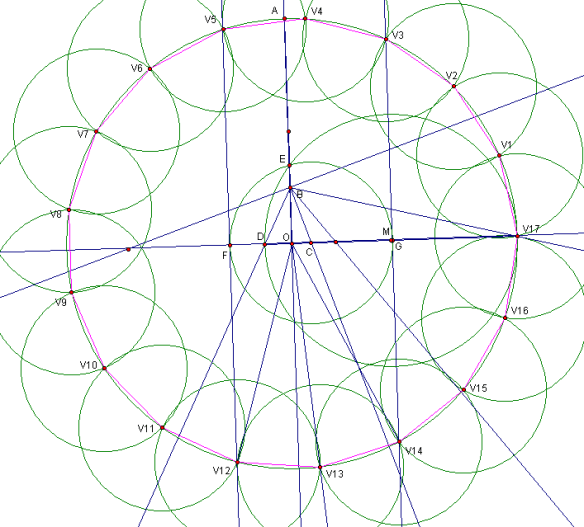
A word of warning, if you attempt to replicate this construction yourself: points M and G are merely close together, but are not in the same place. Point M is the center of the circle which passes through points D and V17, while point G is one of the two points of intersection of (1) the line passing through points O and V17, and (2) the circle centered at C, and passing through E.

Gauss (and other mathematicians, building on his work) also showed, later, that constructions are possible for regular polygons with 257 sides, as well as 65,537 sides. I might, someday, replicate the construction of the regular polygon with 257 sides.

A man named Johann Gustav Hermes once spent ten years completing a 200-page manuscript showing how to construct the regular polygon with 65,537 sides, and I believe he actually performed the construction, as well. I will not be constructing this polygon — ever. I will, however, figure out a proper name for it. Let’s see . . . it’s the heptakaitriacontakaipentacosioikaipentachilikaihexamyriagon. Try saying that five times in a row, quickly!

A Chiral Tessellation

A Chiral Tessellation

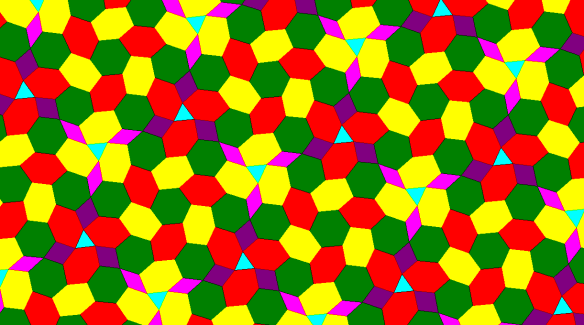
In this chiral tessellation, the blue triangles and green hexagons are regular. The yellow hexagons are “Golden Hexagons,” which are what you get if you reflect a regular pentagon over one of its own diagonals, then unify the two reflections. The pink and purple quadrilaterals are two types of rhombi, and the red hexagons are a third type of equilateral hexagon. All of the edges of all polygons here have the same length.

There are three different types of points of three-fold rotational symmetry repeated here. Two of these types are centered in the middle of blue triangles, while the third is centered in the middle of some of the green hexagons — specifically, the ones surrounded only by alternating red and yellow hexagons.

When I try to generate the mirror-image of this tessellation, it overloads Geometer’s Sketchpad, and crashes the program. However, inverting the colors of the same reflection, in MS-Paint, to make a color-variant, is easy:

weird tessellation

Triskelion of Regular Polygons

Image

Triskelion of Regular Polygons

Tessellation Using {8/3} Star Octagons and Squares

Image

Tessellation Using {8/3} Star Octagons and Squares

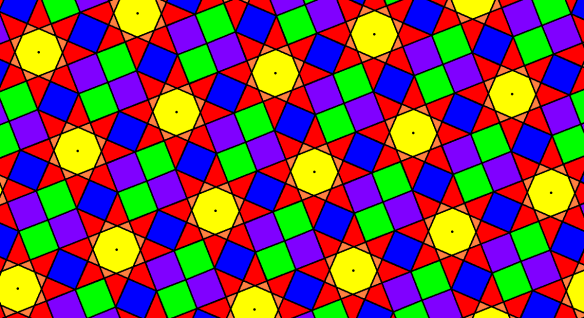
The tessellation of the plane which uses regular convex octagons and squares is well-known. This related tessellation, however, is not. I didn’t know it existed until I stumbled across it . . . although I very much doubt I am the first person to do so.

Some Polygons with Irritating Names

Image

Some Polygons with Irritating Names

These polygons are known to virtually all speakers of English as the triangle and the quadrilateral, but that doesn’t mean I have to like that fact, and, the truth is, I don’t. Why? There are a couple of reasons, all involving lack of consistency with the established names of other polygons.

Consider the names of the next few polygons, as the number of sides increases: the pentagon, hexagon, heptagon, and octagon. The “-gon” suffix refers to the corners, or angles, of these figures, and is derived from Greek, The end of the word “triangle” also refers to the same thing — but not in Greek. For the sake of consistency, triangles should, instead, be called “trigons.”

In the case of the quadrilateral, the problem is twofold. The suffix “-lateral” refers to sides, not angles. For the sake of consistency, “-gon” should be used instead. The prefix “quadri-” does mean four, of course, but is derived from Latin, not Greek. We use the Greek prefix “tetra-” to refer to four when naming polyhedra (“tetrahedron”), so why not use it for polygons with four sides, also? The best name available for four-sided polygons requires a change in both the prefix and suffix of the word, resulting in the name “tetragon” for the figure on the right.

When I listed the names of higher polygons above, I deliberately stopped with the octagon. Here’s the next polygon, with nine sides and angles:

polygons

I’m guilty of inconsistency with the name of nine-sided polygons, myself. All over this blog, you can find references to “nonagons,” and the prefix “nona-” is derived from Latin. Those who already know better have, for years, been calling nine-sided polygons “enneagons,” using the Greek prefix for nine, rather than the Latin prefix, for reasons of consistency. I’m not going to go to the trouble to go back and edit every previous post on this blog to change “nonagon” to “enneagon,” at least right now, but, in future posts, I will join those who use “enneagon.”

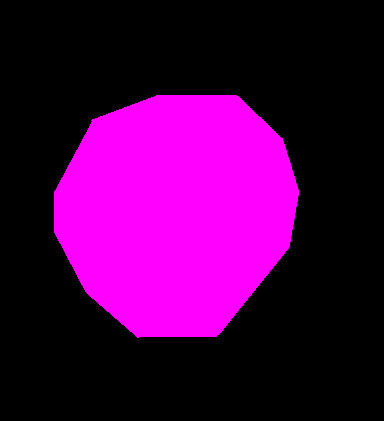
Here’s one more, with eleven sides:
polygons

I don’t remember ever blogging about polygons with eleven sides, but I have told geometry students, in the past, that they are called “undecagons.” I won’t make that mistake again, for the derivation of that word, as is the case with “nonagon,” uses both Latin and Greek. A better name for the same figure, already in use, is “hendecagon,” and I’m joining the ranks of those who use that term, derived purely from Greek, effective immediately.

With “hendecagon” and “enneagon,” I don’t think use of these better names will cause confusion, given that they are already used with considerable frequency. Unfortunately, that’s not the case with the little-used, relatively-unknown words “trigon” and “tetragon,” so I’ll still be using those more-familiar names I don’t like, just to avoid being asked “What’s a trigon?” or “What’s a tetragon?” repeatedly, for three- and four-sided polygons. Sometimes, I must concede, it is necessary to choose the lesser of two irritations. With “triangle” and “quadrilateral,” this is one of those times.

Prismatic Versions of Part of a Tessellation Using Squares and 60-120-60-120 Rhombi

Image

Prismatic Versions of Part of a Tessellation Using Squares and 60-120-60-120 Rhombi

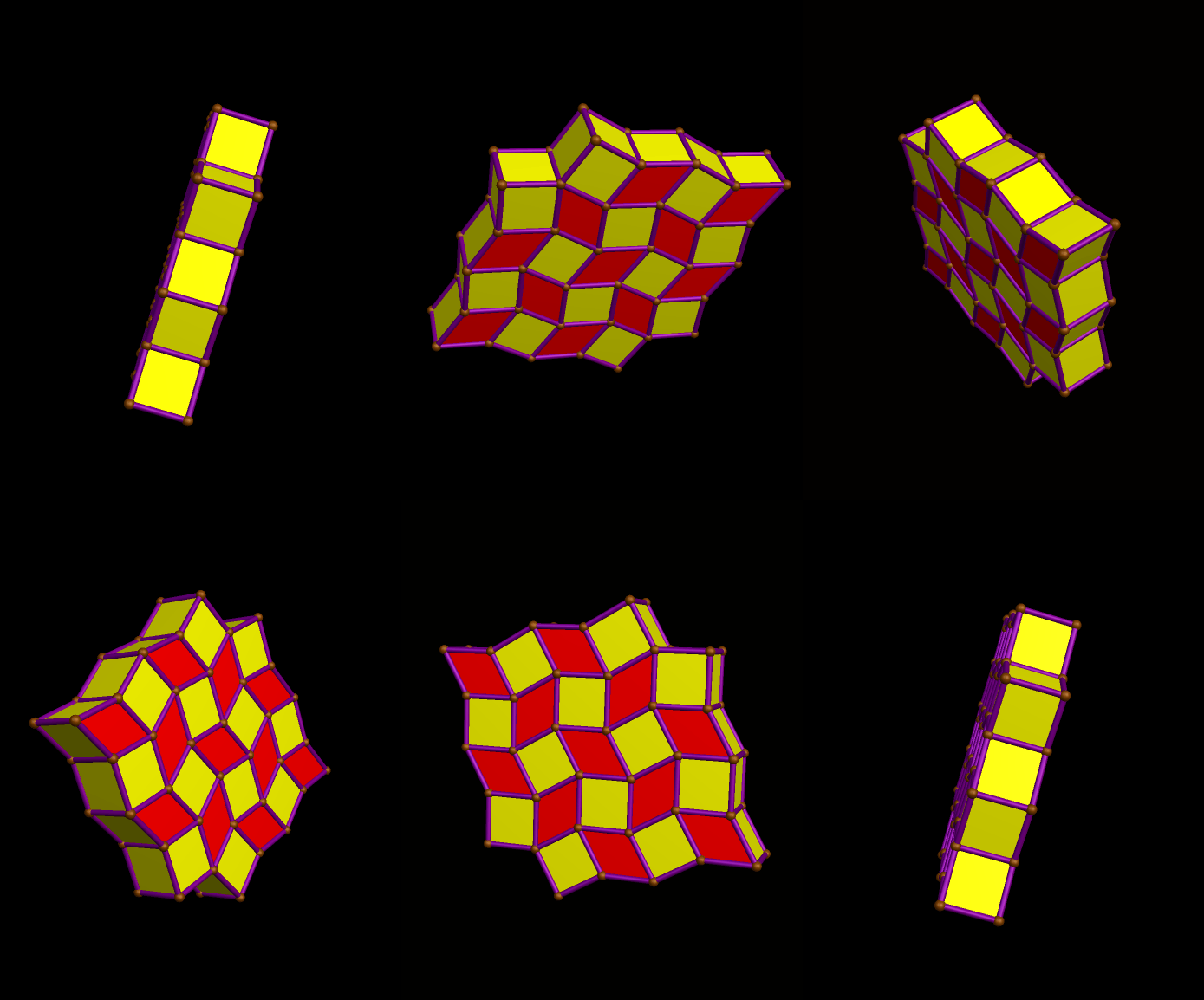
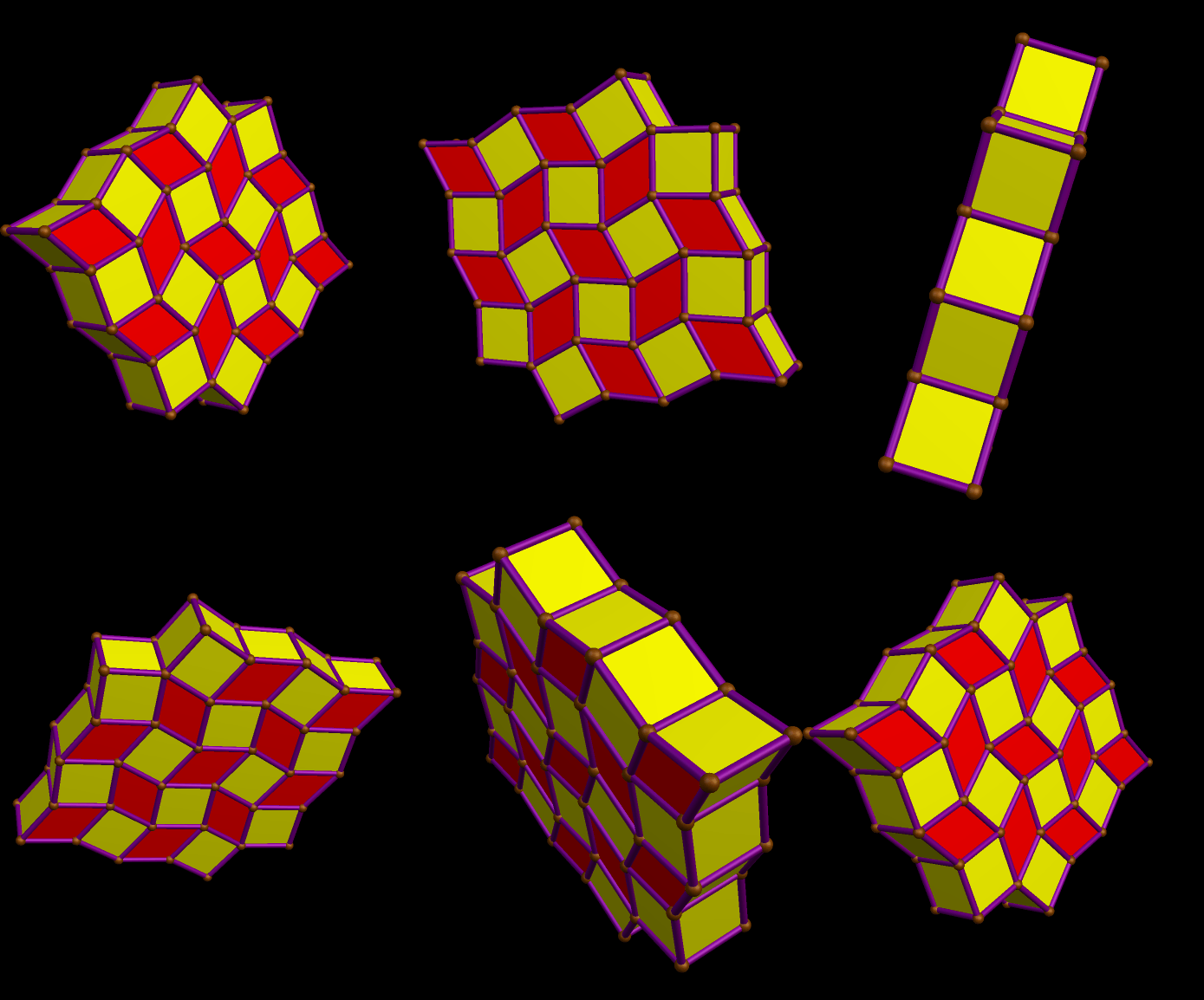
Above, the apparent size of the tessellation-prism does not change. In the next image, though, I set the controls of Stella 4d (the program I use to make these images, which you can try at http://www.software3d.com/Stella.php) to fit the image tightly, separately, in each still frame, causing a “breathing” effect. (Click on it if you wish to see it enlarged.)

Augmented Triangular Prism 2

Next, I added two red rhombi, one at the top and one at the bottom, stellated the result many times, and made one final .gif image, leaving the “breathing” effect on.

Augmented Triangular Prism 3 many stellations later


On the Constructible Angles

Image

The Constructible Angles

The Ancient Greeks figured out how to combine the Euclidean constructions of the regular pentagon and triangle to obtain constructions for the regular pentadecagon, which has central angles (between adjacent radii) of 360/15 = 24 degrees. Here’s an example, showing how this can be performed:

15

Also, it’s easy to construct an equilateral triangle, and then bisect an angle of it, to obtain a 30 degree angle.

The existence of angle difference identities in trigonometry is tied to the fact that you can subtract angles, on paper, with Euclidean constructions. Therefore, an angle of 24 degrees may be subtracted from a 30 degree angle to obtain a 6 degree angle. This can be bisected to get a 3 degree angle, and then bisected again to obtain a 1.5 degree angle, then a 0.75 degree angle, and so on.

However, a one degree angle is impossible to construct. Were this not the case, a 24 degree angle’s constructibility would imply that of the 23 degree angle, by subtraction of a one degree angle. After that, subtract three degrees more, and you have a 20 degree angle . . . and with that, you can construct a regular enneagon, also known an a nonagon. But we know — it has been proven — that regular enneagons have no valid Euclidean constructions. Therefore, one degree angles are also non-constructible, by reductio ad absurdam.

Carl Friedrich Gauss’s much more recent proof (1796; he was 19 years old) that a regular polygon of 17 sides can also be constructed — the first significant advance in this field since the time of the ancient Greeks — adds more constructible angles. Building on his work, other mathematicians have also shown that regular polygons with 257 and 65,537 sides can also be constructed, adding yet more constructible angles, but they are all for angles measuring fractional numbers of degrees, since none of these numbers are factors of 360, which equals (2³)(3²)(5). It’s also possible to combine these possible constructions to construct more regular polygons, as was shown above for the pentadecagon. For example, one can construct a regular pentagon with 51 sides, since 51 = (17)(3) — but, again, combinations of this type only lead to possible constructions of angles with measures which are fractional numbers of degrees. For angles with degree measures which are integers, it’s multiples of three — and that’s it.

[Note regarding images: the photograph of a compass at the top of this page was not taken by me, but simply found with a Google image-search. The pentadecagon-construction image, though, I did make, using both Geometer’s Sketchpad and MS-Paint.]