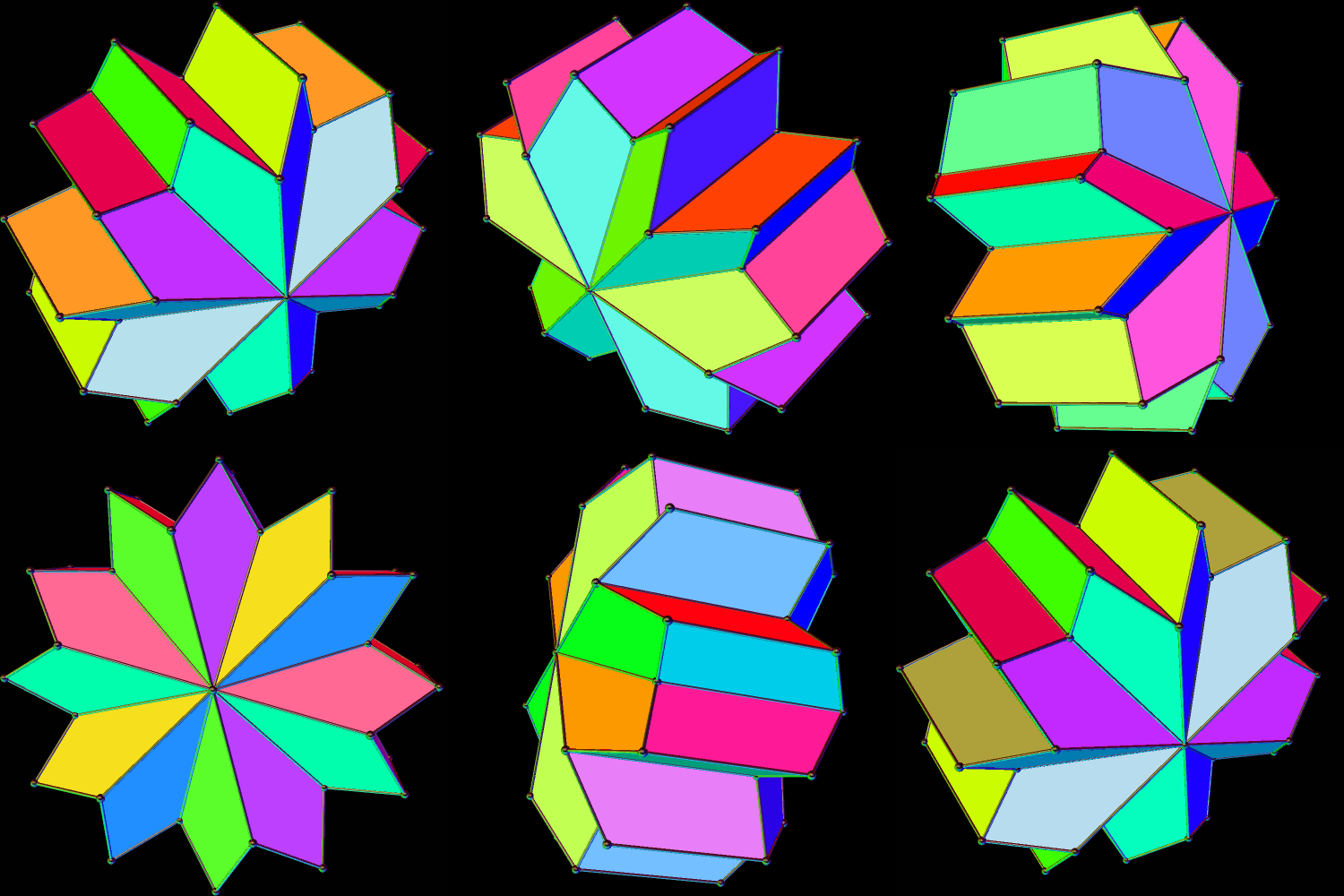
The Chiral Tetrated Dodecahedron: A New Near-Miss?

The images above show a new near-miss (to the Johnson solids) candidate I just found using Stella 4d, software you can try here. Like the original tetrated dodecahedron (a recognized near-miss shown at left, below), making this polyhedron relies on splitting the Platonic dodecahedron into four three-pentagon panels, moving them apart, and filling the gaps with triangles. Unlike that polyhedron, though, this new near-miss candidate is chiral, as you can see by comparing the left- and right-handed versions, above. The image at the right, below, is the compound of these two enantiomers.

Next are shown nets for both the left- and right-handed versions of the chiral tetrated dodecahedron (on the right, top and bottom), along with the dual of this newly-discovered polyhedron (on the left). Like the rest of the images in this post, any of them may be enlarged with a click.

A key consideration when it is decided if the chiral tetrated dodecahedron will be accepted by the community of polyhedral enthusiasts as a near-miss (almost a Johnson solid), or will be relegated to the less-strict set of “near-near-misses,” will be measures of deviancy from regularity.The pentagons and green triangles are regular, with the same edge length. The blue and yellow triangles are isosceles, with their bases located where blue meets yellow. These bases are each ~9.8% longer than the other edges of the chiral tetrated dodecahedron. By comparison, the longer edges of the original tetrated dodecahedron, where one yellow isosceles triangle meets another, are ~7.0% longer than the other edges of that polyhedron. Also, in the original, the vertex angle of these isosceles triangles measures ~64.7°, while the corresponding figure is ~66.6° for the chiral tetrated dodecahedron.

[Later edit: I have now found out I was not the first person to find what I had thought, earlier today, was an original discovery. What I have simply named the chiral tetrated dodecahedron has been on the Internet, in German, since 2008, or possibly earlier, and may be seen here: http://3doro.de/polyeder/.]

Standard and Faceted Versions, Side by Side, of Each of the Thirteen Archimedean Solids

These two polyhedra are the truncated tetrahedron on the left, plus at least one faceted version of that same Archimedean solid on the right. As you can see, in each case, the figures have the same set of vertices — but those vertices are connected in a different way in the two solids, giving the polyhedra different faces and edges.

(To see larger images of any picture in this post, simply click on it.)

The next three are the truncated cube, along with two different faceted truncated cubes on the right. The one at the top right was the first one I made — and then, after noticing its chirality, I made the other one, which is the compound of the first faceted truncated cube, plus its mirror-image. Some facetings of non-chiral polyhedra are themselves non-chiral, but, as you can see, chiral facetings of non-chiral polyhedra are also possible.

The next two images show a truncated octahedron, along with a faceted truncated octahedron. As these images show, sometimes faceted polyhedra are also interesting polyhedra compounds, such as this compound of three cuboids. 

The next polyhedra shown are a truncated dodecahedron, and a faceted truncated dodecahedron. Although faceted polyhedra do not have to be absurdly complex, this pair demonstrates that they certainly can be.

Next are the truncated icosahedron, along with one of its many facetings — and with this one (below, on the right) considerably less complex than the faceted polyhedron shown immediately above.

The next two shown are the cuboctahedron, along with one of its facetings, each face of which is a congruent isosceles triangle. This faceted polyhedron is also a compound — of six irregular triangular pyramids, each of a different color.

The next pair are the standard version, and a faceted version, of the rhombcuboctahedron, also known as the rhombicuboctahedron.

The great rhombcuboctahedron, along with one of its numerous possible facetings, comes next. This polyhedron is also called the great rhombicuboctahedron, as well as the truncated cuboctahedron.

The next pair are the snub cube, one of two Archimedean solids which is chiral, and one of its facetings, which “inherited” its chirality from the original.

The icosidodecahedron, and one of its facetings, are next.

The next pair are the original, and one of the faceted versions, of the rhombicosidodecahedron.

The next two are the great rhombicosidodecahedron, and one of its facetings. This polyhedron is also called the truncated icosidodecahedron.

Finally, here are the snub dodecahedron (the second chiral Archimedean solid, and the only other one, other than the snub cube, which possesses chirality), along with one of the many facetings of that solid. This faceting is also chiral, as are all snub dodecahedron (and snub cube) facetings.

Each of these polyhedral images was created using Stella 4d: Polyhedron Navigator, software available at this website.

Five Faceted Polyhedra

Above, on the left, is a faceted cuboctahedron. To its right are a faceted snub dodecahedron (upper right) which is also a ten-part compound, and a faceted truncated cube below that. Any of these images may be enlarged by clicking on it.

Below, the left figure is a faceting of the great rhombcuboctahedron — one which is also a three-part compound of octagonal prisms. To its right is a faceting of the snub dodecahedron which is markedly different in appearance from the snub dodecahedron faceting shown above. 

Faceted polyhedra have the same vertices as the polyhedra from which they are derived, but those vertices are connected in different ways, changing the faces and edges.

All of these were made using Stella 4d, a program you may try for yourself, for free, right here.

A Pyritohedral and Pentagon-Faced Polyhedron

pyritohedral 36 pentagons

Twelve of the faces of this polyhedron are pink, and the other twenty-four are blue. It has no faces which are not pentagons. I made it using Stella 4d: Polyhedron Navigator, which is avialable at http://www.software3d.com/Stella.php

Polyhedral Peacock

peacock

Created using Stella 4d, available at http://www.software3d.com/Stella.php.

Unsquashing the Squashed Meta-Great-Rhombcuboctahedron

I noticed that I could arrange eight great rhombcuboctahedra into a ring, but that ring, rather than being regular, resembled an ellipse.

Augmented Trunc Cubocta

I then made a ring of four of these elliptical rings.

Augmented Trunc Cubocta B

After that, I added a few more great rhombcuboctahedra to make a meta-rhombcuboctahedron — that is, a great rhombcuboctahedron made of rhombcuboctahedra. However, it’s squashed. (I believe the official term for this is “oblate,” but “squashed” also works, at least for me.)

Augmented Trunc Cubocta 3

So now I’m wondering if I can make this more regular. In other words, can I “unsquash” it? I notice that even this squashed metapolyhedron has regular rings on two opposite sides, so I make such a ring, and start anew.

Augmented Trunc Cubocta a

I then make a ring of those . . . 

Augmented Trunc Cubocta AA

. . . And, with two more ring-additions, I complete the now-unsquashed meta-great-rhombcuboctahedron. Success!

Augmented Trunc Cubocta AAA

To celebrate my victory, I make one more picture, in “rainbow color mode.”

Augmented Trunc Cubocta AAAR

[All images made using Stella 4d, available here: http://www.software3d.com/Stella.php.]

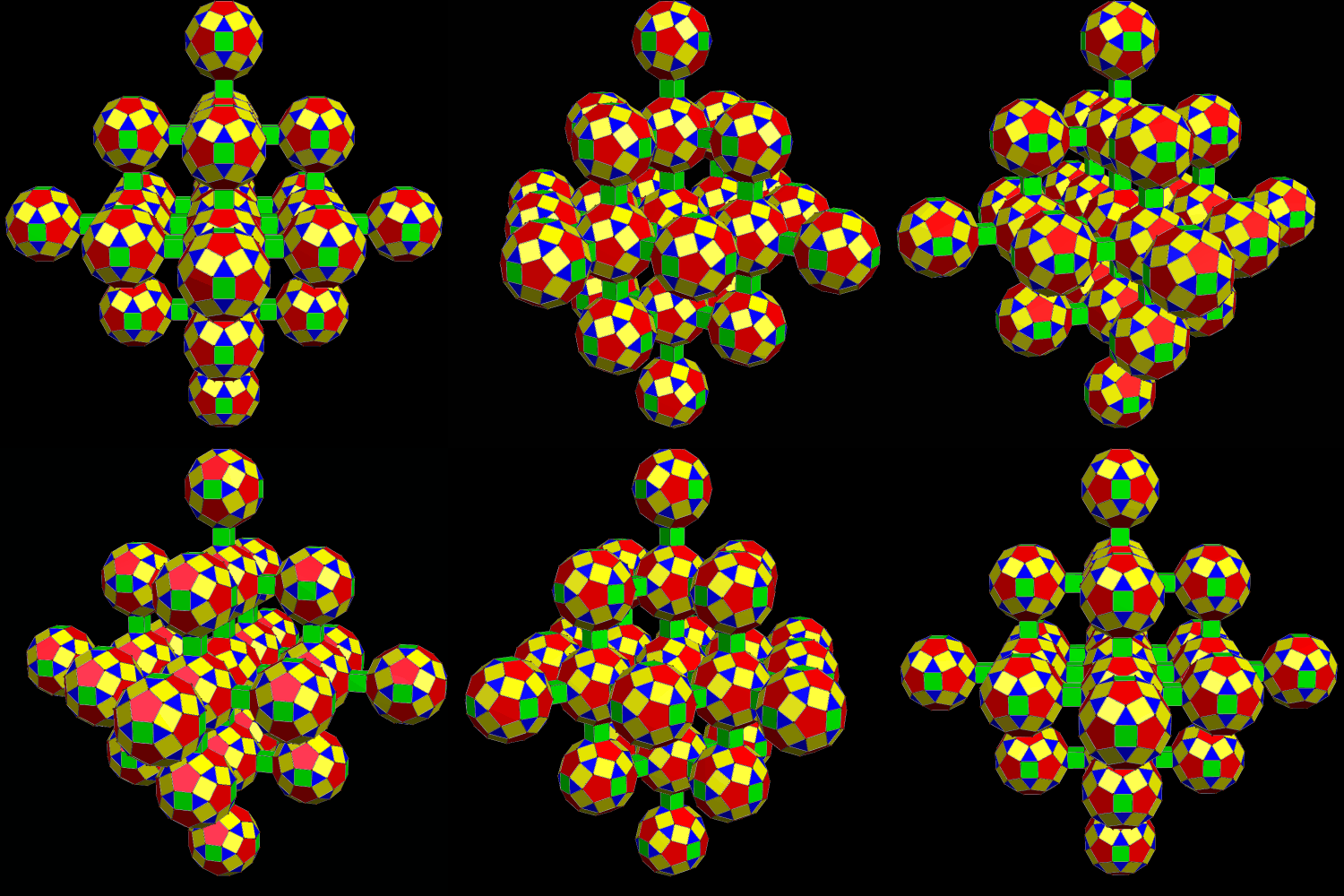
Open Octahedral Lattice of Cubes and Rhombicosidodecahedra

This pattern could be continued, indefinitely, into space.

Augmented Rhombicosidodeca

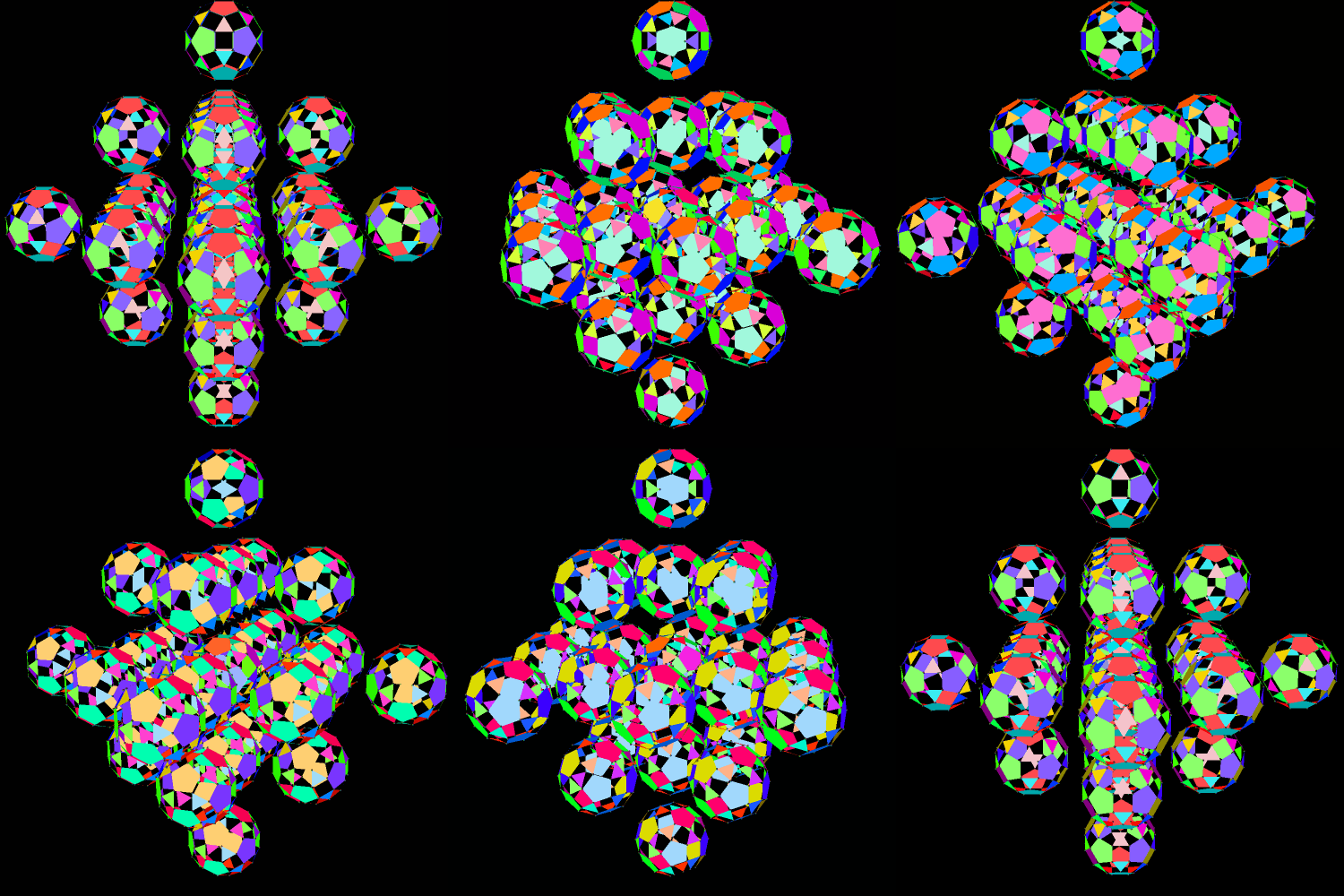
Here is a second view, in rainbow color mode, and with all the squares hidden.

Augmented Rhombicosidodeca rcm

[These images were created with Stella 4d, software you may buy — or try for free — right here.]

Six “Cubish” Polyhedra

I’m using the term “cubish polyhedra” here to refer to polyhedra which resemble a cube, if one looks only at the faces they have which feature the largest number of sides, always six in number, and with positions corresponding to the faces of a cube. In the first two examples shown, these faces are 36-sided polygons, also known as triacontakaihexagons. (Any of the images in this post may be enlarged with a click.) 

Polyhedra fitting this description have appeared on this blog before, but it had not occurred to me to name them “cubish polyhedra” until today. The next two shown have icosakaioctagons, or 28-sided polygons, as their six faces which correspond to those of a cube. Also, and unlike the triacontakaihexagons in the first two cubish polyhedra above, these icosakaioctagons are regular.

The next two cubish polyhedra shown feature, on the left, six hexadecagons (16 sides per polygon) for “cubish faces,” which are shown in yellow — and on the right, six dodecagons (12 sides each), shown in orange. This last one, with the dodecagons, is unusual among cubish polyhedra in that all of its other faces are pentagons.

All six of these cubish polyhedra were made using Stella 4d: Polyhedron Navigator, a program you can find right here.

Eight Chiral Polyhedra with Icosidodecahedral Symmetry

To see a larger version of any rotating model, simply click on it.

Each of these polyhedral images was created using a program called Stella 4d, which is available here.

Eleven Convex, Non-Chiral Polyhedra Featuring Cuboctahedral Symmetry

To enlarge any of these images, simply click on the ones you choose.

All of these images were created using Stella 4d: Polyhedron Navigator, available at http://www.software3d.com/Stella.php.