An Unsolved Problem Involving the Icosahedron and the Dodecahedron, and Their Circumscribed Spheres

This is apparently a problem, posed by Gregory Galperin, which went unsolved at the Bay Area Math Olympiad in 2005. I haven’t solved it yet, but I’m going to try, as I work on this blog-post. My 2010 source is a paper about Zome which may be read, as a .pdf, at bact.mathcircles.org/files/Summer2010/zomes-6-2010.pdf. The problem involves a dodecahedron and an icosahedron, each inscribed inside the same sphere of radius r, and asks which has the greater volume. At the time the authors wrote this paper, they knew of no solution, and I know of none now, but I do like a challenge.

My idea for solving this begins with Zome (info on Zome:  see http://www.zometool.com, as well as other sites you can find by googling “Zome”). In the Zome geometry system, using B1 struts for the edges of both a dodecahedron and an icosahedron, R1 struts are the radii of the circumscribed sphere for the icosahedron,  and Y2 struts are the radii for the circumscribed sphere of the dodecahedron. Since volume formula for polyhedra are generally given in term of edge-length, I need to find B1 in terms of R1 for the icosahedron, and find B1 in terms of Y2 for the dodecahedron.
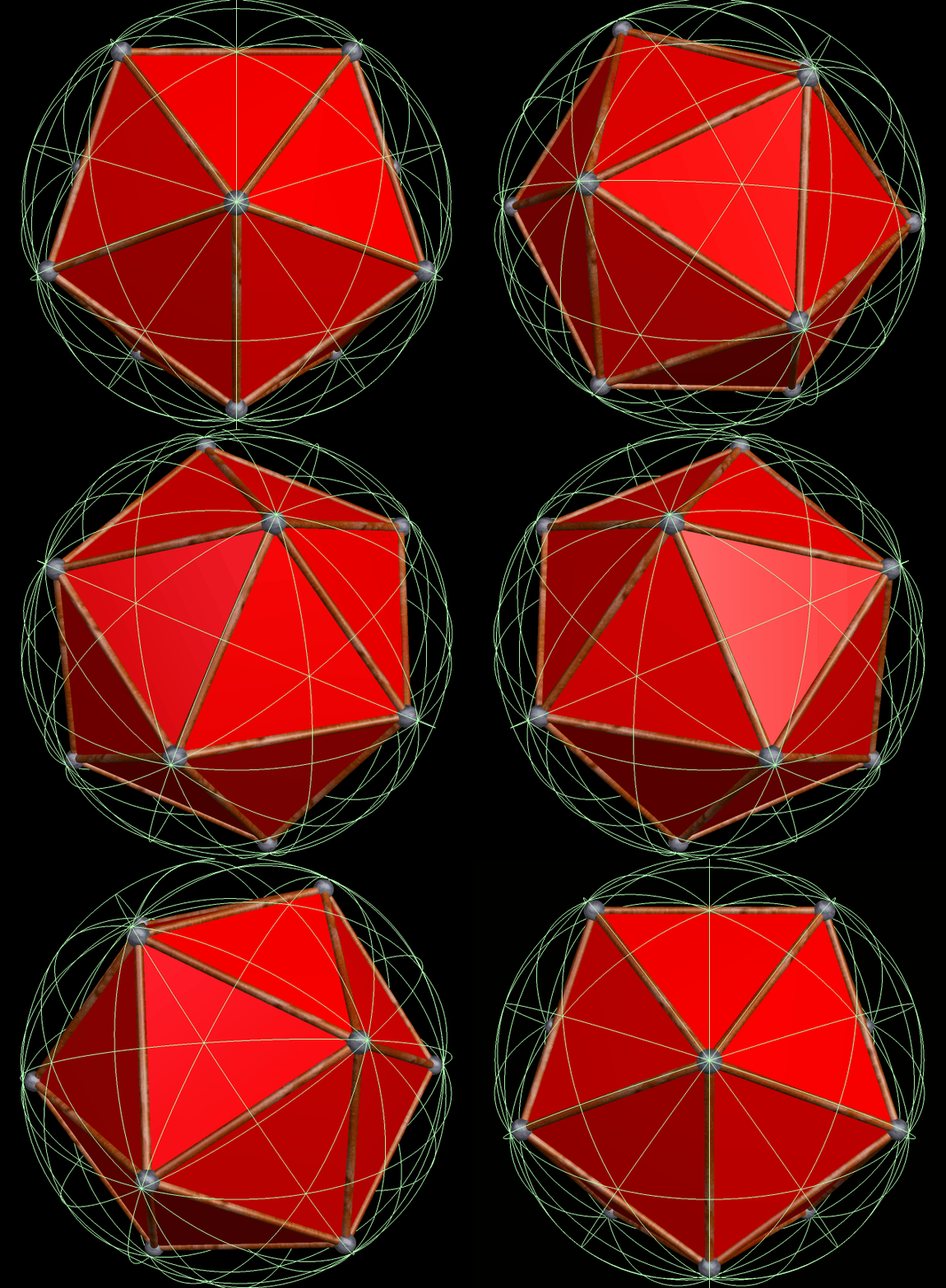
icosa

Icosahedron:  find B1, in terms of R1.

There exists a right triangle which can be built in Zome which has a hypotenuse equal to 2R1, and legs epqual to B1 and B2. B2 = φB1, so, by the Pythagorean Theorem, (2R1)^2 = (B1)^ + φ²(B1)², which simplifies to 4(R1)^2 = (1 + φ²)(B1)^2, which can then be solved for B1 as B1 = sqrt[4(R1)^2/(1 + φ²)]. B1 here is the icosahedron’s edge-length, while R1 is the radius of its circumscribed sphere.

dodecahedron

Dodecahedron:  find B1, in terms of Y2.

In the Zome system, Y2 = φY1, and Y1 = [sqrt(3)/2]B1. Rearrangement of the first of these equations yields Y1 = Y2/φ, and substitution then yields [sqrt(3)/2]B1 = Y2/φ, which then can be rearranged to yield B1 = 2Y2/[φsqrt(3)]. B1 here is the dodecahedron’s edge-length, while Y2 is the radius of its circumscribed sphere.

Next, find the volume of the icosahedron inscribed inside a sphere, in terms of that sphere’s radius.

According to http://mathworld.wolfram.com/Icosahedron.html, the volume of an icosahedron is given by V = (5/12)[3 + sqrt(5)]a³, where a is the edge length, or B1 in the first indented section, between the two images, above.  Then, by substitution, V = (5/12)[3 + sqrt(5)]{sqrt[4(R1)^2/(1 + φ²)]}³, which then becomes (with “r” being the radius of the circumscribed sphere) V = (5/12)[3 + sqrt(5)][2r/sqrt(1 + φ²)]³ = (40/12)[3 + sqrt(5)][1/sqrt(1 + φ²)]³r³ = (10/3)[3 + sqrt(5)][1/sqrt(1 + φ²)]³r³. Then, using the identity φ² = φ + 1, this can be further simplified to V = (10/3)[3 + sqrt(5)][1/sqrt(2 + φ)]³r³.

Next, find the volume of the dodecahedron inscribed inside the same sphere, in terms of that sphere’s radius, r.

According to https://en.wikipedia.org/wiki/Dodecahedron, the volume of an icosahedron is given by V = (1/4)[15 + 7sqrt(5)]a³, where a is the edge length, or B1 in the second indented section, below the second image, above.  Then, by substitution, V = (1/4)[15 + 7sqrt(5)]{2Y2/[φsqrt(3)]}³, which then becomes (with “r” being the radius of the circumscribed sphere) V = (8/4)[15 + 7sqrt(5)]{1/[φsqrt(3)]}³r³ = 2[15 + 7sqrt(5)]{1/[3sqrt(3)]}(1/φ³)r³ = (2/3)[15 + 7sqrt(5)][sqrt(3)/3](1/φ³)r³  = [2sqrt(3)/9][15 + 7sqrt(5)](1/φ³)r³.

So, with the “r” in each case being the same, the icosahedron is larger than the dodecahedron iff (10/3)[3 + sqrt(5)][1/sqrt(2 + φ)]³ > [2sqrt(3)/9][15 + 7sqrt(5)](1/φ³), which simplifies to (5)[3 + sqrt(5)][1/sqrt(2 + φ)]³ > [2sqrt(3)/3][15 + 7sqrt(5)](1/φ³), which simplifies further to {5/[sqrt(2 + φ)]³}[3 + sqrt(5)] > [2sqrt(3)/3φ³][15 + 7sqrt(5)], which is, as a decimal approximation, is (0.726542528)(5.2360679774998) > (3.464101615/12.708203932)(30.6524758), or 3.804226 > 8.355492, which is false, meaning that the dodecahedron is larger, not the icosahedron.

Now for the bad part:  I think I’m wrong, but I don’t know where the error lies. I’m also tired. If any of you see the mistake, please point it out in a comment, and I’ll try to fix this after I’ve rested.

Update:  if the websites http://rechneronline.de/pi/icosahedron.php and http://rechneronline.de/pi/dodecahedron.php work correctly, then the dodecahedron is larger. Evidence:

volume calculators

This does not, however, mean that I did the problem correctly. I merely stumbled upon the correct answer. How do I know this? Simple:  the ratio I obtained was too far off. Therefore, I would still welcome help clearing up the mystery of where my error(s) is/are, in the calculations shown above.
Given Equations for Two Circles, How Does One Find the Coordinates of Their Point(s) of Intersection, If Any?

Image

Given Equations for Two Circles, How Does One Find the Coordinates of Their Point(s) of Intersection, If Any?

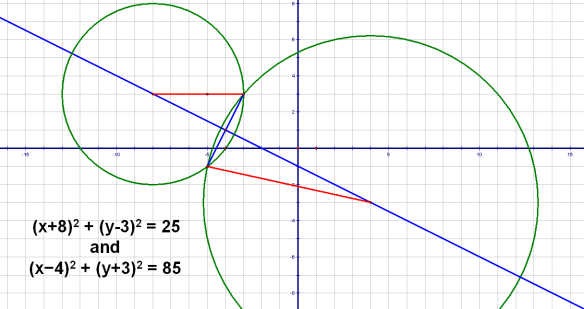
Before attempting to create a method for solving this problem with any given circles, I’m going to attempt solving it for this arbitrary pair of circles. The small circle has radius 5, is centered at (-8,3), and has the equation (x+8)² + (y-3)² = 25. The larger circle has a radius of √85, is centered at (4,-3), and has the equation (x-4)² + (y+3)² = 85.

The first thing I will do is add 60 to each side of the equation of the smaller circle, changing that equation to (x+8)² + (y-3)² + 60 = 85. There are now two equations with 85 on one side, so I will set their other sides equal to each other:  (x+8)² + (y-3)² + 60 = (x-4)² + (y+3)². Next, I square each term in parentheses, turning this equation into x² + 16x +64 + y² -6y +9 + 60 = x² – 8x +16 + y² + 6y +9. After x², y², and 9 are each cancelled from each side, the equation looks like this:  16x +64 – 6y +60 = -8x + 16 + 6y. This simplifies further to -12y + 124= -24x +16, then -12y = -24x -108, then, after dividing both sides -12, that yields the simplified equation for the straight line y = 2x + 9. Any solutions which exist, therefore, must be found on the line y = 2x + 9.

(x+8)² + (y-3)² = 25 is the equation of the smaller circle, and substituting 2x + 9 for y in this equation turns it into (x+8)² + (2x + 9 – 3)² = 25, which is equivalent to (x+8)² + (2x + 6)² = 25. By squaring the terms in parentheses found in this last equation, this turns into x² + 16x +64 + 4x² + 24x + 36 = 25, which simplifies further to 5x² +40x + 75 = 0, and then x² +8x + 15 = 0.

Applying the quadratic formula (because I don’t enjoy factoring trimonials) to this last equation, x = {-8 ± sqrt[64 – (4)(1)15)]}/2, which means that x has two values in this case:  x = (-8 + 2)/2 = -6/2 = -3, and x = (-8 – 2)/2 = -10/2 = -5. When x = -3, then y = 2(-3) +9 = -6 + 9 = 3, so one solution is the ordered pair (-3,3). By constrast, when x = -5, then y = 2(-5) +9 = -10 + 9 = -1, so the other solution is the ordered pair (-5,-1).

For other circle-pairs, the method is the same, but appropriate substitutions will need to be made in the numbers with which I started, likely leading, of course, to different answers. For some pairs of circles, the quadratic formula will not yield two real ordered pairs as solutions. If all values of x and y are nonreal, this simply means that the two circles do not touch at all. If, on the other hand, only ordered pair can be found as a solution, this means the circles are tangent to each other — touching only at a single point.

A Half-Solved Mystery: Rotating a Sine Wave

Image

A Half-Solved Mystery

A few minutes ago, I wondered how to write a function whose graph would be a sine curve, but one that undulated above and below the diagonal line y=x, rather than the x-axis, as is usually the case. How to accomplish such a 45 degree counterclockwise rotation?

Well, first, I abandoned degrees, set Geometer’s Sketchpad to radians, and then simply constructed plots for both y = x and y = sin(x). Next, I added them together. The result is the green curve (and equation) you see above.

This only half-solves the problem. Does it undulate above and below y=x? Yes, it does. However, if you rotate this whole thing, clockwise, one-eighth of a complete turn, so that you are looking at the green curve going along the x-axis, you’ll notice that it is not a true sine curve, but a distorted one. Why? Because it was generated by adding y-values along the original x-axis, not by a true rotation.

I’m not certain how to correct for this distortion, or otherwise solve the problem. If anyone has a suggestion, please leave it in a comment. [Note: an astute follower of this blog has now done exactly that, so I refer the reader to the comments for the rest of the story here.]

My Favorite Passage from the Bible, and How One Atheist Thinks We Just Might Use It to Avoid Extinction.

Image

You may already know I am an atheist, and may be unaware that some of us have favorite passages from the Bible which were not selected for purposes of ridicule, nor of criticism of the Bible, nor because of dislike of any religion. This is my favorite passage because it contains excellent advice. I do not need “faith,” as that word is commonly understood, nor a literal belief in the devil, to recognize, and appreciate, good advice.

What’s not to like about self-control? Or being alert? Those things can keep us all alive. They are important. I used to only cite the first sentence here as my favorite part of the Bible, but have decided to include two complete verses, for context, and elaboration through metaphor, as I interpret this passage. I see no reason not to.

Atheists (only capitalized at the beginning of a sentence, by the way) don’t have denominations, nor creeds, and there are as many different types of atheist as there are atheists. Atheism isn’t a religion — the word simply describes existence without religion. Everyone is born an atheist, albeit an unconscious one. Also, those who remain, or return to, atheism, change, during the course of our lives, just as theists do. The only people who do not change are the dead.

In defiance of stereotype, we are not all angry and bitter, although some of us, it must be admitted, are. (I used to be far more bitter than I am now, although I am working hard to change that.) Many of us even believe in non-theistic ideas which make absolutely no sense, such as, for example, 9/11 conspiracy theories. We only have one thing in common: we lack belief in deities. You almost certainly lack belief in at least some deities, ones which others fervently believe in. If you are a theist, well, atheists just take things a bit further than you — that’s all. We don’t all hate theists, and (thankfully) not all theists hate us. The ability to respectfully disagree is at least one of the keys to peaceful coexistence. Universal agreement among humans simply will not happen (and would be horribly boring, anyway), until the death of the penultimate person, at least. Even if there is a “last person alive” scenario in the (hopefully very distant) future, this unknown last human being will still have internal disagreements, and will almost certainly disagree with remembered ideas of the dead. In fact, given human nature, and history, such a disagreement might even be the cause of the next-to-last person’s death, at the hands of the last man, or woman, ever to live.

I do not want homo sapiens to end this way.  I’d like us to continue, for many generations, until evolution, and speciation, replace us with successor species, a long time from now — still people, but different, in ways we cannot now know, and, hopefully, people who have long ago learned to live without constantly killing each other.  Isn’t it about time we left this nasty habit called “war” behind, along with murder, rape, and the rest of the litany of human horror?

I’m a big fan of John Lennon, but I’d far rather imagine no war than “imagine no religion,” and I no longer accept the idea, common among atheists, that the second is a prerequisite for the first.

Since we have, as a species, figured out several ways to self-destruct, we cannot afford to wait for evolution to “teach” us how to coexist peacefully.  Evolution is far more efficient at destruction than creation, after all, being a random process.  Far more species have gone extinct than exist today, and the process of evolution simply does not care whether we live or die.  Entropy happens.  It took 3.85 billion years of natural selection to get here, and we will not get a second chance to get it right.

We must figure out effective ways to live with our differences now.  I do not mean that we should somehow erase our differences, for I have no desire to live in a world of clones of myself, and I doubt you want to live in your version of such a world, either.  We do, however, need to come to terms, as a world-wide society, with the inescapable fact that people are different.  We have a right to be different, it’s good that we are, and the fact that we vary so much is certainly is no excuse for killing, nor even hating, anyone.

There is another part of human nature that is on our side in our struggle for survival, and this is the hopeful part of this essay. We are good at figuring things out. We actually enjoy trying our best to solve puzzles. We pay hard-earned money for them constantly! Some of us absolutely obsess over single problems, for days — or years — at a time. Well, this is the best, most important problem we have ever faced, with the highest stakes imaginable:  how to avoid our own extinction. The world isn’t a casino with no exit, though.  It has been mostly a game of chance, so far — and we’ve been lucky to have made it to the present.  However, it doesn’t have to be the way it has been, with us stumbling through history, like drunk monkeys in a minefield — which we pretty much are, right now.

We have minds, and it’s time to use them. We can stop playing roulette, especially the Russian variety, and sit down at the table to play chess, instead. We can figure this out.

If this Big Problem isn’t solved soon, though, there may not be a long wait for extinction.  It could very well be later than you think.  Therefore, I encourage everyone to, in the words of the Bible, “Be self-controlled and alert.” That’s a good place to start.