The 22.5-67.5-90 Triangle

Image

22p5-67p5-90-triangle corrrected

In the diagram above, a regular octagon is shown nested inside square LMNP. The central angles of this octagon, such as angle HAF, each measure 360/8 = 45 degrees. Segments HA and FA are radii, and G is the midpoint of HF, making GF a half-side and GA an apothem. Since this apothem bisects angle HAF, angle GAF is 22.5 degrees, making the yellow triangle a 22.5-67.5-90 triangle.

Let FH = 2, as well as FK (and the other six sides of the regular octagon, as well), and GF would then equal 1, since G is the midpoint of FH. Triangle KNF is a 45-45-90 triangle with hypotenuse length 2, giving it a leg length of 2/√2, or simply √2. This makes segment XN (with X the midpoint of EK) have a length of 1 + √2, and the light blue segment, AG, has this same length of 1 + √2, by horizontal translation to the left.

The hypotenuse of the yellow 22.5-67.5-90 triangle can then be found using the Pythagorean theorem, since it is is known that the short leg (GF) has a length of 1, while the long leg (AG) has a length of 1+√2. Let this hypotenuse (AF, shown in red) be x, and then x2 = 12 + (1 + √2)2 = 1 + 1 + 2√2 + 2 = 4 + 2√2, so x, and therefore the hypotenuse, has a length of √(4+2√2).

The 22.5-67.5-90 triangle, therefore, has a short leg:long leg:hypotenuse ratio of 1:1+√2:√(4+2√2).

The 18-72-90 and 36-54-90 Triangles

It is well-known that an altitude splits an equilateral triangle into two 30-60-90 triangles, and that a diagonal splits a square into two 45-45-90 triangles. The properties of these “special right triangles,” as they are often called, are well-understood, and shall not be described here.

What happens if other polygons are split by diagonals, altitudes, or pieces thereof? Can more triangles be found which can allow, for example, exact determination of certain trigonometric ratios?

Yes, and the logical place to start looking is in the regular pentagon.

Image

In this diagram, the yellow triangle is the 18-72-90 triangle. Its hypotenuse is a diagonal of the pentagon, and its short leg is a half-side of the pentagon. Since sides and diagonals of regular pentagons are in the Golden Ratio, (1 + √5)/2, these two sides must be in twice that ratio. Let their lengths, then, be 1 (short leg) and 1 + √5 (hypotenuse), for those are simple, and in the specified ratio. The Pythagorean Theorem may then be applied to find the length of the long leg; the result is sqrt((2√5) + 5). Yes, nested radicals appear at this point, and they resist efforts to make them go away. No one promised this would be simple!

The blue triangle is the 36-54-90 triangle. Its long leg is a half-diagonal of the pentagon, while its hypotenuse is a full side of the pentagon. These triangle sides must, therefore, be in half the Golden Ratio, so the simplest lengths for those sides (which work) are 1 + √5 for the long leg, and 4 for the hypotenuse. Applying the Pythagorean Theorem to find the length of the short leg, nested radicals appear again in the solution:  sqrt(10 – 2√5).

Triangles, and the Circles for Which Their Sides Are Diameters

Image

triangle diameter circles

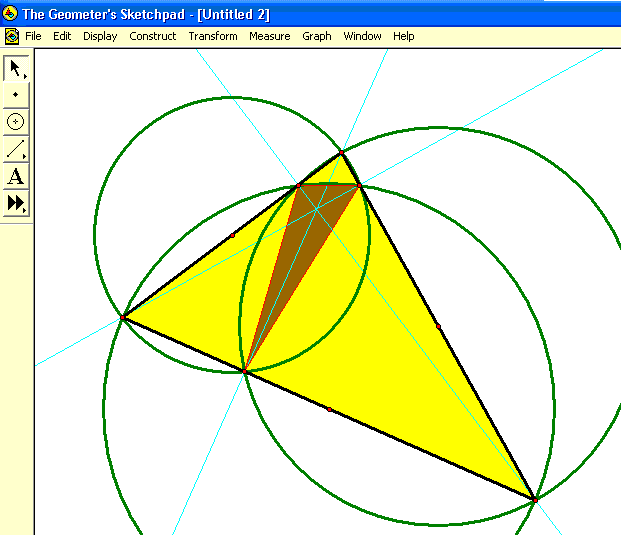
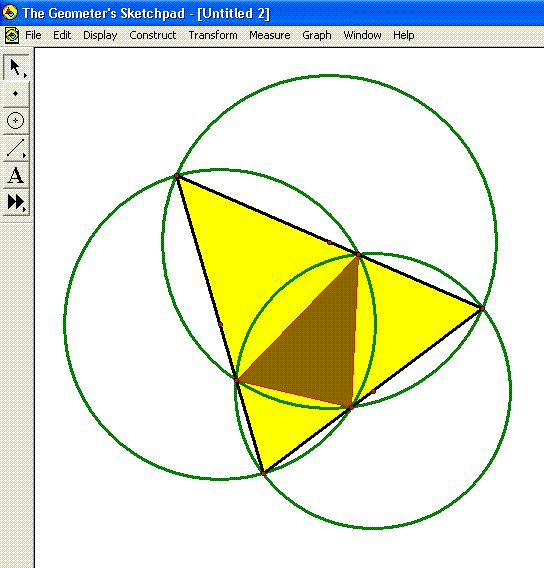
As you can see, these circles intersect on the sides of the triangles. I did not expect that, nor have I proven it. I have moved the triangle around to check to see if this remained true, and it did pass this test. If I can figure out a proof for this, I’ll post it; if one exists already, please post a comment letting me know where to find it.

Later edit: I found out that these points of intersection are the altitude feet. Here’s a diagram showing the lines containing the altitudes, meeting at the orthocenter. These blue lines also contain the angle bisectors of the brown triangle defined by the altitude feet.

triangle diameter circles

Noncongruent Triangles of Equal Area — As Many As You Want

Image

Noncongruent Triangles of Equal Area -- As Many As You Want

Should you need noncongruent triangles of equal area, here’s how to get them. Segment BX is their altitude (height). Segments AC, CD, DE, EF, FG, GH, and HJ (triangle bases) are constructed to be congruent, so each of these non-overlapping, differently-colored triangles has the same area because they have the same base and height lengths. Extend AJ as a line, add more points, using the same spacing, and you can have as many such triangles as you desire.

Triangles and Their Trideans

Image

Triangles and Their Trideans

Much work has been done on the medians of triangles: segments that connect vertices with the midpoints of opposite sides. This morning, I decided to explore what happens if the trideans are examined, rather than the medians.

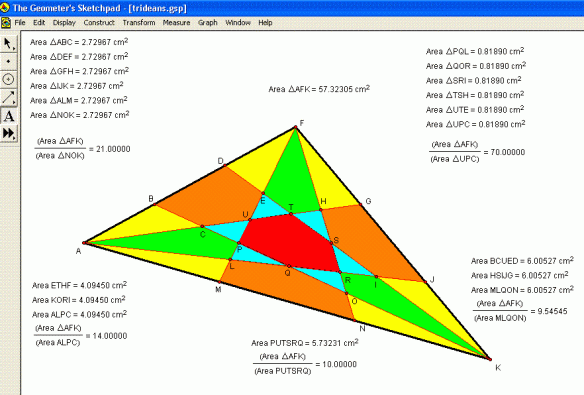
The reason you don’t know the word “tridean” is simple: I just made it up. It’s related to a median, though. To find trideans, you must first trisect, rather than bisect, each side of a triangle. This gives you two equally-spaced points on each side. To form a tridean, simply connect one of those points to the opposite vertex. Every triangle has six trideans, and they split the triangle into a set of non-overlapping polygons, as you can see in the diagram.

When I examined the area of these polygons, I started finding unexpected things right away. As you can see, polygons of the same color in this diagram have the same area, even though they are non-congruent. Moreover, these areas are interesting fractions of the area of the entire triangle. The six yellow triangles, for example, each have 1/21st of the area of the entire triangle. Each blue triangle is 1/70th the area of the large triangle. Each green quadrilateral is 1/14th the area of the large triangle. 21, 70, and 14 have one factor in common: the number seven. Seven? I officially have NO idea why sevens are popping up all over the place in this investigation, but there they are.

The red hexagon in the middle has 1/10th the area of the entire triangle, and this number surprised me as well.

The three orange pentagons took a little more work. As you can see, dividing the area of the large triangle by the area of one of these orange pentagons yields 9.5454, with the “54” repeating. This decimal is 105/11. (Eleven?) At least 105 has three as a factor (as does 21, from earlier); three is the number I expected to pop out all over the place, but it shows up little in this investigation. However, what are the other factors of 105? There’s five — and, yet again, seven.

These sevens are everywhere in this thing, and I have no idea why.

Now, of course, I have proven none of this. This is merely a demonstration and explanation of something I think is a new discovery. I did change the shape of the triangle many ways, as a test, and each of these area ratios remained constant.

If anyone can shed some light on any of this — especially all these sevens — please comment.

How Many Triangles Are Defined By a Regular Polygon and Its Diagonals?

Image

How Many Triangles Are Defined By a Regular Polygon and Its Diagonals?

A regular polygon has some number of sides (n), and its sides and diagonals form a certain number of triangles (t).

For a triangle, n=3 and t=1.

For a square, n=4. There are four triangles congruent to the one shown in orange, and four more like the one shown in light blue, so adding these gives t=8.

For a pentagon, with n=5, there are five of the purple triangles, five of the green triangles, five of the red triangles, and five of the yellow triangles, for a total of t=20.

For a hexagon, there are two of the orange triangles, six of the yellow ones, twelve of the red ones, six of the light blue ones, twelve of the purple ones, twenty-four of the green ones, twelve of the dark blue ones, six of the grey ones, six of the black ones, twelve of the pink ones, and six of the brown ones. That’s 2+6+12+6+12+24+12+6+6+12+6 = t = 104.

Three yields one, four yields eight, five yields 20, and six yields 104. At the moment, I don’t have the patience to count the triangles in a heptagon, but it would clearly be, well, quite a few.

There may or may not be a formula for this; any pattern eludes me, so far. I am reminded of the alkane series in chemistry: one isomer each of methane, ethane, and propane, two of butane, three of pentane, and so on to 75 for decane, and beyond. All efforts to find a formula for the number of isomers, in terms of the number of carbon atoms, have failed (to date). For now, these are both filed under “unsolved problems.”

UPDATE:  A friend of mine has shown me that this polygon problem has, in fact, been solved, and he provided this link:  http://oeis.org/A006600 — apparently I missed some of the triangles in the pentagon (the red and yellow combined, for example), as well as the hexagon. The correct numbers for those two polygons are 35 and 110, respectively. Aside from this update, I’m not changing the rest, for I need reminders of my own fallibility. This will do nicely.

The Joy of Rediscovery

Even if you are not the first to find something, the thrill of finding it independently is still every bit as real.

So, this morning, as I often do, I’m playing with triangles.  I constructed a triangle’s incircle, using its three angle bisectors. I also constructed the perpendicular bisector of each side, in order to construct the circumcircle.

What I didn’t expect was to find each angle bisector intersecting a perpendicular bisector on the circumcircle. The three such points of intersection (N, O, P) are the  vertices of the yellow triangle below, while the original triangle, ABC, is in bold black.

Image

“Hey, that’s pretty cool,” I thought, using Geometer’s Sketchpad to move A B, and C around, to test what I was seeing. This was certainly no proof, but now I was wondering if it was an original discovery. Google, however, revealed to me that this discovery had already been made:

http://demonstrations.wolfram.com/TheIntersectionOfAnAngleBisectorAndAPerpendicularBisector/

Well, I could be upset that someone else beat me to this discovery, I suppose, but I think I’d rather take comfort in knowing someone else has already written the proof, for I really don’t feel up to that.

At least not today.

And there is joy in rediscovery. As much as in discovery? Well, no, of course not, but life can be such that no joy should be overlooked. When you know something, and no one taught it to you, but you found it out yourself, does that not make you happy? It certainly works for me.

How I Found the Nagel Line While Playing with Triangles

Several days recently swirled down the drain in a depression-spiral. Needing a way out, I spent my Saturday morning playing with triangles, after first getting plenty of sleep. It worked. This technique, however, probably would not transfer to those who are not geometry obsessives. Perhaps any favorite activity would work? I leave that to others to explore.

Here’s what I did that worked for me:

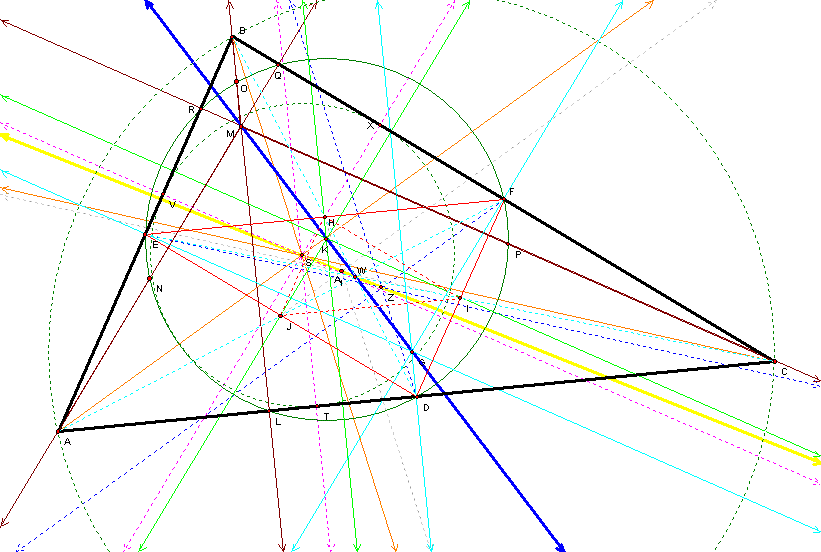
ImageThe original triangle is ABC, and is in bold black. The bold blue line is its Euler Line, and contains the orthocenter (M), circumcenter (G), nine-point center (K), and centroid (point W). It does not, however, contain the incenter (S).

It struck me as odd that the incenter would be different in this way, so I investigated it further. It is the point of concurrence of the three angle bisectors of a triangle. On a lark, I constructed the midsegments of triangle ABC, forming a new, smaller triangle, shown in red. When I then found the incenter of this smaller triangle (Z), it appeared to be collinear with S and W. I checked; it was, and this line is shown in bold yellow. Moreover, the process could be continued with even smaller midsegment-triangle incenters, and they were also on this yellow line.

I wondered if I had discovered something new, and started to check. It didn’t take long to find out that Nagel had beaten me to it. The Nagel line is the official name of this yellow line I stumbled upon, and here is my source:  http://mathworld.wolfram.com/NagelLine.html — but, as far as I know, I did discover that these midsegment-derived points also lie on the Nagel line.

Someone else may have known this before, of coruse. I don’t know, and it doesn’t matter to me, for I had my fun morning playing with triangles, and now feel better than I have in days.

[Side note:  this is my 100th post, and I’d like to thank all my readers and followers, and also thank, especially, those who encouraged me to try WordPress to get a fresh start after Tumblr-burnout. It worked!]


An Odd Tiling of the Plane

Image

An Odd Tiling of the Plane

An exploration of one way to surround points with hexagons, triangles, and squares.