Not “Dead Presidents”

Image

Not Dead Presidents

Attention, Americans:

These two men, Alexander Hamilton and Benjamin Franklin, are, indeed, dead. However, neither of them ever served as president. Therefore, please stop calling money “dead presidents,” unless you are excluding these two denominations, and, moreover, please stop this immediately.

Your cooperation is appreciated.

My Polyhedral Nemesis: The Great Icosahedron

Image

My Polyhedral Nemesis:  The Great Icosahedron

I used Stella 4d, a program you can find at http://www.software3d.com/stella.php, to make the rotating .gif file you see here. You can many such rotating pictures of other polyhedra elsewhere on this blog.

Older versions of this program would only create still images. In those days, I would also make actual physical models out of paper (usually posterboard or card stock). However, I’ve stopped doing that, now that I can make these rotating pictures.

There is one polyhedron for which I never could construct a physical model, although I tried on three separate occasions. It’s this one, the great icosahedron, discovered, to the best of my knowledge, by Johannes Kepler. Although it only has twenty faces (equilateral triangles), they interpenetrate — and each triangle has nine regions visible (called “facelets”), with the rest of each face hidden inside the polyhedron.

To create a physical model, 180 of these facelets must be individually cut out, and then glued or taped together, and there’s very little margin for error. On my three construction-attempts, I did make mistakes — but did not discover them until I had already built much more of the model. When making paper models, if errors are made, there is a certain point beyond which repair is impossible, or nearly so.

Although I never succeeded in making a physical model of the great icosahedron myself, and likely never will, I did once have a team of three students in a geometry class successfully build one. One of the students kept the model, and all three received “A” grades.

The Strange American Custom of Holiday Observance

Image

The Strange American Custom of Holiday Observance

Today is not Dr. Martin Luther King, Jr.’s actual birthday. The anniversary of his birth came, this year, last Wednesday. As you can see above, that’s January 15. However, it’s being observed today — the date circled above — to give people a three-day weekend.

That’s related to something else, apart from the sheer inaccuracy of moving a date on the calendar, that bugs me about “MLK Day,” as it is often called. It’s essentially the same thing that bothers me about Memorial Day, and Veteran’s Day. To honor people we respect and admire for their hard work — for civil rights, defending the nation in battle, or anything else — what do we often do, as a nation? We close schools, many businesses, the stock market, mail service, etc., all to give as many people as possible a day without work. How does a day off, of all things, honor the hard work of anyone?

Stephen Hawking, on His Own IQ, and IQs in General

Image

I have had my IQ tested, but, like Stephen Hawking, I have no idea what it is. The people conducting the test did not share the results with me.

This does not bother me in the slightest. Why? Because I agree with Hawking on this subject, that’s why!

Something You Likely Did Not Know, About the “Pledge of Allegiance”

Image

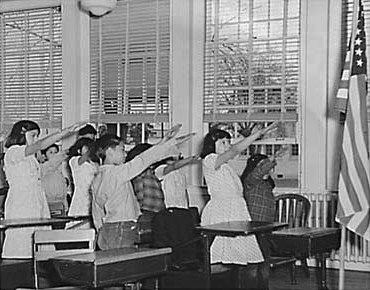
I thought I knew the (rather complicated) history of the “Pledge of Allegiance” well — until I saw this picture. This was the original “flag salute” pose American students were taught to use, nationwide, until World War II was well underway. It had been in use since 1892, and was called the “Bellamy salute.”

The current “hand over the heart” gesture didn’t go into effect until 1942, and was changed in reaction to the Nazis using essentially the same salute which you see American schoolchildren displaying in this (circa 1941) photograph. From where did this gesture really originate? A common belief is that it started in ancient Rome, but the article at http://en.wikipedia.org/wiki/Roman_salute — and the sources cited there — throw doubt on this idea. It seems that, instead, this gesture was depicted in an 1874 painting of an ancient Roman scene, spread into other neoclassical artworks, then plays and other performances, until it was well-established in the public consciousness as something the ancient Romans did — but that belief appears to be unsupported by the relatively small number of actual writings, or works of art, which have survived from ancient times.

It was twelve years after the change in the civilian American flag-salute gesture that Congress made another, much better-known change — the 1954 addition (unconstitutional, in my opinion) of the words “under God.” Just as the early gesture-change was made, in wartime, as a reaction against the practices of an enemy, arguments have been made that this change in the wording of the Pledge was made for similar reasons, given that we were then in the early years of the Cold War, with America’s enemies, in that long struggle, being what were often called the “Godless Communists.”

[Additional source, beyond the one given above: http://en.wikipedia.org/wiki/Pledge_of_Allegiance (with more sources cited at the bottom of that article)].

“Strong Grape Juice”

Image


My earliest memory of a church service involves a trip to visit relatives, and I started discovering how different from others I was at a very young age. This is one of the episodes which played a major role in that discovery.

I was only four or five years old, and had already developed an intense hatred of being bored. Ignoring the sermon seemed like an even more boring prospect that actually paying attention to it, so I consciously chose the latter, which I’ve observed is often not the choice young children make.

This church’s denomination is one of those that teaches that drinking alcohol is sinful. They are also Biblical literalists. This, of course, poses a problem, for there is a lot of drinking of wine to be found in the Bible. This preacher didn’t avoid the contradiction, though. His task, that Sunday morning, was to deal with it head-on, and he did so with the following claim: when Jesus, his disciples, and numerous other people from the Bible are described as drinking wine, that wine actually contained no alcohol. It was not wine as we know it today. It was, rather, merely “strong grape juice.” Those were his exact words.

Even at that young age, I had already started working on building, in my own mind, the best crap-detector I could possibly create. (Improving it is still something I work on today.) I didn’t yet realize that real wine would be far safer, before refrigeration existed, than grape juice, simply because alcohol, at the concentrations found in wine, kills lots of disease-causing bacteria. However, that morning, I had learned enough to instantly recognize this “strong grape juice” claim as absolute crap.

Dismissing the preacher as not worthy of further attention, I stood up in our pew, and turned around to face the back of the church. We were sitting near the front, so this let me see most of the congregation. I didn’t need to speak to them — I just wanted to look at them. I remember being stunned by what I saw. Nearly everyone appeared quite attentive to the sermon. Some mouths were half-open, and numerous heads were nodding in agreement with the preacher’s droning nonsense. I figured it out: they were actually accepting what this man was saying as the truth, and were doing so without question! They believed him! At first, I felt dizzy, and then, later, I felt sick. The more I thought about the experience, the worse I felt, and I could think about nothing else for a long time after that church service finally ended.

I’d been exposed to religion many times before, but it always seemed to me that adults didn’t really believe what they were saying, any more than when they told children my age about the Tooth Fairy or Santa Claus. At that moment, though, I realized I had been mistaken. This was no act. These people, in that church that day, actually believed what they were told. Why? I didn’t know. I still don’t. If that man told them that two plus two equals six, would they believe that? I suspected they would.

I was surrounded by a herd of sheep. That moment of clarity, when I realized this fact, scared me. It made me wonder, and not for the last nor first time, if I had been secretly planted on earth by aliens, as a baby, and without a guidebook.

This is only one of many experiences that convinced me of the importance of skepticism. The fact that it is so clear, in my memory, leads me to think it was one of the more important of those experiences. It cemented, in my mind, a scary truth: the world is infested with large numbers of incredibly gullible, deluded people. They weren’t like me. I didn’t understand them. They were everywhere. I wasn’t anything like them, and didn’t want to be, either. I was, however, stuck here with them.

I was stranded on the wrong planet, with no prospect for escape, any time soon. That was over forty years ago, and I’m still here.

The Story of the Void, Chapter Two

Image

The Story of the Void, Chapter Two

For chapter one: https://robertlovespi.wordpress.com/2014/01/18/the-story-of-the-void-chapter-one/

* * *

Richard had no way to know how long he’d been flat on his back, in a bed, in a dark, locked, otherwise-empty room. He was angered when the lights came on. They were bright. The door opened. A man in an expensive suit walked in.

Richard’s brain went into “attack mode,” and told his body to kill this intruder. Having recently undergone major abdominal surgery, though, his body wasn’t up to the task. He collapsed in a heap at the man’s feet.

“That wasn’t very smart, Richard. However, we don’t need you for your mind. You’ll work fine.” The man turned to speak more loudly, in the direction of the open door. “This one will work! Have him ready to launch in a week!”

“Launch? What launch?” Richard hadn’t been conscious since being shot by police after a killing spree. He was furious, but powerless to do anything about it. “Who are you? Don’t I get a lawyer or something?”

“You killed twenty-two people. You were captured and shot by the police. A doctor worked for hours to save you. As far as anyone knows, though, he failed. The world thinks you’re dead, and absolutely no one misses you, or will look for you. Don’t expect a lawyer. Yes, you’ll be perfect.” The man left before Richard could gather the strength to attempt attack again. The lights stayed on — for the rest of the time Richard was in the room.

Richard received drugs through an IV tube. He got angry at one point, and ripped the IV out of his arm, spraying blood all over the place. Gas then entered the room through a panel in the ceiling, and, when he could finally hold his breath no more, he inhaled a small amount, and it knocked him out.

When he next regained consciousness, he was held motionless by restraints. A new IV was in his other arm, and a feeding tube had been placed down his throat. He was surprised he didn’t gag, for he had no way to know that one of the drugs entering his body through the IV tube suppressed his gag reflex. His fury filled his thoughts, after only a little while, but it made no difference. He could do nothing except heal. A week later, he was judged healthy enough to survive a launch into space — maybe — by a team of doctors whom he never saw. Most of them had medical and/or ethical reservations, of course, and expressed them. These objections were ignored.

One doctor never voiced objections. He was the one who was monitoring this unusual patient when he had a strong sedative administered, and then taken to a small space probe, atop a tall rocket. By that point, the other doctors had all been reassigned, and some were already dead, seemingly from natural causes. The rest followed soon thereafter, by “disease” or “accident.”

Richard was still heavily sedated when the rocket was launched. Accelerating him into space nearly killed him, but that didn’t bother the computer which piloted the space probe. It didn’t need Richard’s assistance, and simply monitored his vital signs, relaying them back to Houston Space Central. He had no viewport, and so did not know that he had been placed into orbit around the sun, in earth’s orbit, but in the opposite direction.

Months earlier, a powerful, automated telescope, in solar orbit, had detected something no one in NASA had been able to explain. It was located in earth’s orbit, also, on the far side of the sun, where the earth would be or was, six months into the future or past. It revolved around the sun at the same speed as the earth, and in the same direction. It might have just appeared there, or it might have been there for billions of years. There was no way to tell, for the simple reason that no one had looked at that region of space before.

After it was discovered that the object’s x-ray signature resembled that of a black hole, the decision was quickly made to keep the anomaly a secret, lest a panic begin. In other wavelengths, though, it appeared as a planet-sized object of the expected temperature, or didn’t appear at all. The distribution of readings along the electromagnetic spectrum baffled all who were allowed access to this discovery. It wasn’t perturbing any orbits with the gravitational pull it would have if it had, say, the mass of the earth, or even of earth’s moon. As far as NASA’s scientists could tell, it had no gravitational effect on anything.

A robotic probe was sent to the far side of the sun, equipped with observational and communications equipment. It sent signals, right up to the point when it had encountered the anomaly. At that moment, it fell permanently silent.

The loss of a $950,000,000 space probe would be hard to hide from Congress, so the second probe, the one containing Richard Wayne Dahmer, was stripped down, and less expensive. It did not have the sophisticated sensing equipment on the first probe. It was sent simply to learn what effect, if any, close proximity, and then an actual encounter with, the enigma in earth’s orbit would have on a human being, and then send that medical data back to earth. No well-known, expensively-trained astronaut was needed; what was, rather, was someone deemed completely expendable. Richard, therefore, fit the criteria for this mission perfectly. No one connected to the mission saw any reason to inform Richard, himself, of any of this, and so he had no idea what awaited him. But, then again, neither did those people who merely thought they were controlling his mission.

He got furious, repeatedly, but that didn’t matter. After three months, his windowless probe encountered the anomaly. Once again, mission monitors for NASA saw all communications from a probe go dark, all at the same time. The conclusion was that the anomaly was incompatible with human life, and that the involuntary passenger on the probe had died.

Richard wasn’t dead, however. He, and his probe, fell into the mysterious singularity. Like a black hole, it had an event horizon. The probe passed through it, entering a void out of which it could send no signals back to earth, and inside which it detected, just as it vanished, the first, purely-robotic probe NASA had sent. The message about this discovery could not escape the event horizon, however, and so there it stayed.

The singularity woke up. It was conscious now. It had reversed direction, acquiring the momentum of Richard’s probe, in its entirety, as if the singularity itself had no mass. It was headed toward earth, along that planet’s orbit. It also vanished from the view of the sun-orbiting telescope which had first detected it. No one on earth knew it was coming.

Richard Wayne — no, just Richard, that was enough, he needed no other name now — was awake, and undrugged, now. There was no evidence of the probe that had held him for the last three months. He saw only the void. He didn’t see the singularity. He was the singularity, and the singularity was him.

The brain tumor that had been exerting ever-increasing pressure on that part of the brain responsible for moral reasoning — for ethical behavior — was now gone, along with Richard’s physical brain, itself. Only his consciousness remained, unimpaired by the undiscovered tumor which had turned him into a raging psychopath.

He wasn’t angry any longer, and, although he didn’t know it, he was now heading towards home.

* * *

The Story of the Void continues here: https://robertlovespi.wordpress.com/2014/02/01/the-story-of-the-void-chapter-three/.


The Story of the Void, Chapter One

Image

The Story of the Void, Chapter One

He couldn’t blame his parents for naming him Richard Wayne Dahmer. He was born years before Richard Ramirez, John Wayne Gacy, or Jeffrey Dahmer had killed their first victim, after all. However, he was not so old that he escaped being tormented in school because he shared names with serial killers.

He hated school, and had dropped out.

Richard had then, predictably, found a low-paying job. He was a janitor. Dealing with other people’s trash, and cleaning things, wasn’t a big deal to him. He found the job easy. He stayed there a few years, and finally moved out of his parents’ house, and into the lowest-rent studio apartment he could find.

Then, one day, everything changed for him. It was payday, and, when his shift was over, not having a bank account, he walked to a nearby grocery store which cashed checks for a small fee. Leaving for home, he was followed. It was getting dark. No one was around when a bigger man stepped around the corner of a building, pulled a gun on him, and demanded his money.

There was no fear in Richard. There was only rage. Richard lunged at the man, and struck him with both hands, on the side of the man’s head. This did, of course, give the would-be robber a chance to fire the gun, and the bullet did hit Richard, but it didn’t kill him. He was moving so fast, in a weaving path, that the robber nearly missed, and the bullet merely grazed Richard’s neck. He was bleeding, but not heavily.

The other man didn’t fare so well. After Richard hit his head, as hard as he could, it slammed into side of the nearby building. Knocked unconscious, he dropped the gun as he fell to the sidewalk, and stopped moving, except to breathe. His eyes were closed.

With his attacker unconscious, Richard was completely out of danger, but his rage didn’t fade. Three hundred dollars was all he had, and this guy had tried to take it by force? Without pausing to think, Richard already had his hands around the guy’s throat. He tightened his grip. Just as the choking man made his final noises, a third person came around the corner of the building. Amy Fletcher was blonde, five foot five inches tall, and dressed like she was on the hunt for sex. She wasn’t expecting to see a man getting strangled, and she screamed when she found herself facing exactly that.

“No witnesses,” said Richard, primarily to himself, and he grabbed the nearby, dropped gun. Amy ran, back the way she had come. Richard followed her until he could see her retreating form clearly, and then he stopped, aimed the gun as best he could, and fired.

This was Richard’s first time to ever fire anything bigger than a BB gun, and he missed. He fired three more times, and missed each of those times, as well. The fifth shot, however, severed Amy’s femoral artery, and she bled out within two minutes. Richard saw her drop, assumed she was dead, and simply ran. Another woman who lived nearby heard the shots, and called 911. The police arrived quickly, and found the two bodies, but Richard was gone.

When police detectives had blood from the crime scene analyzed, though, they learned that three blood types were present, The O-negative blood was that of the strangled man, and the B-positive blood was found to be Amy’s. There was no body to match up with the A-positive blood from Richard’s neck, and spots of it were later found, in a winding trail, leading generally South for nearly six blocks. At that point, Richard’s wounds had clotted, and no more blood had fallen for the police to find.

His rage still consumed him, however. The next person he encountered, he decided, would be the third one to die that night.

After that, there was a fourth. Before sunrise, a fifth was added. When the sun came up, Richard stumbled upon a manhole, removed the cover, and lowered himself into the sewer-drain below, then replaced the cover. There was very little water in the tunnel underneath, but it had a foul smell. He found a dry spot, laid down, and went quickly to sleep.

After sleeping for about twenty minutes, Richard had a seizure. He had several more before waking up, many hours later. When he found another exit, it was dark again. He was calm.

He was calm, that is, until he encountered another human being. At that point, the rage returned, and he started killing again. He killed many, one after another, that second night. The day after, he slept under a bridge. This time, the police caught him. Once awake, he resisted. The police, acting in self-defense, shot him.

Everything went black for Richard. He did not know about the ambulance arriving on the scene minutes later, or the successful efforts of a surgeon, working for hours at a nearby hospital, to save his life.

Few others knew about this success, either. The doctor was found dead shortly thereafter, the victim of an apparent heart attack — and the official spokesman for the hospital announced that Richard Wayne Dahmer, suspected killer of twenty-two people, had died in surgery. No one outside his family mourned his fabricated death. Not even his family questioned it, for a cadaver from the hospital’s morgue was altered to resemble Richard. The ruse worked, and Richard’s shocked parents were fooled.

Richard was alone, and awake, in a completely dark room, weeks later, his rage finally fading. As far as anyone but his captors knew, he was as dead as his victims.

* * *

This story continues here:  https://robertlovespi.wordpress.com/2014/01/19/the-story-of-the-void-chapter-two/

How Far Have I Traveled?

Image

How Far Have I Traveled?

Earth’s average orbital speed is a mind-blowing 108,000 kilometers per hour — fast enough to travel one earth-diameter in just seven minutes or so. At that speed, surviving on this ball of rock for 46 years, as of today, means that I have traveled roughly 43 billion kilometers in my lifetime, just due to earth’s motion around the sun. Also, by the way, NO, I will not convert this speed, nor this distance, into those annoying non-metric units!

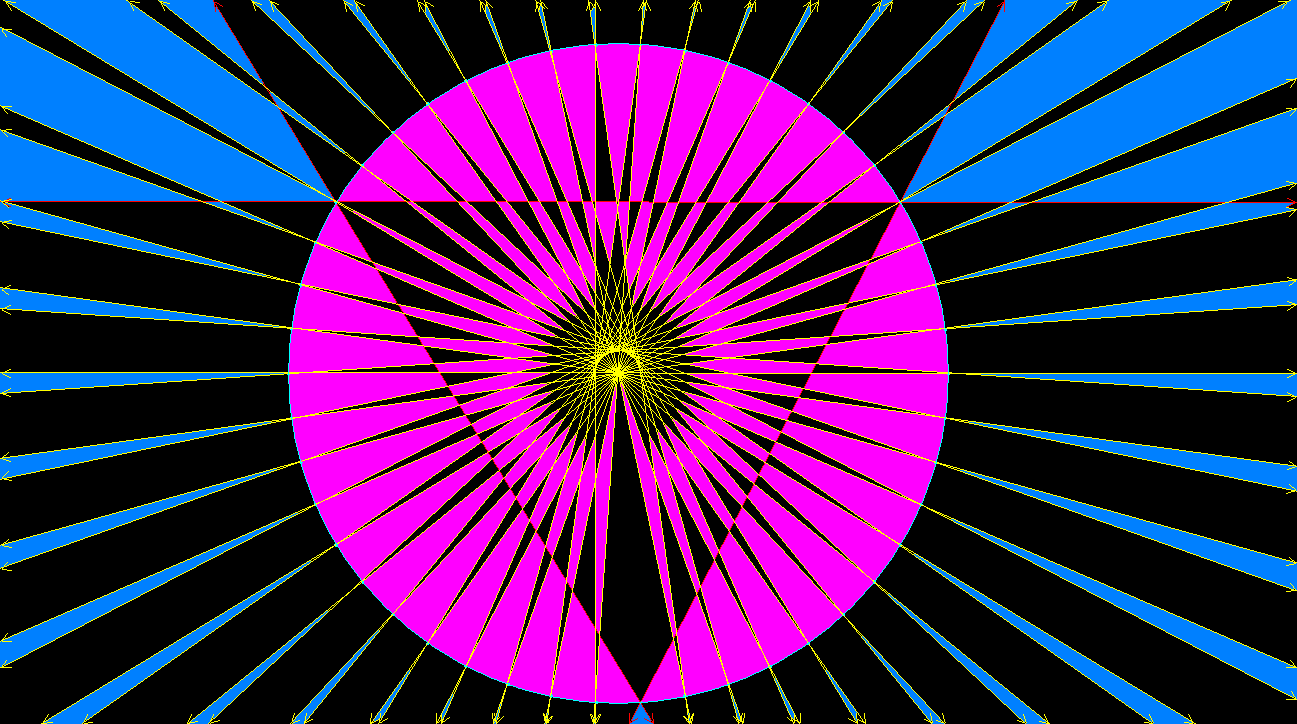
Star 46

Image

Star 46

I started a personal tradition 43 years ago, on the day I turned three years old, of associating stars with my birthday. On that day, I looked up in the sky, and saw the three stars of Orion’s Belt: Alnitak, Alnilam, and Mintaka. Given that these three stars were bright, and formed a fairly straight line, and given that I was turning three that day, it seemed perfectly obvious that those three stars had been placed there, in the sky, specifically for me — and so, that day, I claimed them as my personal property. (No one has ever accused me of lacking ego, nor self-confidence.)

As a young child, the science that most fascinated me was astronomy. In more recent years, my interest in stars has become more focused on the geometrical figures called stars, or star polygons — and so, now, rather than looking for my birthday stars in the sky, I always use geometry to construct some star, or starlike pattern, based on the number of years I have survived, to date. This is the one for the number 46, my age as of today.