On Classification of Concave Polygons By Number of Concavities

Image

On Classification of Concave Polygons By Number of Concavities

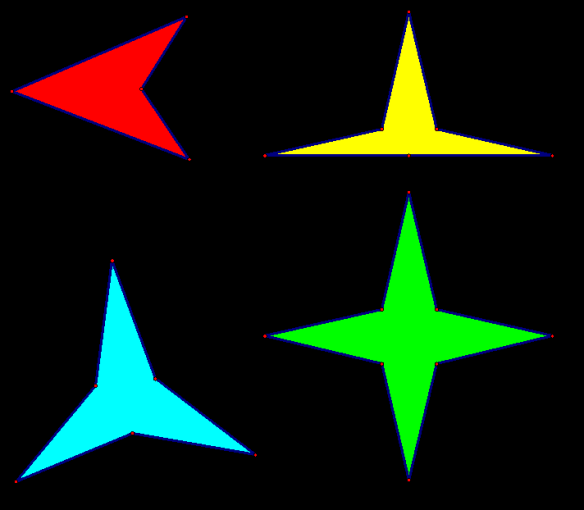
Concave triangles do not exist, so concavity does not appear in the examination of polygons by ascending side length until the quadrilateral. A quadrilateral may only have one concavity, as shown in the red figure. Any polygon with exactly one concavity is called a uniconcave polygon.

Beginning with pentagons, the potential for two concavities appears. A polygon with two concavities, such as the yellow pentagon shown here, is a biconcave polygon.

Triconcave polygons, such as the blue hexagon here, have exactly three concavities. It is not possible for a triconcave polygon to have fewer than six sides.

For a tetraconcave polygon, with four concavities, at least eight sides are needed. The example shown here is the green octagon.

For higher number of concavities, simply double the number of sides to find the minimum number of sides for such a polygon. This pattern begins on the bottom row in the diagram here, but does not apply to the polygons shown in the top row.
A Tessellation Featuring Regular Heptagons

Image

Tessellation Featuring Regular Heptagons

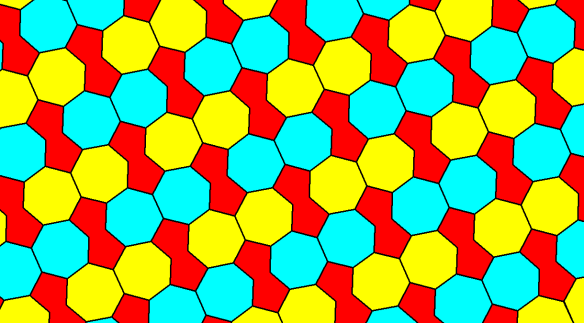
Regular heptagons, of course, can’t tile a plane by themselves. Of all tessellations of the plane which include regular heptagons, I think this is the one which minimizes between-heptagon gap-size (the parts of the plane outside any heptagon). However, I do not have a proof of this. The shape of each of the polygons which fill the “heptagon-only gaps” is a biconcave, equilateral octagon. With these octagons, this is a tessellation, but without them, it wouldn’t fit the definition of that term.

[Later edit:  on Facebook, a friend showed me two others with smaller gap-sizes. In other words, the conjecture above has now been shown to be wrong.]

An Icosahedron Variant Featuring Kite-Stars

Image

An Icosahedron Variant Featuring Kite-Stars

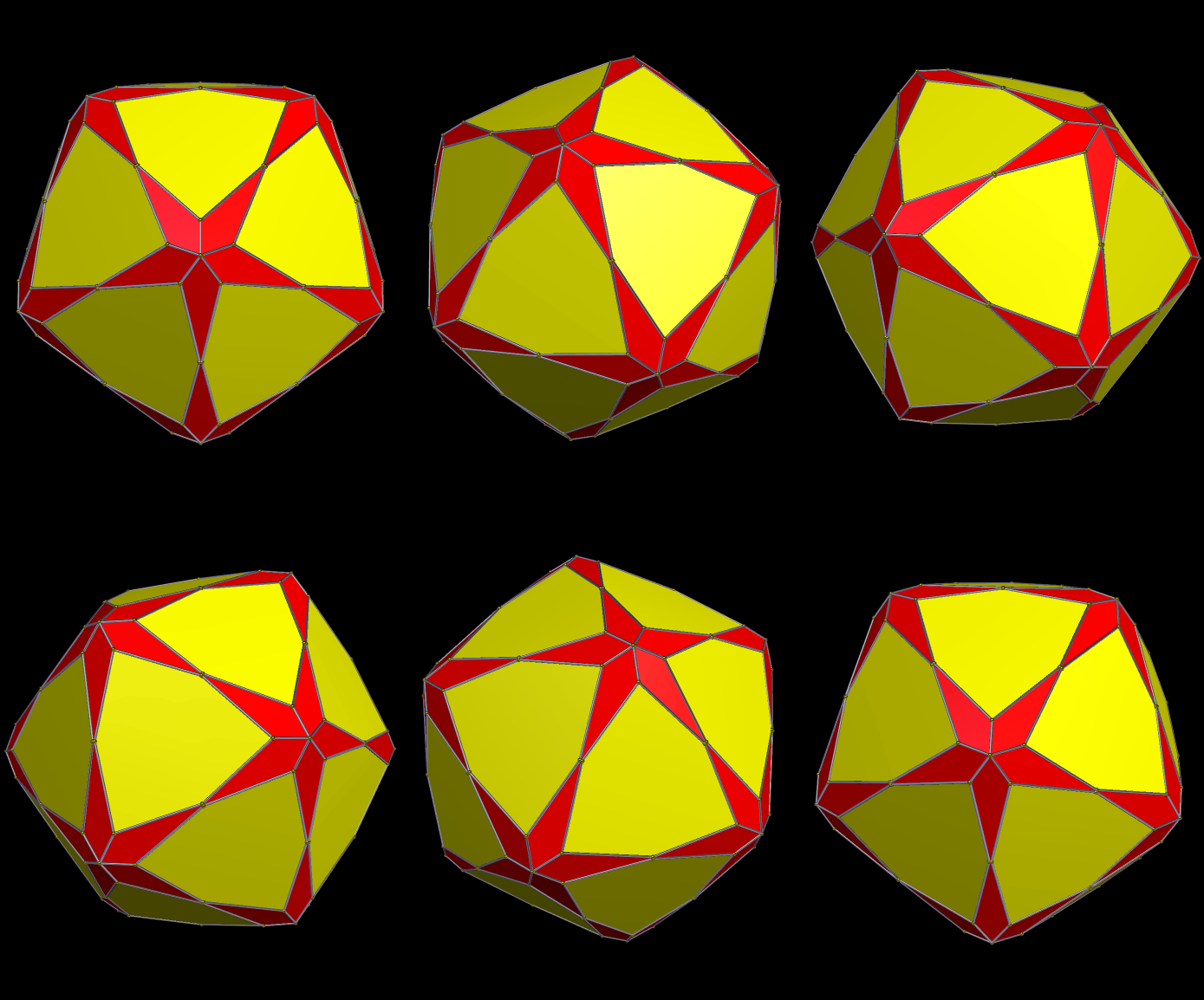
This variant of the icosahedron has five kites meeting at each of its twelve vertices, forming what I call the twelve “kite-stars” of this polyhedron. Also, two kites meet at the midpoint of each of the icosahedron’s thirty edges. The emplacement of the kites changes the triangular faces of the icosahedron into equilateral, but non-equiangular, hexagons.

Software credit: see http://www.software3d.com/stella.php to try or buy Stella 4d, the software I used to create this image.

A Variant of Kepler’s Stella Octangula

Image

A Variant of Kepler's Stella Octangula

Johannes Kepler named the compound of two tetrahedra the “stella octangula,” thus helping make it one of the best-known polyhedral compounds today. This variant uses triakis tetrahedra in place of the Platonic tetrahedra in that compound. The triakis tetrahedron is a Catalan solid, and is dual to the truncated tetrahedron.

Software credit: see http://www.software3d.com/stella.php to try or buy Stella 4d, the software I used to create this image.

The Compound of Six Dodecahedra

Image

The Compound of Six Dodecahedra

Some polyhedral compounds are well-known, such as the compound of five cubes, while others are less famous. I had never heard of this compound before building one today (virtually, not as a physical model). However, a quick Google-search told me that I was not the first person to discover it.

Software credit: see http://www.software3d.com/stella.php to try or buy Stella 4d, the software I used to create this image.

Long, Narrow, Multicolored Hexagons As the Edges of a Rotating, Hollow Rhombic Dodecahedron

Image

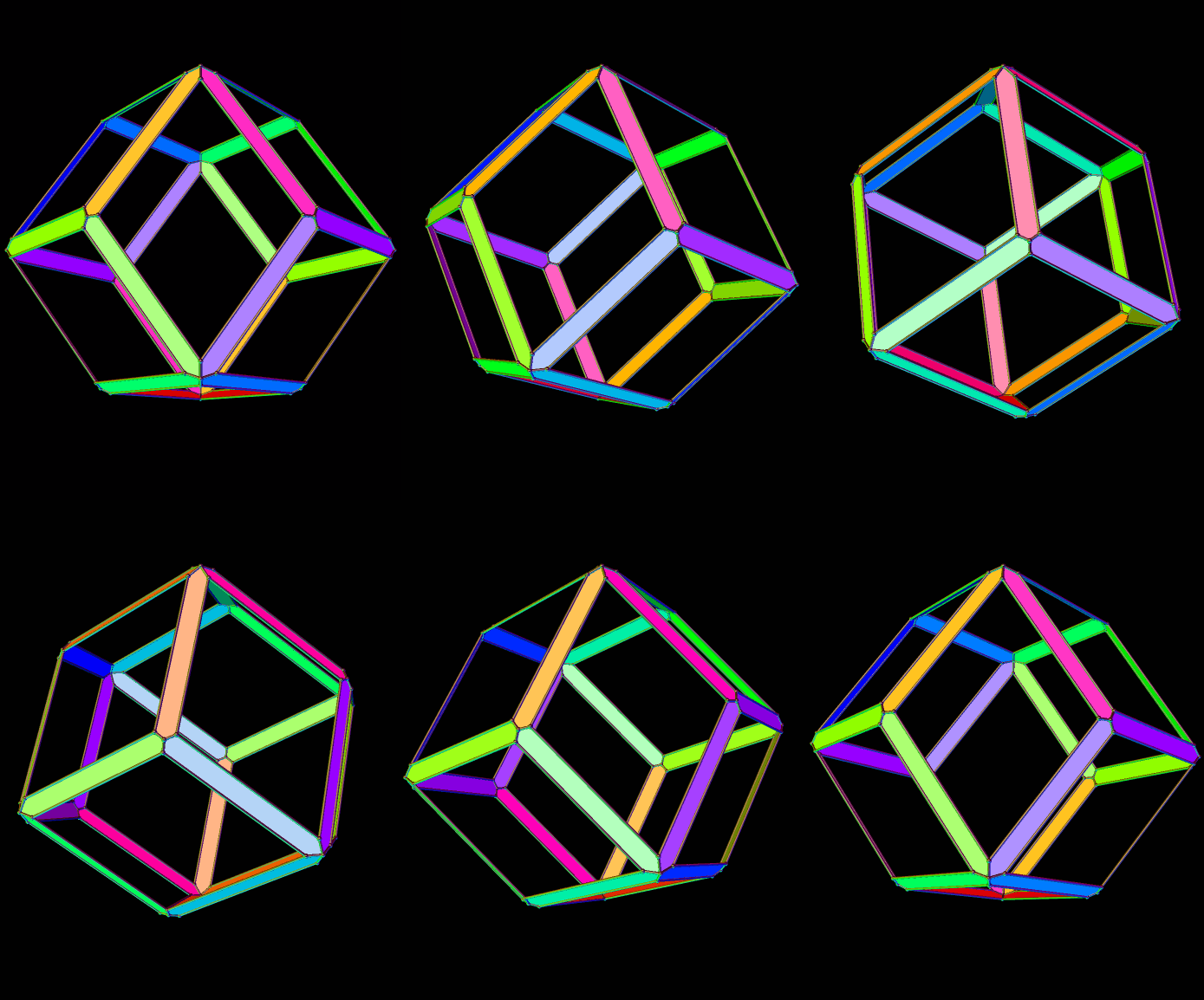
Long, Narrow, Multicolored Hexagons As the Edges of a Rotating, Hollow Rhombic Dodecahedron

Software credit: see http://www.software3d.com/stella.php to try or buy Stella 4d, the software I used to create this image.

A Close-Packing of Space, Using Three Different Polyhedra

Image

A Close-Packing of Space, Using Three Different Polyhedra

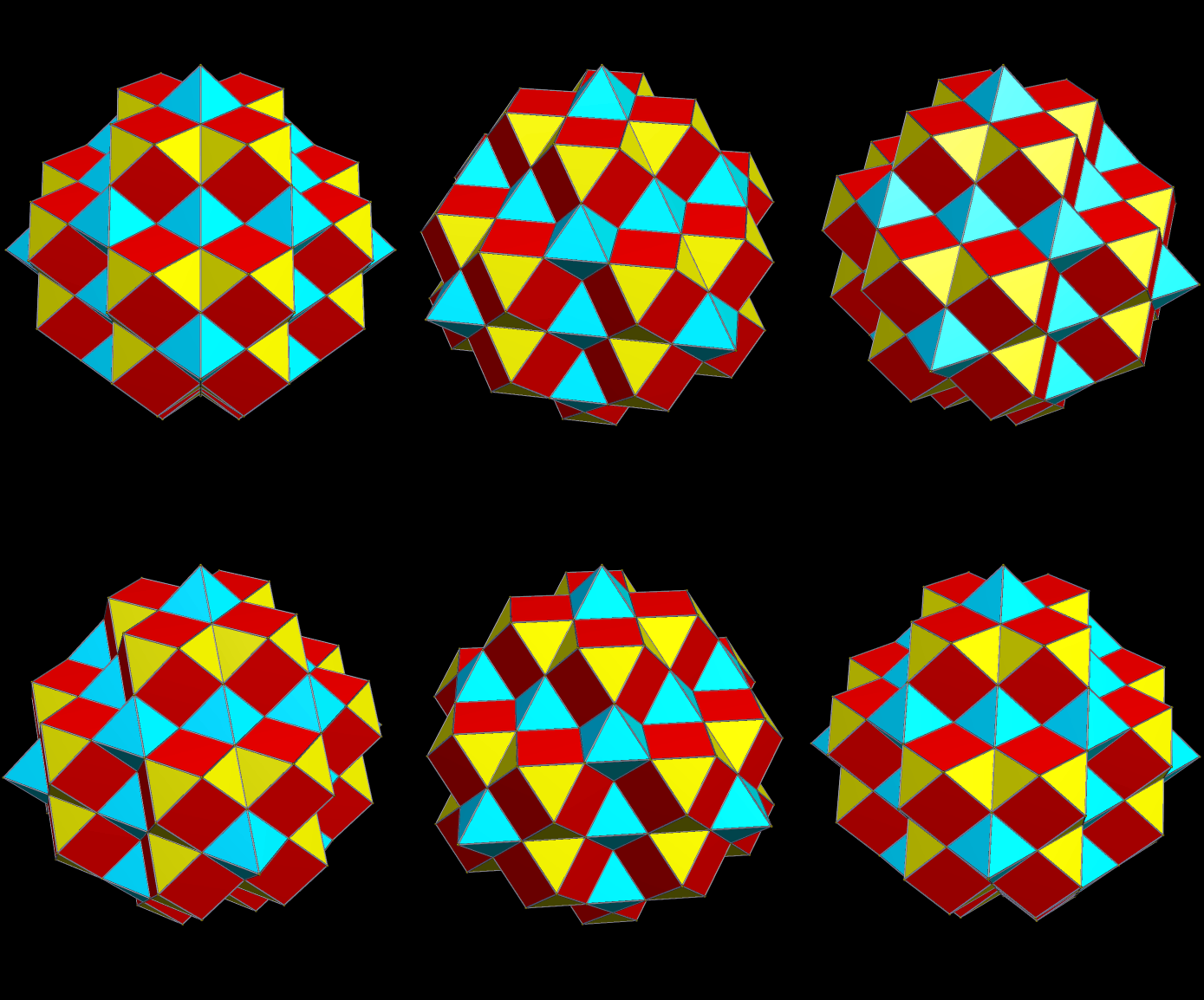
This is like a tessellation, but in three dimensions, rather than two. The pattern can be repeated to fill all of space, using cubes (yellow), truncated octahedra (blue), and great rhombcuboctahedra, also known as truncated cuboctahedra (red).

Software credit: see www.software3d.com/stella.php to try or buy Stella 4d, the software I used to create this image.

One Aspect of Having Asperger’s (at least for one of us)

Image

One Aspect of Having Asperger's (at least for one of us)

Aspies (a term for ourselves, used by those with diagnosed or undiagnosed Asperger’s) sometimes have trouble understanding what people say, because we tend to view things literally, while many others often say things in non-literal, or even anti-literal, ways.

For example, without reasons known to us, person A says something offensive to person B. Why deliberately offend someone, without good cause? We don’t know. Person B then says, in response, “Say that again!” — and Aspies who hear this (and we do, for we’re everywhere) often become even more confused. Clearly, person B does not actually want to be offended again, yet is telling person A to do exactly that which person B does not really want person A to do. I’ve asked people to explain this behavior more than once, tried to understand it, and each time I revisit the subject, I become more confused than before, for understanding the explanation would involve bending my mind in a direction it simply won’t bend. I also must admit I do not want my mind to bend that direction, either, for fear that doing so would weaken my ability to reason logically.

This is true for much of what I hear. Things that do not make logical sense are inherently hard to understand, at least for us . . . and I don’t even understand why everyone isn’t like us in this respect, either.

Cluster of Twenty Snub Dodecahedra

Image

Cluster of Twenty Snub Dodecahedra

This was made by the augmentation of an icosahedron, using snub dodecahedra on each of its twenty faces. I used software available at http://www.software3d.com/stella.php.

A Space-Filling Pair of Polyhedra: The Cuboctahedron and the Octahedron

Image

A Space-Filling Pair of Polyhedra:  The Cuboctahedron and the Octahedron

There are only a few polyhedra which can fill space without leaving gaps, without “help” from a second polyhedron. This filling of space is the three-dimensional version of tessellating a plane. Among those that can do this are the cube, the truncated octahedron, and the rhombic dodecahedron.

If multiple polyhedra are allowed in a space-filling pattern, this opens new possibilities. Here is one: the filling of space by cuboctahedra and octahedra. There are others, and they are likely to appear as future blog-posts here.

Software credit: I made this virtual model using Stella 4d, polyhedral-manipulation software you can buy, or try as a free trial download, at http://www.software3d.com/Stella.php.