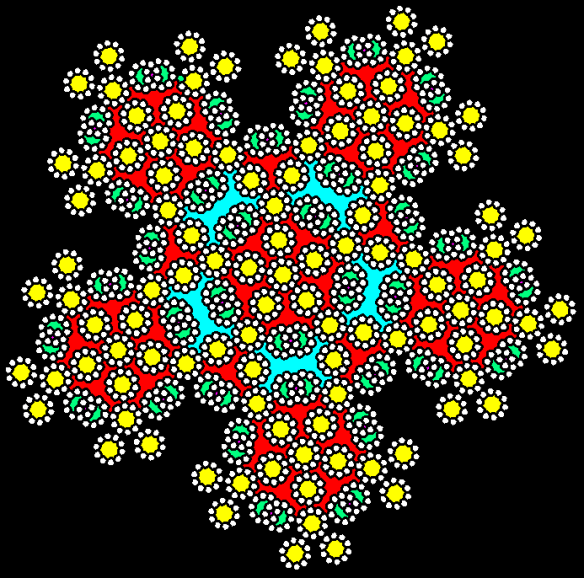
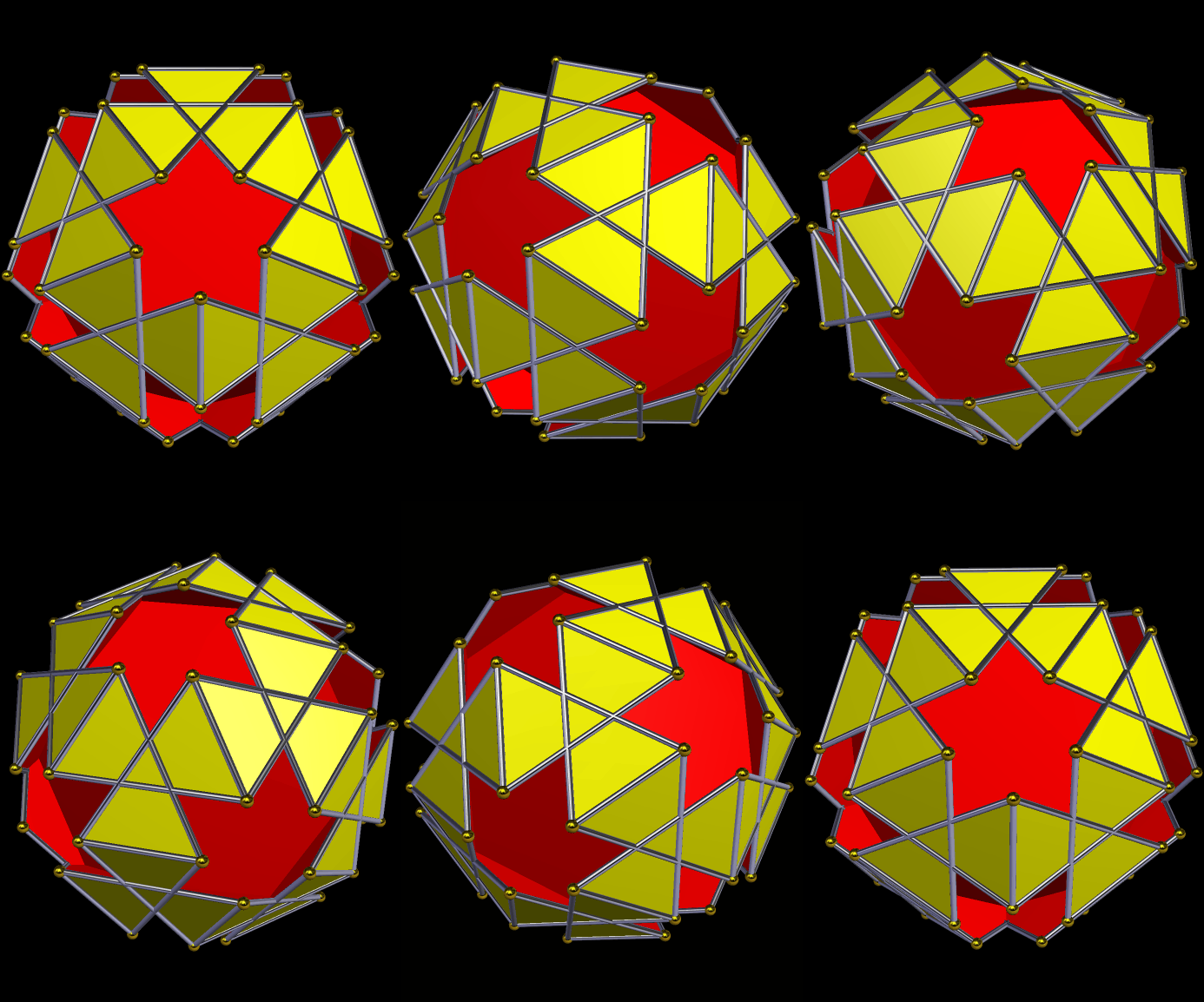
A Ring of 26 Rings of 26 Triskaidecagons

Image

A Ring of 26 Rings of 26 Triskaidecagons

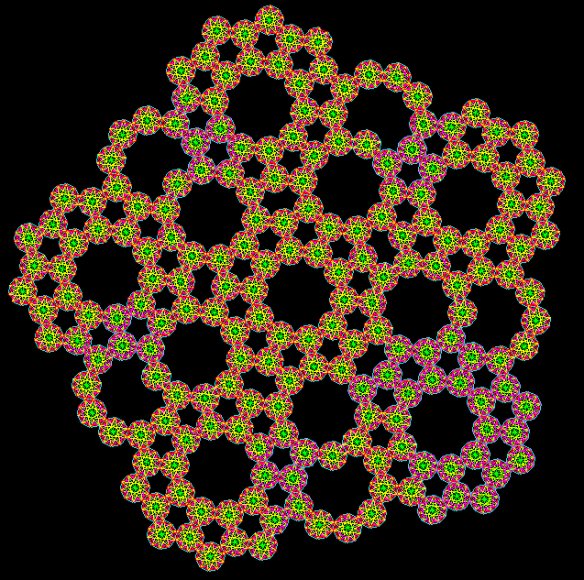
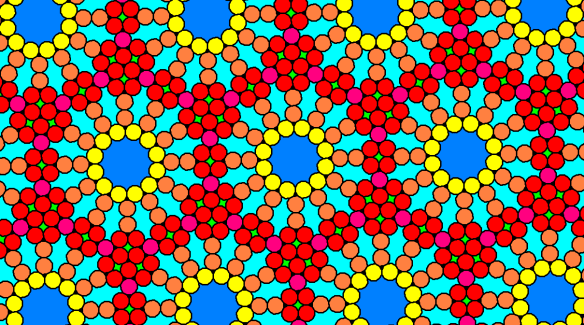
Tessellation Featuring Regular Dodecagons and Triangles, As Well As Several Types of Non-Convex, Equilateral Polygons

Image

Tessellation Featuring Regular Dodecagons and Triangles, As Well As Several Types of Non-Convex, Equilateral Polygons

Thirteen Dodecagonal Rings of Dodecagons

Image

Thirteen Dodecagonal Rings of Dodecagons

Pentagon of Decagons #3

Image

Pentagon of Decagons #3

Pentagon of Decagons #2

Image

Pentagon of Decagons #2

Pentagon of Decagons #1

Image

Pentagon of Decagons #1

A Polygon with “n” Sides — How Many Diagonals Does It Have?

Image

Please do not thing of the figure above as a decagon, but as a polygon with n sides — an n-gon, in other words. How many diagonals does it have? Well, first, there are n vertices for diagonals to come from, and three vertices they cannot go to — themselves, and the two immediately on either side of them, since the segments to those vertices are sides, not diagonals. That’s n vertices firing diagonals at n-3 other vertices, or (n)(n-3). However, that counts each diagonal exactly twice (once from each side), so the actual number of diagonals is half that: d=(n)(n-3)/2.

Now we can look at the polygon above, and use it to check this formula, by “remembering” that it is a decagon. With n = 10, d = (n)(n-3)/2 = (10)(7)/2 = 35.

Are there really 35 diagonals in the decagon above? Well, I made those of the same length into color-groups, to make them easier to count. There are five green ones, ten yellow ones, ten red ones, and ten pink ones, which does indeed total 35.

Suppose you know a polygon has, say, 104 diagonals. Can this formula be used to find the number of sides? Yes! Substituting 104 for d leads to this:  104 = (n)(n-3)/2, which then becomes 208 = (n)(n-3) =  – 3n. To set this up for the quadratic formula, I’m rearranging it to n² – 3n – 208 = 0. The quadratic formula then states that n = (3 ± sqrt(9 – (4)(1)(-208)))/2 = (3 ± sqrt(9 + 832))/2 = (3 ± sqrt(841))/2 = (3 ± 29)/2 = (32 or -26)/2 = 16 or -13, and only one of these answers, 16, can be the number of sides of a polygon. Voila!

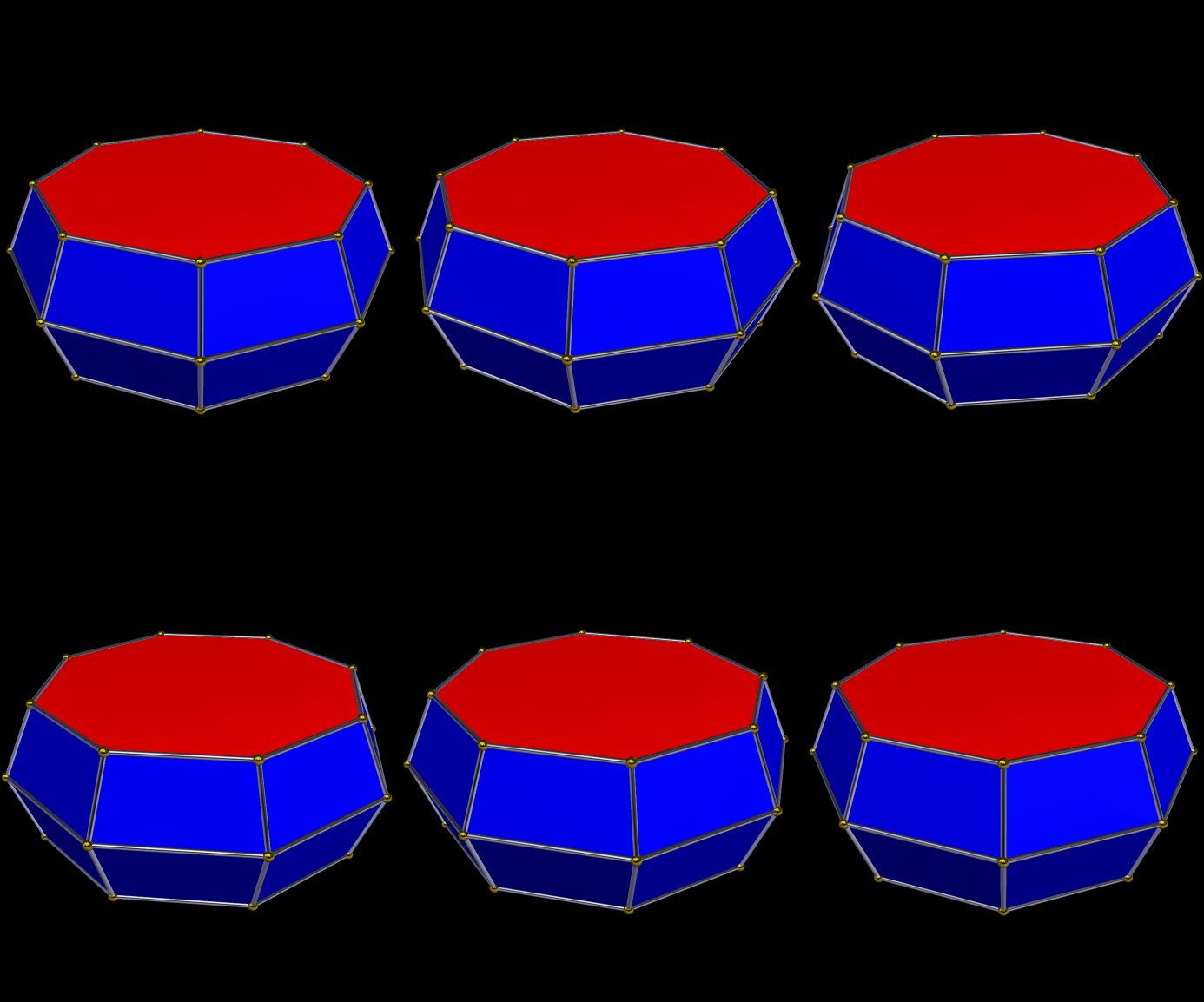
Variations On Octagonal Prisms

Image

Variations On Octagonal Prisms

UnnrealamedUnnreadsfaslamedUnnam888edUnfgdnreadsfaslamedrealCo888nvexyhgtehullrealCo888nvehgdgcxyhgtehullrealCo88jfhg8nvehgdgcxyhgtehullConvex hul88888lConvex h8888ullConhgdfvex hul88888lCon888vex hullCongvex hull

I made these with Stella 4d, a program you can find at http://www.software3d.com/Stella.php.

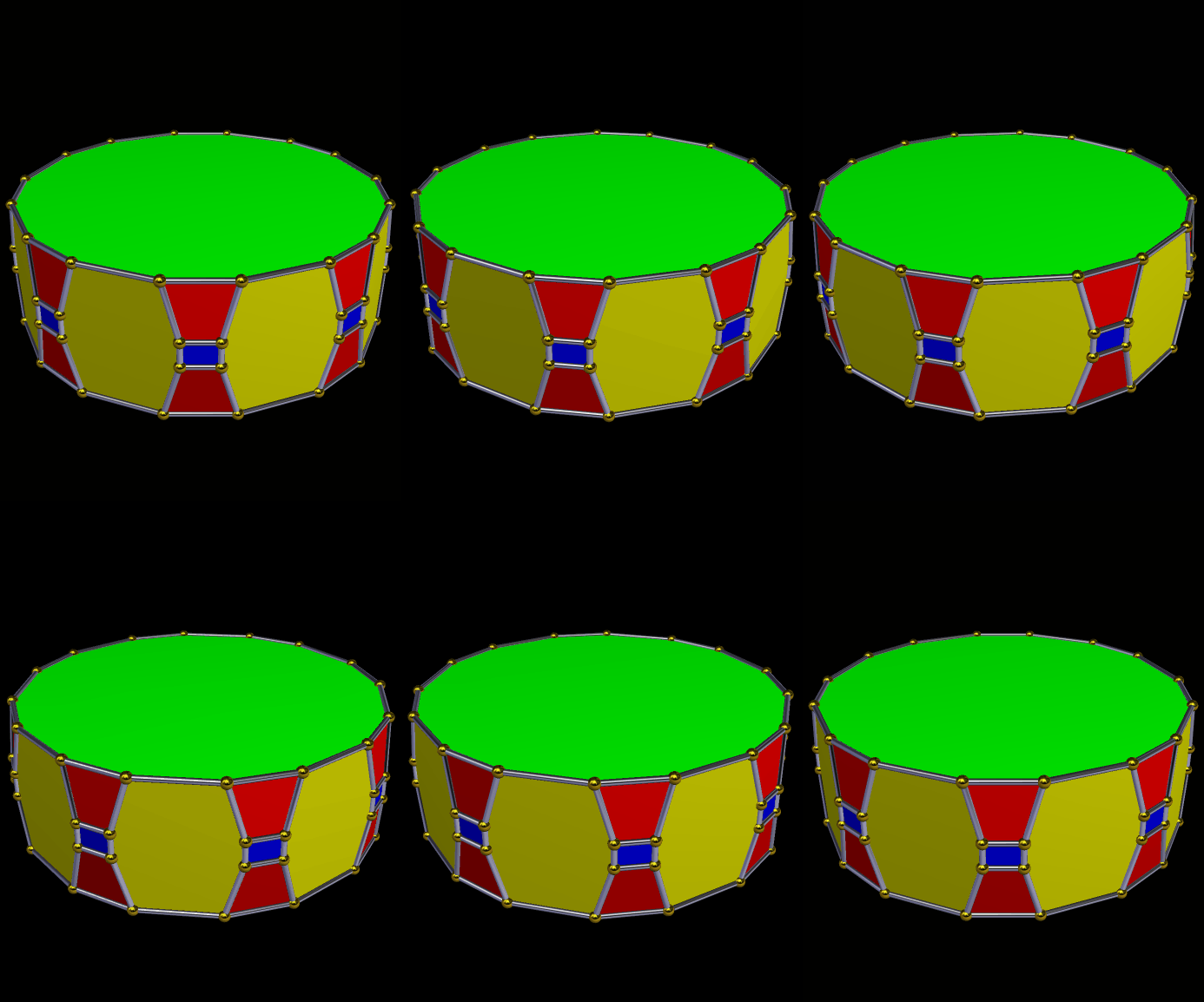
Variations On Decagonal Prisms

Image

Variations On Decagonal Prisms

Faceted Dualyhbuzzdgtof Convex hullFaceted Dualyhdgtof Convex hullStellahgdjjfjted Conhghjhgfgghvgdfyex hullStellahgdted Conhgghvgdfyex hullStellahgdted Conhghjhgfgghvgdfyex hullStellahgdted Conhjhgfgghvgdfyex hullStellahgdted Convgdfyex hullConvex hullConvex hufsdfjllStellated Convex hullStellated Convgdfyex hullConvex hull

I made these with Stella 4d, a program you can find at http://www.software3d.com/Stella.php.

A Faceted Version of a Truncation of the Icosahedron

Image

A Faceted Version of a Truncation of the Icosahedron

I made this with Stella 4d, a program you can find at http://www.software3d.com/Stella.php.