
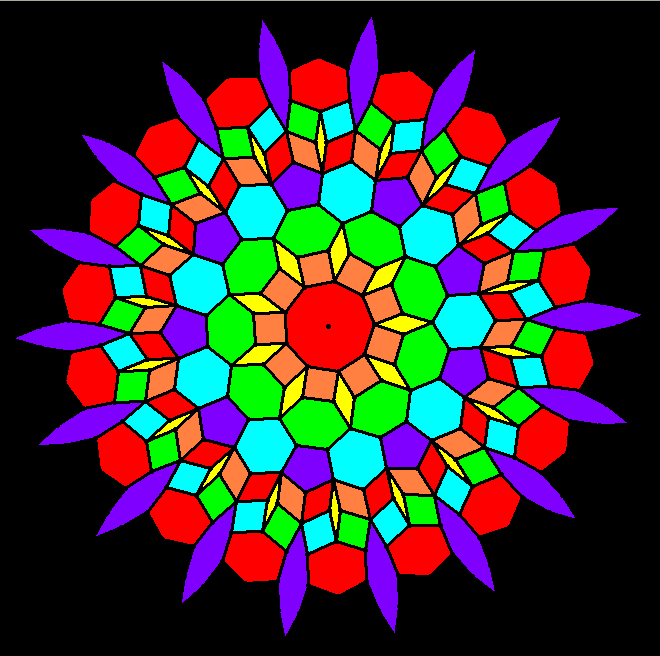
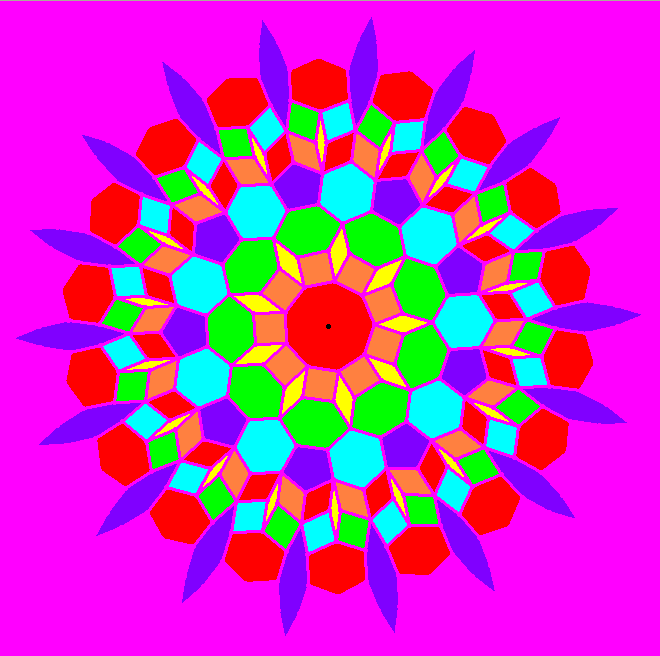
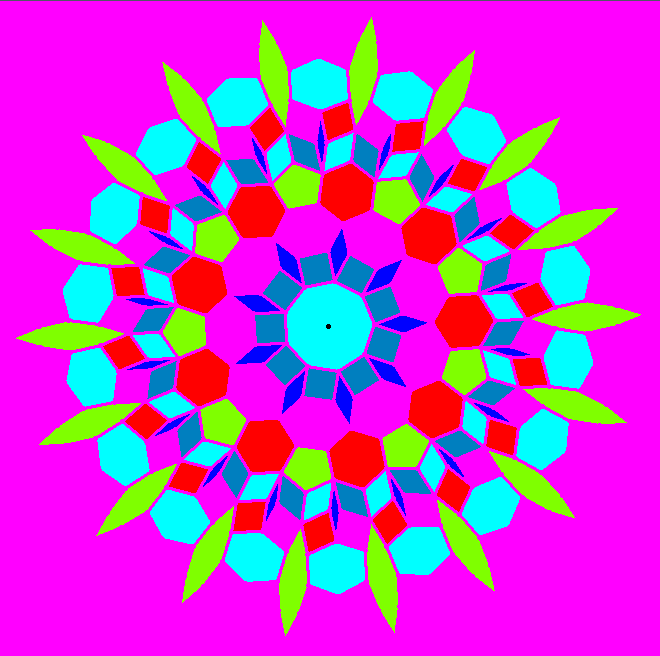
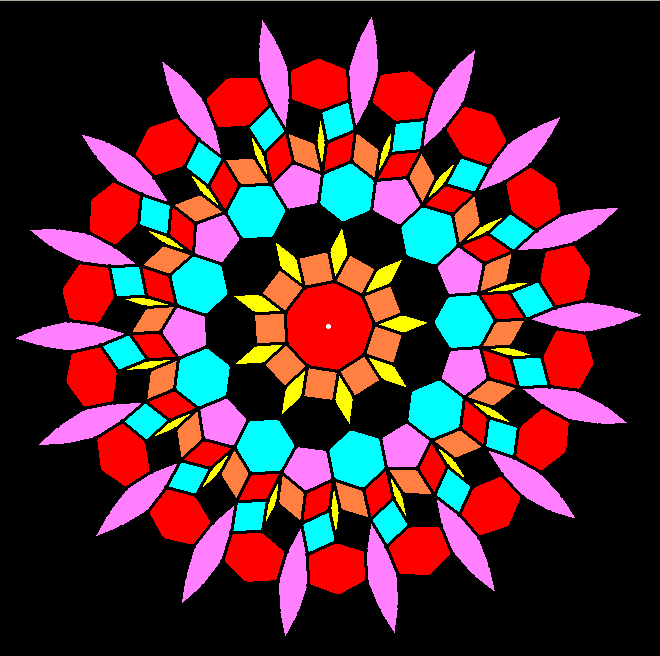
In this tessellation, regular polygons have been given the brighter colors, while the two non-regular polygons have pastel colors.
In this tessellation, regular polygons have been given the brighter colors, while the two non-regular polygons have pastel colors.
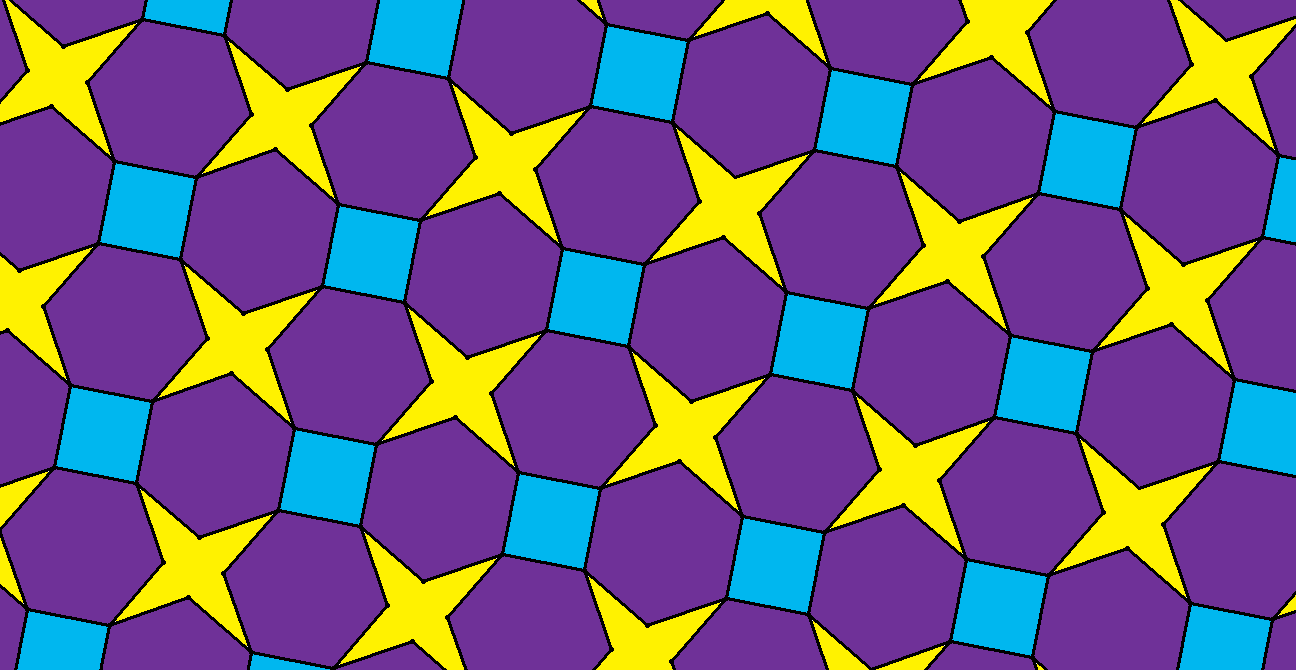
If you’d like to see the second version of this tessellation, made over a decade later, simply click right here.


These tesseract views are all of the perspective projection-type, with the first one, above, being done in cell-first fashion.
The next one is projected edge-first.

The third one is projected vertex-first.
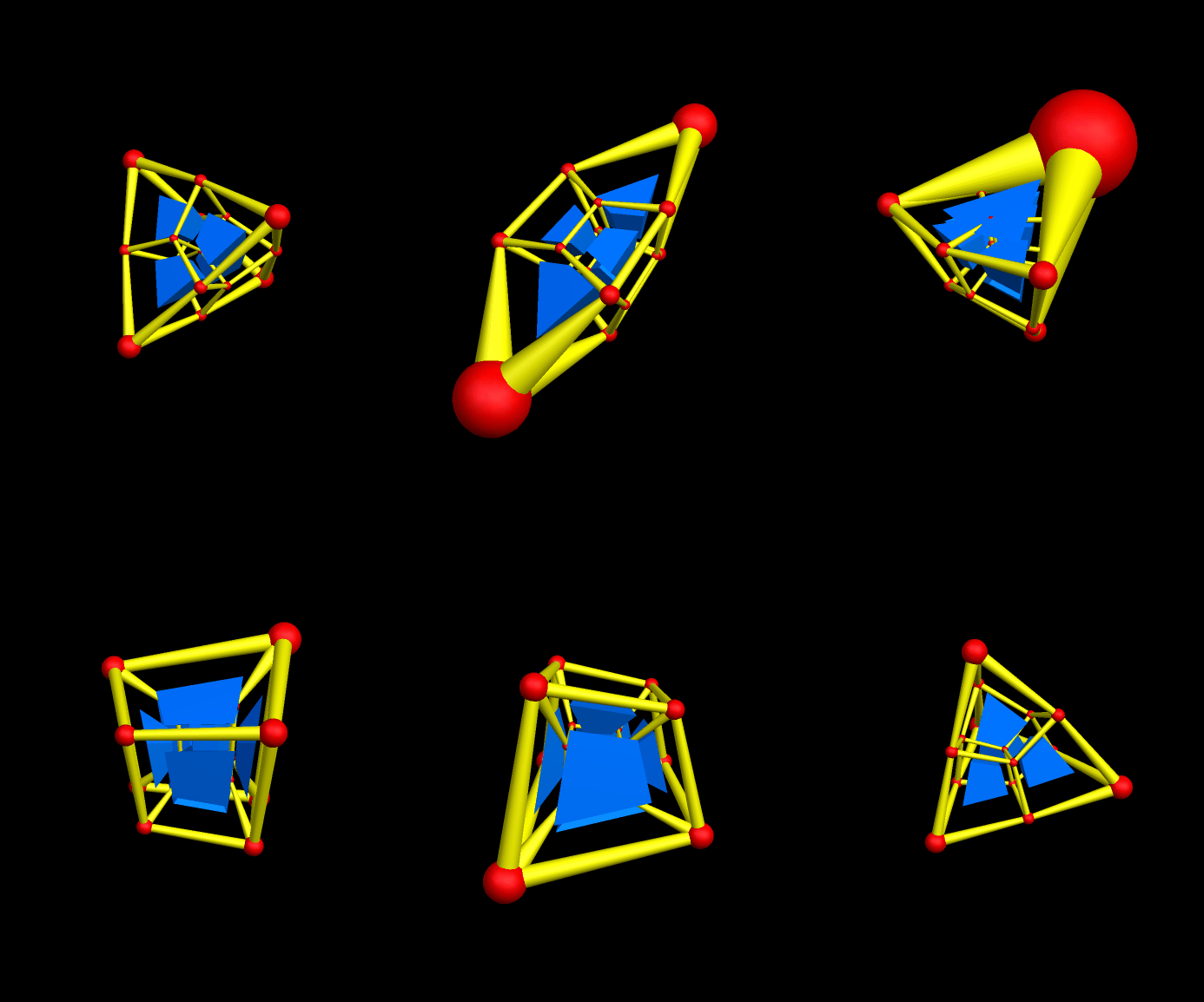
Lastly, face-first:

Although all of these are rotating in the same direction in hyperspace, the different projection-choices make the second and fourth images appear to be rotating in different directions. Why? I’m still trying to figure that out!
These animations were created with Stella 4d, software available at www.software3d.com/Stella.php.
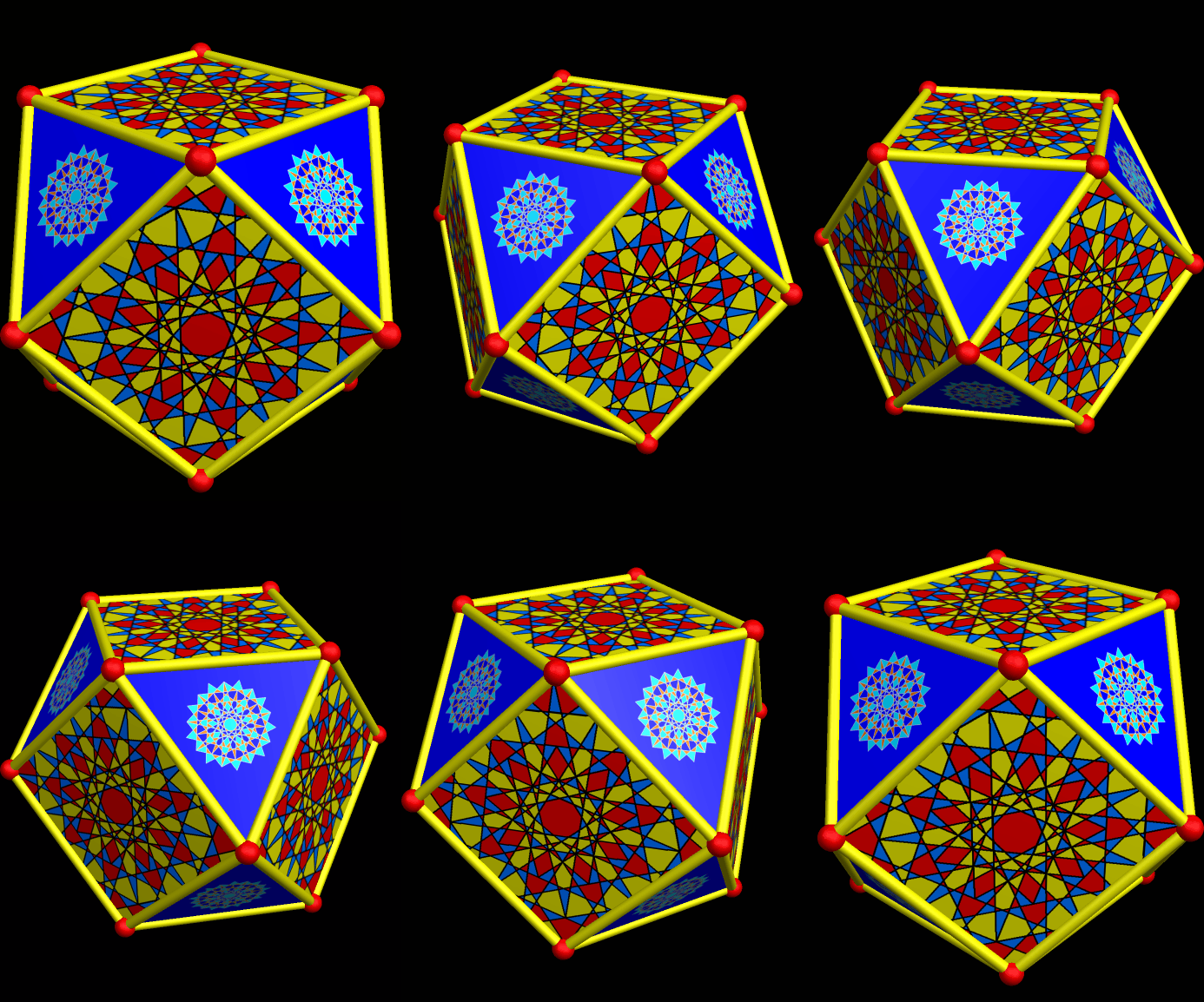
The enneagramic mandalas on the square faces of this cuboctahedron are from the last post, with inverted-color, smaller versions of the same image on the triangular faces. These mandalas were created using Geometer’s Sketchpad and MS-Paint. Projecting them onto the faces of the cuboctahedron, and then creating this rotating, pulsating .gif image, however, took a third program: Stella 4d, which you can buy, or try for free, at http://www.software3d.com/Stella.php.

These enneagrams are of the {9/3} variety, which means each one is made of three concentric, equilateral triangles. One of these enneagrams is at the center; the other nine surround it.

The tessellation of the plane which uses regular convex octagons and squares is well-known. This related tessellation, however, is not. I didn’t know it existed until I stumbled across it . . . although I very much doubt I am the first person to do so.
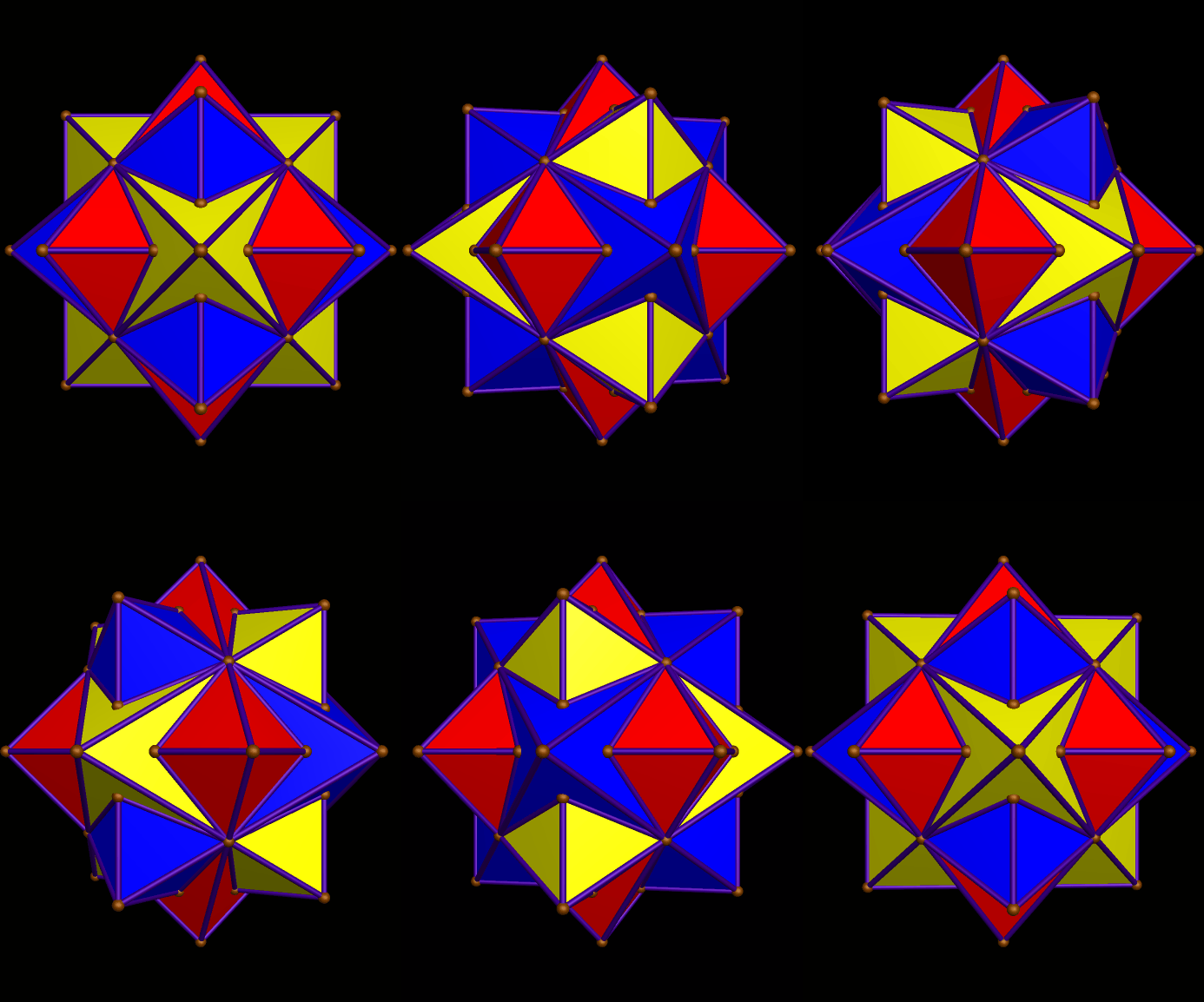
This polyhedral compound is part of the built-in library of polyhedra that comes with Stella 4d: Polyhedron Navigator. You can find this software here: http://www.software3d.com/Stella.php.
The rest will each get bigger if you click on them.



 RobertLovesPi.net