My Four Favorite Authors

favorite authors

Whenever people ask me to name my favorite author, I always have to ask them to be more specific, for I cannot bring myself to choose just one. If gender is specified, and either fiction or non-fiction is, as well, then I am able to choose a favorite author in each of the resulting four categories.

My two favorite writers of fiction, Flannery O’Connor and Robert A. Heinlein, are shown at the top. Flannery O’Connor was often described as a Southern gothic writer with an excellent ability to describe the grotesque, mostly with short stories, while Robert Heinlein was often called the greatest of all writers in the genre of science fiction. I wish it were possible for them to write even more, but, unlike the two authors described next, they are no longer living.

Shown below O’Connor and Heinlein are my two favorite authors of non-fiction, Jung Chang and Sam Harris. Jung Chang writes about Chinese history, eloquently, from the perspective of someone who actually was a Red Guard during the utterly insane period known as the Chinese Cultural Revolution, as a teenager, but later managed to get out of the People’s Republic — and, crucially, she was also able to mentally escape the powerful cult of personality which surrounded that nation’s leader for over two decades, Chairman Mao Zedong. She has gone on to become one of Mao’s harshest critics.

Sam Harris, a neuroscientist, began his career as an author by writing books criticizing religion, in the wake of the 9/11 terrorist attacks of 2001. He has since moved on to other topics (and writing better books than his earlier work, in my opinion), such as the corrosive effects of lying, the question of the existence or non-existence of free will, and a scientific approach to dealing with issues involving good and evil. He also has a new book coming out in September.

Other than their amazing skill at the difficult craft of writing, these four have little in common . . . but who wants to read the same sort of books all the time? If you aren’t familiar with their work already, I recommend giving each of them a read, and seeing what you think of their books. For one of them, Sam Harris, you can even give some of his writing a try for free, for he maintains a blog you can check out for yourself, at http://www.samharris.org.

For the other three, it isn’t quite that easy to get started, but their books may still be found in any decent public library, or, of course, websites such as Amazon. For O’Connor, the best place to start is with her collected short stories (Amazon link: http://www.amazon.com/The-Complete-Stories-Flannery-OConnor/dp/0374515360/ref=sr_1_2?ie=UTF8&qid=1405366654&sr=8-2&keywords=collected+short+stories+of+flannery+o%27connor). For Jung Chang, I recommend starting with the story of what happened, against the tumultuous backdrop of Chinese history, to her grandmother, mother, and finally herself, in Wild Swans:  Three Daughters of China (see http://www.amazon.com/Wild-Swans-Three-Daughters-China/dp/0743246985/ref=sr_1_1?s=books&ie=UTF8&qid=1405366792&sr=1-1&keywords=wild+swans). Heinlein’s works are numerous, and there are many good starting places to be found. Among the best books with which to start reading Heinlein are Stranger in a Strange Land (his most famous work), Friday, The Moon Is a Harsh Mistress, and Job:  A Comedy of Justice. Amazon’s Robert Heinlein page may be found at http://www.amazon.com/Robert-Heinlein/e/B005GDIOHM/ref=sr_tc_2_0?qid=1405367065&sr=1-2-ent.

Enjoy, and, if you have book recommendations of your own, I invite you to leave them in a comment to this post.

“Antisemitism” has become an inherently confusing word. Here’s how to fix this problem.

symbols

When referring to the Holocaust, it never caused confusion to refer to Nazis as “antisemitic.” German is not a Semitic language, and the non-Semite Nazis were trying to exterminate an ethnoreligious group, the Jews, who are a Semitic people. In that context, the word “antisemitism,” in a European setting, is not difficult to understand. This is also true of antisemitism earlier in European history.

Decades later, and outside of Europe, however, the situation has changed, and the word “antisemitism” is now far less clear in its meaning. The one nation most closely identified with the Jewish people is Israel, and Israel is not in conflict with Germany. Israel is, of course, currently in an active conflict with an organization, Hamas, which has been firing rockets from nearby Gaza across the border, into Israel. In response, Israel has been retaliating, using even greater force than that wielded by Hamas. In this current conflict, there have been numerous deaths of noncombatants, including many children, in Gaza, but no deaths (so far) in Israel. For this reason, some people have raised their voices in criticism of the actions of the Israeli government in the current conflict. Predictably, but not logically, those who are criticizing Israel’s actions are now being accused of antisemitism.

When the word “antisemitic” gets thrown around, in the context of conflicts in the Middle East which involve Israel, it doesn’t help anyone understand anything. The word is actually an impediment to understanding. The reason for this is that “Semite” does not mean what many people think it means. For one thing, most Semites are not Jews.

“Semites” refers to a collection of ethnolinguistic groups — people who speak, or are descended from those who spoke, any of a large collection of languages known as the Semitic languages . . . and one of the Semitic languages is Arabic. Are Jews Semites? Yes, they are, but so are Arabs. The current conflict in the Middle East is a conflict between two different groups of people, both of whom are Semitic. To throw the emotionally-charged word “antisemitic” into the middle of the fray, therefore, makes no sense. It increases confusion, and clarifies nothing. The word also further enflames the emotions of those arguing and fighting, on both sides, in a situation where the exact opposite is needed.

It doesn’t help that many Westerners believe a fallacy related to Arabs, using “Arab” (which refers to an ethnic group) interchangeably with “Muslim,” which is not an ethnic term at all, but one that simply refers to anyone who practices the religion known as Islam. In reality, there are many Arabs who are not Muslims, and there are hundreds of millions of Muslims who are not Arabs. For example, consider the people who live in Iran. The governments of Israel and Iran are often hostile to each other, and Iran has very few Arabs, despite being a nation where an overwhelming majority practice Islam.

When Israel has conflicts with other nations (or organizations, for Hamas is not a nation) in the Middle East, those conflicts are political in nature, with religion playing a strong role as well. Israel is associated with the religion of Judaism (even though much of its Jewish population is only ethnically Jewish, not Jewish in the religious sense of the term), and is often in conflict with others in the Middle East who are associated with the religion called Islam. “Antisemitic,” used as a synonym for anti-Jewish bigotry, is an unfortunate misnomer, but there are alternatives which are better, in the sense that they are more specific, and therefore more clear. There is already a word in common use for fear and hatred of Islam and/or Muslims:  “Islamophobia.”  The corresponding term for fear and hatred of Judaism and/or Jews, including those who are Jewish only in the ethnic sense of the word, is “Judeophobia.” Most of the time, when people use the word “antisemitism,” they actually mean Judeophobia. Since Arabs are, themselves, a subset of the Semites, it would be illogical to refer to a specific person who is both an Arab, and a hater of Jews, as an “antisemitic Arab.”  To describe that person as a “Judeophobic Arab,” on the other hand, makes perfect sense.

Finally, it must be recognized that there are numerous people, within both Judaism and Islam, who do not have within them the blind, furious hatred of the other group that has caused so much death and destruction in the Middle East since the founding of the modern nation of Israel, in the years following World War II. I am referring, of course, to non-Islamophobic Jews, and non-Judeophobic Muslims. One does not often see them featured in the news, especially when conflicts such as the current one are raging, but such people do exist, and their existence should give all people who prefer peace over war hope for the future. May their numbers increase.

Seven Moving Lights in the Sky, the Seven Days of the Week, and Other Significant Sets of Seven

days of week and lights in the sky

Have you ever wondered why the number seven appears in all the places it does? We have seven days in the week. Churches teach about the seven deadly sins, and “seven heavens” is a common phrase. There are seven wonders of the ancient world, and seven of the modern world. The number seven has appeared in many other socially significant ways, in societies all over the world, for millennia.

It is no coincidence, I think, that the ancients were able to see seven lights in the sky which are either visible in daylight, or move against the background of “fixed” stars at night. They ascribed great significance to what went on in the sky, since they viewed “the heavens” as the realm of the gods in which they believed. The evidence for this lives on today, in the names of the seven days of the week, and numerous other sets of seven, all over the world.

It is possible to see the planet Uranus without a telescope, but it is very dim, and you have to know exactly where to look. No one noticed it until after the invention of the telescope. If Uranus were brighter, and had been seen in numerous ancient societies, I have no doubt that we would have eight days in the week, etc., rather than seven.

A Non-Convex Polyhedron with Icosidodecahedral Symmetry

Convdsgfsdgdsfgex hull

I made this using Stella 4d, available at http://www.software3d.com/Stella.php.

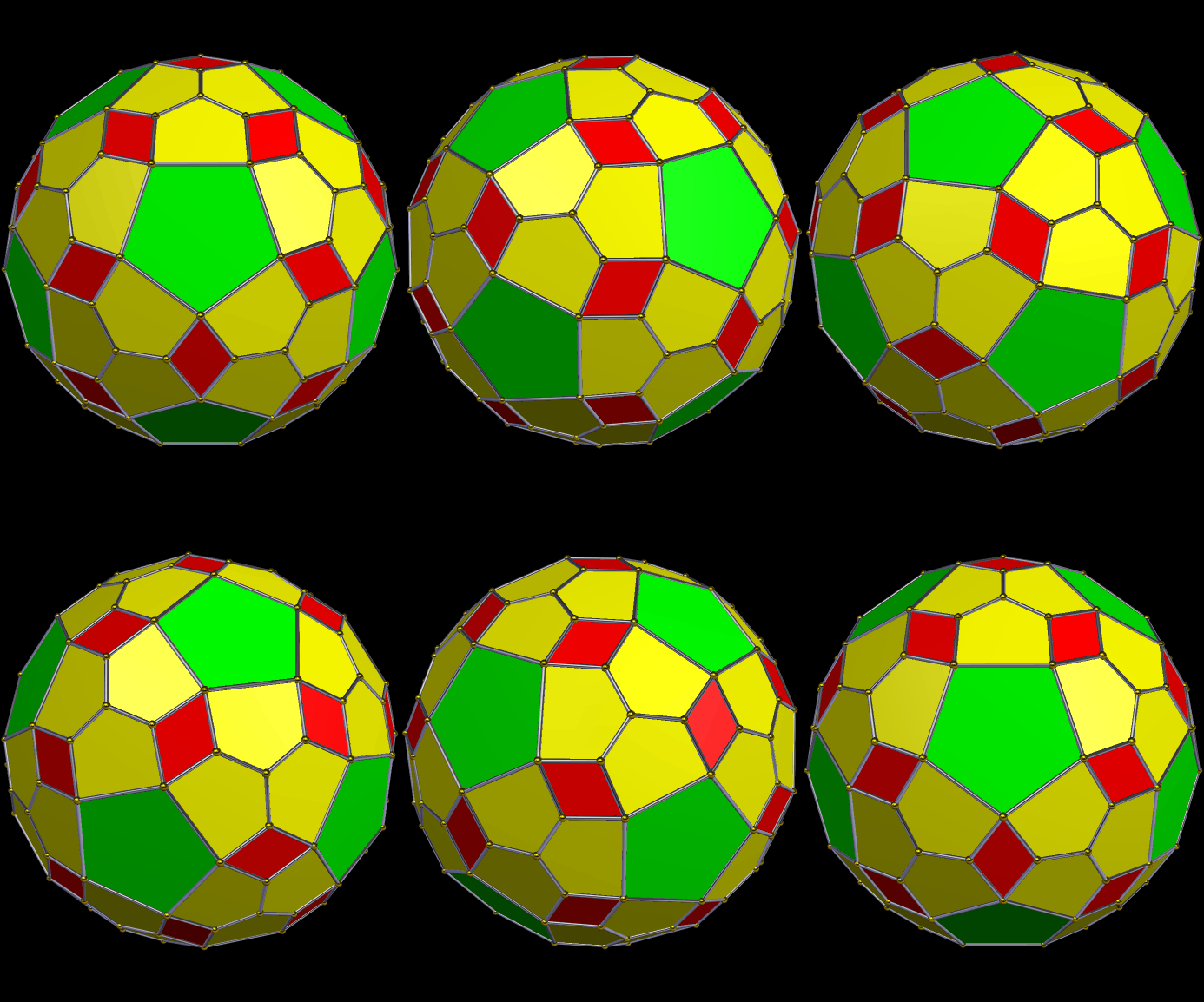
A Polyhedron with Only Pentagons and Rhombi As Faces

Convemvbdsjfx hull

I made this with Stella 4d, a program you can find at http://www.software3d.com/Stella.php.

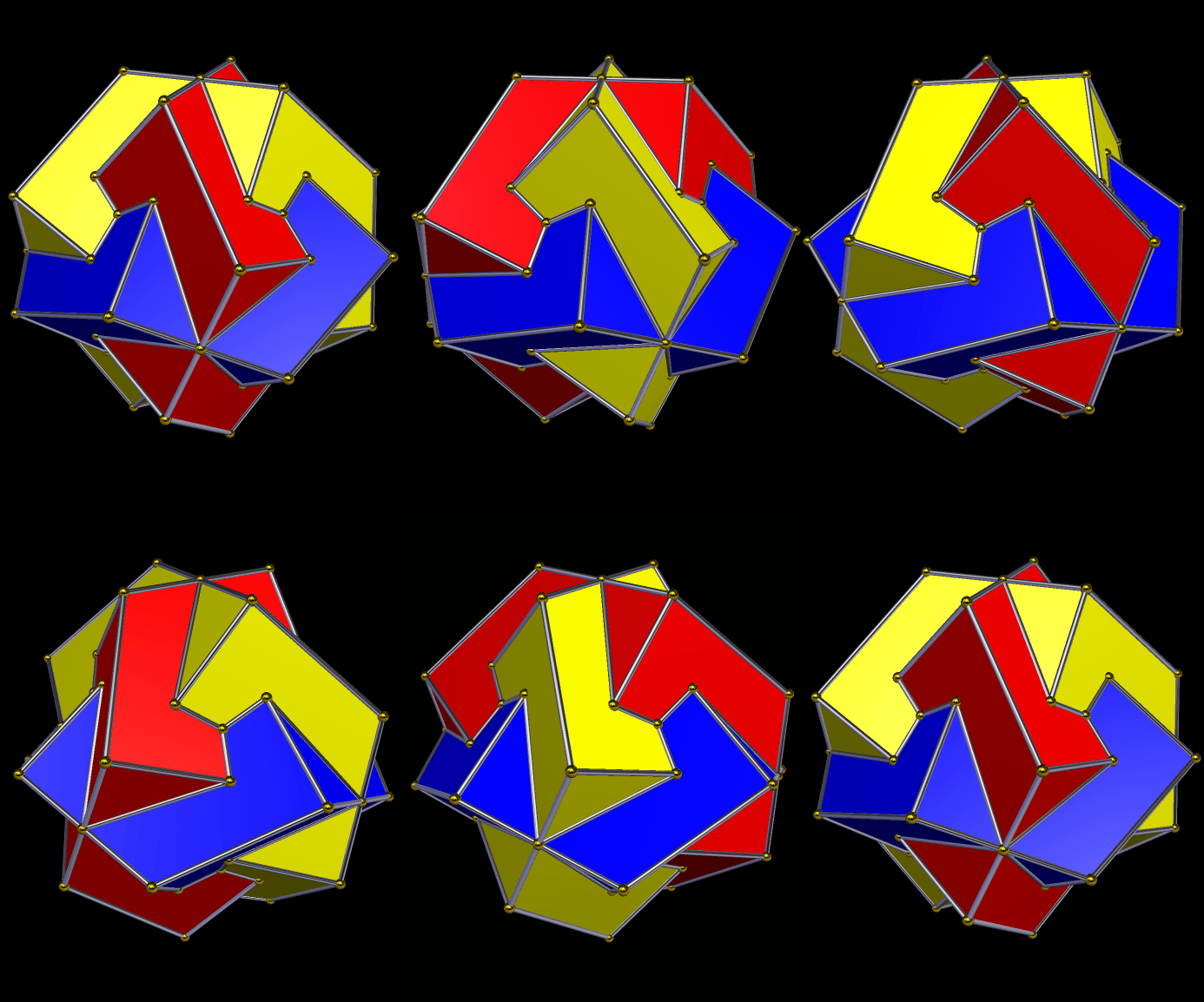
Three-Part Polyhedral Compound

Compound of three polyhedra with eight kite-faces each

Since I stumbled across this by stellating other polyhedra, I’ve never seen what a face of one component of this compound looks like, without having part of that face covered. My best guess is that the faces (of which there are eight in each part of the compound) are kites.

I used Stella 4d, available at http://www.software3d.com/Stella.php, to make this, and a free trial download is available at that site.

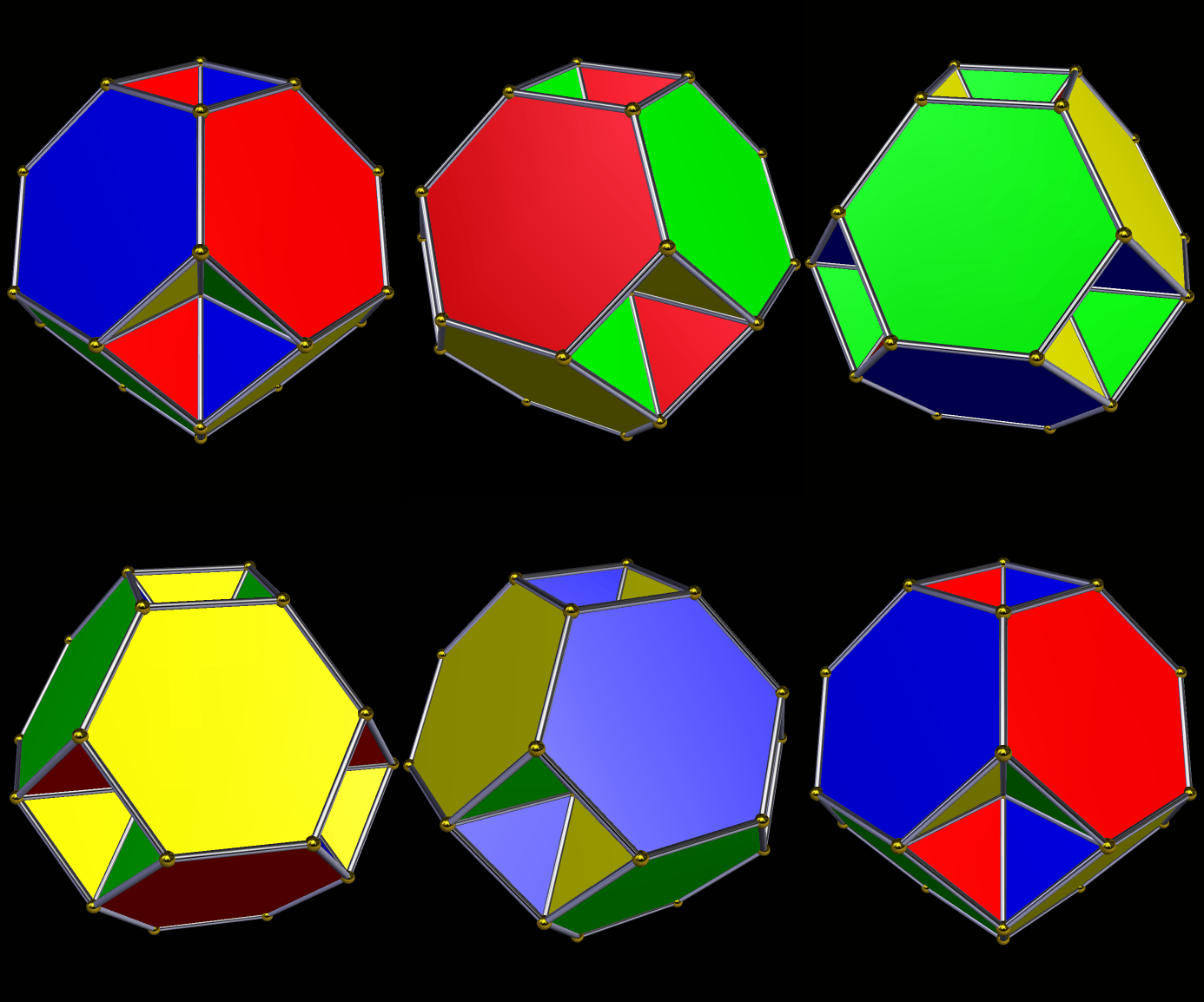
A Truncated Octahedron, with Pyramids Excavated from the Square Faces

excavated Trunc Octa

I used Stella 4d, available at http://www.software3d.com/Stella.php, to make this.

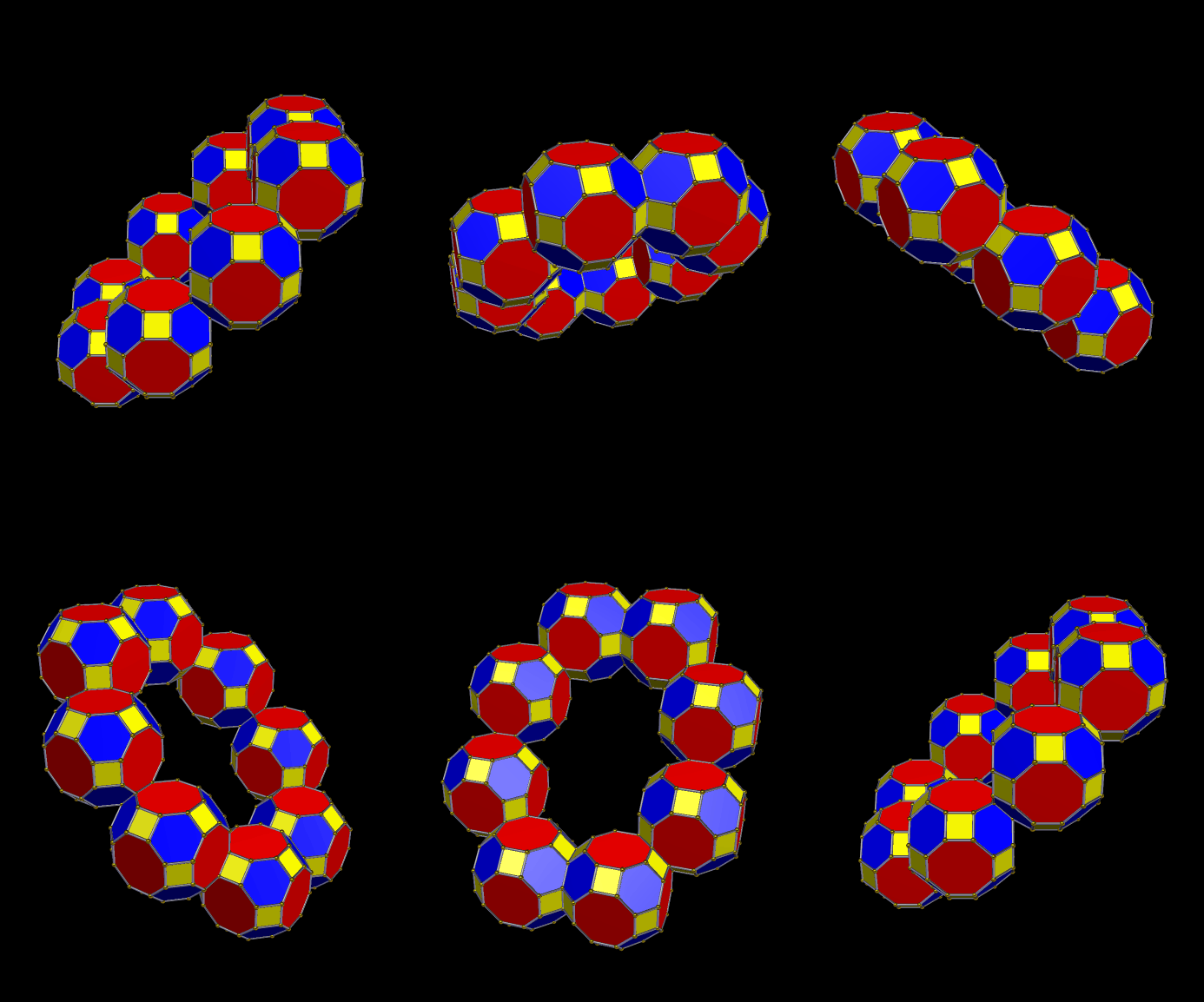
Ring of Eight Great Rhombcuboctahedra

Augmented Trunc Cubocta

I used Stella 4d, available at http://www.software3d.com/Stella.php, to make this.

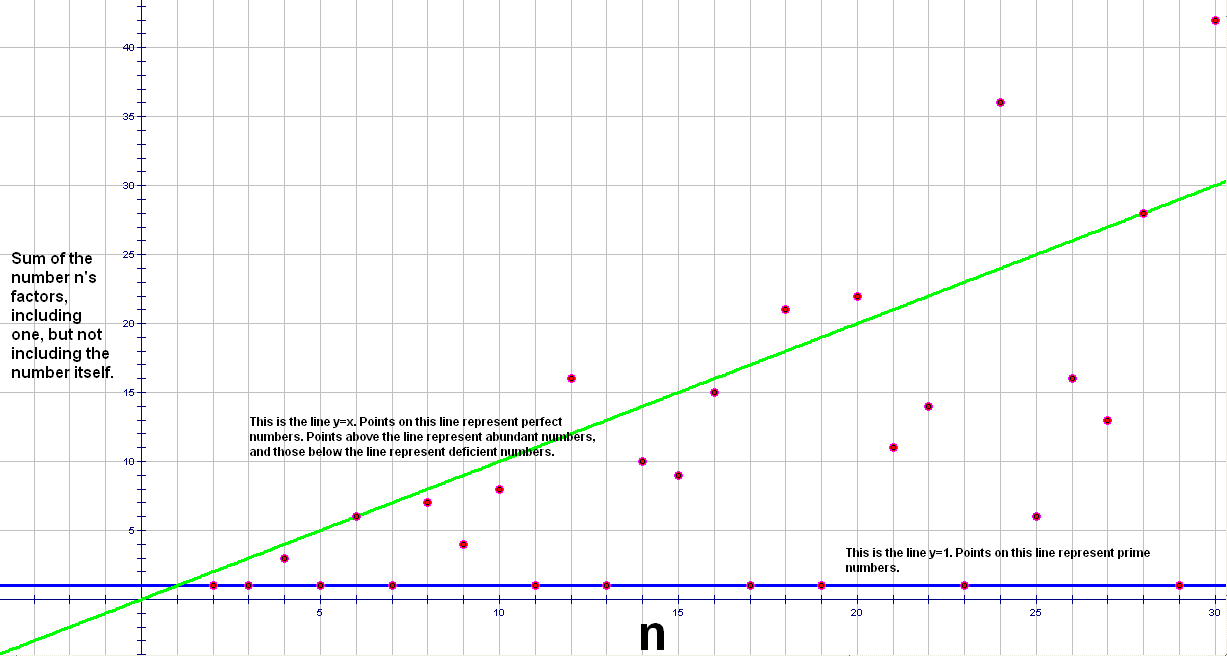
A Graphical Survey of Prime, Perfect, Deficient, and Abundant Numbers From Two to Thirty

graphical survey of prime, perfect, deficient, and abundant numbers from 2 to 30

In this graph, each number on the x-axis (from 2 to 30) is plotted against the sum of all its factors (including one, but excluding the number itself) on the y-axis. Numbers on the blue line y = 1 have no factors other than one and themselves, and are therefore prime numbers. Numbers on the green line y = x are equal to the sum of their factors (including one, but excluding themselves), and are therefore perfect numbers. Perfect numbers are much rarer than prime numbers in the entire set of natural numbers, as well as in this small sample.

If a number’s factor-sum, examined in this manner, is smaller than the number itself, such a number is called a “deficient number.” This applies to all numbers with points below the green line. Numbers which have points on the blue line are deficient numbers, as well as being prime numbers – and this is true for all prime numbers, no matter how large. The numbers represented by points between the green and blue lines are, therefore, both deficient and composite, and can also be called “non-prime deficient numbers.”

A few numbers on this graph, called “abundant numbers,” are represented by points above the green line, because their factor-sum is greater than the number itself. There are only five abundant numbers in this sample: 12, 18, 20, 24, and 30. As an example of how a number is determined to be abundant, consider the factors of 30: 1+2+3+5+6+10+15 = 42, which is, of course, greater than 30.

Of the 29 numbers examined in this sample, here is how they break down by category:

• Abundant numbers: 5 (~17.2% of the total)
• Perfect numbers: 2 (~6.9% of the total)
• Non-prime deficient numbers: 12 (~41.4% of the total)
• Prime numbers: 10 (~34.4% of the total)

These percentages only add up to 99.9%, due simply to rounding. Also, the total number of deficient numbers in this sample (both prime and composite) is 22, which is ~75.9% of the total sample of 29 numbers.

So what happens if this survey is extended far beyond the number 30, to analyze much larger (and therefore more meaningful) samples? Well, for one thing, the information on the graph above would quickly become too small to read, but that is only of trivial importance. More significantly, what would happen to the various percentages, for each category, given above? First, both prime and perfect numbers become more difficult to find, as larger and larger numbers are examined – so the percentages for these categories would shrink dramatically, especially the one for perfect numbers. With smaller percentages of prime and perfect numbers in much larger samples, the sum of the percentages for the other two categories (abundant and non-prime deficient numbers) would, of necessity, grow larger. That has to be true for this sum – but that says nothing about what would happen to its two individual components. My guess is that abundant numbers would become more common in larger samples . . . but since I have not yet examined the data, I’m only calling this a guess, not even a conjecture. As for what would happen to the percentage of non-prime deficient numbers when larger samples are analyzed, I don’t even (yet) have a guess.

All-Seeing Eye

all-seeing eye