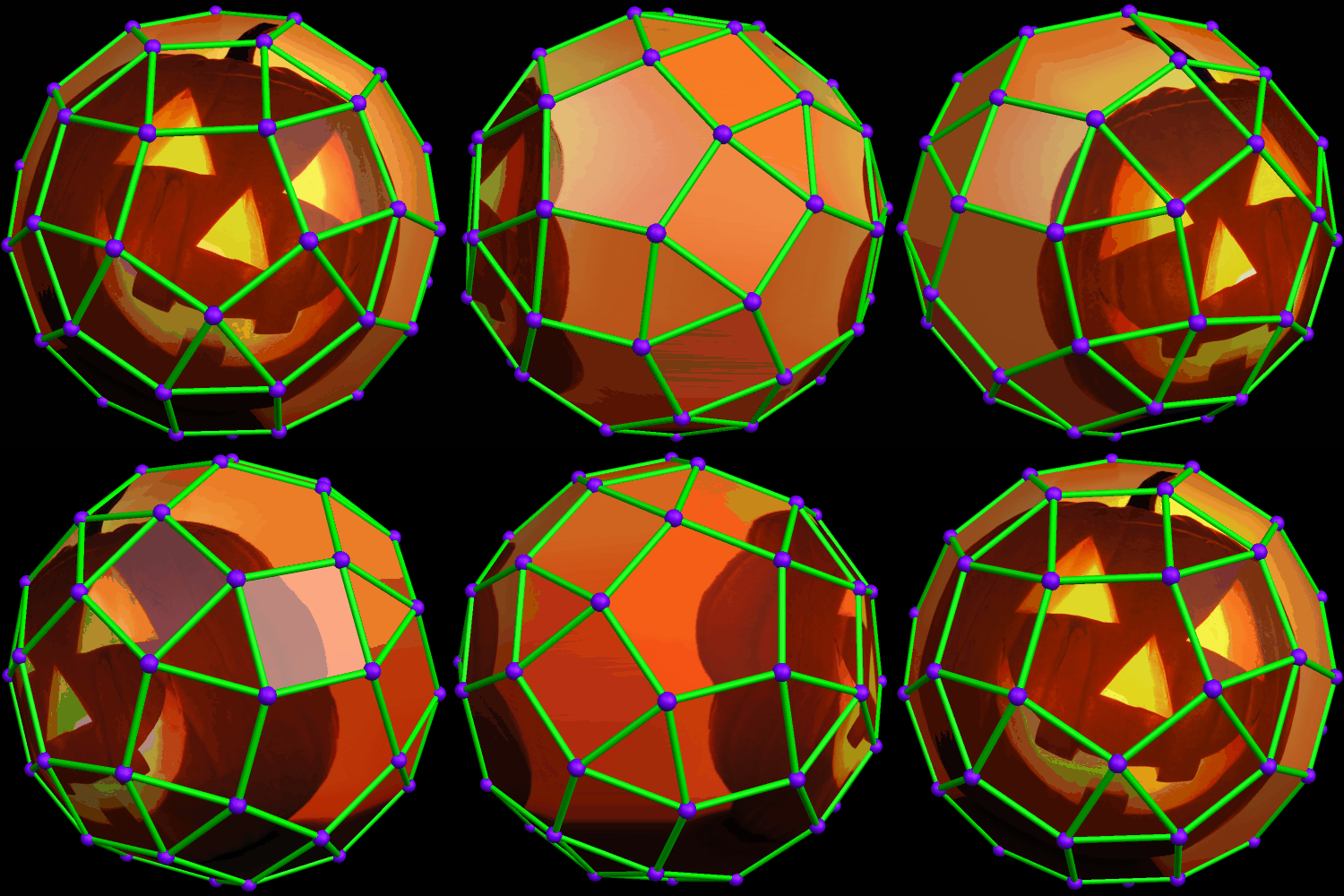
This Jack-o-Lantern picture was found with a Google image-search, and then I projected it onto a rhombicosidodecahedron, and created this rotating .gif file, using Stella 4d — a program available at http://www.software3d.com/Stella.php. Happy Halloween!
Monthly Archives: October 2014
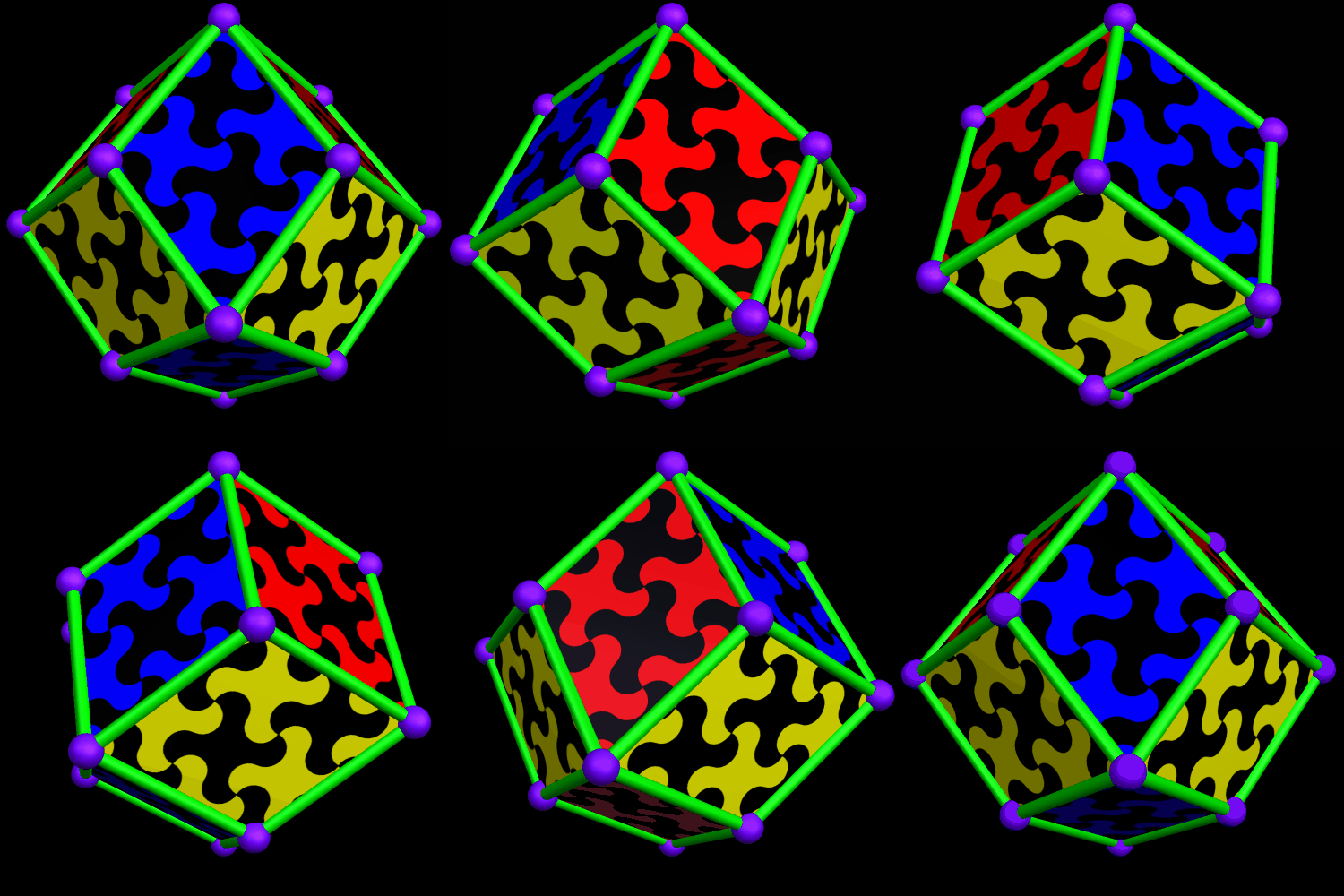
A Rhombic Dodecahedron, Decorated with Curvy Tessellations
The faces of this polyhedron are decorated with the same type of curvy tessellation seen in the last post here, and it was created using Geometer’s Sketchpad and MS-Paint. Projecting these images onto the faces of this rhombic dodecahedron, in different colors, and then creating this rotating images of it, required a third program, Stella 4d: Polyhedron Navigator. This latter program, an indispensable tool for polyhedral investiagations, may be tried for free, as a trial version, at http://www.software3d.com/Stella.php.
A Blue and Yellow Tessellation Made with Semicircles
A Dozen Triangula
This dodecahedron is adorned with images of the Triangulum Galaxy. The plural of “Triangulum” is “Triangula,” is it not?
Software credit: this rotating image was created using Stella 4d: Polyhedron Navigator, which is available at http://www.software3d.com/Stella.php.
On Mental Health: My Reasons for Letting the Sunshine In
There are quite a few posts on this blog on the subject of mental health, and they can be easily found by simply looking at that category, in the pull-down menu on the right side of your screen. In these posts, I have been quite candid about such things as my own panic disorder, PTSD, and Asperger’s Syndrome.
What I have not done, until now, is explain my reasons for my openness on this subject.
First and foremost, I am trying to do what I can to remove the stigma which surrounds the entire subject of mental illness. This stigma is harmful, for it keeps millions of people who need help from mental health professionals from seeking it, out of fear of being labeled and/or ostracized — or worse. I learned this the hard way: by experiencing it. I had my first panic attack at age 16. Like most panic attacks, this one lasted perhaps twenty minutes, or less. Few people have panic attacks that last longer than that — unless they fail to seek treatment, and the panic attacks continue to happen, which is what happened to me.
Over time, panic disorder tends to become worse, if not treated. The fear of the panic attacks themselves becomes an issue, for those who have them frequently, and such fear can lead to people avoiding situations where they fear a panic attack would be particularly embarrassing, and/or debilitating — somewhere like, for example, the middle of a Walmart, or their church, or their workplace. In some cases, untreated panic disorder leads to full-blown agoraphobia, with some people actually reaching the point where they simply do not leave their homes at all — until they die.
In my case, I avoided treatment for my own panic disorder (or any other mental health problem) for about a decade, specifically because of my fear of the stigma of mental illness. I tried to keep my panic attacks a secret, but, of course, that did not stop them. They grew in intensity, and the duration of the attacks increased as well. A ten-hour panic attack — something which is incredibly rare — is what finally drove me to get over my fear of this stigma, and make an appointment with the man who is still my psychiatrist.
In the years that followed, I grew more and more disturbed by the existence of this stigma, and finally made a decision: I would do whatever I could to neutralize it, for the benefit of others. I do not wish anyone to suffer the effects of deliberately delaying needed medical treatment. After much thinking, I eventually figured out one thing I can do, toward this end: be open about such matters, simply to help others know that mental illness can, with appropriate help, become transformed into mental health. In other words, as with many other illnesses, those with mental health problems can, and do, get better. This is why I have chosen the category-name “mental health” for these posts, rather than “mental illness.”
Of the particular struggles I have which involve issues of mental health, PTSD is the most difficult to treat . . . but I work hard, with the help of my doctor, to get better. What’s more, it is working, although I cannot claim this work is complete. I want everyone to know that getting better is a goal which is both realistic, and achievable.
With Asperger’s, my motivation for openness is somewhat different, for this condition is not actually a mental illness at all, as evidenced by the fact that it was recently “de-listed” from the latest version of the DSM (Diagnotic and Statistical Manual of Mental Disorders). Asperger’s Syndrome is simply a difference in the way some people think, as opposed to an actual disease. Some “Aspies” (our culture’s own nickname for ourselves), however, do suffer greatly, because of the difficulties involved in interacting socially with others, especially non-Aspies. I share what I have figured out, on this subject, with two goals in mind: (1) helping my fellow Aspies who struggle, and sometimes suffer, because of these differences, in any way I can, and (2) helping non-Aspies understand us better, so that these difficulties in interaction between Aspies and non-Aspies can become less of a problem — for everyone.
Finally, it simply feels good to no longer be trapped, in a metaphorical closet, regarding these things which are, after all, part of my life. As the saying goes, borrowed from the gay rights activists who invented it, “closets are for clothes, not for people.”
I much prefer letting the sunshine in.
On Life, and Death, in the Marvel Comics Universe
To write this, I did a lot of research, and had much help from friends. One of them, Craig Deaton, gave permission for his name to be used, but the others have not. I am grateful to them all.
This is a compilation of three lists, for purposes of comparison and analysis, and concerns life, death, being “unkilled,” then “re-killed” after being unkilled, and then, sometimes, being “re-unkilled,” and so on. In other words, the topic here is bad writing, and a terribly overused plot device. To (try to) keep this simple, I’m limiting this survey to the primary Marvel Comics universe, in which Earth is called, for reasons I do not understand, Earth-616. I started this yesterday, by simply posting some questions on Facebook, and watched, with growing amazement, as the information started pouring in.
The shortest of these lists includes only comic book characters who are currently dead, but whom I have high confidence Marvel will unkill, before too long.
- Wolverine, a/k/a James “Logan” Howlett
- Uatu, a/k/a The Watcher
- Charles Xavier, a/k/a Professor X
At least two of these characters (Wolverine and Professor X) have been killed, and then resurrrected, before, and I will be shocked if this process is not repeated, again (and again, and again, and again…).
The next list includes characters who have been killed, have actually remained dead, so far, and whose resurrections I do not (at least not fully) expect.
- The Abomination
- The Ancient One (associated with Dr. Strange)
- Hector Ayala, the Black, Hispanic, male version of the White Tiger, killed after Matt Murdock failed to secure his acquittal on a murder charge, of which Ayala was innocent
- Blink, of the X-Men
- Daken, son of Wolverine
- Jean DeWolf, a police detective who used to work with Spider-Man
- Dr. Doom’s mother
- Leland Drummond, a corrupt FBI man involved in “outing” Daredevil’s secret identity
- Richard Fisk, son of the Kingpin (Wilson Fisk)
- Flashback, a little-known mutant killed in a weird time-travel scenario created by his own superpowers
- Bill Foster, a/k/a Goliath, a/k/a Black Goliath
- Adolf Hitler, a/k/a Hate Monger (brought back from the dead, and then re-killed)
- Karen Page, the primary love interest of Matt Murdock’s (Daredevil’s) life
- Mar-Vell, a Kree warrior who went by the name “Captain Marvel”
- Microbe, of the New Warriors
- “Battlin’ Jack” Murdock, best-known as Daredevil’s father
- Namorita, of the New Warriors
- Night Thrasher, of the New Warriors
- Scott Perkins, a police officer whom Hector Ayala (see above) was falsely convicted of killing, despite Matt Murdock’s best efforts, as his lawyer, to secure Ayala’s acquittal
- Pyro, one of many foes of the X-Men, who was killed, brought back as a zombie, and then killed again
- Spider-Man’s father
- Spider-Man’s mother
- Spider-Man’s Uncle Ben
- Gwen Stacy, former girlfriend of Spider-Man
- Katherine Anne Summers, the mother of the mutants Cyclops, Havok, and Vulcan
- Turbo (the original one)
- The chain of unnamed criminals who first got Daredevil’s secret identity from Karen Page to Wilson Fisk, the Kingpin of crime, and were then ordered killed by Fisk
- Numerous unnamed people who lack superpowers, and also lack connections to superheroes who are neither Daredevil, nor Spider-Man
- The unnamed woman whom Daredevil’s wife Milla, under the influence of mind control, pushed in front of an oncoming subway train, leading to Milla’s institutionalization
- At least one person affected by the Wendigo curse (killed by the Red Hulk)
What can we learn from the list above? Well, for one thing, characters in the Marvel Universe who have no superpowers should stay far away from both Daredevil and Spider-Man.
The last list, and easily the longest, includes characters who have recovered from death at least once, and are currently alive in this fictional universe — one where death obviously “has a very loose grip,” as one of my friends on Facebook phrased it.
- Bucky Barnes / The Winter Soldier, and, briefly, Captain America
- Bullseye
- Cannonball
- Captain America / Steve Rogers
- Colossus, of the X-Men
- Cyclops / Scott Summers, of the X-Men
- Cypher / Doug Ramsey, of the New Mutants
- Daredevil / Matt Murdock
- Darwin, of the X-Men
- Dead Girl (except that she’s still sort of dead, being, after all, Dead Girl)
- Elektra
- Firebrand
- Vanessa Fisk, estranged wife of Wilson Fisk, the Kingpin
- Galactus
- Jean Grey (not exactly the same as Phoenix)
- The Grim Reaper (brother of Wonder Man)
- Havok / Alex Summers
- Hawkeye / Clint Barton / Ronin
- The Human Torch (original android version)
- Loki, Norse God of Mischief
- Longshot, of the X-Men
- Moira McTaggert, friend of the X-Men
- Mockingbird, ex-wife of Hawkeye
- Mysterio / Quintin Beck
- Nightcrawler, of the X-Men
- The Owl / Leland Owlsley
- Petra, of the X-Men
- Phoenix (not exactly the same as Jean Grey)
- Agent Preston
- Kathryn “Kitty” Pryde, of the X-Men
- Madelyne Pryor, estranged wife of Cyclops / Scott Summers
- Psylocke, of the X-Men
- The Punisher / Frank Castle
- The Red Skull
- Rogue, of the X-Men
- The Sentry
- Speed, of the Young Avengers
- Spider-Man / Peter Parker
- Spider-Man’s Aunt May
- Spider-Man’s clone
- Storm / Ororo Munroe, of the X-Men
- Hope Summers, of the X-Men
- Sway, of the X-Men
- Tarot
- The Thing / Benjamin Grimm
- Thunderbird, of the X-Men
- Toro, the original (android) version of the Human Torch
- Trickshot
- The Vision
- Vulcan, of the X-Men (brother of Cyclops and Havok)
- Wiccan, of the Young Avengers
- Wonder Man
- Wong, associated with Dr. Strange
- Zzzax
It is clear that the most effective way to cheat death, in the Marvel Universe, is simply to be one of the X-Men. Are there more characters who should be on this list? Yes, but we all got tired after several hours of this, and moved on to other things.
Seriously, though, Marvel needs to stop doing this.
However . . . they won’t.
What Is Art? Here’s Andy Warhol’s Answer.
“How Tall Are You?”
When I am asked for my height, anywhere — especially at school — I answer the question honestly. I am 1.80 meters tall.
I also live in the USA, one of only three remaining countries (the other two holdouts are Liberia and Myanmar) which have stubbornly refused to adopt the metric system. However, I am every bit as stubborn as other Americans, but, on this issue, I choose to be stubborn in the opposite direction.
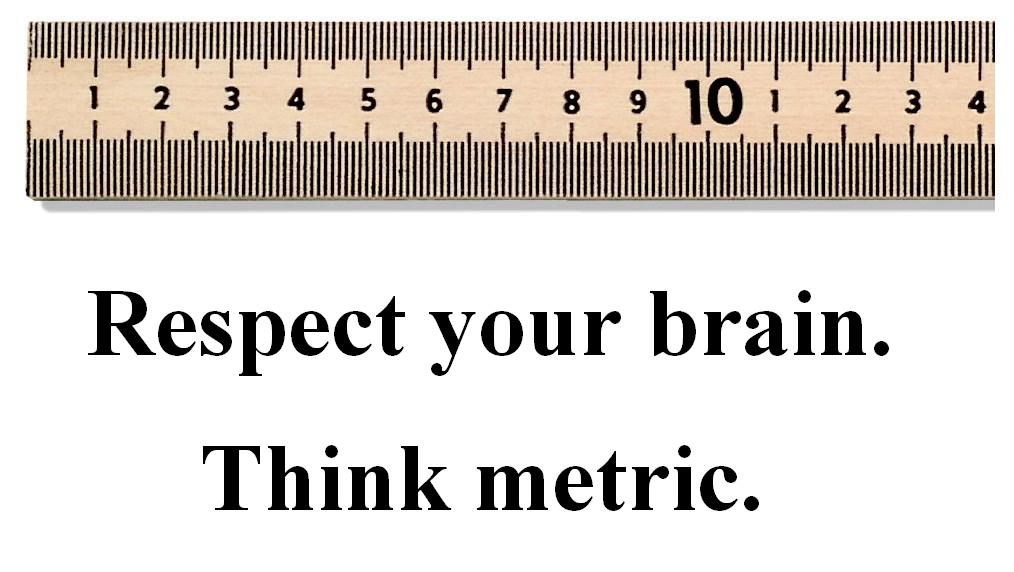
It should surprise no one who knows me well that my classroom, whether I am teaching science or mathematics, is, by design, an all-metric zone. After all, like >99% of people, I have ten fingers (assuming thumbs are counted as fingers), ten toes, and almost always use the familiar base-ten number system when counting, measuring, doing arithmetic, or doing actual mathematics. (Doing arithmetic is not the same thing as doing real mathematics, any more than spelling is equivalent to writing.) Using the metric system is consistent with these facts, and using other units is not.
Admittedly, I do sometimes carry this to an extreme, but I do so to make a point. Metric units are simply better than non-metric units. Why should anyone need to memorize the fact that there are 5,280 feet in one mile? It actually embarrasses me that I have that particular conversion-factor memorized. By “extreme,” I mean that I have been known to paint the non-metric side of meter sticks black, simply to make it impossible for students in my classes to confuse inches and centimeters, and prevent them from measuring anything with the incorrect units.
To those who object that American students need to understand non-metric units, I simply point out that there are plenty of other teachers who take care of that. This is, after all, the truth.
Often, after giving my height as 1.80 meters, I am asked to give it in other units. Unless the person asking is a police officer (in, say, a traffic-stop situation), however, I simply refuse to answer with non-metric units. What do I say, instead? “I’m also 180 centimeters tall. Would you like to know my height in kilometers?”
If pressed on this subject in class — and it comes up, because we do lab exercises where the height of people must be measured — I will go exactly this far: I am willing to tell a curious student that there are 2.54 centimeters in an inch, 12 inches in a foot, and 3.28 feet in a meter. Also, I’m willing to loan calculators to students. Beyond that, if a student of mine really wants to know my height in non-metric units, he or she simply has to solve the problem for themselves — something which has not yet happened. I do not wish to tell anyone my height in feet and inches, for I do not enjoy headaches, and uttering my height, in those units I despise, would certainly give me one. Also, obviously, you won’t find my height, expressed in non-metric units, on my blog, unless someone else leaves it here, in a comment — and I am definitely not asking anyone to do that.
I might, just for fun, at some point, determine my height in cubits. For all I know, a person’s height, measured with their own cubits, might be a near-constant. That would be an interesting thing to investigate, and my students, now that I’ve thought about the question, might find themselves investigating this very issue, next week. The variability of cubits, from one person to another, makes them at least somewhat interesting. It also makes cubits almost completely useless, which explains why they haven’t been used since biblical times, but that’s not the point. One can still learn things while investigating something which is useless, if one is sufficiently clever about it.
Feet and inches, however, are not interesting — at all. They are obsolete, just as cubits are, and they are also . . . offensive. It is not a good thing to insult one’s own brain.
On Boiling Eggs, William Shakespeare, and Richard Feynman
Not long ago, I boiled a dozen eggs.
After accidentally misquoting Shakespeare, while watching these eggs boil (“Boil, boil, toil and trouble, fire burn and cauldron bubble”), I then correctly quoted Shakespeare at the eggs, by shouting, “You egg!” at them, as they boiled.
What . . . you’ve never talked to your food? If not, just try it some time, for it makes life more interesting. If you’re worried about people thinking you’re crazy, I have another quote, from the physicist Richard Feynman, for you to consider: “What do you care what other people think?”
Little seems to be going right today, for correctly quoting Shakespeare meant being, at the same time, mathematically incorrect. Twelve and one are, of course, not the same number, but I’m not willing to deliberately misquote Shakespeare, for that would be, well, wrong.
I was then asked, by someone who heard me, um, shouting at boiling eggs, exactly which of Shakespeare’s plays it is, in which the line “you egg” appears. Since I did not know the answer to this question, I immediately used this situation as an opportunity to test the alleged omniscience of Google, which I test, and re-test, frequently. (So far, Google always passes these experimental tests, but I will post an announcement here if this fact ever changes.) I also googled my earlier, failed attempt to quote Shakespeare, which is how I now know that I was misquoting him.
In case you’re wondering why I was fact-checking myself, here’s another Feynman quote, offered as explanation: “The first principle is that you must not fool yourself — and you are the easiest person to fool.” Those are words to live by — and I do.
Not only did Google know that the two-word quote I remembered (from 10th grade English class, over thirty years ago, simply because I found it funny) comes from Macbeth, Act 4, Scene 2, but it also, very helpfully, showed me the way to the YouTube video which you can see below.
For those few readers of my blog who have not already noticed this, I lead a strange life.
Of course, I certainly wouldn’t want a normal one, but, clearly, I don’t need to worry about that.
On Omniscience and Omnipresence
Anyone who does not believe in omniscience should reconsider Google, and anyone who does not believe in omnipresence should reconsider Walmart.