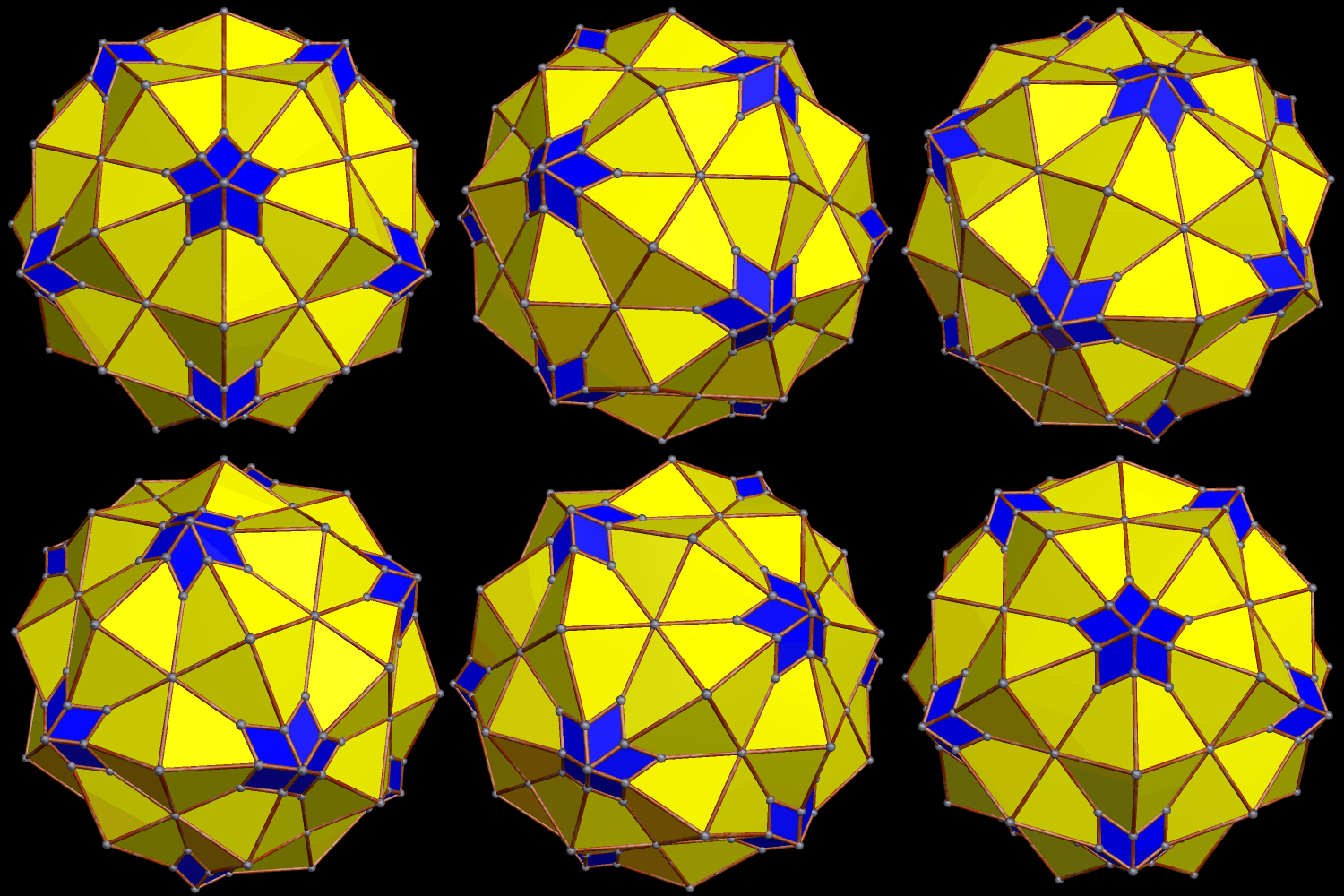
I made this compound using software called Stella 4d: Polyhedron Navigator. This program may be purchased (or a trial download tried for free) at this website.

I made this compound using software called Stella 4d: Polyhedron Navigator. This program may be purchased (or a trial download tried for free) at this website.


All four of these rotating images were created using software called Stella 4d: Polyhedron Navigator. You can buy this program, or try it for free, at this website. Faceting is the inverse function of stellation, and involves connecting the vertices of an already-established polyhedron in new ways, to create different polyhedra from the one with which one started. For each of these, the convex hull is the great rhombcuboctahedron, itself.
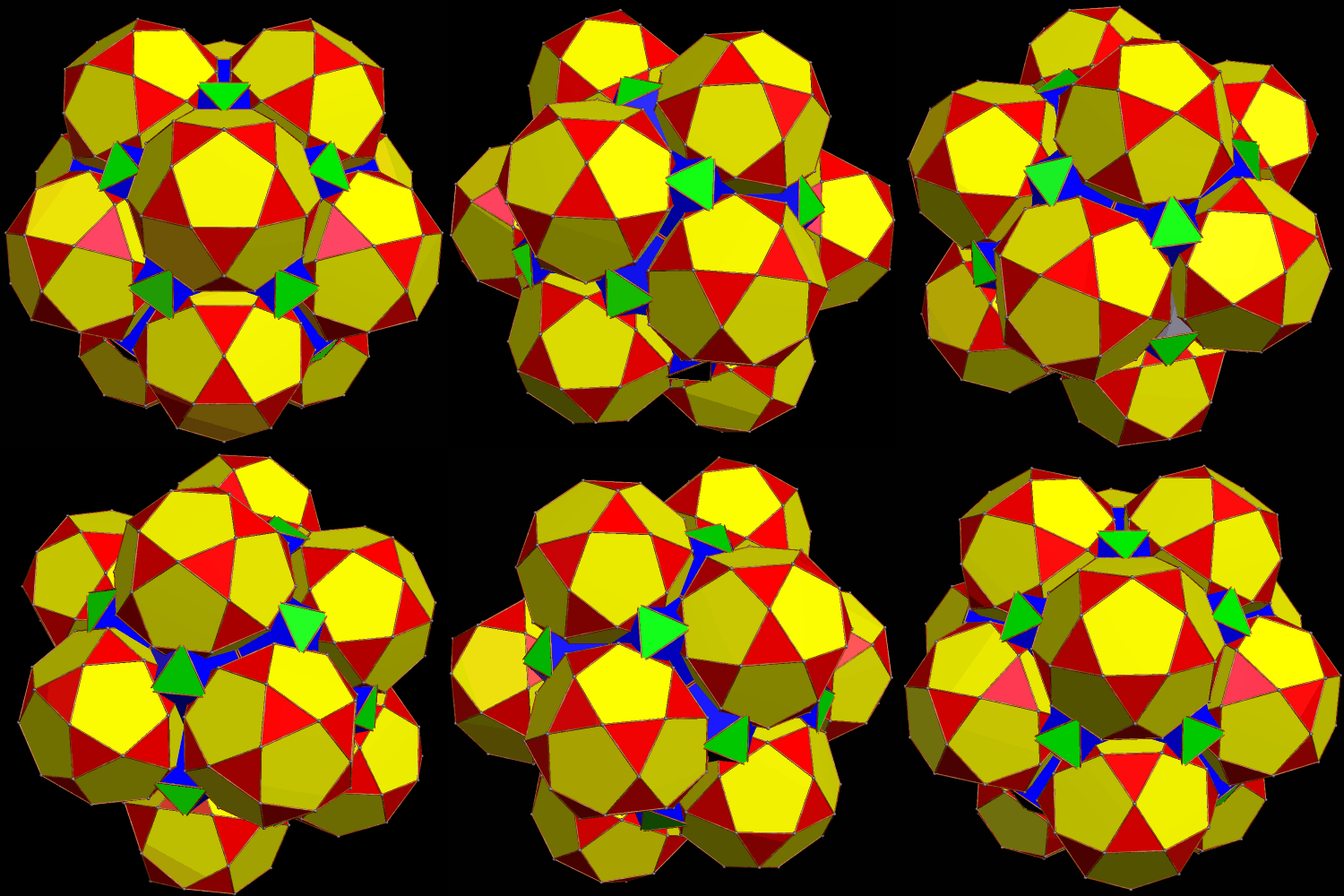
Above and below, you will find two different coloring-schemes for this particular cluster of polyhedra. I made both of these rotating images using Stella 4d, software you can buy, or try for free, right here.

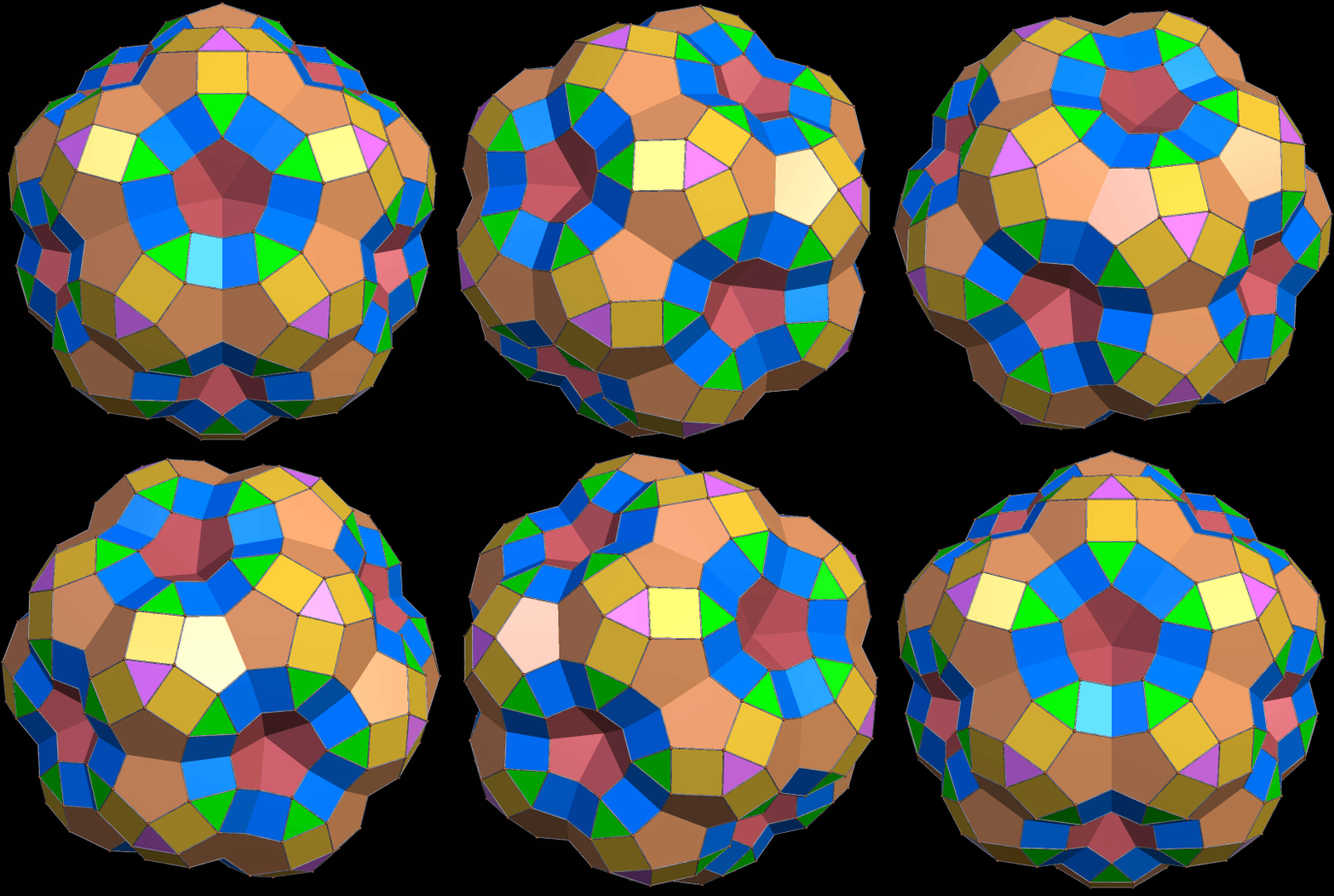
A model this complex would have taken days to build by hand. With software called Stella 4d: Polyhedron Navigator, however, making this “virtual model” was easy. This program is available for purchase at this website — and there is a free trial download available there, as well.

I’ve been a fan of John Lennon for as long as I can remember, and October 9, his birthday, has always been a special day for me. In 1983, when I was a high school junior, celebrating his birthday changed from something I simply did, by choice, into what, at the time, I considered a moral imperative.
In October of ’83, I was a student — a junior — at McClellan High School in Little Rock, Arkansas, and October 9th happened to be the day that all juniors were, according to that school’s administration, required to take the ASVAB: the Armed Services Vocational Aptitude Battery. While this is a standardized test, it isn’t like other standardized tests — it is actually a recruitment tool for the United States military.
At the time, Ronald Reagan was president, and we were in one of the many scary parts of the Cold War, with the threat of global thermonuclear war looming over us at all times. If you are too young to remember the Reagan era well, it may be hard to understand just how real, and how scary, it was to grow up with a president who did such things as making “jokes,” like this, in front of a microphone:
Reagan made this extremely unfunny “joke” the next year, in 1984, but the climate of fear in which he thought such a thing would be funny was already firmly in place in 1983, and I was already openly questioning the sanity of our president. My own anti-war attitudes, very much influenced by Lennon and his music, were already firmly in place. For the few unfamiliar with it, here is a sample of Lennon’s music.
So here I was, a high school junior, being told I had to take a test, for the military, on John Lennon’s birthday. I reacted to this in pretty much the same way a devout Jew or Muslim would react to being told to eat pork chops: I absolutely refused to cooperate. “Blasphemy” is not a word I use often now, and it wasn’t then, either, but to cooperate with this would have been the closest thing to blasphemy which I was capable of understanding at that age (I was 15 years old when this happened).
The other juniors got up and shuffled off, like good, obedient soldiers, when the intercom told them to go take the ASVAB. I simply remained seated.
The teacher told me it was time to go take the ASVAB. I replied, calmly, that no force on earth could compel me to take a test for the military on John Lennon’s birthday. At that point, I was sent to the office. Going to the office posed no ethical nor moral dilemmas for me, for I wanted the people there to know, also, that it was wrong for them to give a test for the military on October 9, of all days.
The principal, a man already quite used to dealing with me and my eccentricities, knew it would be pointless to argue with me about the ASVAB. He simply showed me a chair in the main office, and told me I could sit there that day, all day, and I did. To the school, this might have been seen as a single day of in-school suspension, but I saw it for what it really was: a one-person, sit-down protest for peace, in honor of the greatest activist for peace the world has ever known. It was an act of civil disobedience, and I regret nothing about it.
I will be sharing this story with Lennon’s widow, Yoko Ono, a woman I very much admire, and the greatest living activist for peace in the world today. Yoko, I do hope you enjoy this story. You and John have done great things, and they will not be forgotten, as long as people remain alive to tell about them.
Peace to all.
[Credits: photo from rollingstone.com; videos from YouTube.]

Ordinarily, with Zometools, the compound of five cubes is an all-blue model. However, I wanted to build one in which each cube is a different color, so I made a special request to the Zometool Corporation (their website: http://www.zometool.com) for some off-color parts, to make this possible.
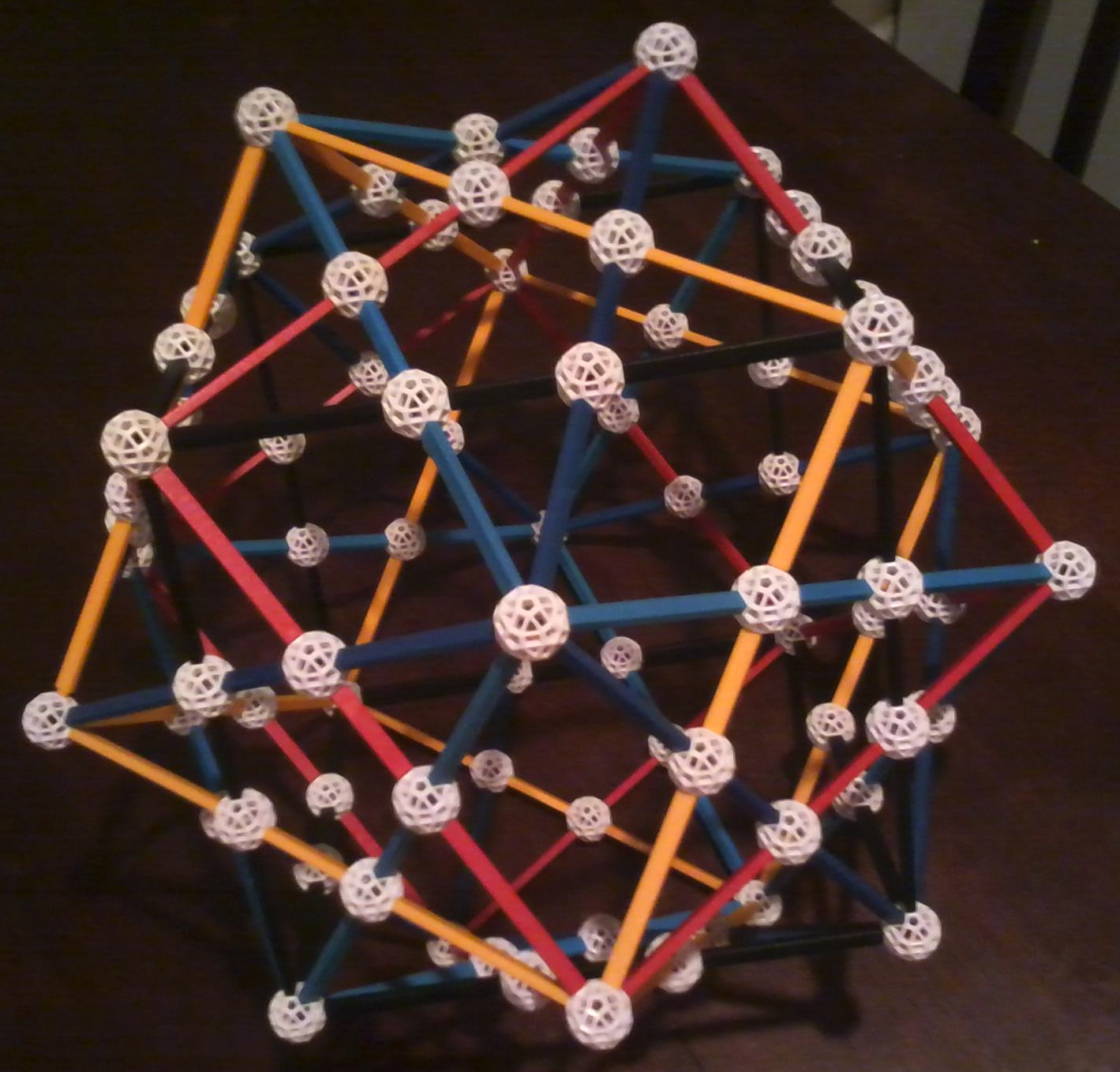
The five colors used in this model are standard blue, a darker shade of blue, red, yellow, and black.
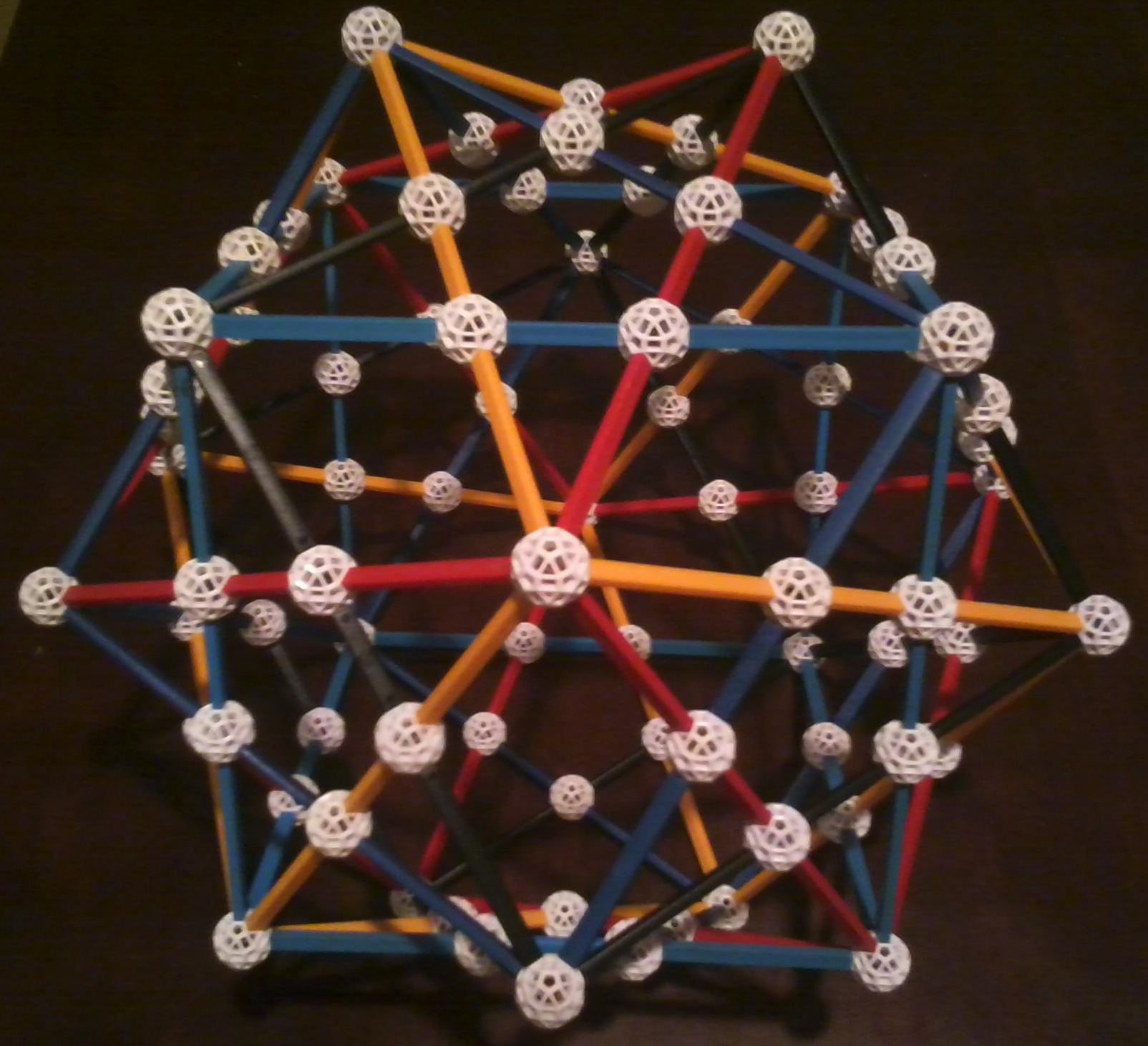
I also received the struts needed to build this model with one cube in white, so I will be making a second version of this soon. I didn’t want the Zomeballs used to match any strut color, though, so I will have to wait for the shipment of purple Zomeballs I ordered, today, to arrive, before I can build that model.
Zome is a fantastic tool to use for mathematical investigations, as well as education, and other applications as well. I recommend this product highly, and without reservation.
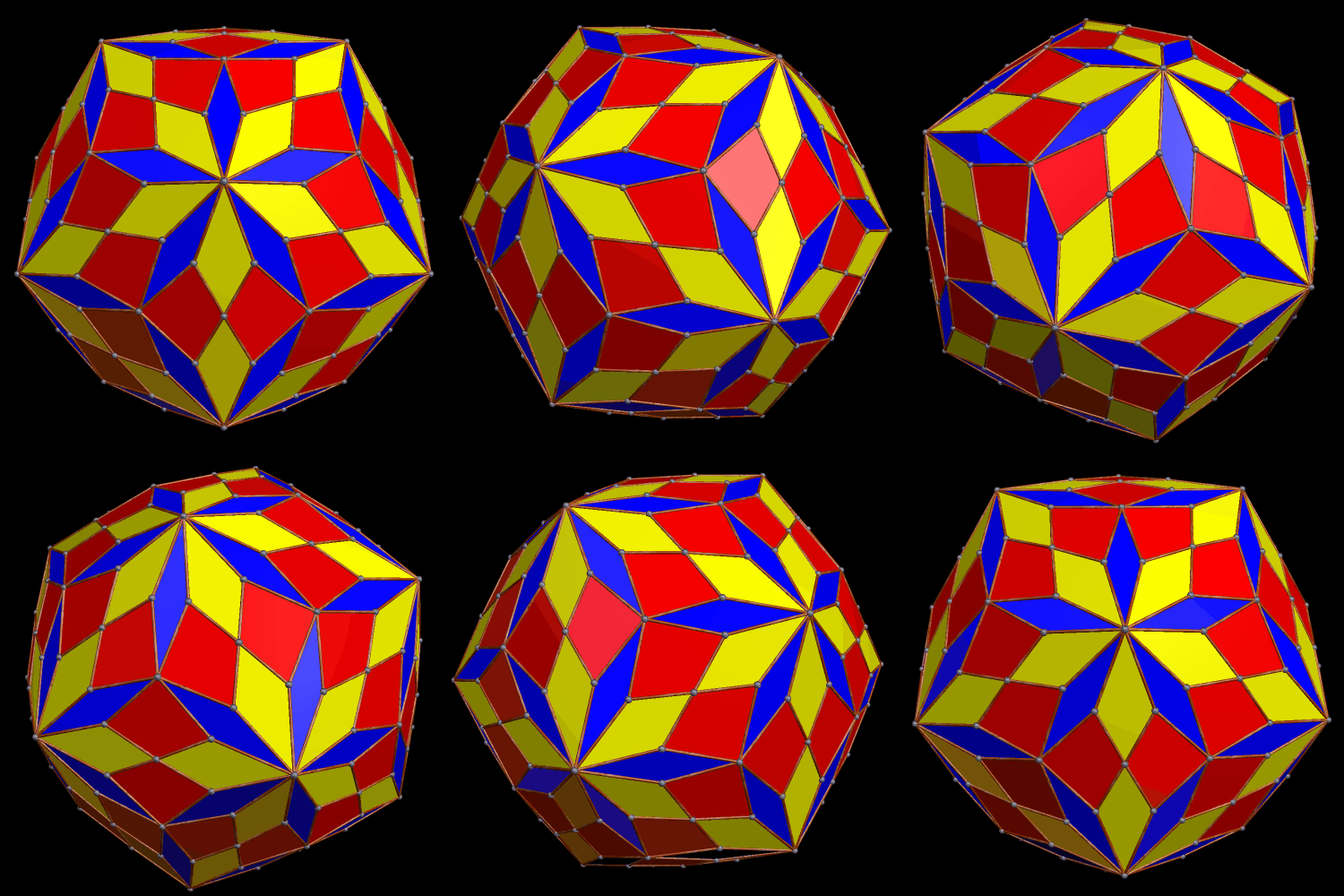
If one starts with the great rhombicosidodecahedron, then makes a compound of it, and its dual, and then forms the convex hull of that compound, this is the result:
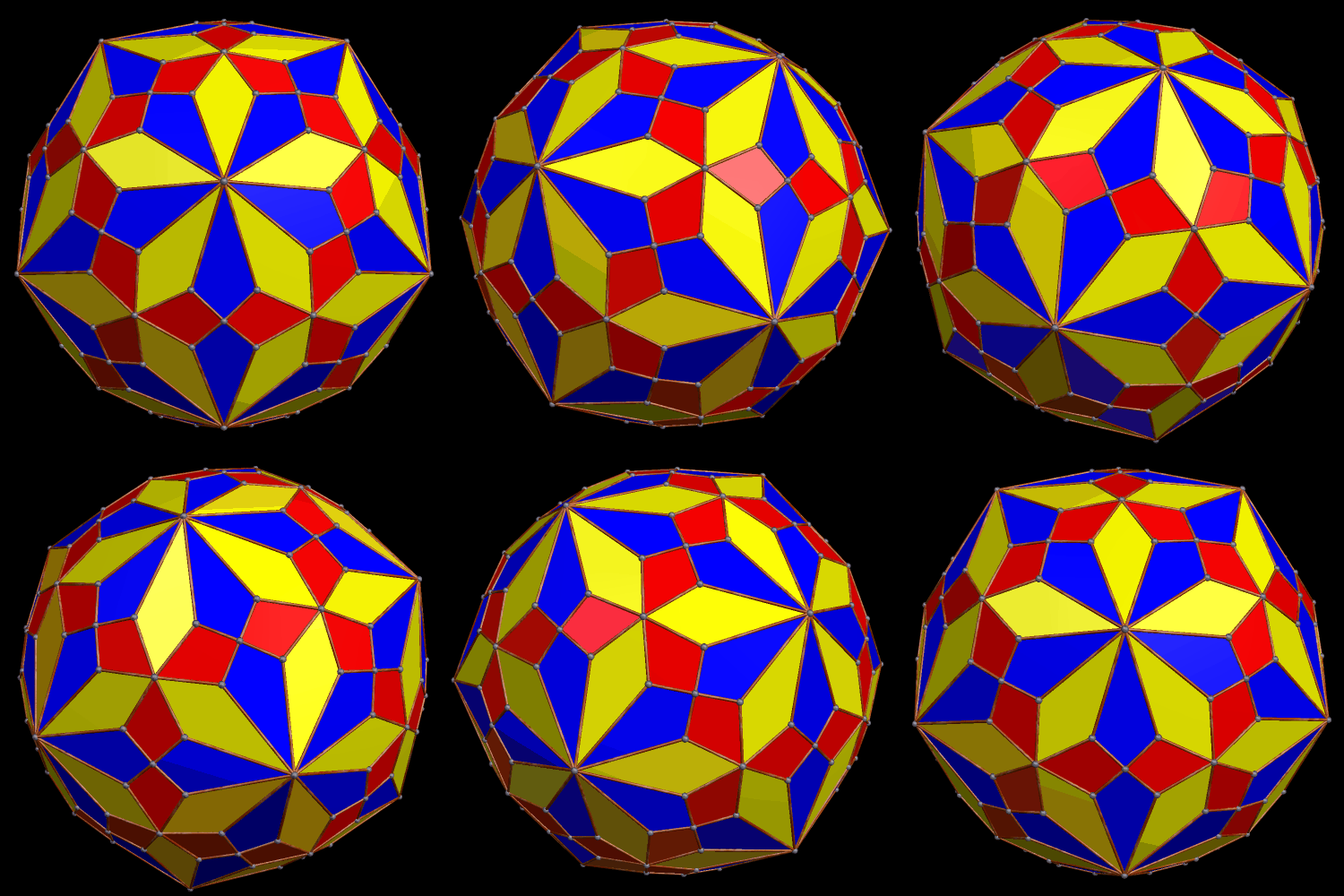
This polyhedron has 180 faces, all of them kites. What’s more, there are equal numbers — sixty each — of the three different types of kites in this polyhedron.
It also has an interesting dual:
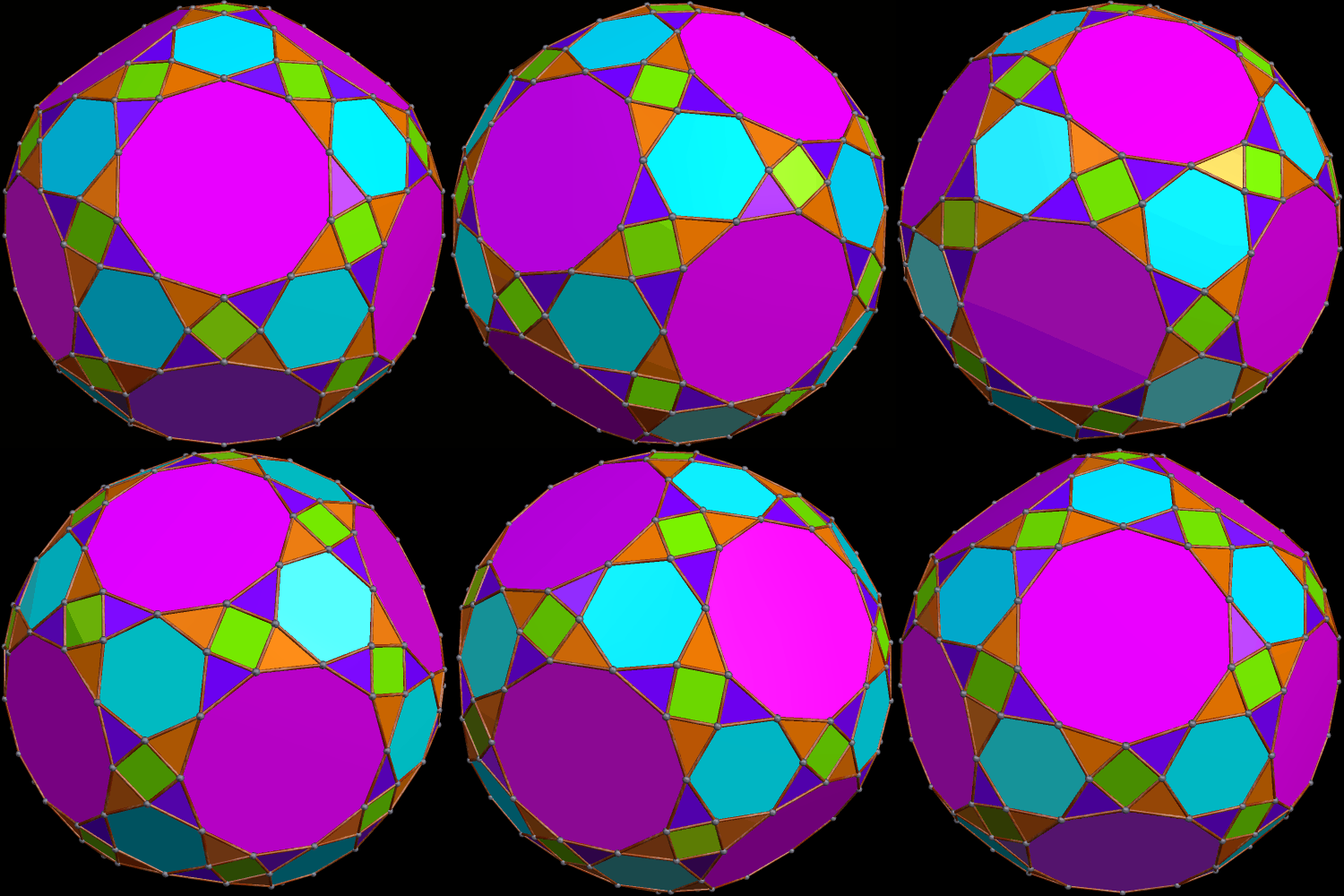
These virtual polyhedral models were created using Stella 4d: Polyhedron Navigator, which you can buy, or try for free, right here. Stella contains a “try to make faces regular” function, and here is what appears if that operation is applied to the dual shown above:
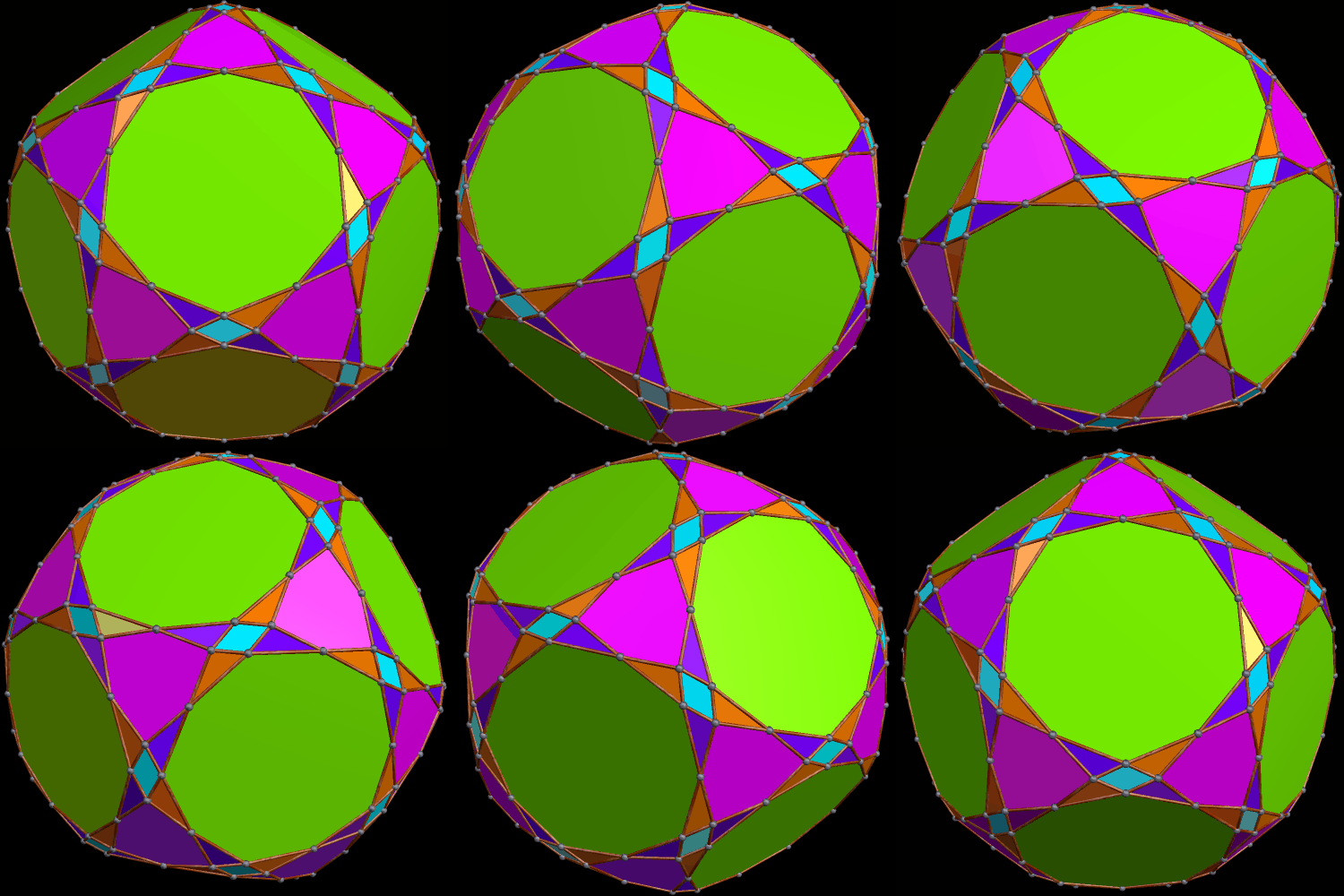
The dual of this figure is similar to the original polyhedron at the top of this post, featuring 180 kites, again: sixty each, of three different types:
In September, I noticed that friends of mine started suddenly having superheroes appear as their Facebook profile-pictures. After learning that this was being done to support the efforts to find cures for pediatric cancer, I decided to join them. However, I also have adult friends and relatives who are battling cancer, so I cannot limit this to only pediatric cancer. I’m also not changing my profile picture back, just because it is no longer September. Of course, I chose my favorite comic book character. This is what I now “look” like, on Facebook:

Other animated characters I have seen, as profile pictures of friends of mine who are also participating in this effort, include (in alphabetical order) Batman, Cyclops, She-Hulk, Snoopy, Stan Marsh (of South Park), Susan Storm (the Invisible Woman), and the new, female Thor, as well as others.
To those also participating: thank you. To those not yet participating, I invite you to join us.
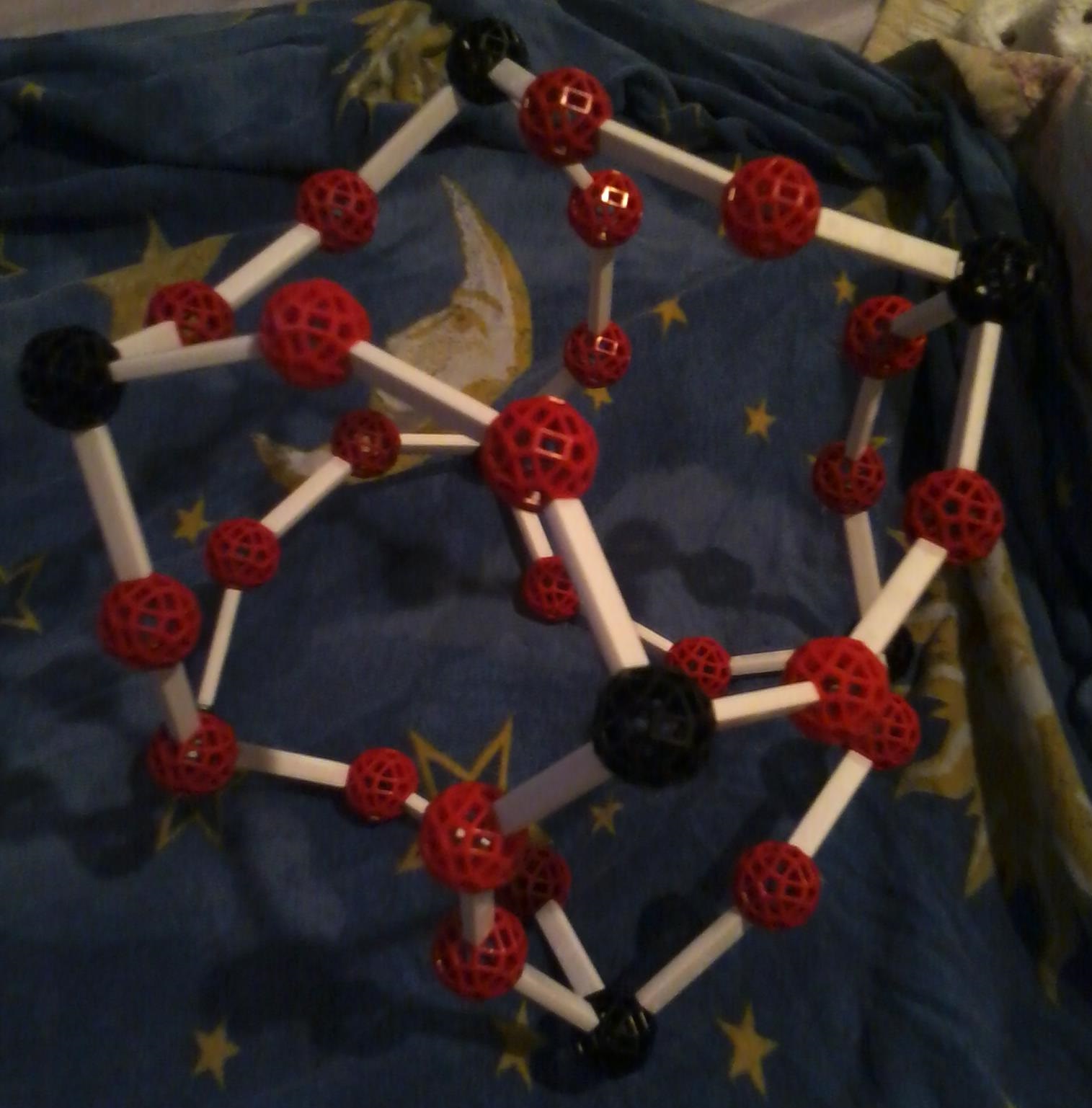
The President of the Zometool Corporation, Carlos Neumann, gave me a challenge, not long ago: find a solution to the Zome Cryptocube puzzle which uses only B0s, which I call “tiny blue struts.” For the Cryptocube puzzle, though, these “blue” struts actually appear white. Carlos knows me well, and knows I cannot resist a challenge involving Zome. Here is what I came up with, before the removal of the black cube, which is what the Zome Cryptocube puzzle starts with.

In a “pure” Crypocube solution, the red Zomeballs would also be white — not just the “blue” struts. However, when Carlos issued this challenge, I was at home, with all the white Zomeballs I own located at the school where I teach — so I used red Zomeballs, instead, since I had them at home, and did not wish to wait.
Here’s what this Cryptocube solution looks like, without the black cube’s black struts. You can still “see” the black cube, though, for the black Zomeballs which are the eight corners of the black cube are still present. As is happens, this particular Cryptocube solution has pyritohedral symmetry — better known as the symmetry of a standard volleyball.
While the Cryptocube puzzle is not currently available on the Zome website, http://www.zometool.com, it should be there soon — hopefully, in time for this excellent Zome kit to be bought as a Christmas present. Once a child is old enough so that small parts present no choking hazard, that child is old enough to start playing with Zome — and it is my firm belief that such play stimulates the intellectual growth of both children and adults. As far as a maximum age where Zome is an appropriate Christmas gift, the answer to that is simple: there isn’t one.
Also: while I do openly advertise Zome, I do not get paid to do so. I do this unpaid advertising for one reason: I firmly believe that Zome is a fantastic product, especially for those interested in mathematics, or for those who wish to develop an interest in mathematics — especially geometry. Also, Zome is fun!

Source for image, before I added the words: http://saanichfusionfc.ca/wp-content/uploads/2015/06/Lightning_over_city.jpg
Source for the quote, itself: More Maxims of Mark, By Mark Twain, ed. Merle Johnson (New York: Privately printed, November 1927). See, also, this website.
I am grateful to my friend Tom, for helping me correct this Mark Twain quote, an earlier (and apparently incorrect) version of which I posted here.
Regarding the incorrect grammar in the quote: it’s Mark Twain. One does not correct the grammar of a great writer!
 RobertLovesPi.net