Unknown's avatar

About RobertLovesPi

I go by RobertLovesPi on-line, and am interested in many things, a large portion of which are geometrical. Welcome to my own little slice of the Internet. The viewpoints and opinions expressed on this website are my own. They should not be confused with those of my employer, nor any other organization, nor institution, of any kind.

A Tour of the Periodic Table of the Elements, Part 1

Periodic-Table-of-Elements 1st one with alkali metal and such

(click to enlarge)

In this, and the some upcoming posts, I’ll be showing you various collections of elements on the horizontally-extended version of the periodic table — one that includes the f-block elements in their proper place, rather than relegating them to two separate rows below the other elements. (I’m also suggesting the purple letters A – N for the usually-unrecognized groups in the f-block, and keeping the group numbers 1-18, with which many are familiar, for other groups).

For this first post, I’ll start with some sets of elements which are familiar to most who have studied the subject, plus some others which are much less well-known.

  • Light blue — the alkali metals.
  • Black background with red symbol and atomic number — hydrogen, which is definitely not an alkali metal, despite it sharing group 1 with them.
  • Dark blue — the alkaline-earth metals.
  • Dark yellow — the lanthanides.
  • Orange — these two elements are included with the lanthanides in some sources, and with the transition metals in others.
  • Bright pink — the actinides.
  • Light pink — these two elements are included with the actinides is some sources, and with the transition metals in others.
  • Red — the transition metals, also known as the transition elements, and d-block elements.
  • Light purple — group 13 is often called the “boron group,” but it also goes by other names, such as the “icosagens” and the “triels.”
  • Dark purple — group 14 is often called the “carbon group,” but it also goes by other names, such as “tetragens” and “crystallogens.” In semiconductor physics, these elements are referred to as group IV elements. 
  • Dark green — group 15 elements are referred to as the pnictogens, or nitrogen-group elements.
  • Bright yellow — bright yellow is used here for the chalcogens, also known as the group 16 elements, or oxygen-group elements.
  • Light green — the halogens.
  • Gray — the noble gases.

Elementary School Mathematics Education Mysteries

mystery

Since these two problems are really the exact same problem, in two different forms, why not just use “x” to teach it, from the beginning, in elementary school, instead of using the little box? The two symbols have the exact same meaning!

To the possible answer, “We use an ‘x’ for multiplication, instead, so doing this would be confusing,” I have a response: why? Using “x” for multiplication is a bad idea, because then students have to unlearn it later. In algebra, it’s better to write (7)(5) = 35, instead of 7×5 = 35, for obvious reasons — we use “x” as a variable, instead, almost constantly. This wouldn’t be as much trouble for students taking algebra if they had never been taught, in the first place, that “x” means “multiply.” It’s already a letter of the alphabet and a variable, plus it marks spots. It doesn’t need to also mean “multiply.”

Why are we doing things in a way that causes more confusion than is necessary? Should we, as teachers, not try to minimize confusion? We certainly shouldn’t create it, without a good reason for doing so, and these current practices do create it.

These things may not be mysteries to others, but they certainly are to me.

[Note: for those who do not already know, I am a teacher of mathematics. However, I do not have any experience teaching anything at the elementary level. For this particular post, that’s certainly relevant information.]

The True Tale of the “Facebook Agent”

facebook

Today, a guy claiming to be named Ronnie Crider friend-requested me on Facebook. It wasn’t long after I accepted the friend-request before I got a private message from him, at which time I found out that, according to his profile and his messages to me, he’s a “Facebook Agent.”

It seems this supposed F.A. needed certain personal information from me, so that he could get my “$200,000 thousand United State dollars” prize to me, at which point the conversation got bogged down, since I wanted clarification whether he wanted to give me two hundred thousand thousand (which is two hundred million, and is what he typed), or just a “mere two hundred thousand,” as I called it, it only being 0.1% of the originally stated figure. The amount he was pretending to offer sounded paltry, when compared to the much higher figure he actually, but accidentally, pretended to offer!

After getting giving him sufficient “rope,” which he used, as predicted, for the usual purpose in such situations, I reported him to Facebook — for impersonating Facebook. I thought T.R. Facebook (“The Real Facebook”) would have a serious problem with F.S. Facebook (“Fake Scammy Facebook”) doing their fake scammy things. This seems reasonable, does it not?

However, I just got a message, in response to my report, from T.R. Facebook, and they aren’t closing F.S. Facebook’s account. Apparently, T.R. Facebook is just fine, for reasons I do not understand, with people pretending to be “Facebook Agents,” but I still wouldn’t recommend it. To anyone. That’s no way to live one’s life. 

I have this guy blocked now, but I did notice we had a bunch a mutual friends on T.R. Facebook, so those who know me on T.R. Facebook, in particular, are advised to watch out for F.S. Facebook, who uses the name mentioned above, and a profile-picture of a white guy in a suit, approximate age 50. I’m including the actual name he used because he (or she) probably stole it from some guy whose real name is Ronnie Crider, and perhaps that identity-theft victim will find out he is being impersonated because of this blog-post. The odds are small, but it is possible. Perhaps, if the actual Ronnie Crider reports F.S. Facebook for impersonating him, then T.R. Facebook will close his account. Maybe.

Now, of course, “watching out” for Agent F.S. Facebook, as I advised above, doesn’t mean you can’t have a little fun at his expense. If you would find it an entertaining diversion, and want to toy with him over his terrible math and writing when/if he contacts you, as I did, I suppose that’s what he deserves, for trying to scam people.

Later note: T.R. Facebook contacted me again, and now they are reviewing the rules of Facebook with F.S. Facebook, which sounds like oh so much fun to endure, does it not? Perhaps T.R. Facebook follows my blog?

One Dozen Precious Metal Cubes: A Problem Involving Geometry, Chemistry, and Finance (Solution Provided, with Pictures)

The troy ounce is a unit of mass, not weight, and is used exclusively for four precious metals. At this time, the prices per troy ounce, according to this source for current precious metal prices, for these four elements, are:

  • Gold, $1,094
  • Palladium, $600
  • Platinum, $965
  • Silver, $14.82

(As a side note, it is rare for platinum to have a lower price per troy ounce than gold, as is now the case. I would explain the reasons this is happening, except for one problem: I don’t understand the reasons, myself, well enough to do so. Yet.)

A troy ounce equals 31.1034768 grams, but, for most purposes, 31.103 g, or even 31.1 g, works just fine.

Also, as you can see here, these “troy elements” are all in one part of the periodic table. This is related to the numerous similarities in these elements’ physical and chemical properties, which is itself related, of course, to the suitability of these four elements for such things as jewelry, coinage, and bullion.

1371846764_periodic_table_of_elements

To determine the volume of a given mass of one of these metals, it is also necessary to know their densities, so I looked them up, using Google (they are not listed on the periodic table above):

  • Gold, 19.3 g/cm³
  • Palladium, 11.9 g/cm³
  • Platinum, 21.46 g/cm³
  • Silver, 10.49 g/cm³

In chemistry, of course, one must often deal with elements (as well as other chemicals) in terms of the numbers of units (such as atoms or molecules), except for one problem: this is absurdly impractical, due to the outrageously small size of atoms. Despite this, though, it is necessary to count such things as atoms in order to do much chemistry at all, so chemists have devised a “workaround” for this problem: when counting units of pure chemicals, they don’t count such things as atoms or molecules directly, but count them a mole at a time. A mole is defined as a number of things equal to the number of atoms in exactly 12 grams of pure carbon-12. To three significant figures, this number is 6.02 x 10²³. To deal with moles, since atoms have differing masses, we need to know the molar mass (mass of one mole) of whatever we are dealing with to convert, both directions, between moles and grams. Here are the molar masses of the four troy-measured elements, as seen on the periodic table above, below each element’s symbol.

  • Gold, 196.97 g
  • Palladium, 106.42 g
  • Platinum, 195.08 g
  • Silver, 107.87 g

I’ve given these numbers  as the information needed to solve the following problem: rank one dozen precious metal cubes (descriptions follow) by ascending order of volume. There are three cubes each of gold, palladium, platinum, and silver. Four of the twelve (one of each element) have a mass of one troy ounce each. Another four each have a value, at the time of this writing, of $1,000. The last set of four each contain one mole of the element which composes the cube, and, again, there is one of each of these same four elements in the set.

If you would like to do this problem for yourself, the time to stop reading is now. Otherwise (or to check your answers against mine), just scroll down.

.

.

.

.

.

.

.

.

.

.

.

In the solutions which follow, a rearrangement of the formula for density (d=m/v) is used; solved for v, this equation becomes v = m/d. In order, then, by both volume and edge length, from smallest to largest, here are the twelve cubes:

Smallest cube: one troy ounce of platinum

One tr oz, or 31.103 g, of platinum would have a volume of v = m/d = 31.103 g / (21.46 g/cm³) = 1.449 cm³. A cube with this volume would have an edge length equal to the its volume’s cube root, or 1.132 cm. (This explanation for the calculation of the edge length, given the cube’s volume, is omitted in the items below, since the mathematical procedure is the same each time.)

Second-smallest cube: $1000 worth of gold

Gold worth $1000, at the time of this posting, would have a troy mass, and then a mass in grams, of $1000.00/($1,094.00/tr oz) = (0.914077 tr oz)(31.103 g/tr oz) = 28.431 g. This mass of gold would have a volume of v = m/d = 28.431 g / (19.3 g/cm³) = 1.47 cm³. A cube with this volume would have an edge length of  1.14 cm.

Third-smallest cube: $1000 worth of platinum

Platinum worth $1000, at the time of this posting, would have a troy mass, and then a mass in grams, of $1000.00/($965.00/tr oz) = (1.0363 tr oz)(31.103 g/tr oz) = 32.231 g. This mass of platinum would have a volume of v = m/d = 32.231 g / (21.46 g/cm³) = 1.502 cm³. A cube with this volume would have an edge length of  1.145 cm.

Fourth-smallest cube: one troy ounce of gold

One tr oz, or 31.1 g, of gold would have a volume of v = m/d = 31.1 g / (19.3 g/cm³) = 1.61 cm³. A cube with this volume would have an edge length of 1.17 cm.

Fifth-smallest cube: one troy ounce of palladium

One tr oz, or 31.1 g, of palladium would have a volume of v = m/d = 31.1 g / (11.9 g/cm³) = 2.61 cm³. A cube with this volume would have an edge length of 1.38 cm.

Sixth-smallest cube: one troy ounce of silver 

One tr oz, or 31.103 g, of silver would have a volume of v = m/d = 31.103 g / (10.49 g/cm³) = 2.965 cm³. A cube with this volume would have an edge length of 1.437 cm.

Sixth-largest cube: $1000 worth of palladium

Palladium worth $1000, at the time of this posting, would have a troy mass, and then a mass in grams, of $1000.00/($600.00/tr oz) = (1.6667 tr oz)(31.103 g/tr oz) = 51.838 g. This mass of palladium would have a  volume of v = m/d = 51.838 g / (11.9 g/cm³) = 4.36 cm³. A cube with this volume would have an edge length of  1.63 cm.

Fifth-largest cube: one mole of palladium

A mole of palladium, or 106.42 g of it, would have a volume of v = m/d = 106.42 g / (11.9 g/cm³) = 8.94 cm³. A cube with this volume would have an edge length of 2.07 cm.

Fourth-largest cube: one mole of platinum

A mole of platinum, or 195.08 g of it, would have a volume of v = m/d = 195.08 g / (21.46 g/cm³) = 9.090 cm³. A cube with this volume would have an edge length of 2.087 cm.

Third-largest cube: one mole of gold

A mole of gold,  or 196.97 g of it, would have a volume of v = m/d = 196.97 g / (19.3 g/cm³) = 10.2 cm³. A cube with this volume would have an edge length of  2.17 cm.

Second-largest cube: one mole of silver

A mole of silver, or 107.87 g of it, would have a volume of v = m/d = 107.87 g / (10.49 g/cm³) = 10.28 cm³. A cube with this volume would have an edge length of 2.175 cm.

Largest cube: $1000 worth of silver

Silver worth $1000, at the time of this posting, would have a troy mass, and then a mass in grams, of $1000.00/($14.82/tr oz) = (67.48 tr oz)(31.103 g/tr oz) = 2099 g. This mass of gold would have a volume of v = m/d = 2099 g / (10.49 g/cm³) = 200.1 cm³. A cube with this volume would have an edge length of  5.849 cm.

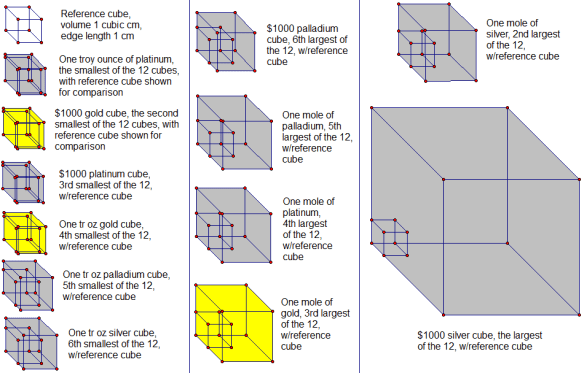
Finally, here are pictures of all 12 cubes, with 1 cm³ reference cubes for comparison, all shown to scale, relative to one another.
dozen cubes

A third of these cubes change size from day-to-day, and sometimes even moment-to-moment during the trading day, if their value is held constant at $1000 — which reveals, of course, which four cubes they are. The other eight cubes, by contrast, do not change size — no precious metal prices were used in the calculation of those cubes’ volumes and edge lengths, precisely because the size of those cubes is independent of such prices, due to the way those cubes were defined in the wording of the original problem.

On Motivational Speakers

motivational speakers

The Physics of Cats, Copperheads, Centipedes, Catbounce, and Catbouncemax

catbouncemax

Definition of catbouncemax (shortened form of “maximum catbounce”): for any particular cat, its catbouncemax is equal to the takeoff kinetic energy of that cat if it suddenly and unexpectedly finds itself face-to-face with an adult copperhead snake.

I’ve actually seen this happen. Really. The cat reached a height I estimate as 1.4 meters.

Measured in joules, a cat’s catbouncemax can most easily be approximated by observing and estimating the maximum height of the cat under these conditions. For ethical and safety reasons, of course, one must simply be observant, and wait for this to happen. Deliberately introducing cats and copperheads (or other dangerous animals) to each other is specifically NOT recommended. Staying away from copperheads, on the other hand, IS recommended. Good science requires patience!

After the waiting is over (be prepared to wait for years), and the cat’s maximum height h, in meters, has been estimated, the cat’s catbouncemax can then be determined by energy conservation, since its takeoff kinetic energy (formerly stored as feline potential energy, until the moment the cat spots the copperhead) is equal to the gravitational potential energy (PE = mgh) of the cat at the top of the parabolic arc. In the catbounce I witnessed, the cat who encountered a copperhead (while walking through tall grass, which is why the cat didn’t see the snake coming) was a big cat, at an estimated mass of 6.0 kg. His catbouncemax was therefore, by energy conservation, equal to mgh = (6.0 kg)(1.4 m)(9.81 m/s²) = ~82 joules, which means this particular cat had 82 J of ophidiofeline potential energy stored, specifically for use in the event of an encounter with a large, adult copperhead, or other animal (there aren’t many) with the ability to scare this cat equally as much as such a copperhead. (I’m using a copperhead in this account for one reason: that’s the type of animal which initiated the highest catbounce I have ever witnessed, and I seriously doubt that this particular cat could jump any higher than 1.4 m, under any  circumstances.)

It should be noted that the horizontal distance covered by a catbounce is not needed to calculate a cat’s catbouncemax. However, this horizontal distance will not be zero, as is apparent in the diagram above. Why? Simple: cats don’t jump straight up in reaction to copperheads, for they are smart enough not to want to fall right back down on top of such a snake.

It is more common, of course, for cats to jump away from scary things which are less scary than adult copperheads. For example, there certainly exist centipedes which are large enough to scare a cat, causing it to catbounce, but with that centipede-induced catbounce being less than its catbouncemax. The following fictional dialogue demonstrates how such lesser catbounces can be most easily described. (Side note: this dialogue is set in Arkansas, where we have cats and copperheads, and where I witnessed the copperhead-induced maximum catbounce described above.)

She: Did you see that cat jump?!?

He: Yep! Must be something scary, over there in that there flowerpatch, for Cinnamon to jump that high. At least I know it’s not a copperhead, though.

She: A copperhead? How do you know that?

He: Oh, that was quite a jump, dear, but a real copperhead would give that cat of yours an even higher catbounce than that! The catbounce we just saw was no more than 75% of Cinnamon’s catbouncemax, and that’s being generous.

She: Well, what IS in the flowerpatch? Something sure scared poor Cinnamon! Go check, please, would you?

He: [Walks over from the front porch, where the couple has been standing this whole time, toward the flowerpatch. Once he gets half-way there, he stops abruptly, and shouts.] Holy %$#@! That’s the biggest centipede I’ve ever seen!

She: KILL IT! KILL IT NOW!

Silly U.S. Map Puzzle #5

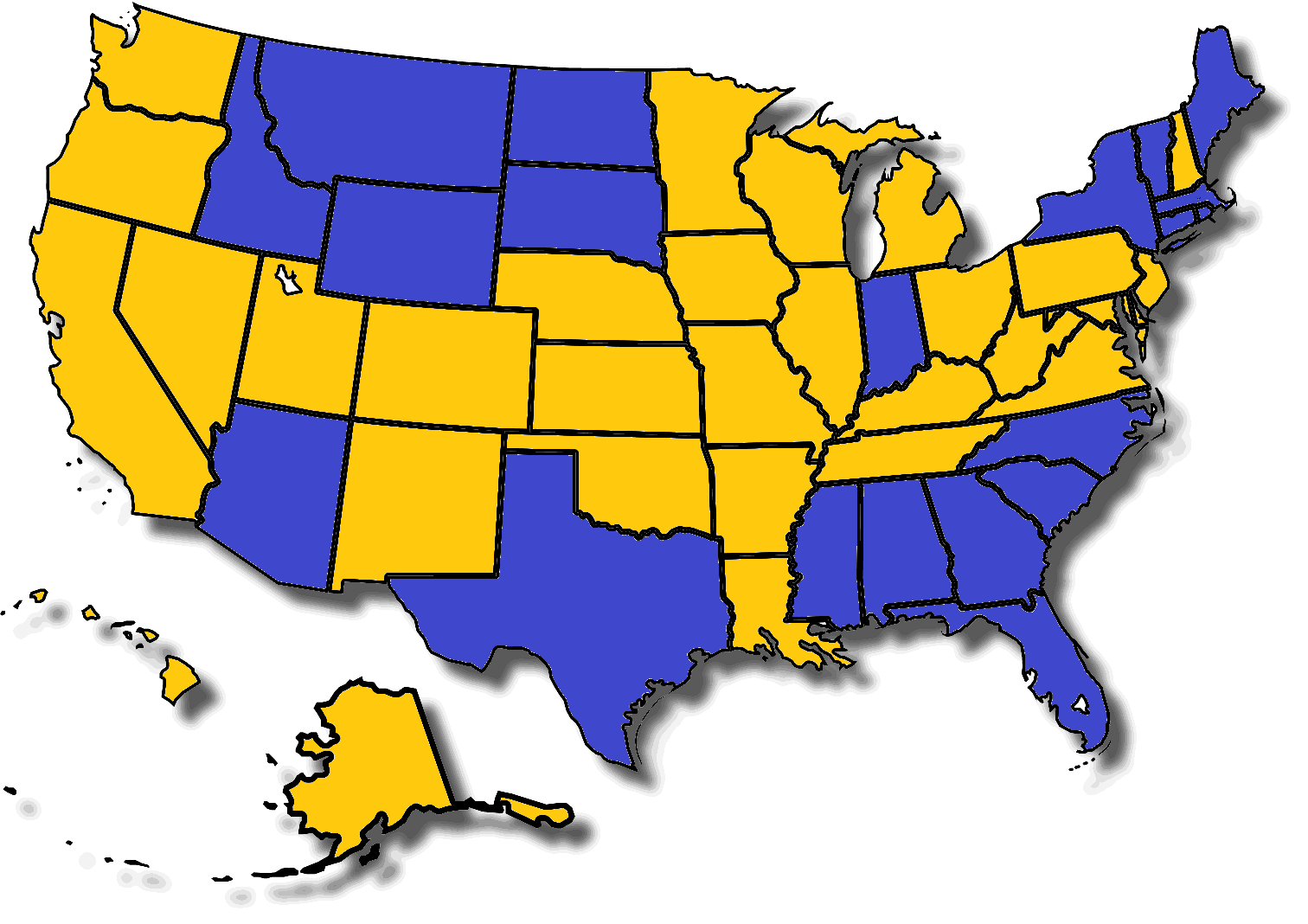
What do the colors on this map mean?

mappuzzle5

If you wish to check your answer, or just what to know what the solution is, just scroll down.

.

.

.

.

.

.

.

And keep on scrollin’. . . .

.

.

.

.

Solution:

Of the other 49 states in the USA, how many are adjacent to this one? The answer to this question determines the color of each state.

One point of clarification: if it takes a lengthy trip by boat or ship to get there, I didn’t count it as an adjacent state . . . so, for example, Minnesota and Michigan didn’t make each other’s lists. Simply going over a bridge isn’t enough for this sort of separation, though, which is why Arkansas and Tennessee did make each others’ lists of adjacent states. Had I interpreted water borders differently, this map would have some differences.

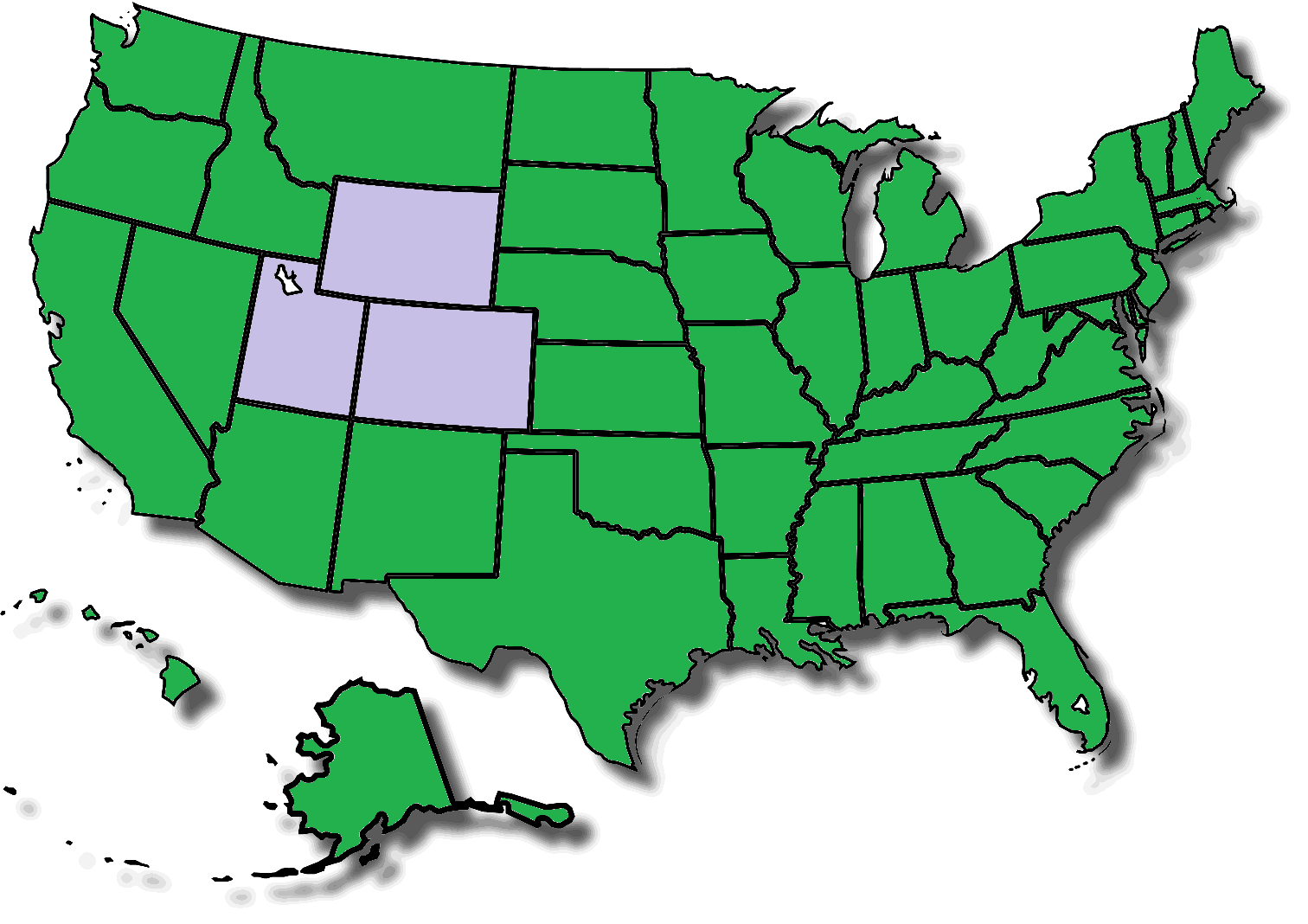
Another way this map could be altered would be to count states that meet others only at a single point, rather than a border with non-zero length. This would change the colors of the “four corners” states of Arizona, Utah, New Mexico, and Colorado, but would have no effect on the other 46 states.

Silly U.S. Map Puzzles #4a and 4b

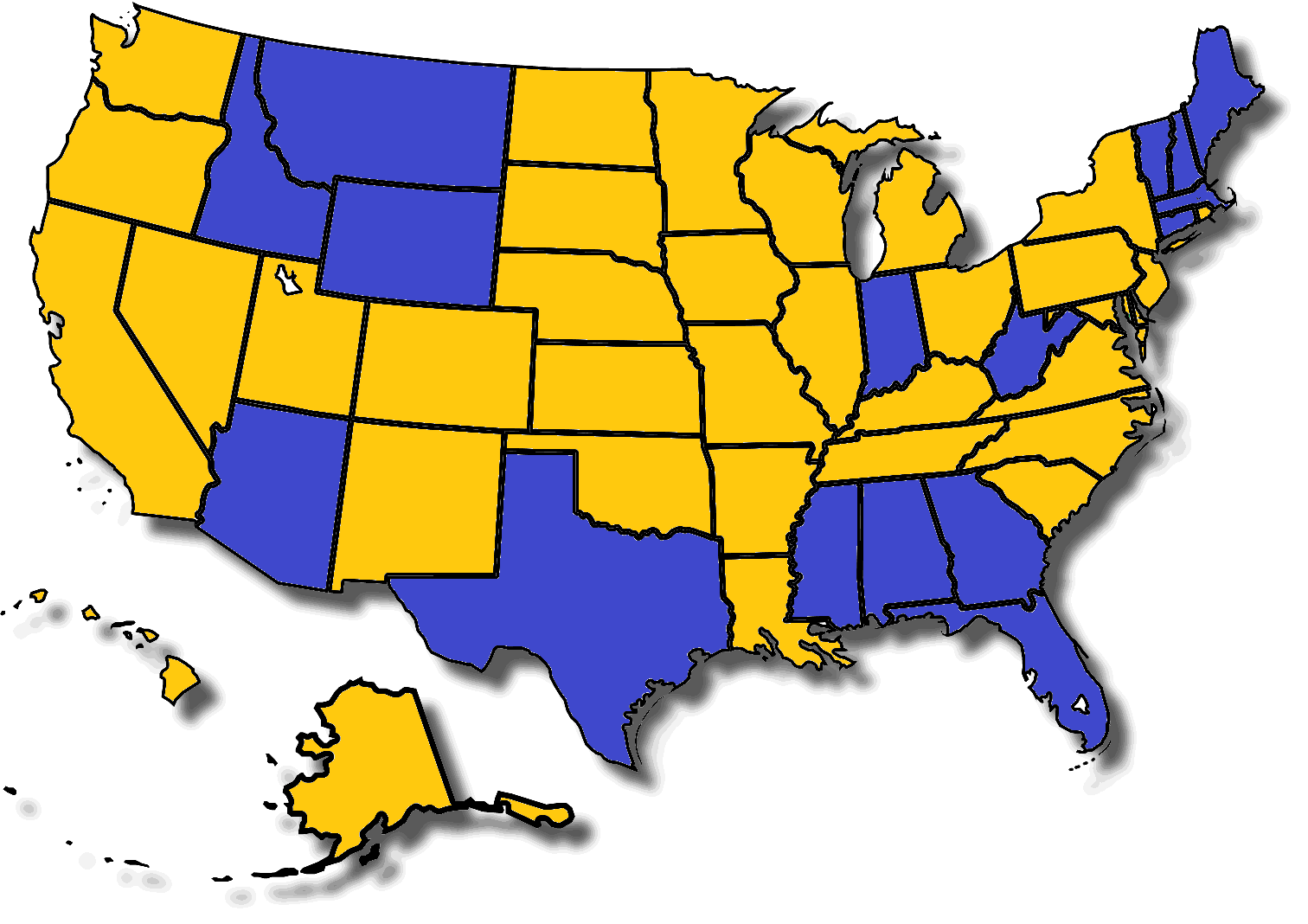
First, for puzzle #4a, what are the meanings of the colors on this map?

mapquiz4a-letters

For puzzle #4b, what do the colors mean on this second, similar map?

mapquiz4b-characters

To find the answers, simply scroll down.

.

.

.

.

.

.

Keep scrolling….

.

.

.

.

.

Solution:

In the first map, consider the number of letters in the name of each state. Is this number prime or composite?

In the second map, consider the number of characters, rather than letters, in each state’s name. This number is different for states with two-word names, due to the single character, a blank space, needed to separate the two words. Again: prime, or composite?

Silly U.S. Map Puzzle #3

What is represented by the colors on this map?

mapquiz3

The answer may be found by scrolling down.

.

.

.

.

.

.

.

Keep scrolling….

.

.

.

.

Answer:

Do any of the borders of this state contain squiggles? (Note: if you think New Mexico is the wrong color, check the part of that state which borders El Paso, Texas.)

Silly U.S. Map Puzzle #2

What is represented by the colors on this map?

mapquiz2

If you give up, you can scroll down to find the answer.

.

.

.

.

.

.

Keep scrolling….

.

.

.

Answer: the colors show whether the name of each state starts with a letter in the first, or second, half of the alphabet.