Unknown's avatar

About RobertLovesPi

I go by RobertLovesPi on-line, and am interested in many things, a large portion of which are geometrical. Welcome to my own little slice of the Internet. The viewpoints and opinions expressed on this website are my own. They should not be confused with those of my employer, nor any other organization, nor institution, of any kind.

A Golden Tessellation

golden tiling

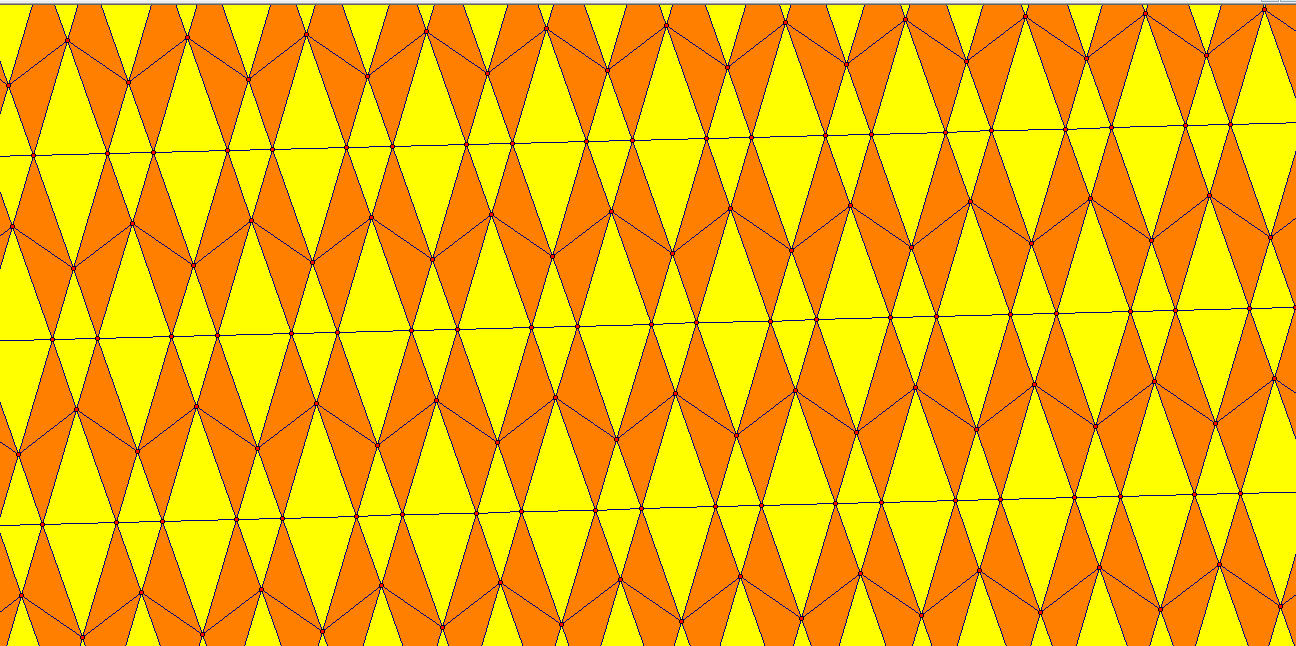
This tessellation can be viewed in at least two ways: it can be seen as being composed of overlapping octagons which are equilateral, but not equiangular — or it can be viewed as a periodically-repeating pattern of golden gnomons, as well as golden triangles of two different sizes. Both golden triangles and golden gnomons are isosceles triangles with sides in the golden ratio, but golden triangles are acute, while golden gnomons are obtuse.

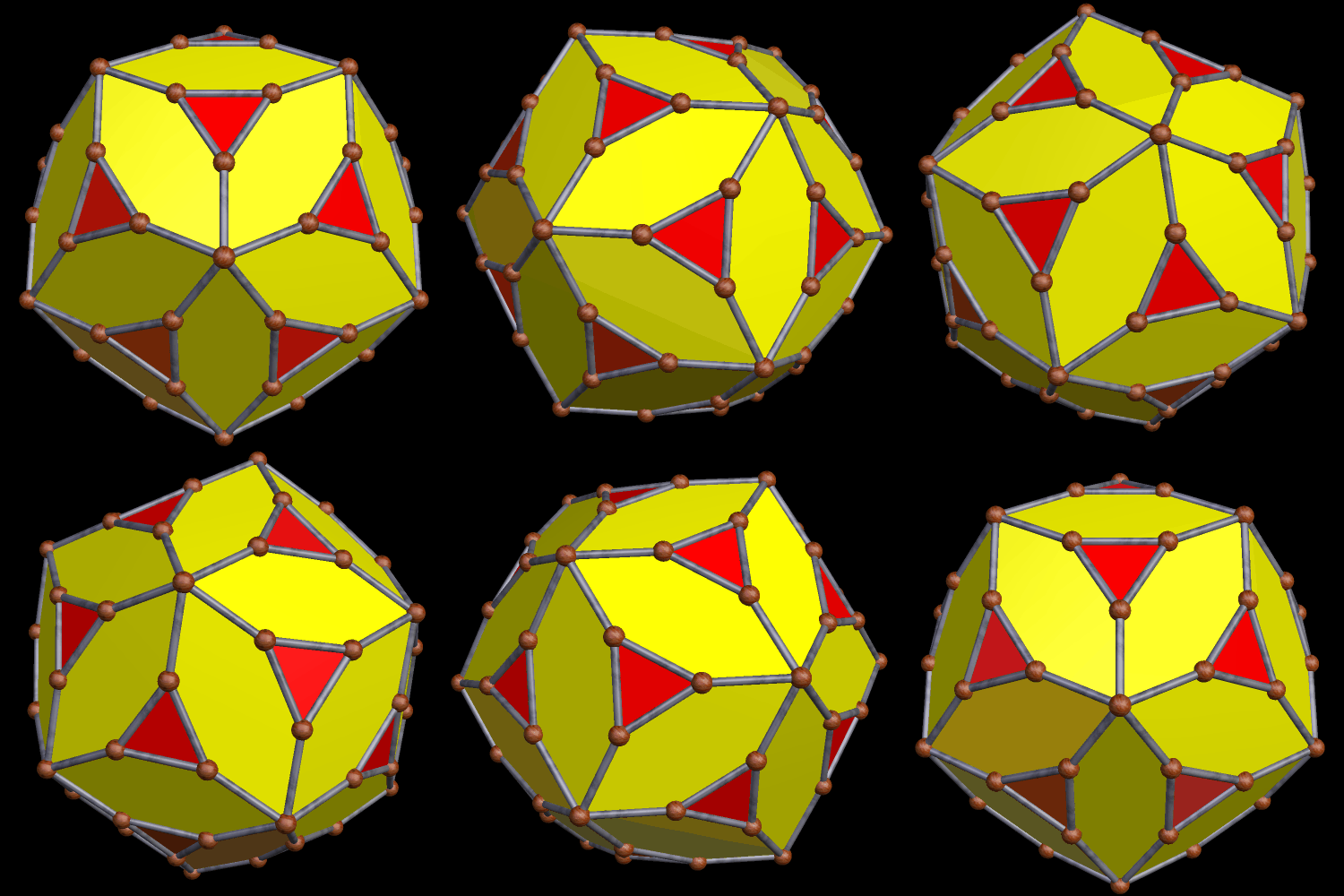
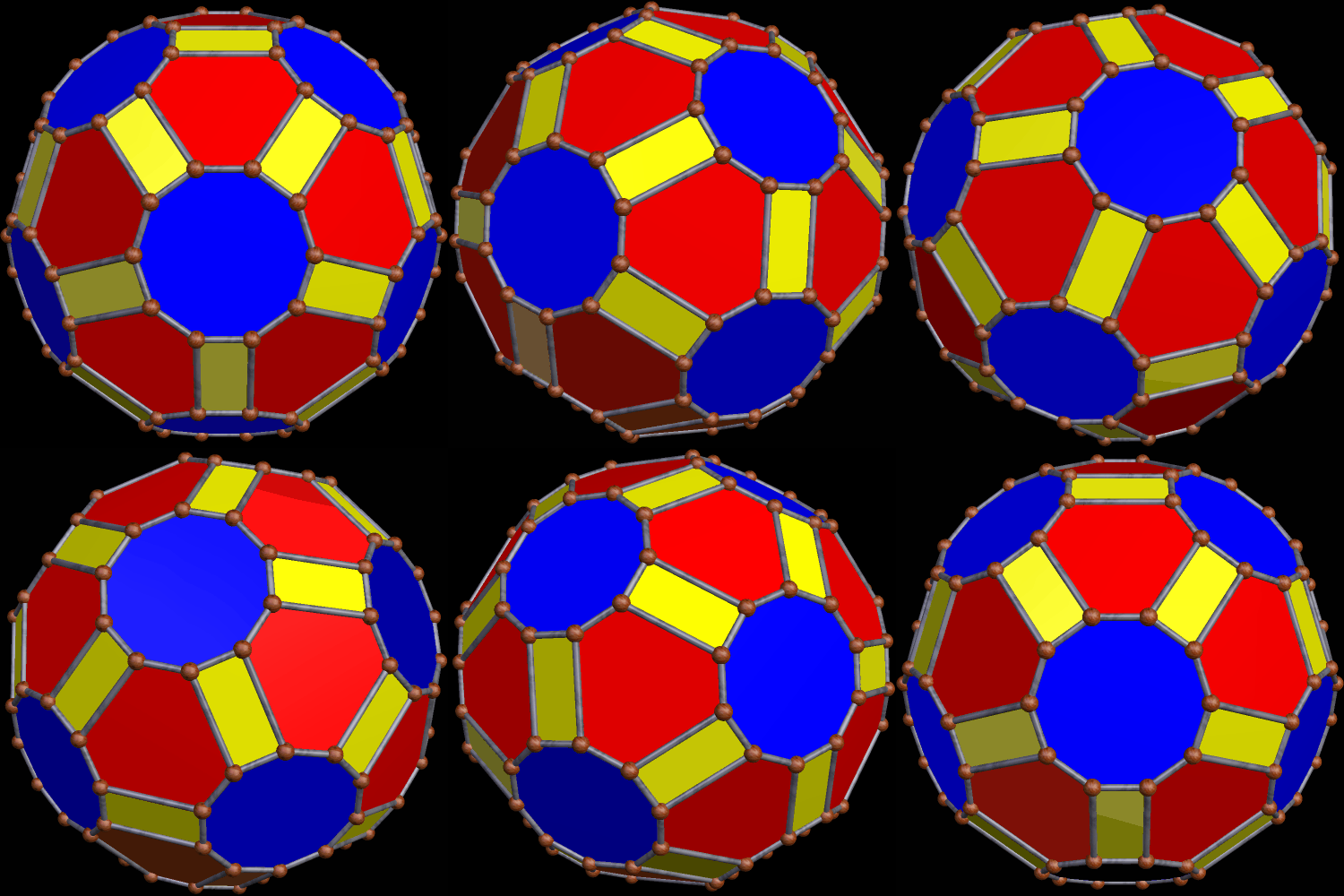
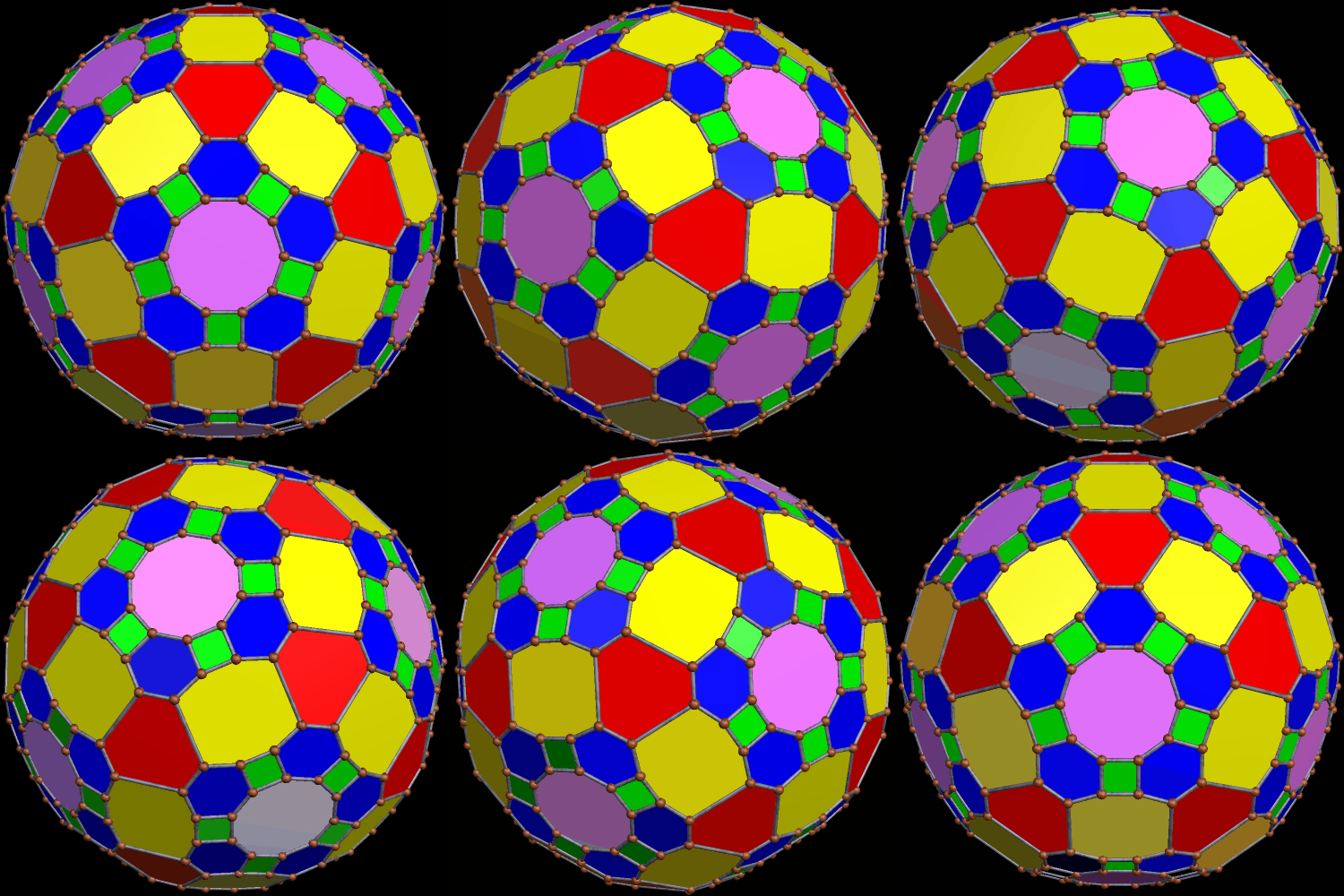
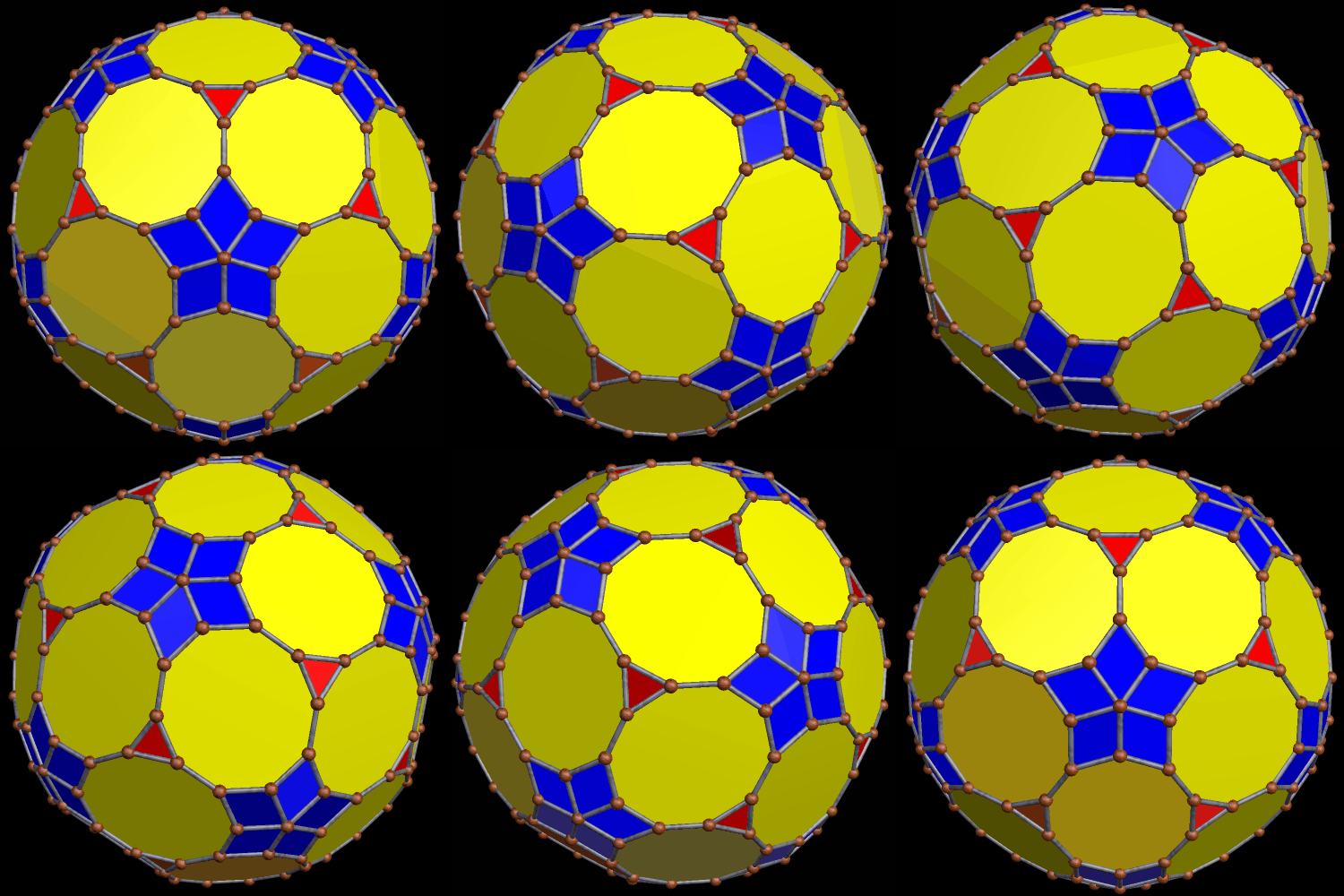
The Seven Zonish Icosahedra with Zones Added Based on Faces, Edges, and/or Vertices

If a zonish icosahedron is created with zones based on the icosahedron’s vertices, here is the result.

zonish icosa v

If the same thing is done with edges, this is the result.

zonish icosa e

Another option is faces-only.

zonish icosa f

The next zonish icosahedron has had zones added based on the icosahedron’s faces and edges, both.

zonish icosahedra e f

Here’s the one for vertices and edges.

zonish icosa v e

Here’s the one for faces and vertices.

zonish icosahedron v f

Finally, the last of this set of seven has had zones added based on all three: faces, vertices, and edges.

zonish icosa v e f

All seven of these were made with Stella 4d, which is available at http://www.software3d.com/Stella.php.

Compounds of Enantiamorphic Archimedean Solid Duals

An enantiomorphic-pair compound requires a chiral polyhedron, for it is a compound of a polyhedron and its mirror image. Among the Archimedeans, only the snub cube and snub dodecahedron are chiral. For this reason, only threir duals are chiral, among the Archimedean duals, also known as the Catalan solids.

Compound of enantiomorphic pair snub cube duals

That’s a compound of two mirror-image snub cube duals (pentagonal icositetrahedra) above; the similar compound for the snub dodecahedron duals (pentagonal hexacontahedra) is below.

Compound of enantiomorphic pair

Both these compounds were made with Stella 4d, which is available at http://www.software3d.com/Stella.php.

An Icosagon, with Its Diagonals

icosagon

A Special Type of Compound, Built with Zome, of the Great and Small Stellated Dodecahedra

For years, I have used Zometools (sold here:  http://www.zometool.com) to teach geometry. The constructions for the icosahedron and dodecahedron are easy to teach and learn, due to the use of short reds (R1s) and medium yellows (Y2s) for radii for the two of them, as shown below, with short blue (B1) struts as edges for both polyhedra.

10865862_10204218181029594_3308928268978197013_o

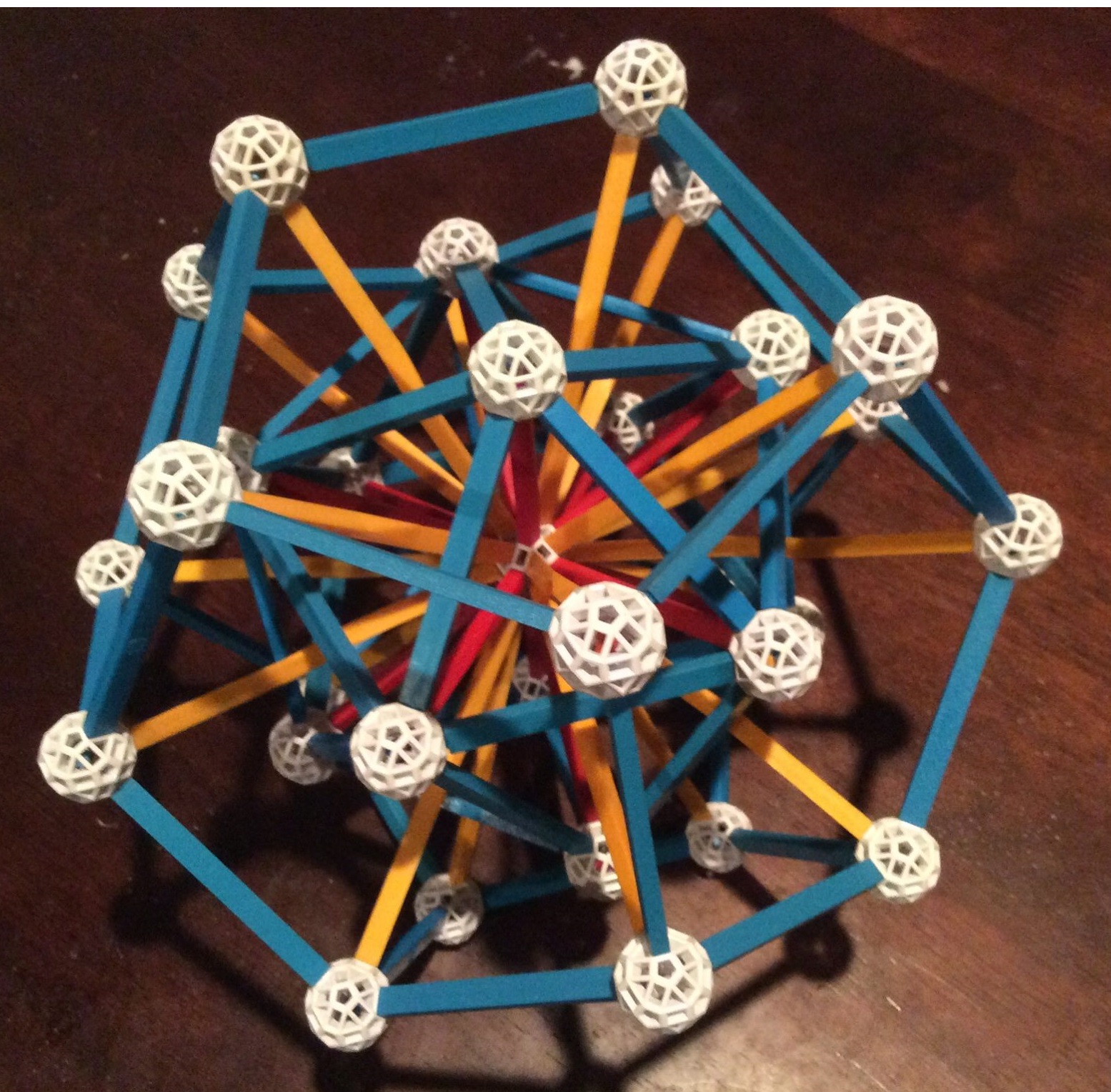
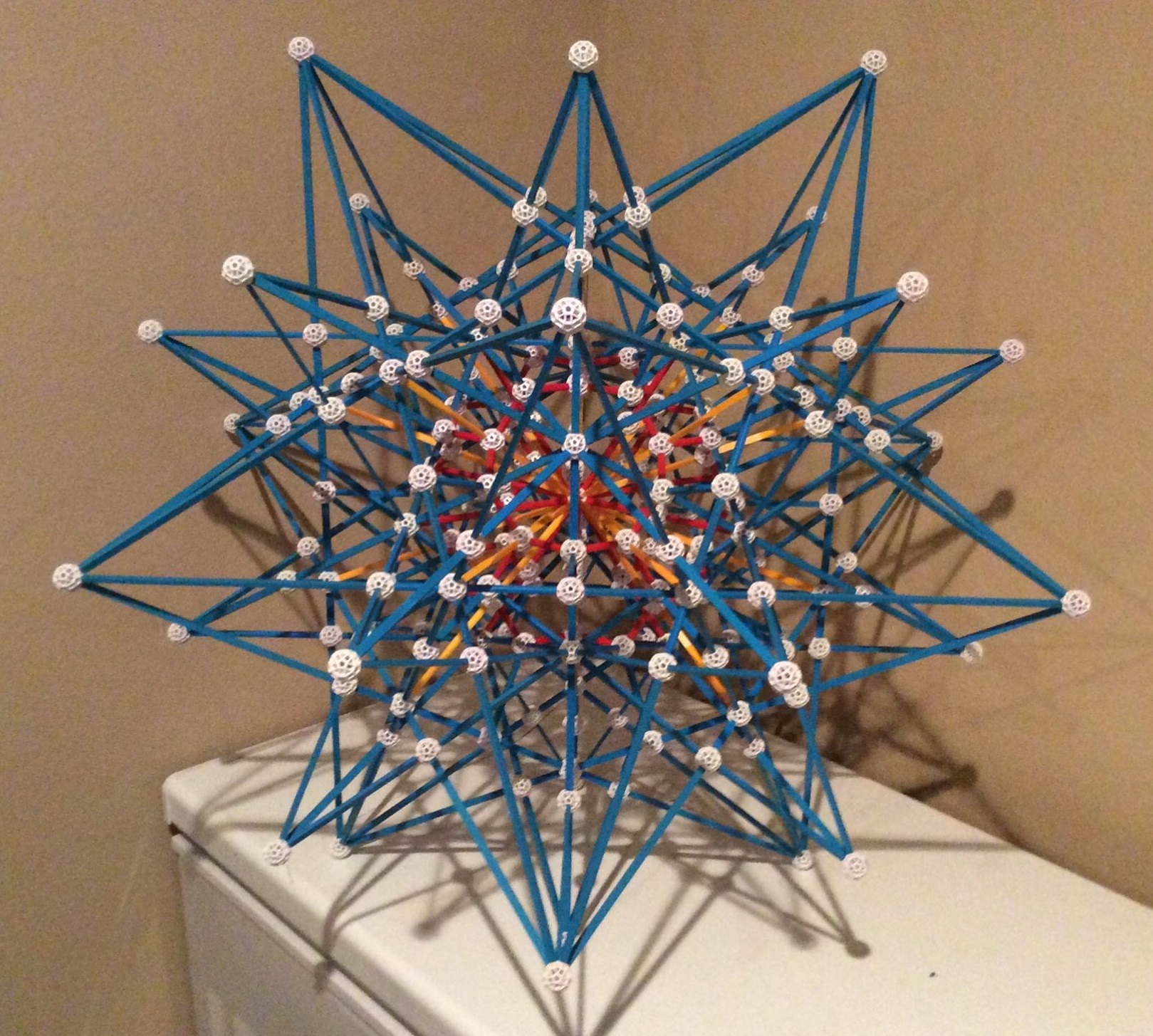
Unexpectedly, a student (name withheld for ethical and legal reasons) combined the two models, making this:

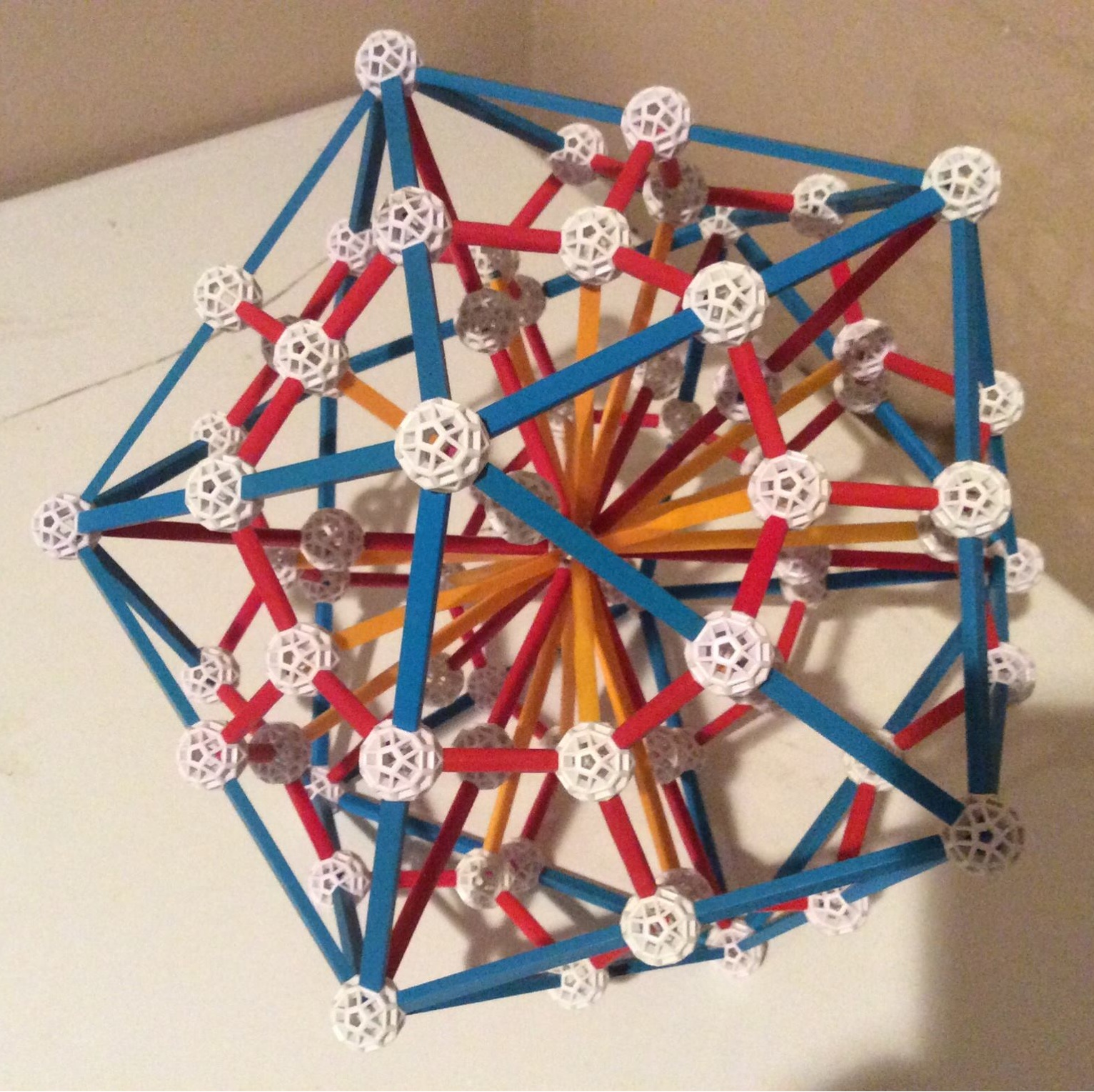
1401165_10204218146948742_4605456240300721240_oI saw it, and wondered if the two combined Platonic solids could be expanded along the edges, to stellate both polyhedra, with medium blues (B2s), to form the great and small stellated dodecahedron. By trying it, I found out that this would require intersecting blue struts — so a Zomeball needed to be there, at the intersection. Trying, however, only told me that no available combination would fit. After several more attempts, I doubled each edge length, and added some stabilizing tiny reds (R0s), and found a combination that would work, to form a compound of the great and small stellated dodecahedron in which both edge lengths would be equal. In the standard (non-stellated) compound of the icosahedron and dodecahedron, in which the edges are perpendicular, they are unequal in length, and in the golden ratio, which is how that compound differs from the figure shown directly above.

Here’s the stabilized icosahedral core, after the doubling of the edge length:

10865862_10204218180989593_3871605705756535601_oThis enabled stellation of each shape by edge-extension. Each edge had a length twice as long as a B2 added to each side — and it turns out, I discovered, that 2B2 in Zome equals B3 + B0, giving the golden ratio as one of three solutions solution to x² + 1/x = 2x (the others are one, and the golden ratio’s reciprocal). After edge-stellation to each component of the icosahedron/dodecahedron quasi-compound, this is what the end product looked like. This required assembling the model below at home, where all these pictures were taken, for one simple reason: this thing is too wide to fit through the door of my classroom, or into my car.

10847334_10204218153268900_1020271669763339706_o

Here’s a close-up of the central region, as well.

closeup

A Virtual Zomeball

zomeball

For physical modeling of polyhedra, I often use Zometools (available at http://www.zometool.com), which use Zomeballs as nodes for a ball-and-stick modeling system. To make virtual models such as the one above, though, I use Stella 4d: Polyhedron Navigator (available at http://www.software3d.com/Stella.php).

It occurred to me to try to make a virtual model of a Zomeball, which is one of two equally-symmetrical versions of a rhombicosidodecahedron, with its squares replaced by golden rectangles. If you visit the Zometools page, you can see the way they picture Zomeballs, and then let me know how good a simulation I created, above.

Blue-on-Blue Dodecahedron

dodecah3

This uses enlarged spheres centered on the dodecahedron’s vertices, overlapping so that they obscure the edges. Also, the faces are rendered invisible. I created it using Stella 4d, available at http://www.software3d.com/Stella.php.

Buckminsterfullerene Molecular Models: Three Different Versions

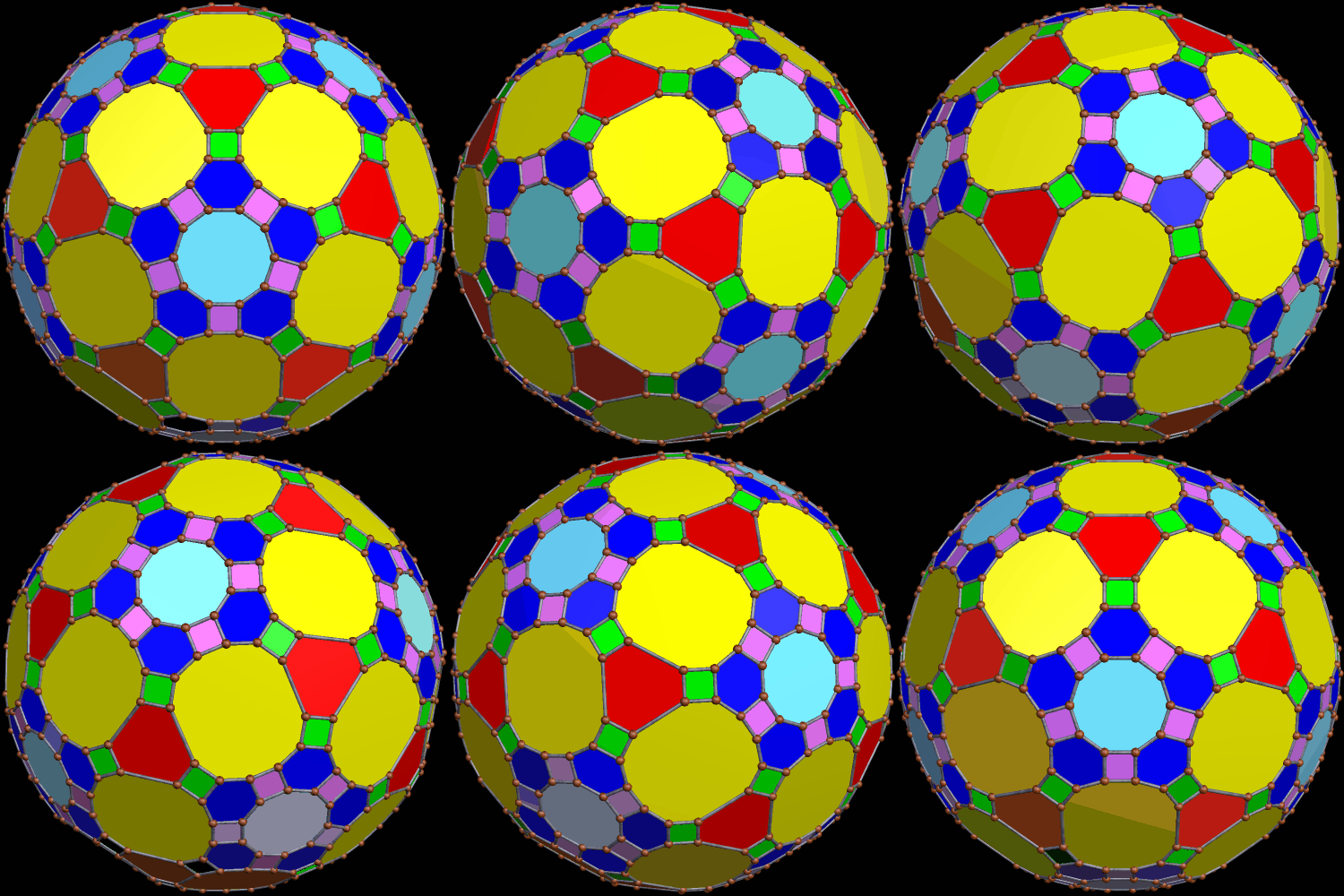
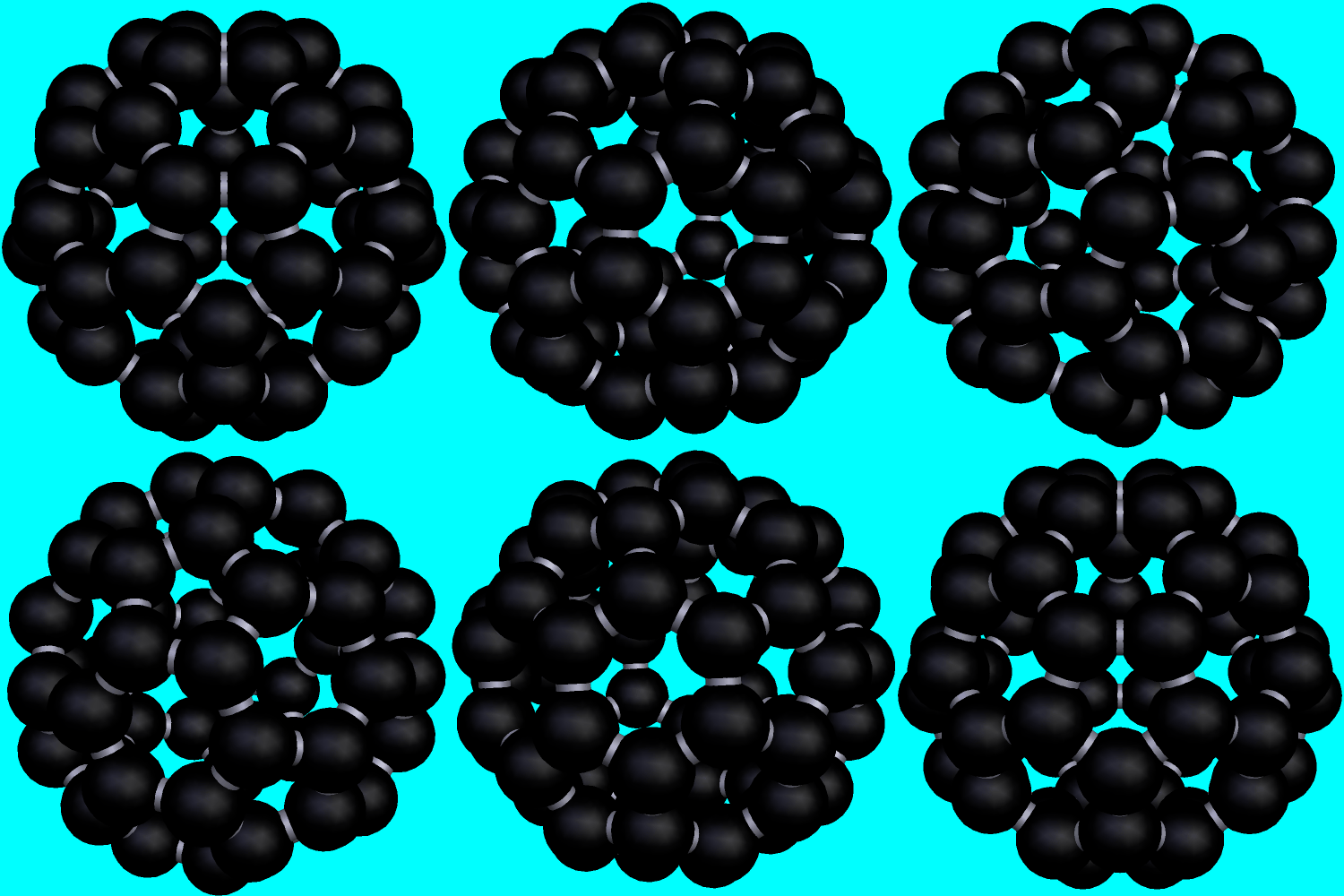
Buckminsterfullerene, a molecule made of 60 carbon atoms, and having the shape of a truncated icosahedron, is easily modeled with Stella 4d: Polyhedron Navigator (see http://www.software3d.com/Stella.php to try or buy this program). The first image shows the”ball and stick” version used by chemists who want the bonds between atoms to be visible.

Trunc Icosa
The second model is intermediate between the ball-and-stick version, and the space-filling version, which follows it.

Trunc Icosa2

Here’s the “closely packed” space-filling version, taken to an extreme.

Trunc Icosa3

Which version better reflects reality depends on the certainty level you want for molecular orbitals. A sphere representing 99% certainty would be larger than one for 95% certainty.

Uniform Polyhedra: A Study, Beginning with the Small Ditrigonal Icosidodecahedron

A set of polyhedra which I have not (yet) studied much are the uniform polyhedra. The uniform polyhedra do, however, include some sets of polyhedra which I have studied extensively:

  • The Five Platonic Solids
  • The Four Kepler-Poinsot Solids
  • The Thirteen Archimedean Solids

Subtracting these 22 polyhedra (and the infinite sets of prisms and antiprisms), from the uniform polyhedra, leaves 53 uniform star polyhedra, of which 5 are quasiregular and 48 are semiregular. There’s also one other star polyhedron, only counted sometimes, which is different from the others in that it has pairs of edges that coincide. Discovered by John Skilling, it is often simply called Skilling’s figure. There are also 40 “degenerate” uniform polyhedra; these are generally not counted toward the total. I’ve been aware that these 54 polyhedra existed for years, but was preoccupied with the others. Now, it’s time to fix that.

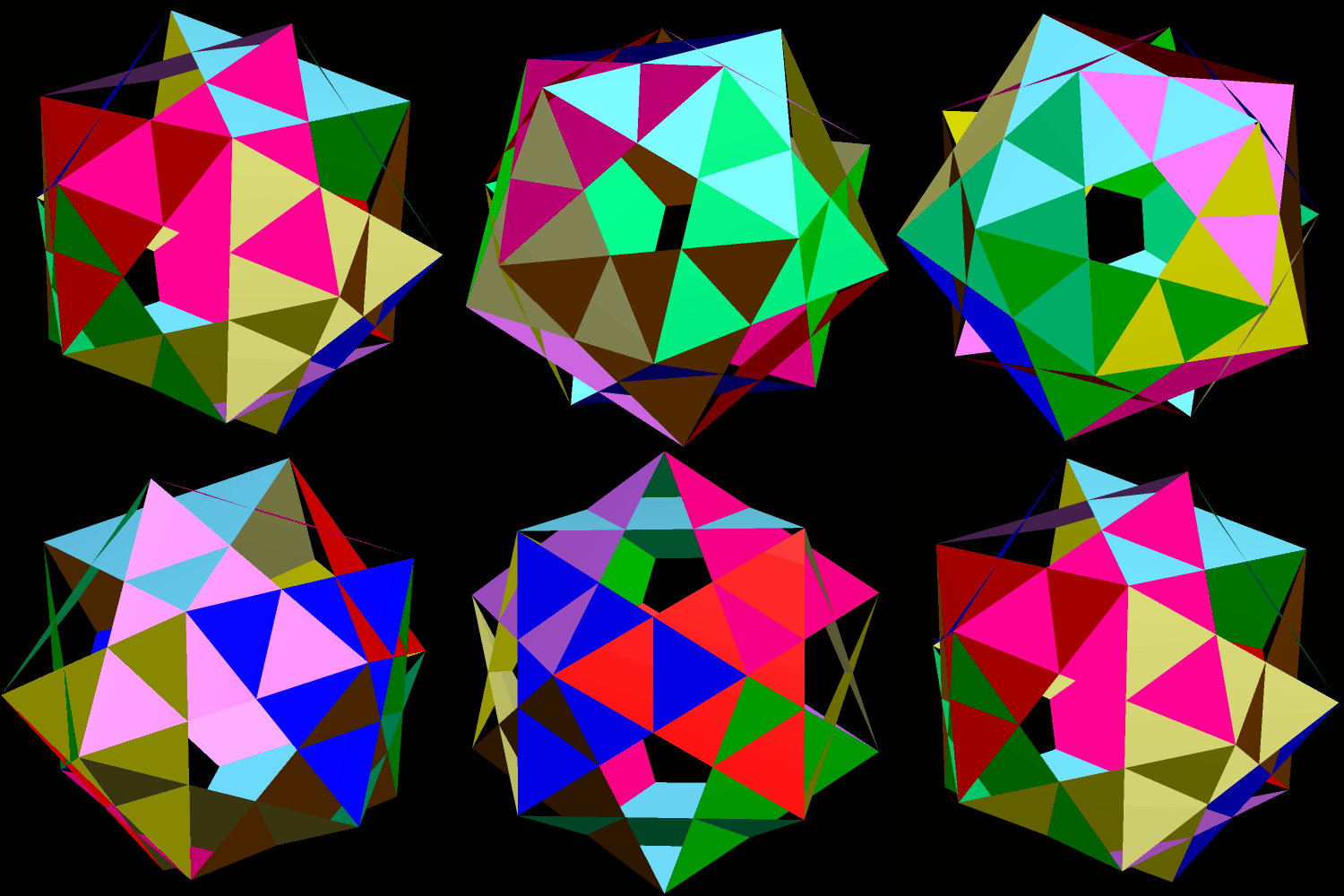
There is a listing of all 75 (or 76) uniform polyhedra at https://en.wikipedia.org/wiki/List_of_uniform_polyhedra, for those who’d like to examine them as a group. My approach will be different: I’m going to study the ones I don’t already know one at a time, starting with one I picked on the basis of aesthetics alone: the small ditrigonal icosidodecahedron. To be a uniform polyhedron, all vertices must be the same (in other words, it is vertex-transitive), and all faces must be regular, with regular star polygons allowed. In this figure, each vertex has three equilateral triangles meet, as well as three star pentagons, with these figures alternating as one moves around the vertex, examining them.

Small Ditri Icosidodeca

Here are just the twelve star pentagons, with only parallel faces having the same color.
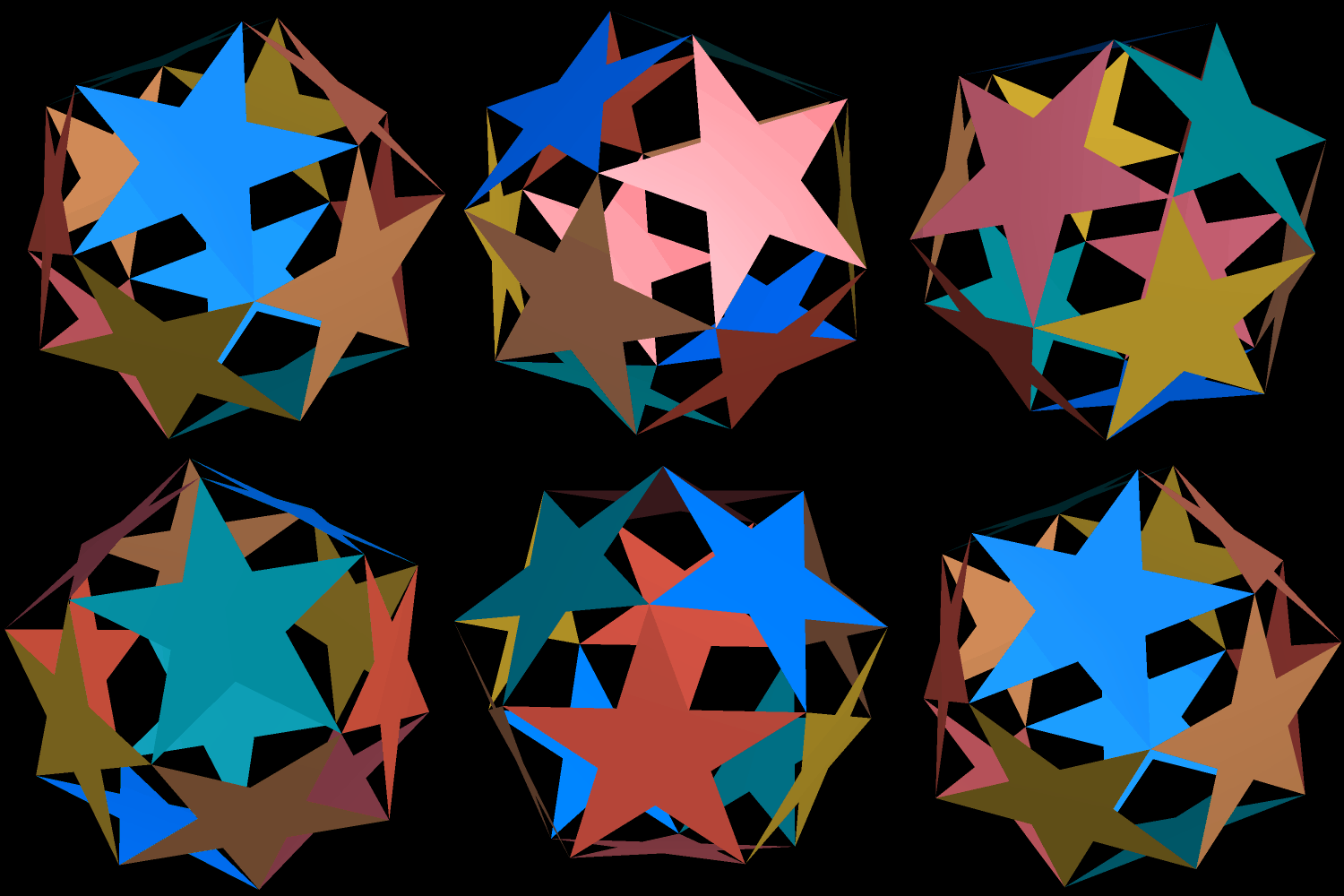
12 STAR PENTAGONS

Here are only the twenty equilateral triangles, with only parallel triangles having the same color. As you can see, the triangles interpenetrate.

20 EQUILATERAL TRIANGLES

At least for me, the reason I had trouble understanding this figure, for so long, was that I mistook the small triangular “facelets” (the visible parts of the faces) for the triangular faces, themselves. In reality, the edges of the triangles are just as long as the star polygon edges. Because it has exactly two face-types which alternate around a vertex, it is edge-transitive (not all uniform polyhedra are), and so this polyhedron is part of smaller subset of uniform polyhedron called the quasiregular polyhedra.

Stella 4d, a program I use to study polyhedra, and make these images, will be the primary tool I use to investigate these uniform polyhedra with which I am not already familiar. It is available at http://www.software3d.com/Stella.php.

Four Non-Convex Polyhedra with Icosidodecahedral Symmetry

Unnamed Dhgual

pretty

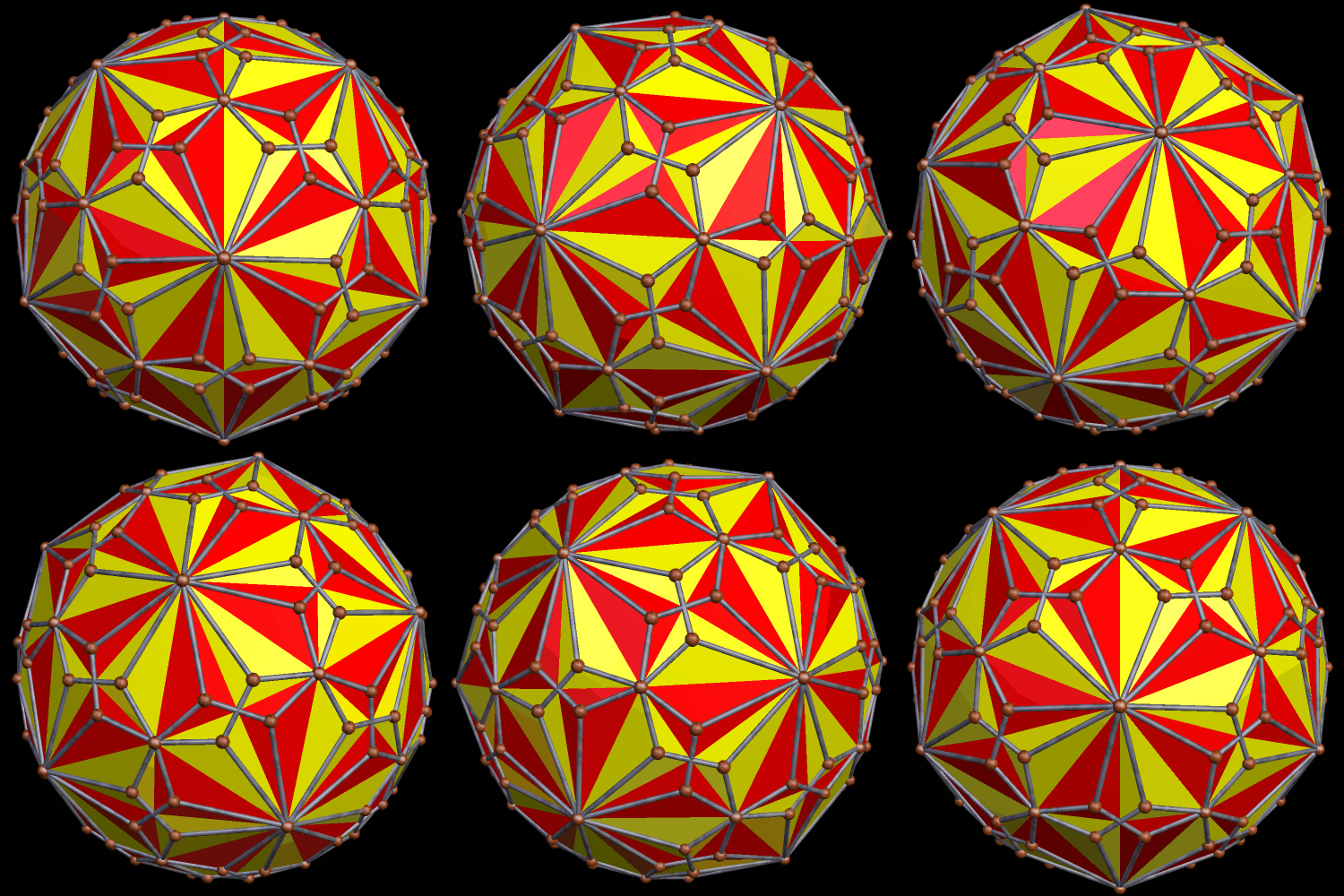
Dual of Augmented Convex hull

unholy messl

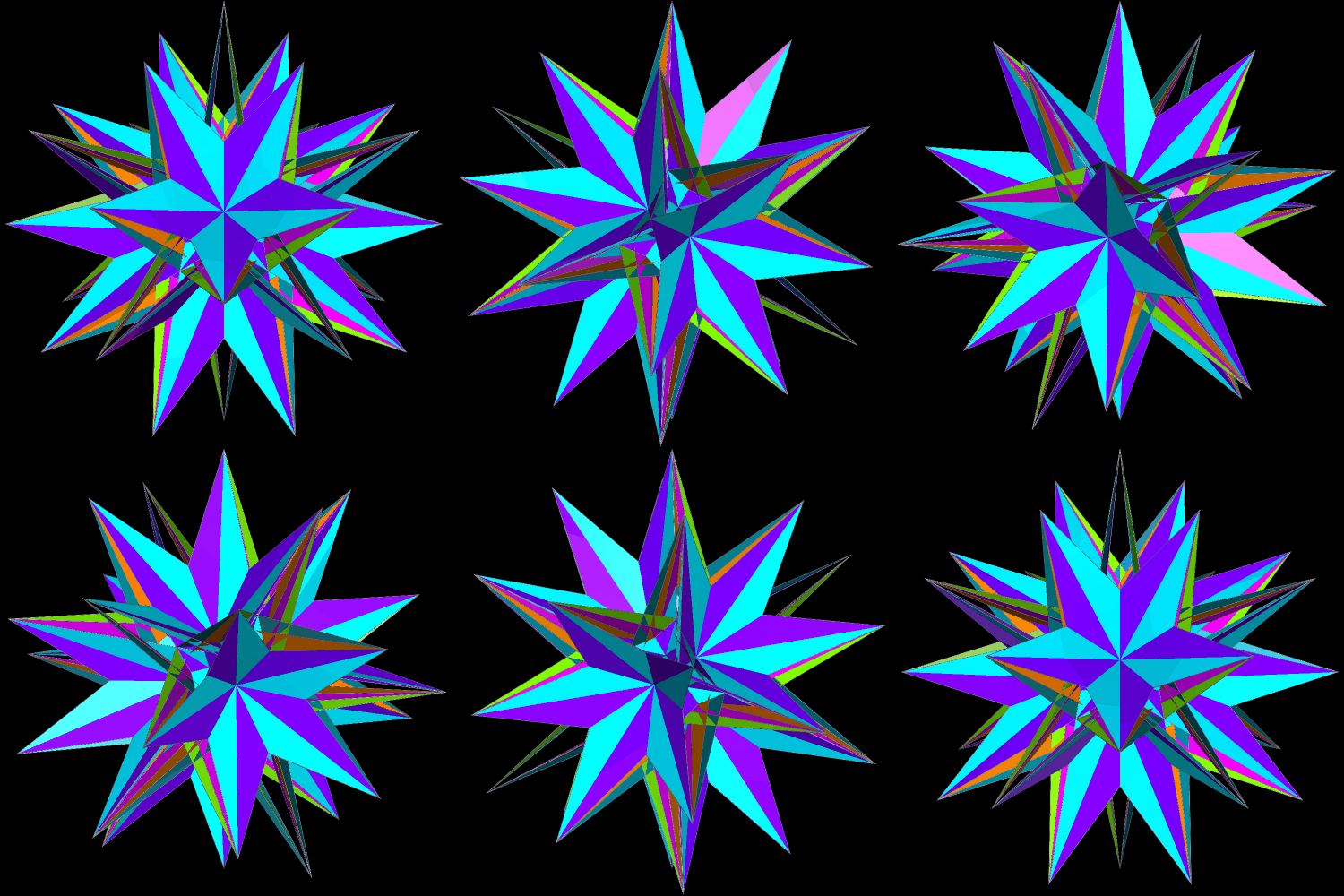
All of these were made with Stella 4d, a program you can find at http://www.software3d.com/Stella.php.