Unknown's avatar

About RobertLovesPi

I go by RobertLovesPi on-line, and am interested in many things, a large portion of which are geometrical. Welcome to my own little slice of the Internet. The viewpoints and opinions expressed on this website are my own. They should not be confused with those of my employer, nor any other organization, nor institution, of any kind.

Anticarbon-14 and Oxygen-18 Nuclei: What If They Collided? And Then, What About the Reverse-Reaction?

anticarbon-14 and oxygen-18Were nuclei of anticarbon-14 and oxygen-18 to collide (and their opposite charges’ attractions would help with this), what would happen? Well, if you break it down into particles, the anticarbon-14 nucleus is composed of six antiprotons and eight antineutrons, while the oxygen-18 contains eight protons and ten neutrons. That lets six proton-antiproton pairs annihilate each other, releasing a specific amount of energy, in the form of gamma rays, with that amount calculable using E=mc² and KE=½mv². The two excess protons from oxygen-18, however, should escape unscathed. In the meantime, eight neutron-antineutron pairs also are converted into a specific, calculable amount of gamma-ray energy, but with two neutrons surviving. Here’s the net reaction:

particles

Two protons and two neutrons, of course, can exist as separate particles, two deuterons, a tritium nucleus and a neutron, or a single alpha particle.

Now, consider this:  any physical process is, at least hypothetically, reversible. Therefore, it should be possible to bombard a dense beam of alpha particles with many gamma rays, each of a specific and calculable energy, and, rarely, the reverse reaction would occur, and anticarbon-14 and oxygen-18 nuclei would appear. Oxygen-18 is stable, but rare, so detection of it would be evidence that the reverse-reaction had occurred. Anticarbon-14, however, can logically being expected to decay to antinitrogen-14 via the antimatter version of beta-negative decay, which, it being antimatter, will result in the emission of an easily-detectable positron. It likely will not have time to do this, though, for carbon-14’s half-life (and anticarbon-14’s as well, one assumes) exceeds 5,000 years. The more likely scenario for the anticarbon-14 nucleus is that it will create a large burst of gamma rays when it encounters, say, a non-antimatter carbon atom — and these gamma rays would come from a different position than the ones bombarding the alpha particles, and can therefore be distinguished from them by determination of their direction.

Such a reverse-reaction would be quite rare, for it involves a decrease in entropy, violating the Second Law of Thermodynamics. However, the Second Law is a statistical law, not an absolute one, so it simply describes what happens most of the time, allowing for rare and unusual aberrations, especially on the scale of things which are extremely small. So, do this about a trillion times (or much more, but still a finite number of trials) and you’ll eventually observe evidence of the production of the first known anticarbon nucleus.

Also, before anyone points this out, I am well aware that this is highly speculative. I do make this claim, though:  it can be tested. Perhaps someone will read this, and decide to do exactly that. I’d test it myself, but I lack the equipment to do so.

Top 100 Banned/Challenged Books: 2000-2009

censorship

The best ways to celebrate Banned Books Week (which is going on now) are to read/buy/give away banned books, and/or donate money to libraries which deliberately put banned books in the circulating collection, as all good libraries do.

I’ve color-coded the list below. Books in red, I have read in their entirety. Books in blue, I have read some of, but have not (yet) finished. Also, now that I know they’re on this list, I’m likely to add some of the books in black, which I have not yet read, to my “books-to-read” list. There are few things I hate as much as censorship.

1. Harry Potter (series), by J.K. Rowling

2. Alice series, by Phyllis Reynolds Naylor

3. The Chocolate War, by Robert Cormier

4. And Tango Makes Three, by Justin Richardson/Peter Parnell

5. Of Mice and Men, by John Steinbeck

6. I Know Why the Caged Bird Sings, by Maya Angelou

7. Scary Stories (series), by Alvin Schwartz

8. His Dark Materials (series), by Philip Pullman

9. ttyl; ttfn; l8r g8r (series), by Lauren Myracle

10. The Perks of Being a Wallflower, by Stephen Chbosky

11. Fallen Angels, by Walter Dean Myers

12. It’s Perfectly Normal, by Robie Harris

13. Captain Underpants (series), by Dav Pilkey

14. The Adventures of Huckleberry Finn, by Mark Twain

15. The Bluest Eye, by Toni Morrison

16. Forever, by Judy Blume

17. The Color Purple, by Alice Walker

18. Go Ask Alice, by Anonymous

19. Catcher in the Rye, by J.D. Salinger

20. King and King, by Linda de Haan

21. To Kill A Mockingbird, by Harper Lee

22. Gossip Girl (series), by Cecily von Ziegesar

23. The Giver, by Lois Lowry

24. In the Night Kitchen, by Maurice Sendak

25. Killing Mr. Griffen, by Lois Duncan

26. Beloved, by Toni Morrison

27. My Brother Sam Is Dead, by James Lincoln Collier

28. Bridge To Terabithia, by Katherine Paterson

29. The Face on the Milk Carton, by Caroline B. Cooney

30. We All Fall Down, by Robert Cormier

31. What My Mother Doesn’t Know, by Sonya Sones

32. Bless Me, Ultima, by Rudolfo Anaya

33. Snow Falling on Cedars, by David Guterson

34. The Earth, My Butt, and Other Big, Round Things, by Carolyn Mackler

35. Angus, Thongs, and Full Frontal Snogging, by Louise Rennison

36. Brave New World, by Aldous Huxley

37. It’s So Amazing, by Robie Harris

38. Arming America, by Michael Bellasiles

39. Kaffir Boy, by Mark Mathabane

40. Life is Funny, by E.R. Frank

41. Whale Talk, by Chris Crutcher

42. The Fighting Ground, by Avi

43. Blubber, by Judy Blume

44. Athletic Shorts, by Chris Crutcher

45. Crazy Lady, by Jane Leslie Conly

46. Slaughterhouse-Five, by Kurt Vonnegut

47. The Adventures of Super Diaper Baby: The First Graphic Novel by George Beard and Harold Hutchins, the creators of Captain Underpants, by Dav Pilkey

48. Rainbow Boys, by Alex Sanchez

49. One Flew Over the Cuckoo’s Nest, by Ken Kesey

50. The Kite Runner, by Khaled Hosseini

51. Daughters of Eve, by Lois Duncan

52. The Great Gilly Hopkins, by Katherine Paterson

53. You Hear Me?, by Betsy Franco

54. The Facts Speak for Themselves, by Brock Cole

55. Summer of My German Soldier, by Bette Green

56. When Dad Killed Mom, by Julius Lester

57. Blood and Chocolate, by Annette Curtis Klause

58. Fat Kid Rules the World, by K.L. Going

59. Olive’s Ocean, by Kevin Henkes

60. Speak, by Laurie Halse Anderson

61. Draw Me A Star, by Eric Carle

62. The Stupids (series), by Harry Allard

63. The Terrorist, by Caroline B. Cooney

64. Mick Harte Was Here, by Barbara Park

65. The Things They Carried, by Tim O’Brien

66. Roll of Thunder, Hear My Cry, by Mildred Taylor

67. A Time to Kill, by John Grisham

68. Always Running, by Luis Rodriguez

69. Fahrenheit 451, by Ray Bradbury

70. Harris and Me, by Gary Paulsen

71. Junie B. Jones (series), by Barbara Park

72. Song of Solomon, by Toni Morrison

73. What’s Happening to My Body Book, by Lynda Madaras

74. The Lovely Bones, by Alice Sebold

75. Anastasia (series), by Lois Lowry

76. A Prayer for Owen Meany, by John Irving

77. Crazy: A Novel, by Benjamin Lebert

78. The Joy of Gay Sex, by Dr. Charles Silverstein

79. The Upstairs Room, by Johanna Reiss

80. A Day No Pigs Would Die, by Robert Newton Peck

81. Black Boy, by Richard Wright

82. Deal With It!, by Esther Drill

83. Detour for Emmy, by Marilyn Reynolds

84. So Far From the Bamboo Grove, by Yoko Watkins

85. Staying Fat for Sarah Byrnes, by Chris Crutcher

86. Cut, by Patricia McCormick

87. Tiger Eyes, by Judy Blume

88. The Handmaid’s Tale, by Margaret Atwood

89. Friday Night Lights, by H.G. Bissenger

90. A Wrinkle in Time, by Madeline L’Engle

91. Julie of the Wolves, by Jean Craighead George

92. The Boy Who Lost His Face, by Louis Sachar

93. Bumps in the Night, by Harry Allard

94. Goosebumps (series), by R.L. Stine

95. Shade’s Children, by Garth Nix

96. Grendel, by John Gardner

97. The House of the Spirits, by Isabel Allende

98. I Saw Esau, by Iona Opte

99. Are You There, God?  It’s Me, Margaret, by Judy Blume

100. America: A Novel, by E.R. Frank

Source:  http://www.ala.org/bbooks/top-100-bannedchallenged-books-2000-2009

Finally, what I am reading, myself, during Banned Books Week is Sam Harris’s latest, Waking Up. It’s a safe bet that all books by Sam Harris are banned in quite a few places.

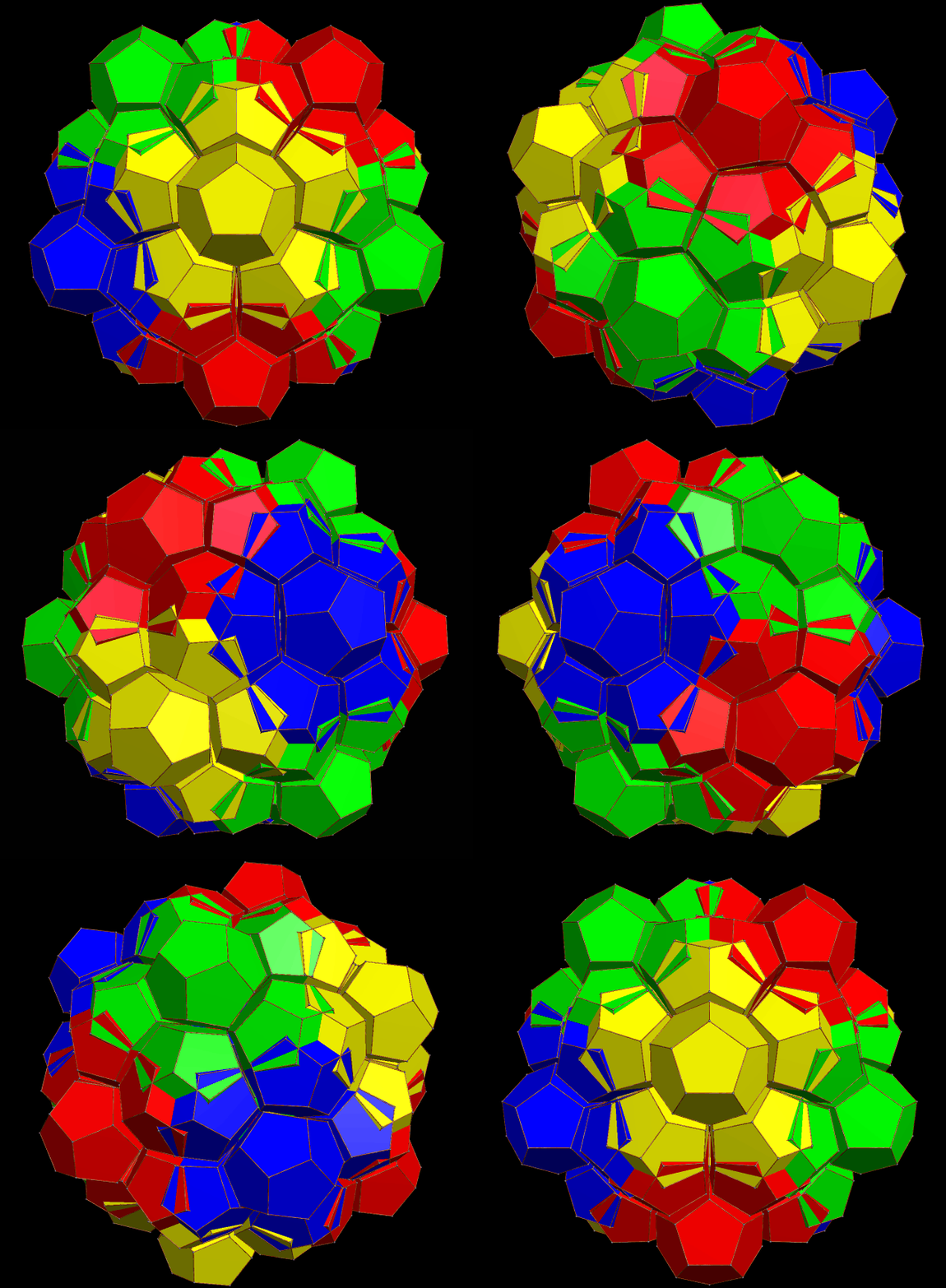
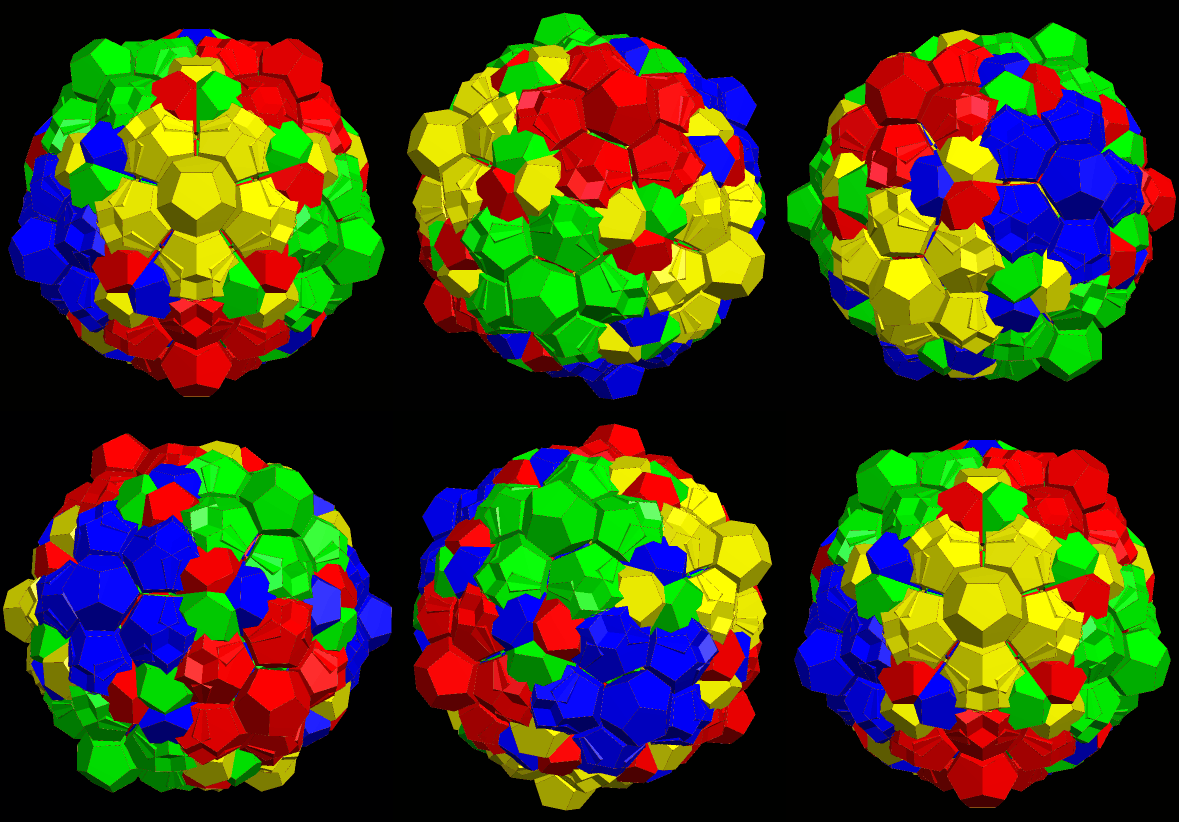
The 109th Stellation of the Triakis Icosahedron

109th stellation of Triakis icosa

Created using Stella 4d:  Polyhedron Navigator, available here.

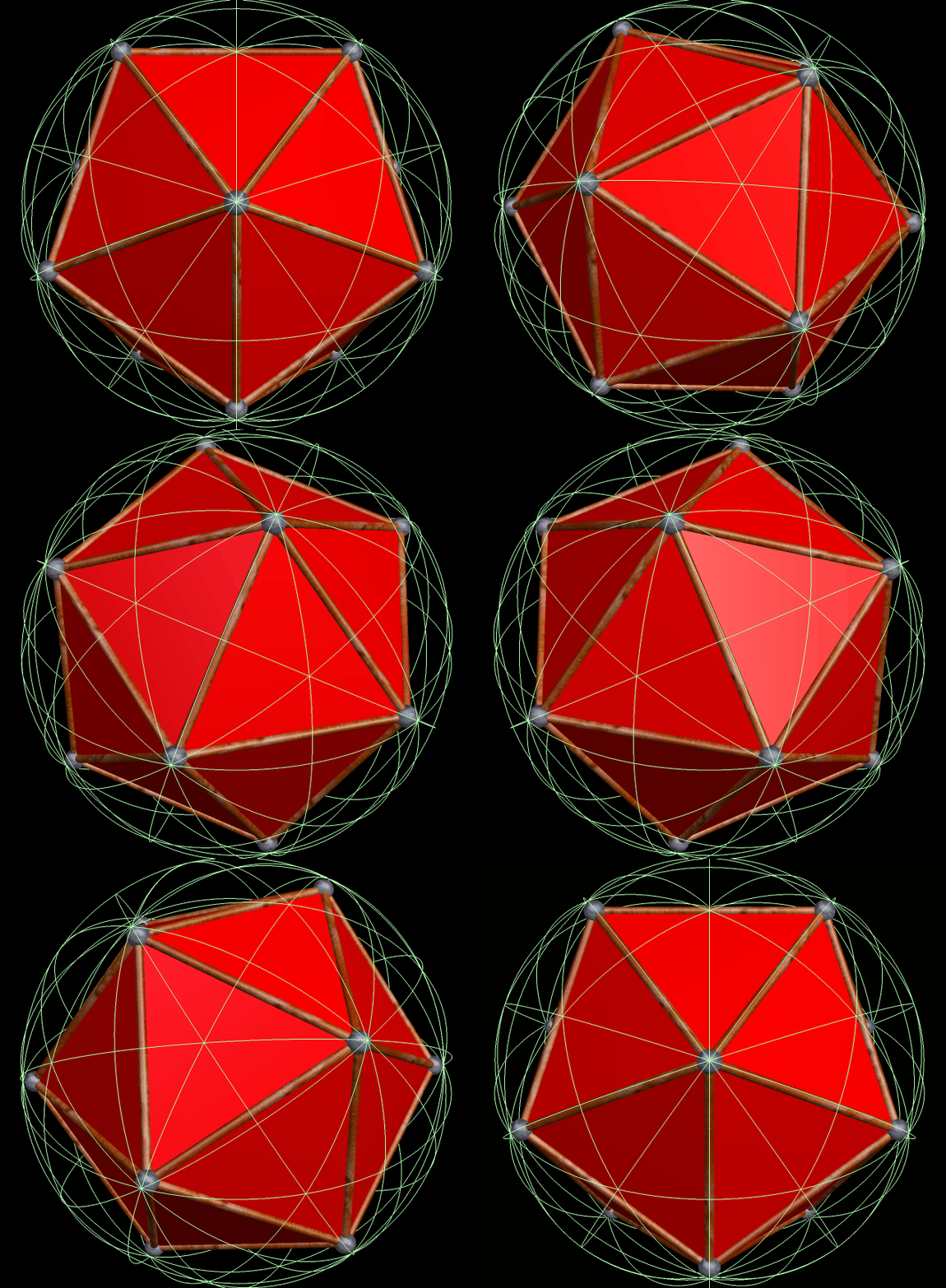
Two Different Sets of Two Dozen Flying Kites

24 kites

Because (6)(4) = 24 = (8)(3), that’s why.

bowtie octagon dual

I used Stella 4d to make each of these. A free trial download of this software is available here.

Moving Polyhedral Desktop Backgrounds for PCs

interesting

I use a rather old laptop PC, but I think this would work for desktop PCs, as well. On a lark, I tried putting a geometrical .gif file — the one you see above — on my PC, as the “wallpaper” for a desktop background. I didn’t think that would work, but, to my surprise, it did — rotational movement and all.

If you want to try the same thing with images from this blog, choose one that’s in a horizontal rectangle, to match the shape of a computer screen — they work better. I make these images with Stella 4d:  Polyhedron Navigator, which you can try here.

Zome: Strut-Length Chart and Product Review

This chart shows strut-lengths for all the Zomestruts available here (http://www.zometool.com/bulk-parts/), as well as the now-discontinued (and therefore shaded differently) B3, Y3, and R3 struts, which are still found in older Zome collections, such as my own, which has been at least 14 years in the making.

Zome

In my opinion, the best buy on the Zome website that’s under $200 is the “Hyperdo” kit, at http://www.zometool.com/the-hyperdo/, and the main page for the Zome company’s website is http://www.zometool.com/. I know of no other physical modeling system, both in mathematics and several sciences, which exceeds Zome — in either quality or usefulness. I’ve used it in the classroom, with great success, for many years.

The 9-81-90 Triangle

In a previous post (right here), I explained the 18-72-90 triangle, derived from the regular pentagon. It looks like this:

18-72-90 triangle

I’m now going to attempt derivation of another “extra-special right triangle” by applying half-angle trigonometric identities to the 18º angle. After looking over the options, I’m choosing cot(θ/2) = csc(θ) + cot(θ). By this identity, cot(9°) = csc(18°) + cot(18°) = 1 + sqrt(5) + sqrt[2sqrt(5) + 5].

Since cotangent equals adjacent over opposite, this means that, in a 9-81-90 triangle, the side adjacent to the 9° angle has a length of 1 + sqrt(5) + sqrt[2sqrt(5) + 5], while the side opposite the 9° angle has a length of 1. All that remains, now, is to use the Pythagorean Theorem to find the length of the hypotenuse.

By the Pythagorean Theorem, and calling the hypotenuse h, we know that h² = (1)² + {[1 + sqrt(5)] + sqrt[2sqrt(5) + 5]}² = 1 + {2[(1 + √5)/2] + sqrt[(2√5) + 5]}² = 1 + {2φ + sqrt[(2√5) + 5]}², where φ = the Golden Ratio, or (1 + √5)/2, since I want to use the property of this number, later, that φ² = φ + 1.

Solving for h, h = sqrt(1 + {2φ + sqrt[(2√5) + 5]}²) = sqrt{1 + 4φ² + (2)2φsqrt[(2√5) + 5] + (2√5) + 5} = sqrt{6 + 4(φ + 1) + 4φsqrt[(2√5) + 5] + (2√5)} = sqrt{6 + 4φ + 4 + 4φsqrt[(2√5) + 5] + (2√5)} = sqrt{10 + 4[(1 + √5)/2] + 4φsqrt[(2√5) + 5] + (2√5)} = sqrt{10 + 2 + (2√5) + 4φsqrt[(2√5) + 5] + (2√5)} = sqrt{12 + (4√5) + 4[1 + √5)/2]sqrt[(2√5) + 5]} = sqrt{12 + (4√5) + (2 + 2√5)sqrt[(2√5) + 5]}, the length of the hypotenuse. Here, then, is the 9-81-90 triangle:

9-81-90 triangle


Reaugmenting the Dodecahedron

Suppose you take a central dodecahedron, and then augment each of its faces with a dodecahedron. That would be an augmented dodecahedron. If you augment this figure with another layer of dodecahedra, then you have the reaugmented dodecahedron:

The Reaugmented Dodeca

After another level of such augmentation, you get this — the metareaugmented dodecahedron:

The MetaReaugmented Dodeca

Both these images were created using Stella 4d, which you can try here.

An Unsolved Problem Involving the Icosahedron and the Dodecahedron, and Their Circumscribed Spheres

This is apparently a problem, posed by Gregory Galperin, which went unsolved at the Bay Area Math Olympiad in 2005. I haven’t solved it yet, but I’m going to try, as I work on this blog-post. My 2010 source is a paper about Zome which may be read, as a .pdf, at bact.mathcircles.org/files/Summer2010/zomes-6-2010.pdf. The problem involves a dodecahedron and an icosahedron, each inscribed inside the same sphere of radius r, and asks which has the greater volume. At the time the authors wrote this paper, they knew of no solution, and I know of none now, but I do like a challenge.

My idea for solving this begins with Zome (info on Zome:  see http://www.zometool.com, as well as other sites you can find by googling “Zome”). In the Zome geometry system, using B1 struts for the edges of both a dodecahedron and an icosahedron, R1 struts are the radii of the circumscribed sphere for the icosahedron,  and Y2 struts are the radii for the circumscribed sphere of the dodecahedron. Since volume formula for polyhedra are generally given in term of edge-length, I need to find B1 in terms of R1 for the icosahedron, and find B1 in terms of Y2 for the dodecahedron.

icosa

Icosahedron:  find B1, in terms of R1.

There exists a right triangle which can be built in Zome which has a hypotenuse equal to 2R1, and legs epqual to B1 and B2. B2 = φB1, so, by the Pythagorean Theorem, (2R1)^2 = (B1)^ + φ²(B1)², which simplifies to 4(R1)^2 = (1 + φ²)(B1)^2, which can then be solved for B1 as B1 = sqrt[4(R1)^2/(1 + φ²)]. B1 here is the icosahedron’s edge-length, while R1 is the radius of its circumscribed sphere.

dodecahedron

Dodecahedron:  find B1, in terms of Y2.

In the Zome system, Y2 = φY1, and Y1 = [sqrt(3)/2]B1. Rearrangement of the first of these equations yields Y1 = Y2/φ, and substitution then yields [sqrt(3)/2]B1 = Y2/φ, which then can be rearranged to yield B1 = 2Y2/[φsqrt(3)]. B1 here is the dodecahedron’s edge-length, while Y2 is the radius of its circumscribed sphere.

Next, find the volume of the icosahedron inscribed inside a sphere, in terms of that sphere’s radius.

According to http://mathworld.wolfram.com/Icosahedron.html, the volume of an icosahedron is given by V = (5/12)[3 + sqrt(5)]a³, where a is the edge length, or B1 in the first indented section, between the two images, above.  Then, by substitution, V = (5/12)[3 + sqrt(5)]{sqrt[4(R1)^2/(1 + φ²)]}³, which then becomes (with “r” being the radius of the circumscribed sphere) V = (5/12)[3 + sqrt(5)][2r/sqrt(1 + φ²)]³ = (40/12)[3 + sqrt(5)][1/sqrt(1 + φ²)]³r³ = (10/3)[3 + sqrt(5)][1/sqrt(1 + φ²)]³r³. Then, using the identity φ² = φ + 1, this can be further simplified to V = (10/3)[3 + sqrt(5)][1/sqrt(2 + φ)]³r³.

Next, find the volume of the dodecahedron inscribed inside the same sphere, in terms of that sphere’s radius, r.

According to https://en.wikipedia.org/wiki/Dodecahedron, the volume of an icosahedron is given by V = (1/4)[15 + 7sqrt(5)]a³, where a is the edge length, or B1 in the second indented section, below the second image, above.  Then, by substitution, V = (1/4)[15 + 7sqrt(5)]{2Y2/[φsqrt(3)]}³, which then becomes (with “r” being the radius of the circumscribed sphere) V = (8/4)[15 + 7sqrt(5)]{1/[φsqrt(3)]}³r³ = 2[15 + 7sqrt(5)]{1/[3sqrt(3)]}(1/φ³)r³ = (2/3)[15 + 7sqrt(5)][sqrt(3)/3](1/φ³)r³  = [2sqrt(3)/9][15 + 7sqrt(5)](1/φ³)r³.

So, with the “r” in each case being the same, the icosahedron is larger than the dodecahedron iff (10/3)[3 + sqrt(5)][1/sqrt(2 + φ)]³ > [2sqrt(3)/9][15 + 7sqrt(5)](1/φ³), which simplifies to (5)[3 + sqrt(5)][1/sqrt(2 + φ)]³ > [2sqrt(3)/3][15 + 7sqrt(5)](1/φ³), which simplifies further to {5/[sqrt(2 + φ)]³}[3 + sqrt(5)] > [2sqrt(3)/3φ³][15 + 7sqrt(5)], which is, as a decimal approximation, is (0.726542528)(5.2360679774998) > (3.464101615/12.708203932)(30.6524758), or 3.804226 > 8.355492, which is false, meaning that the dodecahedron is larger, not the icosahedron.

Now for the bad part:  I think I’m wrong, but I don’t know where the error lies. I’m also tired. If any of you see the mistake, please point it out in a comment, and I’ll try to fix this after I’ve rested.

Update:  if the websites http://rechneronline.de/pi/icosahedron.php and http://rechneronline.de/pi/dodecahedron.php work correctly, then the dodecahedron is larger. Evidence:

volume calculators

This does not, however, mean that I did the problem correctly. I merely stumbled upon the correct answer. How do I know this? Simple:  the ratio I obtained was too far off. Therefore, I would still welcome help clearing up the mystery of where my error(s) is/are, in the calculations shown above.

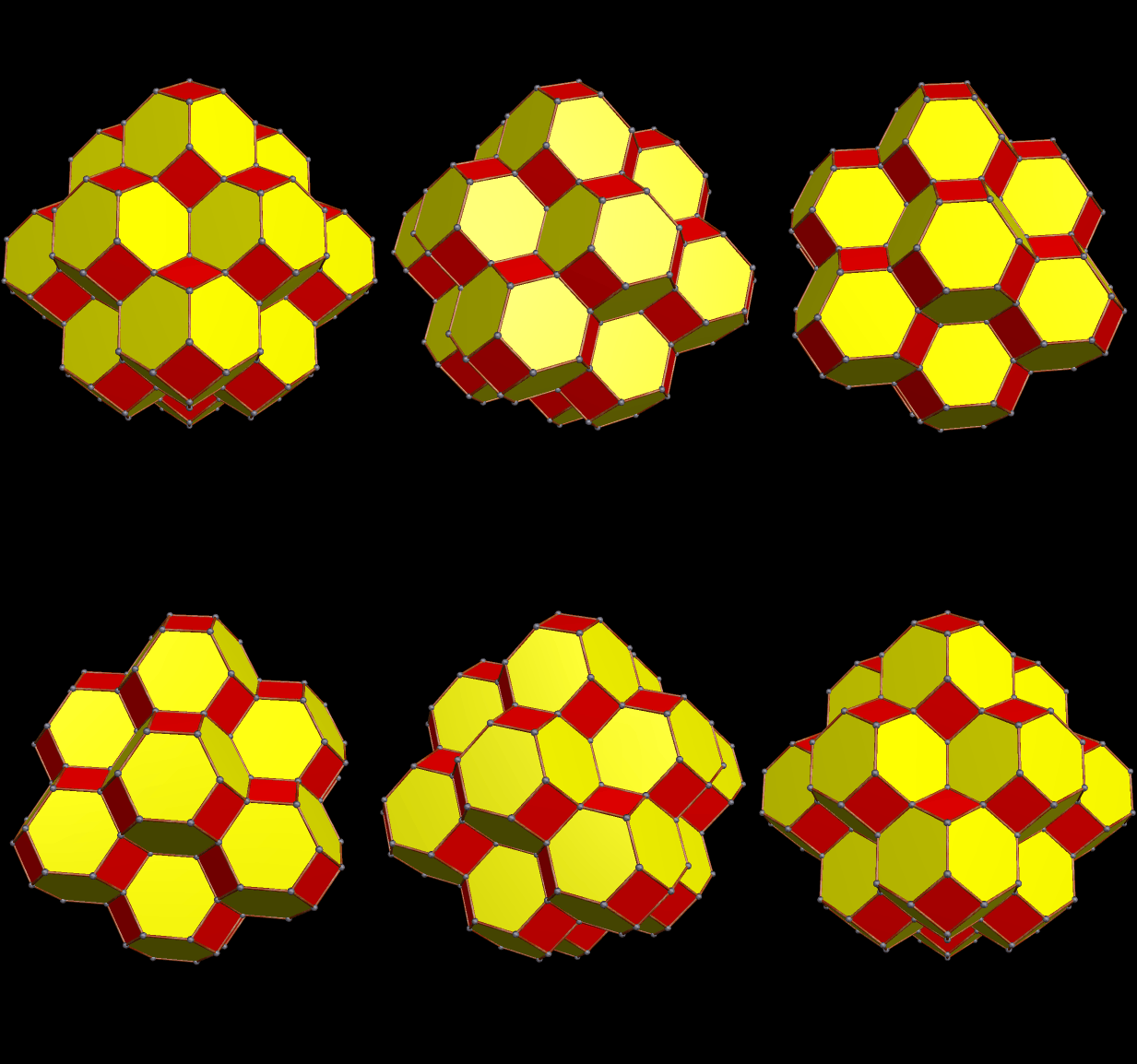
A Cluster-Polyhedron Formed By 15 Truncated Octahedra, Plus Variations

15 Trunc Octa

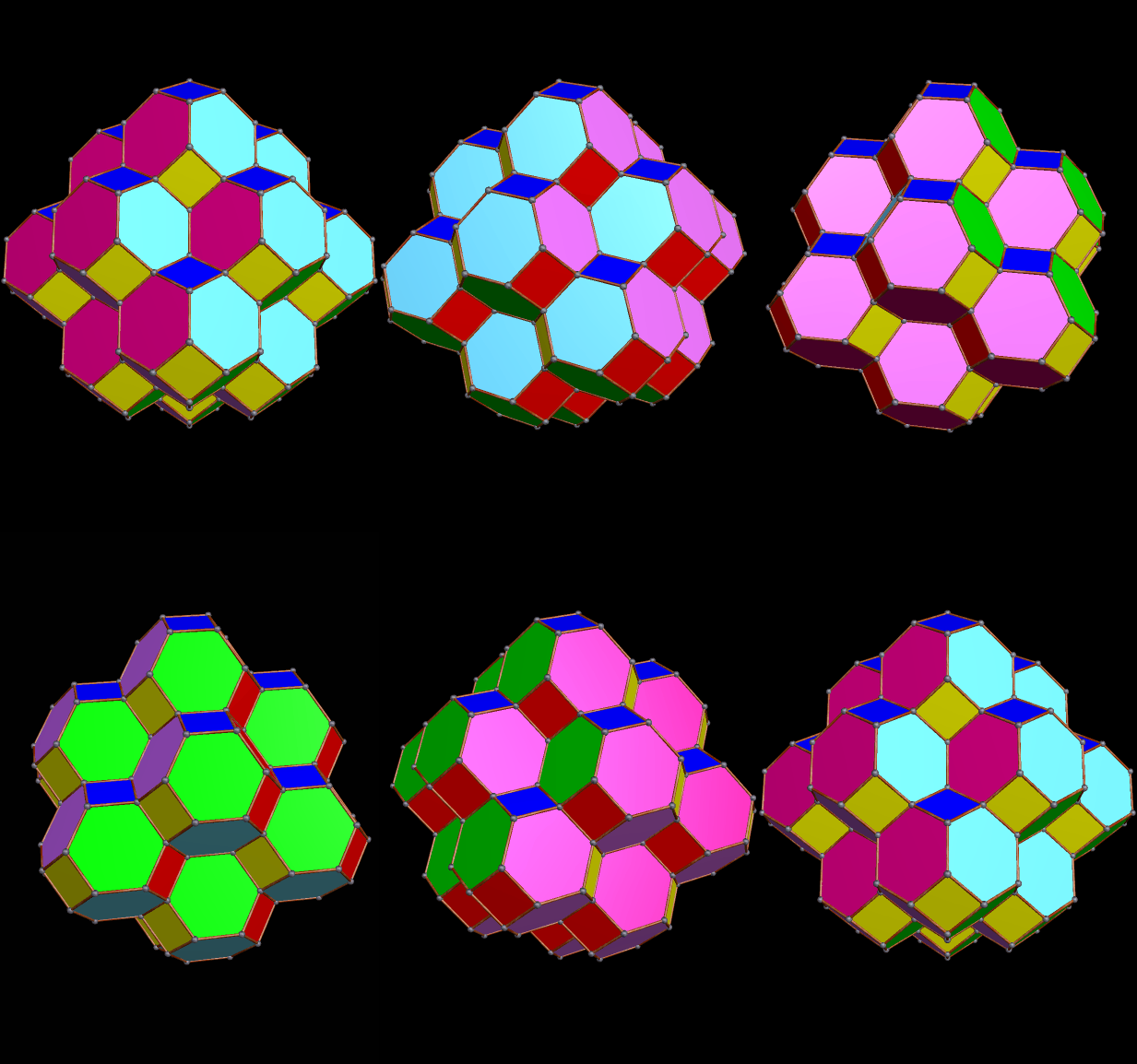
To form the cluster-polyhedron above, I started with one truncated octahedron in the center, and then augmented each of its fourteen faces with another truncated octahedron. Since the truncated octahedron is a space-filling polyhedron, this cluster-polyhedron has no gaps, nor overlaps. The same cluster-polyhedron is below, but colored differently:  each set of parallel faces gets a color of its own.

15 Trunc Octa color by face unless parallel

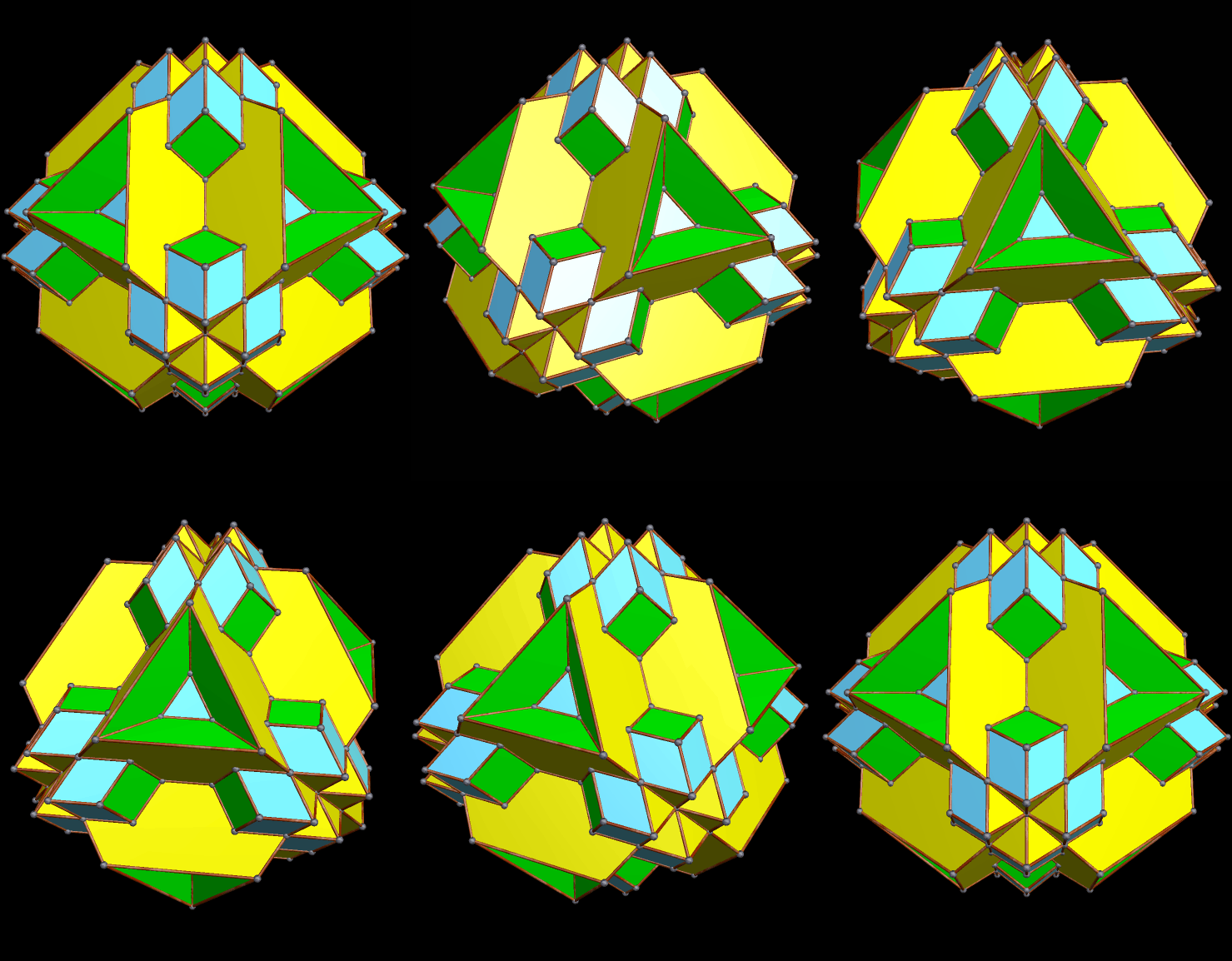
This is the cluster-polyhedron’s sixth stellation, using the same coloring-scheme as in the last image:

15 Trunc Octa color by face unless parallel 6th stellation

Here’s the sixth stellation again, but with the coloring scheme that Stella 4d:  Polyhedron Navigator (the program I use to make these images) calls “color by face type.” If you’d like to try Stella for yourself, you can do so here.

15 Trunc Octa color by face type 6th stellation

Also colored by face-type, here are the 12th, 19th, and 86th stellations.

15 Trunc Octa color by face type 12th stellation

15 Trunc Octa color by face type 19th stellation

15 Trunc Octa color by face type 86th stellation

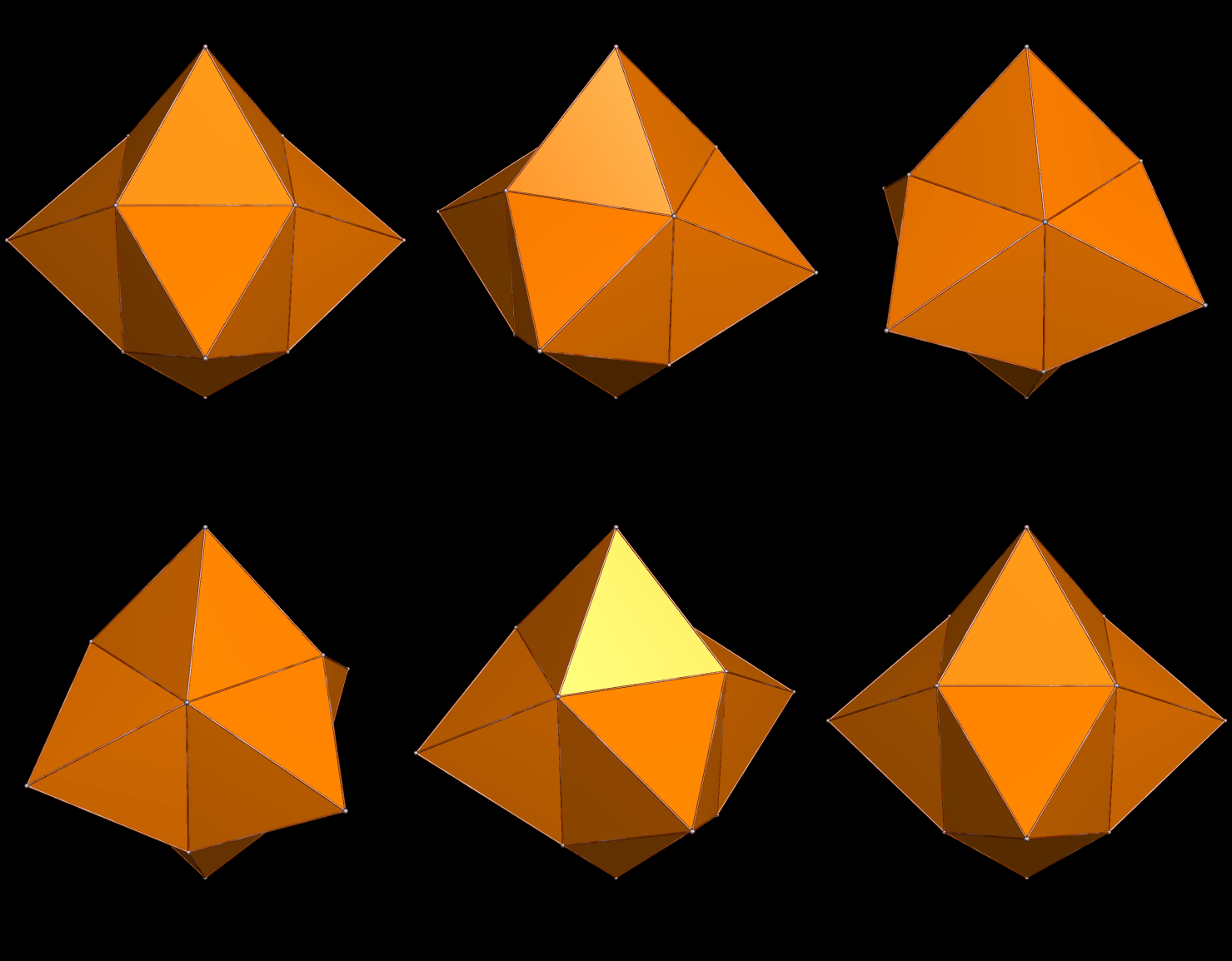
Leaving stellations now, and returning to the original cluster-polyhedron, here is its dual.

15 Trunc Octa dual

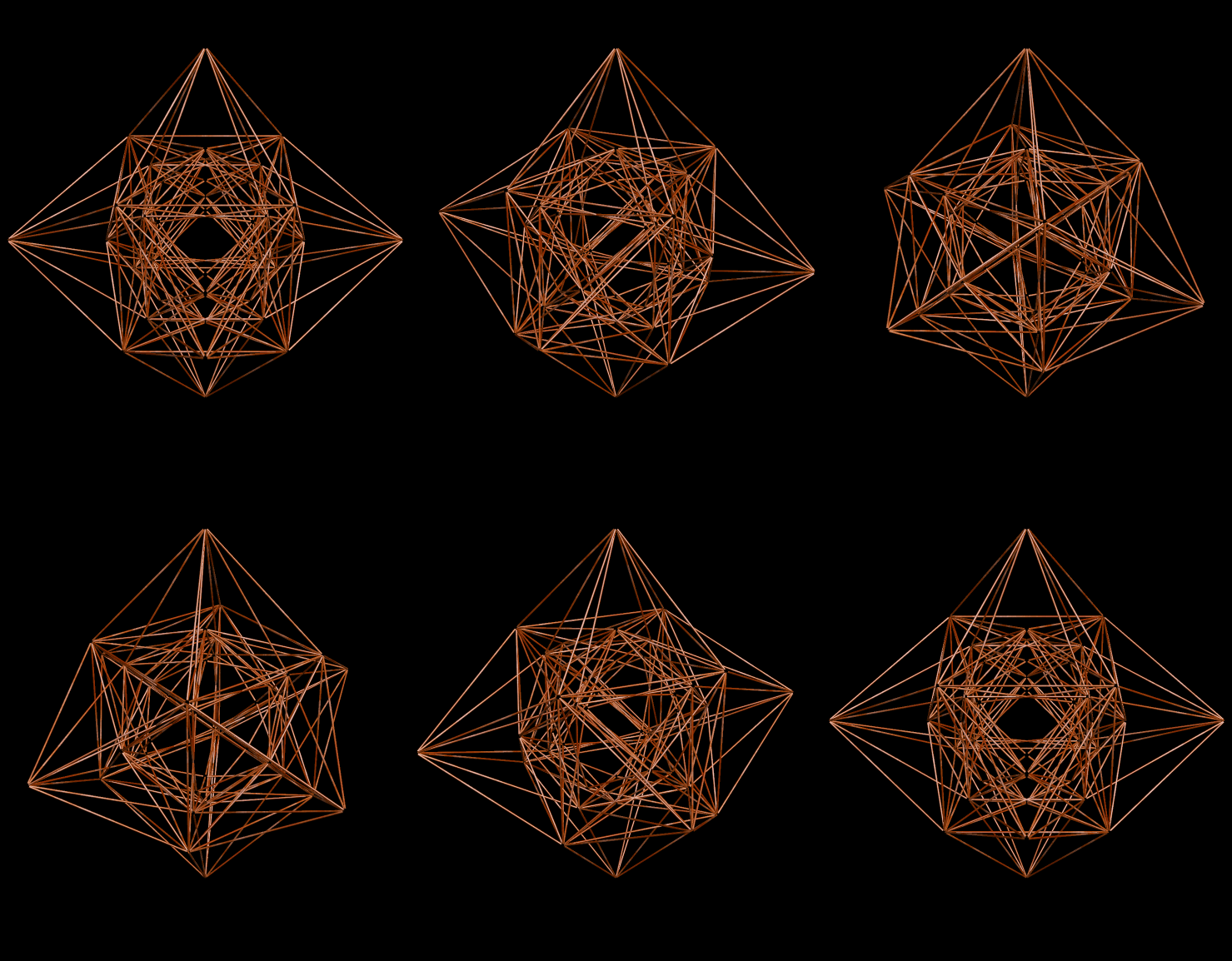
This image reveals little about this dual, however, for much of its structure is internal. So that this internal structure may be seen, here is the same polyhedron, but with only its edges visible.

15 Trunc Octa dual wirre-frame

Finally, here is an edge-rendering of the original cluster-polyhedron, but with vertices shown as well — just not the faces.

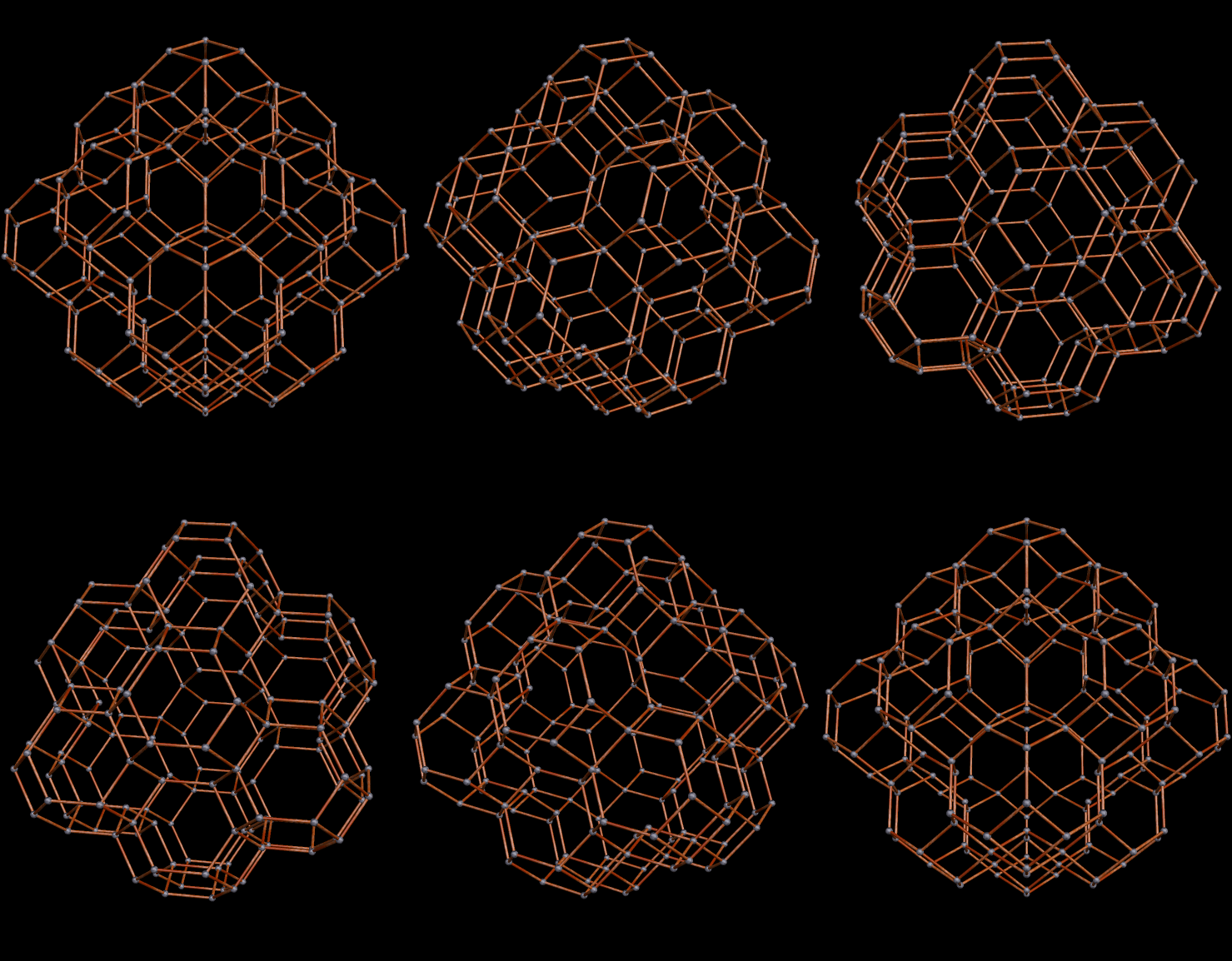
15 Trunc Octa wirre-frame