
Binary (base-2) pi: 11.00100 10000 11111 10110 10101 00010 00100 00101 10100 01100 00100 01101 00110 00100 11000 11001 10001 01000 10111 00000 . . .
Trinary (base-3) pi: 10.01021 10122 22010 21100 21111 10221 22222 01112 01212 12120 01211 00100 10122 20222 12012 01211 12101 21011 20022 01202 . . .
Quaternary (base-4) pi: 3.02100 33312 22202 02011 22030 02031 03010 30121 20220 23200 03130 01303 10102 21000 21032 00202 02212 13303 01310 00020 . . .
Quinary (base-5) pi: 3.03232 21430 33432 41124 12240 41402 31421 11430 20310 02200 34441 32211 01040 33213 44004 32444 01441 04233 41330 11323 . . .
Heximal (base-6) pi: 3.05033 00514 15124 10523 44140 53125 32110 23012 14442 00411 52525 53314 20333 13113 55351 31233 45533 41001 51543 44401 . . .
Septenary (base-7) pi: 3.06636 51432 03613 41102 63402 24465 22266 43520 65024 01554 43215 42643 10251 61154 56522 00026 22436 10330 14432 33631 . . .
Octal (base-8) pi: 3.11037 55242 10264 30215 14230 63050 56006 70163 21122 01116 02105 14763 07200 20273 72461 66116 33104 50512 02074 61615 . . .
Nonary (base-9) pi: 3.12418 81240 74427 88645 17776 17310 35828 51654 53534 62652 30112 63214 50283 86403 43541 63303 08678 13278 71588 . . .
Decimal (base-10) pi: 3.14159 26535 89793 23846 26433 83279 50288 41971 69399 37510 58209 74944 59230 78164 06286 20899 86280 34825 34211 70679 . . .
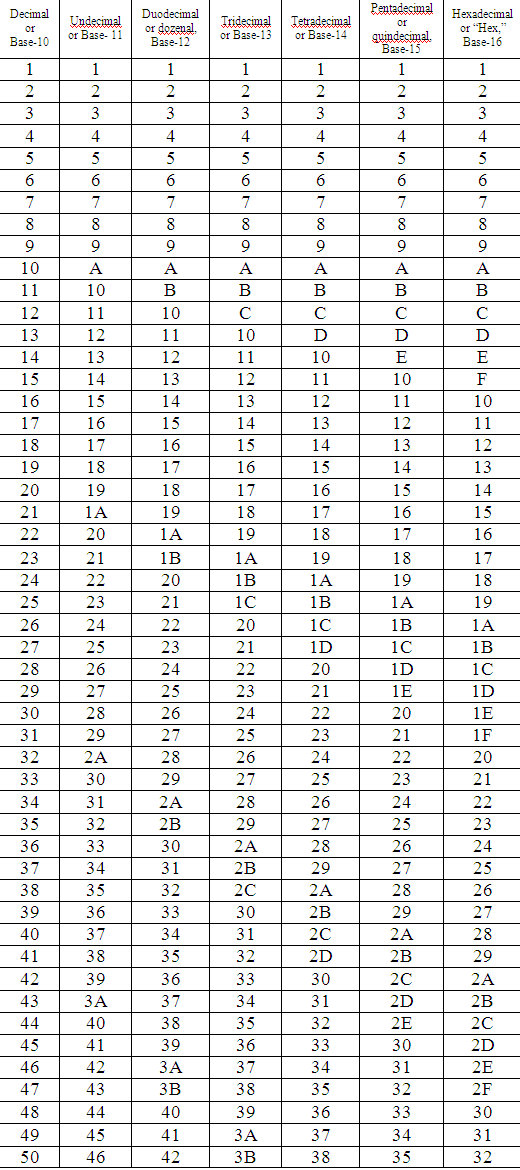
Undecimal (base-11) pi: 3.16150 70286 5A48 . . .
Duodecimal (base-12) pi: 3.18480 9493B 91866 4573A 6211B B1515 51A05 72929 0A780 9A492 74214 0A60A 55256 A0661 A0375 3A3AA 54805 64688 0181A 36830 . . .
Tridecimal (base 13) pi: 3.1AC10 49052 A2C7 . . .
Tetradecimal (base-14) pi: 3.1DA75 CDA81 3752 . . .
Pentadecimal (base-15) pi: 3.21CD1 DC46C 2B7A . . .
Hexadecimal (base-16) pi: 3.243F6 A8885 A308D 31319 8A2E0 37073 44A40 93822 299F3 1D008 2EFA9 8EC4E 6C894 52821 E638D 01377 BE546 6CF34 E90C6 CC0AC . . .
* * *
In each of the above counting systems, pi’s expanded form retains the usual properties of irrational numbers: the digits don’t ever terminate, nor settle into a repetitive pattern. It also isn’t possible, in any of these counting systems, to express pi as a/b, where a and b are whole numbers in that base. However, in base-pi, the number pi is simply written this way, in its entirety: 10. Also, the square of pi is written 100, pi-cubed is written 1000, etc. However, if you want to try to figure out how to write, say, the decimal number ten, in base-pi, best of luck to you.









 RobertLovesPi.net