
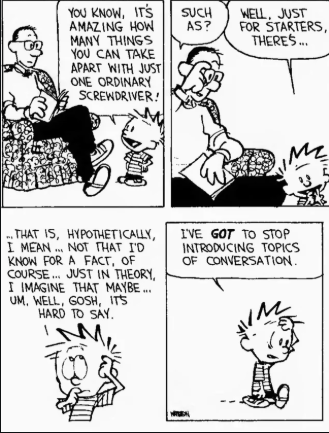
This is one example of an unusual feature sometimes seen in Bill Watterson’s Calvin and Hobbes — a single panel from this cartoon can be presented alone, without being the punch-line at the very end, and actually be funnier, by itself, than the original full comic strip it came from. Here’s the full original comic from which the above image was taken. And yes, Calvin, it is amazing.
Here’s another example of a C&H first-panel-only cartoon being funnier than the strip from which it came. (Side note: also, it’s Saturday right now.) =D

Keep an eye on social media’s image-cycle as they bring this single panel up again every time Saturday happens. (I do my part with this.) The full comic strip is actually harder to find than the striking single panel.

Here’s one more — one of my favorites.

This single panel above is, to me, one of the funniest things ever created on the subjects of death and mathematics. Here’s the full strip it came from. Note that, in this strip, the stand-alone panel is the second one, rather than being the opening panel, as this pattern is usually seen in C&H.
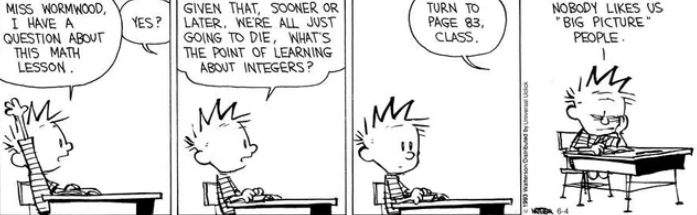
This pattern didn’t dominate Calvin and Hobbes; it was simply an occasionally-reoccuring form which helped make the strip unusual, for most comic strips relied on a punchline at the end of the strip. Here’s an example of a different writing-pattern in the same strip which relies primarily on the entire sequence of events in the strip, and the way the panels interact as the strip progresses.
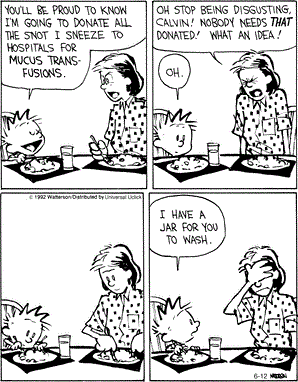
The single-panel-alone technique was used effectivelly by Watterson, but it did not dominate the strip, as was the case in a few other comic strips, most notably Gary Larson’s The Far Side.









 RobertLovesPi.net