Fort Smith? Pine Bluff? What’s the Difference?

Fort Smith is Pine Bluff

Unless you also live in the American state of Arkansas, you may not have even heard of Fort Smith and Pine Bluff. For those who grew up in this state, though, they’re considered (by our peculiar standards) to be major cities. Fort Smith is on the far West side of the state, on the Oklahoma border, while Pine Bluff is in the Southeastern part of the state, also known as the Mississippi Delta.

I didn’t learn Arkansas geography in school. Instead, when I was a child, my family traveled, mostly within the state — a lot. By the time I was ten years old, I’d been in all 75 counties of Arkansas, and knew quite a bit about where things are here . . . except for these two cities, Fort Smith and Pine Bluff.

If you’re from Arkansas, you know these two cities are nothing alike. What I noticed in childhood, above all else, was the fact that the two cities smelled so different from each other. The reason is simple:  Pine Bluff has a lot of paper mills, and the smell near paper mills is not entirely unlike being locked in a small closet with several dozen rotten eggs. Fort Smith, by contrast, is relatively odorless.

What perplexed my parents, though, is the fact that I would consistently confuse these two cities. I’d refer to the “horrible smell of Fort Smith,” or, if I knew we were going to Pine Bluff, I might ask if we’d be crossing the border into Oklahoma. My parents always corrected these mistakes, but I kept making them, repeatedly, which is not like me at all. When young, I never had more than a 50% chance of correctly identifying either of these cities. Once I figured out what I was doing, though — at around age twelve — this repeated error made perfect sense.

When I try to understand something, I examine it, and consider it, mathematically. Often, I’m not even conscious I’m doing that — it’s simply how I think. Both Fort Smith and Pine Bluff are two-word city names. To make matters even worse, the first word of each city-name has four letters, and the second word in each has five. Once I realized these parallels, though, it all made sense:  no wonder I couldn’t tell these places apart, with names which, examined through the lens of childhood mathematics, looked exactly alike.

To my knowledge, no one else has ever had a long-term problem confusing these two Arkansas cities. However, when those who know me well hear this story, they are never surprised that I would do such a thing.

Where Are This Blog’s Readers?

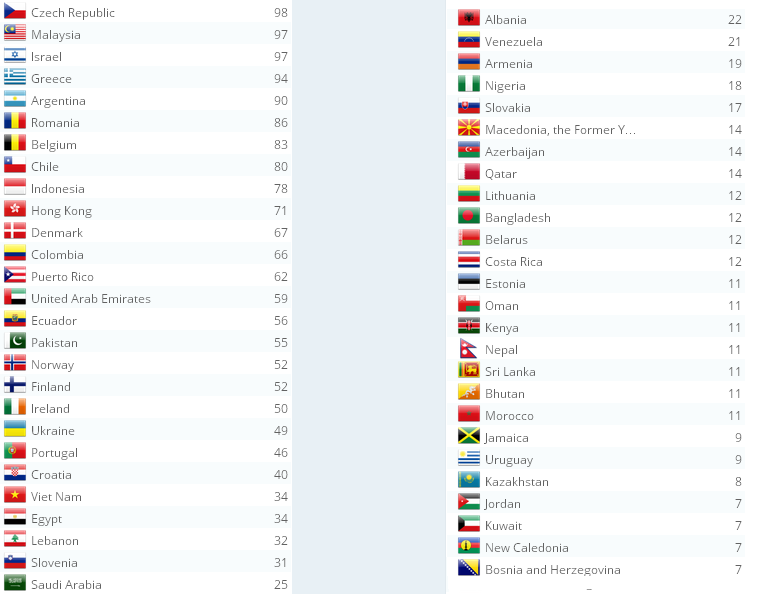
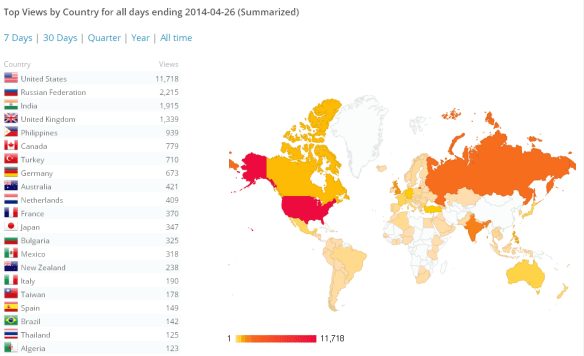
More hits come to this blog from inside the USA than any other country. Considering that I live here, that isn’t surprising. However, my international readers do outnumber what are confusingly called “Americans,” at 54.7% to 43.7% of hits to this blog.

1

When the hits from outside the U.S.A. are considered at as a set, a slim majority of that set is held by six nations, each with over 1,000 hits. India leads this group, followed by Russia. After those non-English-dominated countries come the English-dominated U.K. and Canada, in that order. Germany and the Philippines round out this group.

2

The next set, of 24 nations, are those with between 100 and 1,000 hits each:

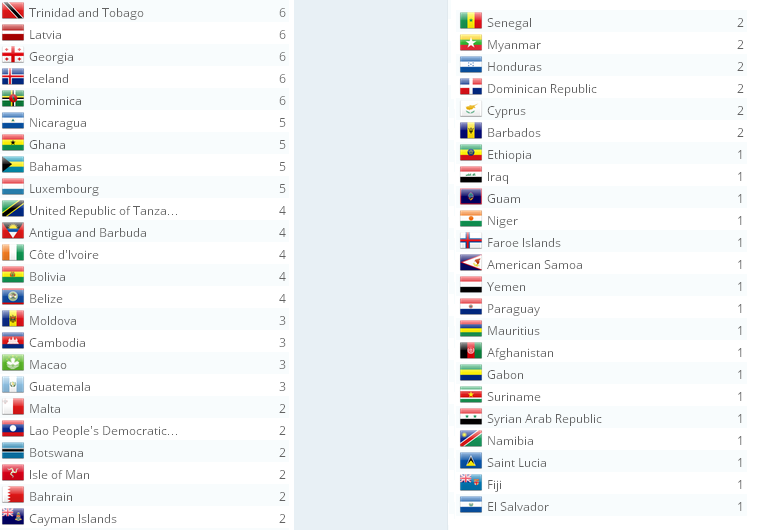
3Below 100, there are numerous nations. The next list goes down to the those nations from which seven or more hits have come.

4

Finally, the readers in each of these nations have only seen my blog between one and six times per nation.

5

Thanks to all my readers, everywhere you are. =)

map

My Australia Story

australia

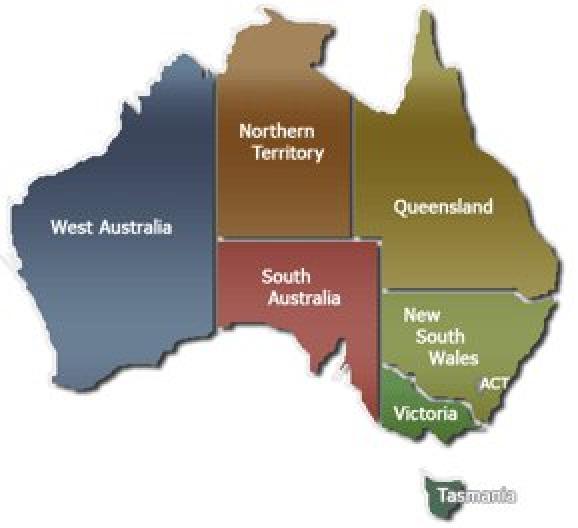
I once got into a huge argument, as a 7th grade student, in a “talented and gifted” section of Social Studies. The issue:  how many countries are there in the continent of Australia?

The assignment was to choose a continent, and draw a map of it on a full-size posterboard. I had worked for hours on this map, only to get it back, ruined, for the teacher had taken a red ball-point pen, slashed through my line “state and territorial boundaries” in my map’s key, and had written, as a correction, “not states — COUNTRIES.” She also docked points from my grade, but that was a minor issue, to me, compared to her ruining my map. She could have, at least, written her incorrect comment on the back of my map!

When I confronted her about her mistake, she maintained that the political divisions you see above are independent countries. In my opinion, “Northern Territory,” especially, doesn’t sound particularly sovereign, and I said so, but she may not have understood the definition of “sovereign,” for that did not work. Confronted with this absurd situation, I proceeded to grab the “Q” volume of a nearby encyclopedia, and began reading the article about Queensland, loudly enough for the entire class to hear: “Queensland: one of the states of Australia….” I freely admit that, at the time, my goal was to embarrass and humiliate her right out of the teaching profession — for the benefit of her present and future students. I’ve changed my approach, a lot, since then.

A huge brouhaha ensued, and we ended up taking each other to the assistant principal’s office:  her, to report a disruptive and defiant student; and me, to report an incompetent teacher, who, in my view, at that age, should have been fired on the spot. Dealing with this situation was probably one of the stranger, and more difficult, situations of that assistant principal’s career, for he knew that Australia is both a single country, and a continent — but he could not, for political reasons I did not yet understand, agree with me in front of this teacher. As for me, I was simply incredulous that someone could be a certified social studies teacher, and not know this basic fact about world geography. The whole scenario, to me, was surreal.

The assistant principal handled it well. To the teacher, he said, “You can go back to class — I’ll handle Robert.” He then “handled” me, after she left, in the only way that could have possibly worked: with an apology, and a polite request to do my best to endure her ignorance until the upcoming end of the year. I respect honesty, was being given a request, not an order, and he had conceded that I was correct. I therefore chose to cooperate — with his polite request.

If he had not taken this approach, I likely would have added him to the list I had, at the time, of people (a mixture of administrators and teachers) whom I was trying to drive out of the education profession, for the benefit of all — but he did the right thing, thus earning my respect.

As for the teacher, I survived the rest of her class, brain intact, and assume she is now retired, this being well over thirty years ago. I’m now in my twentieth year as a teacher, myself, and am pleased to report that average teacher quality has dramatically improved since this fiasco happened. (I wish I could say the same about average administrator quality, but there are, at least, a few competent people working in that field, as well.) During my years of teaching, I haven’t encountered a single teacher who lacked this basic bit of knowledge about world geography. In fact, I count, among my colleagues, many of the smartest people I know.

I am glad, however, that I don’t have to call the teacher in this story a colleague. I simply cannot respect willful, stubborn ignorance, especially in the face of evidence that one is wrong. When one of my students catches me making a mistake, I do the right thing: I thank them, make certain everyone understands the correction, and then we move on with the lesson. That’s what this 7th grade teacher of mine should have done, as well.

North American Geographical Oddity

You’re standing on the mainland of North America — not on an island. From where you are, you can travel due East, and you’ll come to the Pacific Ocean. If you travel due West, however, you will come to the Atlantic Ocean. What’s more, this is true for a relatively large percentage of locations in the country where you are located — a greater percentage than would be the case for any other country on the North American continent, if there even are others.

In what country are you standing?

(Scroll down for the answer.)

.

.

.

.

.

.

.

.

.

.

.

panama

You’re in Panama! Now, before anyone protests that Panama is in Central America, not North America, let me point out that Central America is part of the North American continent, just as Europe and India are part of the Eurasian continent. (Yes, I looked them up.)

Why Is Arkansas Political Geography Such a Mess?

Image

Why Is Arkansan Political Geography Such a Mess?

Technically, we live within the city limits of North Little Rock, but we’re surrounded by Maumelle, and also live in the Pulaski County Special School District, not the North Little Rock School District. Telling people we live in NLR causes confusion, so we say “Maumelle” instead, but mail won’t reach us unless it includes “North Little Rock” in the address. What’s more, that’s all in one county, Pulaski, near the center of the state.

The weirdness doesn’t stop there. Nearby is a city named Conway. I went to college there. It isn’t located in Conway County, though; that’s further West.

Head Southwest on I-30 from Little Rock, and you’ll soon encounter Benton (not in Benton County, although at least Bentonville is), and then get a chance to take an exit to go visit Hot Springs — but you won’t find it in Hot Spring County. Van Buren is right next to Oklahoma, and a long drive from Van Buren County. Is the City of Jacksonville to be found in Jackson County? Of course not — not in this state. Boonville, similarly, is not located in Boone County.

We have a Mississippi County here, and it borders two other states. We also have a long border with the state of Mississippi. However, Mississippi County, Arkansas isn’t one of several counties which do border the State of Mississippi. Instead, it borders Tennessee and Missouri.

Even things which seem intuitively obvious about my state’s political geography end up being wrong. Ask someone familiar with a U.S. map which state(s) you can find South of Arkansas, and they’ll almost certainly answer with Louisiana, perhaps including Texas, as well. However, the states of Oklahoma, Missouri, Tennessee, and Mississippi also include land that is South of carefully-chosen points in Arkansas. Here’s visual proof, which you can enlarge with a click:

arinus

Yes, all six states which border Arkansas are technically South of us, in a sense.

Perhaps the strangest thing about Arkansan political geography is that the town of Lonoke is actually in Lonoke County. It’s even their county seat. What are they trying to do there, confuse people?

Hello, Out There!

Image

Hello Out There!

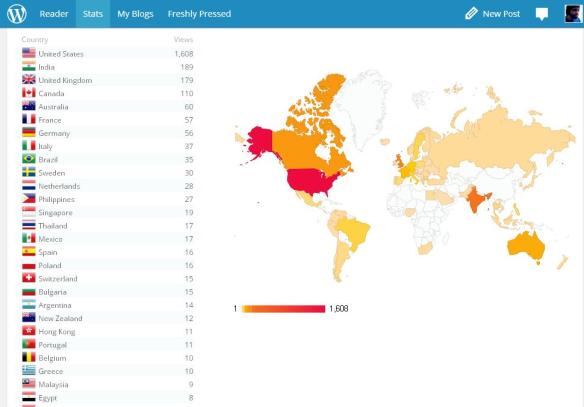
This map shows where the hits on this blog have come from, since its inception.

A notable exception: Iran shows zero hits. However, I know that people in Iran have seen https://robertlovespi.wordpress.com/2012/12/02/love-letters-from-iran/ — but access to the Internet from inside Iran is difficult. Hits from inside Iran show up on this map, no doubt, but they show up as hits from other, less repressive countries.

I also don’t believe for one moment that no one from China has seen my blog. The suspiciously high number of hits from Taiwan make me suspect Internet traffic is simply being routed from The People’s Republic, through Taiwan, to get to the rest of the world.

Information wants to be free. People do, too — and are finding ways around those forces which seek to control us.

On the Geography of Eurasia, and Its Major Divisions

Image

On the Geography of Eurasia, and Its Major Divisions

By any reasonable non-political definition, Eurasia is a single continent. Its area is 54,759,000 km², which is over one-third the earth’s total land area.

The politics of history have created, however, the “continents” of Europe, with an area of 10,180,000 km² (18.59% of Eurasia), and Asia, with an area of 44,579,000 km² (81.41% of Eurasia). These figures for Asia’s land area include that of the “subcontinent,” India, which has an area of 4,400,000 km². (Note: the subcontinent of India is a geographical term, and does not match the borders of the nation of India perfectly. The major reason for this is that India the subcontinent includes the nations of Pakistan and Bangladesh, in addition to the politically-defined nation of India.)  The subcontinent’s area is 8.04 % that of Eurasia, and 9.87% that of Asia.

Europe is a large peninsula, a part of Eurasia with a sizeable portion of its area. So is the Indian subcontinent. So, for that matter, are the Southern portions of both South America and Africa, yet no one calls them separate continents, nor even subcontinents.

Giving India a special designation of “subcontinent” makes no sense, nor does the designation of Europe as a separate continent. Both are simply parts of Eurasia.

Which State Is South of Arkansas?

Image

Which State Is South of Arkansas?

This really happened, in a geography class I took, long ago, in an Arkansas elementary school.

Teacher: “Which state is south of Arkansas?”

Me: “There are six: Oklahoma, Missouri, Tennessee, Mississippi, Louisiana, and Texas.”

Teacher: “No, Robert, that’s wrong.”

Me: “No, YOU’RE wrong. I’m right, and I’ll prove it.” I then got up, walked to the large classroom map of Arkansas, and ran my finger downwards on the map, six times, along the arrows you see above, while shouting, “South! South! South! South! South! South!” It’s true: from some point in Arkansas, you can travel, due South, into some part of any of the six adjacent states.

The teacher called my mother. Her response? “What’s the problem? He was RIGHT, wasn’t he?”

The Pegasus Crude Oil Pipeline

Image

The Pegasus Crude Oil Pipeline

I live quite near Mayflower, Arkansas, site of an oil spill and ongoing cleanup efforts. You’ve probably seen it in the news.

Living in a landlocked state, we did not have “oil spill” on our worry-lists here.

You may live near this pipeline, too, and not even know it. That’s why I’m posting this map (which I did not create, but simply found with a Google image-search). There may be other such pipelines here, as well. Few people notice them — until one breaks.

Hello, India!

Image

Hello, India!

Since I’ve started blogging on WordPress, there have been several surprises, but the most puzzling to me is the recent rise in popularity of my blog in India. I live in the USA, so it’s no surprise that most hits on my blog come from here. However, I have no explanation for why India is #2.

This blog has a high math content, compared to most blogs. Might that have something to do with it?

Whatever the reason, I’m glad I have readers there.

The part of this map I don’t like involves China, Iran, and North Korea: zero hits from each nation. That has nothing to do with the content of my blog, of course, but with heavy censorship in each of those countries, all of which have notoriously bad human-rights records. In at least one of those nations (Iran), my blog has been read, but that doesn’t show up on this map because of the extreme lengths my friends in Iran have to go to simply to surf the web without detection and interference from Tehran.

I would like, someday, to visit all of these countries. In the cases of Iran, North Korea, and China, though, I’m waiting for regime changes first.