An Abbie Hoffman Quote, for Independence Day

hoffman2

Source: Soon to be a Major Motion Picture, p. 214.

The American Historical Clock of War and Peace

SANYO DIGITAL CAMERA

The yellow years are ones in which the USA was getting into or out of major wars — or both, in the case of the brief Spanish-American War. The red years are war years, and the blue years are years of (relative) peace.

The sectors are each bounded by two radii, and a 1.5° arc. The current year is omitted intentionally because 2016 isn’t over yet, and we don’t know what will happen during the rest of it. 

Goodbye, Mom

Mom's Dodecahedron

Soon, the Arkansas Democrat-Gazette will run my mother’s obituary. However, it would not be right for me to allow the obituary they print to be her only one.

Mom’s name when she was born, on January 4, 1942, was Mina Jo Austin. Later, she was known professionally as Mina Marsh. However, I chose to legally change my last name to her maiden name, in 1989, after my parents divorced. I did this so that I could have a last name I associated only with my good parent, for I only had one — the one now in this hospice room with me, as I write this, with little time remaining to her.

This is an old photograph of her, and her two younger sisters, taken when my mother was a teenager.

IMG_1188

Her father, whom I knew (all too briefly) as “Daddy Buck,” taught her many things, very early in life, just as Mom did, much later, for me. He taught her about justice, and its opposite, using as one example of injustice the internment camps for Japanese-Americans which were then operating, here in Arkansas, when my mother was a little girl. Even in the wake of Pearl Harbor, and in complete disagreement with the masses, my grandfather thought it an obscenity that people had been herded into these camps simply because of their ethnicity, and, in a world where evil does exist, he decided his daughter needed to know about it. Only with knowledge of evil can one stand up to it, oppose it, and speak truth to it, even when that evil is mixed with power, as happens all too often. He instilled in her a strong sense of justice, and taught her courage, at the same time.

Mom started college at Harding University, in Searcy, Arkansas, and demonstrated her courage, and refusal to tolerate injustice, there, during the 1960 presidential election campaign. The assembled students of Harding were told, in chapel, that it was their duty, as Christians, to go forth on election day, and cast their votes for Richard Nixon, because allowing John F. Kennedy, a Catholic, to become president would be a horrible, sinful thing to do. She found this offensive, in much the same way that her father had found America’s treatment of Japanese-Americans offensive during World War II. On principle, therefore, she withdrew from Harding, and transferred to the University of Arkansas (in Fayetteville) to complete her college coursework. She also, later, left the denomination associated with Harding, eventually becoming a member of the Episcopal Church. I am grateful to her church here in Fayetteville, Arkansas, for the many comforts they have given her over the years. They even went so far as to raise the funds needed, in 2010, for her emergency transportation, by air, to a Mayo Clinic in Minnesota, where surgery was performed to save her from a rare adrenal-gland tumor called a pheochromocytoma. Without this help from them, her life would have been shortened by over five years.

Mom is survived by two children. I came along in 1968, and my sister (who had three children herself — my mother’s three grandchildren) was born the following year. Mom is also survived by three step-grandchildren, and two step-great-grandchildren. Mom began to teach both my sister and myself, as early as she could, what her father had taught her, early in life. Strangely enough, one of my earliest memories of her doing this also involved Richard Nixon, for the first news event I clearly remember seeing on television was Nixon’s 1974 resignation speech. At that young age, and with my parents clearly disgusted with America’s most disgraced president to date, I blurted forth, “I wish he was dead!” Mom wasn’t about to let that pass without comment, and did not. I remember the lesson she taught me quite well: there was nothing wrong with wishing for him to lose his position of power, as he was doing — but to wish for the man to die was to cross a line that should not be crossed. One was right; the other was wrong. It is my mother who taught me how to distinguish right from wrong. From this point forward, I now have a new reason to try, in every situation, to do the right thing: anything less would dishonor my mother’s memory.

It was around this time that my sister and I started school, and to say Mom was deeply involved in our experiences at school would be to understate the issue. In a conservative state where many schools openly (and illegally) do such insane things as teach young-earth Creationism in “science” classes, and anti-intellectualism is sometimes actually seen as a virtue, our entry into the school system was not unlike entering a battleground. At this time, education specifically designed for gifted and talented students simply did not exist in Arkansas. Mom had already had some teaching experience herself, although she had since moved on to other work. She was often appalled by the inane things that happened in our schools, when we were students, such as this from the fifth grade, and this (also from elementary school), and this especially-awful example from the seventh grade. Never one to tolerate injustice, Mom was deeply involved, from the beginning, in the formation of an organization called AGATE (Arkansans for Gifted and Talented Education), which fought a long, uphill, but ultimately successful battle to bring special programs for the education of gifted and talented students into the public schools of our state. She did this for her own two children, true — I consider forcing someone (who already understands it) to “practice” long division, year after year, to be a form of torture, and she was trying to save me from such torture — but she also did it for thousands of other Arkansas students, and tens of thousands have since benefited from her work in this area.

mom

Mom was never content to fight in just one struggle at a time, for there is too much important work to do for such an approach. She was also a dedicated naturalist, a Master Gardener, and served as the Deputy Director of the Arkansas Natural Heritage Commission for 25 years, seeking ways to protect and preserve areas of natural beauty, and scientific significance, in our state. After retiring from that position, she later served on the board of directors of the Botanical Garden of the Ozarks, and also became the Development Director of the Ozark Natural Science Center.

My mother affected the lives of a great many people in her 73 years of life, including many who do not even know her name — but neither gaining credit, nor fame, was ever her goal. She will be deeply missed.

# # #

[About the rotating image: the picture of the banded agate, a reference to AGATE, the organization, on the faces of Mom’s dodecahedron, at the top of this post, came from here. The rotating dodecahedron itself, which the ancient Greeks associated with the heavens, was created using Stella 4d, software available at this website.]


For John Lennon’s Birthday, the True Story of How I Observed This Holiday in 1983

lennon-306-1391778060

I’ve been a fan of John Lennon for as long as I can remember, and October 9, his birthday, has always been a special day for me. In 1983, when I was a high school junior, celebrating his birthday changed from something I simply did, by choice, into what, at the time, I considered a moral imperative.

In October of ’83, I was a student — a junior — at McClellan High School in Little Rock, Arkansas, and October 9th happened to be the day that all juniors were, according to that school’s administration, required to take the ASVAB: the Armed Services Vocational Aptitude Battery. While this is a standardized test, it isn’t like other standardized tests — it is actually a recruitment tool for the United States military.

At the time, Ronald Reagan was president, and we were in one of the many scary parts of the Cold War, with the threat of global thermonuclear war looming over us at all times. If you are too young to remember the Reagan era well, it may be hard to understand just how real, and how scary, it was to grow up with a president who did such things as making “jokes,” like this, in front of a microphone:

Reagan made this extremely unfunny “joke” the next year, in 1984, but the climate of fear in which he thought such a thing would be funny was already firmly in place in 1983, and I was already openly questioning the sanity of our president. My own anti-war attitudes, very much influenced by Lennon and his music, were already firmly in place. For the few unfamiliar with it, here is a sample of Lennon’s music.

So here I was, a high school junior, being told I had to take a test, for the military, on John Lennon’s birthday. I reacted to this in pretty much the same way a devout Jew or Muslim would react to being told to eat pork chops: I absolutely refused to cooperate. “Blasphemy” is not a word I use often now, and it wasn’t then, either, but to cooperate with this would have been the closest thing to blasphemy which I was capable of understanding at that age (I was 15 years old when this happened).

The other juniors got up and shuffled off, like good, obedient soldiers, when the intercom told them to go take the ASVAB. I simply remained seated.

The teacher told me it was time to go take the ASVAB. I replied, calmly, that no force on earth could compel me to take a test for the military on John Lennon’s birthday. At that point, I was sent to the office. Going to the office posed no ethical nor moral dilemmas for me, for I wanted the people there to know, also, that it was wrong for them to give a test for the military on October 9, of all days.

The principal, a man already quite used to dealing with me and my eccentricities, knew it would be pointless to argue with me about the ASVAB. He simply showed me a chair in the main office, and told me I could sit there that day, all day, and I did. To the school, this might have been seen as a single day of in-school suspension, but I saw it for what it really was: a one-person, sit-down protest for peace, in honor of the greatest activist for peace the world has ever known. It was an act of civil disobedience, and I regret nothing about it.

I will be sharing this story with Lennon’s widow, Yoko Ono, a woman I very much admire, and the greatest living activist for peace in the world today. Yoko, I do hope you enjoy this story. You and John have done great things, and they will not be forgotten, as long as people remain alive to tell about them.

Peace to all.

[Credits: photo from rollingstone.com; videos from YouTube.]

The Tragedy of Modern American History

usa outline map

The tragedy of modern American history: we fought our bloodiest war to date, and ended slavery, in the 1860s. Race, a difficult issue in the USA, to say the least, could have started to become less of an issue — at that point.

But . . . this didn’t happen. Instead, the “Jim Crow” era began, and, as a nation, we foolishly let it run for roughly another century before fixing that, and even then, we’ve left large parts of this problem unfixed, to this day — such as the problems that underlie high-profile police-brutality cases, which usually involve Black men being clobbered, to, or near, the point of death — by alleged “public servants,” who do a great disservice to the actual men and women of honor (yes, they do exist) who wear police uniforms. It is the fault of these “criminal cops” that police officers are not widely trusted, nor liked, in many African American communities.

All this, and Americans actually wonder why such things as an academic achievement gap still exist? Hint: DNA has absolutely nothing to do with it. The cause of this “gap” is easy to see: entrenched, pervasive racism, and the perfectly-understandable reaction to it, from a population with every reason to be utterly sick of being treated as less than fully human.

It’s 2015: well into the 21st Century. This situation is both absurd, and shameful.

June 4, 1989: An Ugly Day in History

Tank-Man1

If you’re old enough, you remember this iconic image, from June 4, 1989 — twenty-six years ago today.

If you don’t know what happened 26 years ago in Tiananmen Square, here’s a link to Wikipedia’s article describing the vicious crackdown there, on peaceful pro-democracy protesters in Beijing, China, on June 4, 1989: twenty-six years ago today. https://en.wikipedia.org/wiki/Tiananmen_Square_protests_of_1989

I was in college, as an undergraduate. So were many of the protesters. I watched the tanks roll in and murder them on live TV. This man, through an a amazing display of courage, held off a row of tanks alone, and unarmed, and delayed those tanks’ arrival at the massacre — but he couldn’t block every street to Tiananmen Square, and the Red Army was free to attack from any direction. This tense, but quiet, scene was not all I saw and heard those dark June days. When Deng Xiaoping gave the order, the Red Army came in, and took the college kids out. And thus, for decades, the hopeful light of freedom has dimmed almost to nothingness. People in college right now in China are quite likely not to even know about what happened in 1989. That’s forbidden information, so it isn’t freely shared, and much time has passed.

Think about that, please: “forbidden information.” The group that can hide the past can do anything they want in secret, and no one will ever know. That’s the position in which recline the decadent neo-“Communists” now in control of China. There, “to be rich is glorious,” as Deng rewrote Mao (who had rewritten Marx), and they fully intend to stretch the current period out for as long as they can.

China never gets in a hurry. Get things done, yes, but not on anyone else’s schedule.

Beijing still denies there was a large massacre in 1989, and still punishes anyone there who dares to discuss the topic, publicly, in any way that doesn’t “properly” defer to the regime. If you are ever in communication with anyone inside China, it’s important to avoid this topic — for the safety of that person, as well as his or her family.

“You Majored in WHAT?”

I’m in my twentieth year of teaching mostly science and mathematics, so it is understandable that most people are surprised to learn that I majored in, of all things, history.

It’s true. I focused on Western Europe, especially modern France, for my B.A., and post-WWII Greater China for my M.A. My pre-certification education classes, including student teaching, were taken between these two degree programs.

Student teaching in social studies did not go well, for the simple reason that I explain things by reducing them to equations. For some reason, this didn’t work so well in the humanities, so I took lots of science and math classes, and worked in a university physics department, while working on my history M.A. degree, so that I could job-hunt in earnest, a year later, able to teach physics and chemistry. As it ended up, I taught both my first year, along with geometry, physical science, and both 9th and 12th grade religion. Yes, six preps: for an annual salary of US$16,074.

History to mathematics? How does one make that leap? In my mind, this explains how:

  • History is actually the story of society over time, so it’s really sociology.
  • Sociology involves the analysis on groups of human minds in interaction. Therefore, sociology is actually psychology.
  • Psychology is the study of the mind, but the mind is the function of the brain, one of the organs of the human body. Psychology, therefore, is really biology.
  • Biological organisms are complex mixtures of interacting chemicals, and, for this reason, biology is actually chemistry.
  • Chemistry, of course, breaks down to the interactions of electrons and nuclei, governed by only a few physical laws. Chemistry, therefore, is really physics.
  • As anyone who has studied it knows, physics often involves more mathematics than mathematics itself.

…And that at least starts to explain how someone with two history degrees ended up with both a career, and an obsession, way over on the mathematical side of academia.

So an Ancestor of Mine Fed Insects to George Washington . . . .

“I have two cooks … one of them, Mr. Foutz … fancies himself quite the expert in worldly cuisine. … If we fed this army in the same manner Mr. Foutz has attempted to feed me, there would be mass desertion. He actually set out an elaborate dinner whose main attraction was bugs. Covered in some kind of sauce, mind you, but bugs nonetheless. I made the decision at that moment that Mr. Foutz would better serve this army by shouldering a musket.” ~George Washington, to Benjamin Franklin (Source: Rise to Rebellion, by Jeff Shaara, p. 385.)

I’ve just been told that this guy, whose name we know as Andrew Fouts, is an ancestor of mine. I rather like the idea of being descended from someone who fed insects to George Washington.

The Most Disturbing Thing I Ever Witnessed in a College Class

  • The Year: 1993
  • The College: The University of Central Arkansas
  • The Course: Educational Psychology

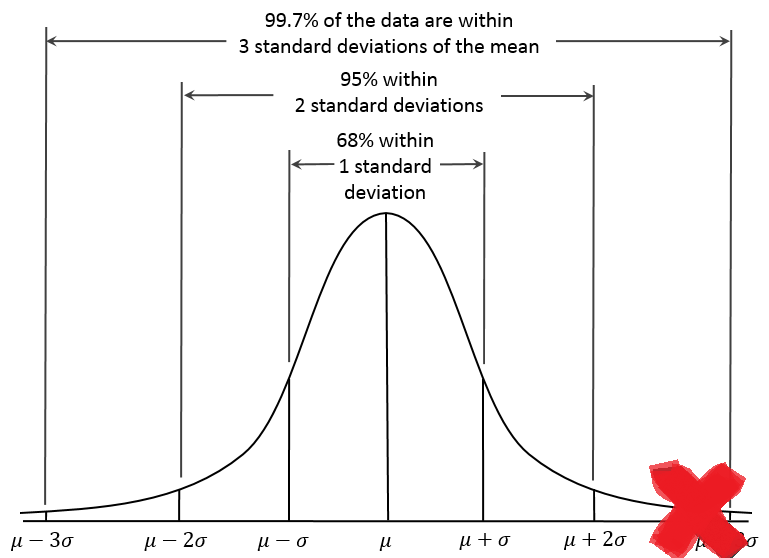
In a class called “Educational Psychology,” the bell curve, a statistical concept often used to describe the distribution of intelligence in humans, should be expected to receive some attention, and, when I took the class, it did — for about five minutes. I found the image below here; in this class, the professor drew a somewhat simpler version of it on a chalkboard.

Empirical_Rule (1)

The professor (who should be glad I do not remember his name, since I would blog it) proceeded to describe, briefly, characteristics associated with different “columns” of the bell curve, as some in academia apply it to intelligence. He then said, “Actually, what I’ve always really wanted to do was to get rid of these people.” He then added an “x” to what he’d drawn on the board. I’ve made it red, simply to make the location where he drew his “x” easier to see.

Empirical_Rule

I sat, in shocked silence, as the majority of the students in the class laughed. Laughed.

Once I could move again, after the initial, paralyzing shock turned into a deepening horror, I looked around the classroom. No one looked appalled, as I was; no one else even seemed to be disturbed, nor even slightly upset. Some were still visibly amused, in fact. I considered objecting, directly to the professor, but I was so affected by the whole episode that I was experiencing severe nausea. I couldn’t speak, for fear of throwing up.

The professor may not have known this — in fact, I would be surprised if he had — but what he was “joking” about has actually happened. It was called the Cambodian genocide, and was carried out by one of the most brutal regimes of the 20th Century, the Khmer Rouge. One of their tools used to stay in power was intimidation, taken to an extreme. In this photograph, from the article linked immediately above, you can see one form of this intimidation: the public display of the skulls of their victims. One need not be able to read to understand the message of such a display; below, the reason why this was important to the Khmer Rouge should become apparent.

800px-Choeungek2

I’ve studied this genocide. From just 1975 to 1979, the Khmer Rouge, driven by a radical Stalinist-Maoist and extremely anti-intellectual ideology, managed to reduce the population of Cambodia by an estimated 25%. They targeted, among many others, teachers. They separated children from their parents, since parents are often known to teach their children. They killed people who were seen wearing glasses — because glasses are often used to help people read books. They did their utmost to wipe out as much of the high-intelligence part of the bell curve as possible. They did their best to eliminate literacy.

Those who survived this horror were still devastated, for a whole nation had been traumatized — just imagine an entire country with PTSD (post-traumatic stress disorder). To make this situation even worse, the very people who could have helped most with the post-Khmer-Rouge recovery (doctors, therapists, teachers, clergy, etc. — all professions which require education) were almost entirely wiped out, and the people who could train new recruits for such professions had also been killed. As a direct result of this targeting of intellectuals for slaughter, the effects of the Cambodian genocide lasted far longer than the regime which perpetrated it.

I was thinking about this as the class period ended. In a daze, I walked away — far away. Even though I did return for future class sessions, since the course was a requirement for teacher certification, I never listened to another word that professor said, for he had permanently lost all credibility with me. At the end of the term, I left his class with an “A,” and a renewed determination to oppose those who, like the Khmer Rouge, try to “dumb down” society — at every opportunity. As for the people of Cambodia . . . they are still recovering, and will be, for many more years.

Wiping out a group of people — any group — simply isn’t funny.

A Response to “Sacred Geometry”

It is unlikely that anyone knows how many types of superstitious nonsense exist, for counting them would be an enormous task, with no compelling reason to do it, and only a slim hope of actually finding them all. However, a given person will be more likely than other people to know about a particular type — if it is related to things the first person finds of interest. For example, a physician will be more likely to be aware of homeopathy, and the faulty ideas upon which it is based, than would a randomly-selected college-educated adult.

It won’t take long, reading this blog, for anyone to figure out that I have a strong interest in geometry. Were it not for this, I likely would be unaware of another type of superstitious nonsense: “Sacred Geometry,” which I cannot bring myself to type without quotation marks. If you google that term, you’ll quickly find an amazing number of websites devoted to that topic, with many extraordinary claims about certain polygons and polyhedra, but you won’t find more than miniscule amounts of logical reasoning on any of these sites, mixed in with large portions of utter nonsense.

Geometry is inherently interesting, and many geometrical shapes and patterns are aesthetically pleasing. However, to search for their mystical or spiritual qualities is to do nothing more, nor less, than to waste one’s time.

chestahedron-blue-model

I did not create, nor discover, the figure above, but found this picture at http://earthweareone.com/a-new-form-has-been-discovered-in-sacred-geometry-meet-the-chestahedron/. It is described there as a polyhedron with seven faces (well, they call them “sides,” but they clearly mean faces) of equal area — three faces with four sides each, and four faces with three sides each. Knowing that, I tried to figure out exactly what the back side of the figure would look like, but the text at that website isn’t particularly helpful in that regard, being filled with claims, allegedly related to this shape, regarding the human heart as an “organ of flow,” not a pump (What’s the difference?);  “the earth in its foundational form [as] not a sphere but rather [with] its basis [being] a ‘kind of tetrahedron'” (What?); and a (claimed) special relationship between this polyhedron, and the oh-so-profoundly-mystical Platonic Solids. If none of that makes sense to you, you are not alone. It doesn’t make sense.

I often use software called Stella 4d (which you may try at http://www.software3d.com/Stella.php) to investigate the geometric properties of polyhedra. Based upon comments about this polyhedron written by Stella 4d‘s author, Robert Webb,  I was able to create the rotating virtual model below, with Stella, to help me understand what all the faces of the green polyhedron above look like, included those on the back side, as the figure is shown in the picture above. This polyhedron is similar to an octahedron, with a single face augmented by a tetrahedron, and with three pairs of coplanar equilateral triangles then fused into rhombi. Here is that figure:

Augmented Octa

This isn’t the exact polyhedron in the first picture, but is isomorphic to it. Vertices and edges are moved a bit, changing the size and shapes of the four-sided faces, as well as the dihedral angles between the triangular faces, until all faces are equal in area. This process turns the three rhombic faces into kites.

On the above-linked “Earth We Are One” website, where the “sacred geometry” of this polyhedron is “explained” (and where I found the non-moving first picture here), this is called a “Chestahedron.” While Stella can help someone understand the geometrical properties of the Chestahedron, it offers no information whatsoever about the spiritual or mystical properties of this polyhedron, nor any other. There’s a good reason for this, though: the complete lack of evidence that any such properties exist, for the Chestahedron, or, indeed, for any geometrical figure.

As for the people, whom I’m calling the “Sacred Geometricians,” who are pouring so much time and effort into investigations of these alleged non-mathematical properties of hexagons, pentagons, enneagons, many polyhedra, and other geometrical figures, I have three things to say to them:

  1. This isn’t ancient Greece, and you aren’t in the Pythagorean Society.
  2. That part of the work of the Pythagoreans had no basis in reality in the first place, anyway. Geometry, together with religion and/or mysticism, as it turns out, can be mixed — the Pythagoreans were correct, on this one point — but such mixtures are invariably incoherent and illogical, revealing the efforts to create them as activities which are both pointless, and useless. Just because two things can be blended does not imply that they should be blended.
  3. Please stop. You give me a headache.