A Historically-Accurate (But Not Recommended) Way to Observe Columbus Day

130205155638-christopher-columbus-story-top

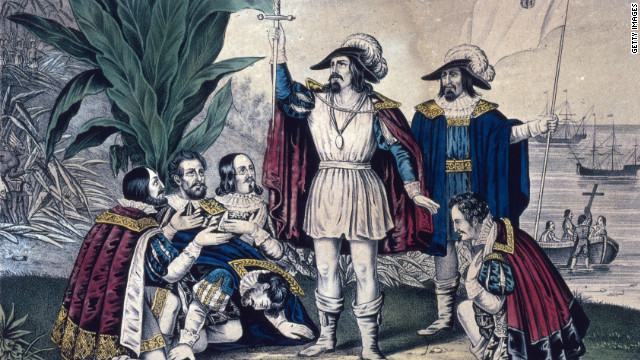
Today is Columbus Day in the United States. While I do not recommend actually doing this, the following would be a historically-accurate way to observe this day.

  1. Break into the house where a family of your neighbors live.
  2. Announce to this family that you live there now.
  3. Kick the entire family outside, into the cold.
  4. If you notice them shivering, make them feel better by sharing your religious beliefs with them.
  5. If #4 does not work, use swords to put your former neighbors out of their misery.
  6. If step #5 seems a bit too excessive, use this option instead, based on the actions of those who followed Columbus:  “help” your shivering former neighbors keep warm . . . by throwing some smallpox-infested blankets to them.

Obviously, regarding Christopher Columbus:  I’m not a fan. I therefore call upon the United States Congress to remove Columbus Day from our list of official national holidays.

[Image credit:  see http://www.cnn.com/2014/10/10/opinion/perry-columbus-day-what-to-tell-your-kid/ — this is where I found the image above.]

Daylight Saving Time: The One (and Only) Way the Rest of America Should Be More Like Arizona

Entering_Arizona_on_I-10_Westbound

I’m not used to saying that the rest of America should be more like Arizona . . . but my passionate hatred of Daylight Saving Time forces me to agree with them, when the clock-changes remind me of this fact, twice each year.

Yoko Ono Explains How to Change the World

yoko-ono

A Sheryl Crow Quote: “Write About What’s Going On”

sheryl-crow-20051117-84892

I couldn’t have phrased that any better, myself, so I didn’t try to.

Top 100 Banned/Challenged Books: 2000-2009

censorship

The best ways to celebrate Banned Books Week (which is going on now) are to read/buy/give away banned books, and/or donate money to libraries which deliberately put banned books in the circulating collection, as all good libraries do.

I’ve color-coded the list below. Books in red, I have read in their entirety. Books in blue, I have read some of, but have not (yet) finished. Also, now that I know they’re on this list, I’m likely to add some of the books in black, which I have not yet read, to my “books-to-read” list. There are few things I hate as much as censorship.

1. Harry Potter (series), by J.K. Rowling

2. Alice series, by Phyllis Reynolds Naylor

3. The Chocolate War, by Robert Cormier

4. And Tango Makes Three, by Justin Richardson/Peter Parnell

5. Of Mice and Men, by John Steinbeck

6. I Know Why the Caged Bird Sings, by Maya Angelou

7. Scary Stories (series), by Alvin Schwartz

8. His Dark Materials (series), by Philip Pullman

9. ttyl; ttfn; l8r g8r (series), by Lauren Myracle

10. The Perks of Being a Wallflower, by Stephen Chbosky

11. Fallen Angels, by Walter Dean Myers

12. It’s Perfectly Normal, by Robie Harris

13. Captain Underpants (series), by Dav Pilkey

14. The Adventures of Huckleberry Finn, by Mark Twain

15. The Bluest Eye, by Toni Morrison

16. Forever, by Judy Blume

17. The Color Purple, by Alice Walker

18. Go Ask Alice, by Anonymous

19. Catcher in the Rye, by J.D. Salinger

20. King and King, by Linda de Haan

21. To Kill A Mockingbird, by Harper Lee

22. Gossip Girl (series), by Cecily von Ziegesar

23. The Giver, by Lois Lowry

24. In the Night Kitchen, by Maurice Sendak

25. Killing Mr. Griffen, by Lois Duncan

26. Beloved, by Toni Morrison

27. My Brother Sam Is Dead, by James Lincoln Collier

28. Bridge To Terabithia, by Katherine Paterson

29. The Face on the Milk Carton, by Caroline B. Cooney

30. We All Fall Down, by Robert Cormier

31. What My Mother Doesn’t Know, by Sonya Sones

32. Bless Me, Ultima, by Rudolfo Anaya

33. Snow Falling on Cedars, by David Guterson

34. The Earth, My Butt, and Other Big, Round Things, by Carolyn Mackler

35. Angus, Thongs, and Full Frontal Snogging, by Louise Rennison

36. Brave New World, by Aldous Huxley

37. It’s So Amazing, by Robie Harris

38. Arming America, by Michael Bellasiles

39. Kaffir Boy, by Mark Mathabane

40. Life is Funny, by E.R. Frank

41. Whale Talk, by Chris Crutcher

42. The Fighting Ground, by Avi

43. Blubber, by Judy Blume

44. Athletic Shorts, by Chris Crutcher

45. Crazy Lady, by Jane Leslie Conly

46. Slaughterhouse-Five, by Kurt Vonnegut

47. The Adventures of Super Diaper Baby: The First Graphic Novel by George Beard and Harold Hutchins, the creators of Captain Underpants, by Dav Pilkey

48. Rainbow Boys, by Alex Sanchez

49. One Flew Over the Cuckoo’s Nest, by Ken Kesey

50. The Kite Runner, by Khaled Hosseini

51. Daughters of Eve, by Lois Duncan

52. The Great Gilly Hopkins, by Katherine Paterson

53. You Hear Me?, by Betsy Franco

54. The Facts Speak for Themselves, by Brock Cole

55. Summer of My German Soldier, by Bette Green

56. When Dad Killed Mom, by Julius Lester

57. Blood and Chocolate, by Annette Curtis Klause

58. Fat Kid Rules the World, by K.L. Going

59. Olive’s Ocean, by Kevin Henkes

60. Speak, by Laurie Halse Anderson

61. Draw Me A Star, by Eric Carle

62. The Stupids (series), by Harry Allard

63. The Terrorist, by Caroline B. Cooney

64. Mick Harte Was Here, by Barbara Park

65. The Things They Carried, by Tim O’Brien

66. Roll of Thunder, Hear My Cry, by Mildred Taylor

67. A Time to Kill, by John Grisham

68. Always Running, by Luis Rodriguez

69. Fahrenheit 451, by Ray Bradbury

70. Harris and Me, by Gary Paulsen

71. Junie B. Jones (series), by Barbara Park

72. Song of Solomon, by Toni Morrison

73. What’s Happening to My Body Book, by Lynda Madaras

74. The Lovely Bones, by Alice Sebold

75. Anastasia (series), by Lois Lowry

76. A Prayer for Owen Meany, by John Irving

77. Crazy: A Novel, by Benjamin Lebert

78. The Joy of Gay Sex, by Dr. Charles Silverstein

79. The Upstairs Room, by Johanna Reiss

80. A Day No Pigs Would Die, by Robert Newton Peck

81. Black Boy, by Richard Wright

82. Deal With It!, by Esther Drill

83. Detour for Emmy, by Marilyn Reynolds

84. So Far From the Bamboo Grove, by Yoko Watkins

85. Staying Fat for Sarah Byrnes, by Chris Crutcher

86. Cut, by Patricia McCormick

87. Tiger Eyes, by Judy Blume

88. The Handmaid’s Tale, by Margaret Atwood

89. Friday Night Lights, by H.G. Bissenger

90. A Wrinkle in Time, by Madeline L’Engle

91. Julie of the Wolves, by Jean Craighead George

92. The Boy Who Lost His Face, by Louis Sachar

93. Bumps in the Night, by Harry Allard

94. Goosebumps (series), by R.L. Stine

95. Shade’s Children, by Garth Nix

96. Grendel, by John Gardner

97. The House of the Spirits, by Isabel Allende

98. I Saw Esau, by Iona Opte

99. Are You There, God?  It’s Me, Margaret, by Judy Blume

100. America: A Novel, by E.R. Frank

Source:  http://www.ala.org/bbooks/top-100-bannedchallenged-books-2000-2009

Finally, what I am reading, myself, during Banned Books Week is Sam Harris’s latest, Waking Up. It’s a safe bet that all books by Sam Harris are banned in quite a few places.
On Coming Out of the Closet

I have a strong belief that asking nosy questions is an incredibly rude thing to do, and I find it particularly appalling when person A asks person B to identify his or her sexual orientation. What could be more personal, and private, than what consenting adults do in their own bedrooms? For this reason, I don’t ask questions on this subject, nor do I tell (when asked). To ask would be rude, and to answer such a nosy question would be to encourage rudeness. I don’t wish to do either.

There is exactly one situation I can think of where person A needs such information from person B, and that is if person A wants to have sex with person B. Even then, though, are there not far better ways to begin a flirtatious conversation?

At a school where I used to teach, I co-sponsored a student-initiated GSA, or Gay-Straight Alliance. On the basis of this co-sponsorship, plus my wearing a rainbow-colored wristband, many assumed that I was gay. To make a statement about how such things do not matter, I refused to ever confirm, nor deny, such rumors. On Facebook, I didn’t answer the “interested in” questions, nor did my blog reveal my sexual orientation — until now.

At this time, having considered the ramifications carefully, I’ve decided it is time to come out. I’m teaching at a new school, and am no longer co-sponsoring a GSA. I’ve kept quiet on the subject of my own sexual orientation long enough to make my point. And, now, I’m going to make another point . . . by coming out, here and now.

coming out straight

Yes, world, I admit it . . . I am a raving heterosexual, and one who has finally decided to come out — as a straight person. I’m not ashamed of it; this is part of who I am. There may be some who do not approve of this, but I do not have to care what they think.

In case my point is escaping you, please consider what it is like for gays, lesbians, bisexuals, and others who don’t conform to society’s norms, to do what I just did. Imagine what it would be like, for “heteros,” if social pressure favored homosexuality, rather than heterosexuality. How many “straights,” in such a world, would be willing to risk being ostracized, losing their jobs, being shunned by former friends and family, etc., simply for admitting they have a preference for the other sex, rather than the same one? If you, yourself, are also straight, and lived in a gay-dominated world, would you have the courage to come out as one of “those people,” the “heteros,” with their allegedly-“disgusting” sexual practices?  

It’s ridiculous that anybody has to think about such things. “Live and let live” is not too much to ask — of anyone.

How Richard Feynman Saved Eastern Tennessee from Getting Nuked

feynman

I’m reading the book shown above for the second time, and am noticing many things that escaped my attention the first time through. The most shocking of these items, so far, is finding out that history’s first nuclear explosion almost occurred by accident, in Oak Ridge, Tennessee, during World War II. One person prevented this disaster, and that person was Richard Feynman, my favorite scientist in any field. If you’d like to read Feynman’s account of this, in his own words, it’s in the chapter “Los Alamos from Below,” which starts on page 107.

Feynman, a physicist, was one of many civilians involved in the Manhattan Project, doing most of his work in New Mexico. At one point, though, he obtained permission to visit Oak Ridge, in order to try to solve problems which existed there. These problems were caused by the American military’s obsession with secrecy, which was caused, in turn, by the fact that it was known, correctly, that at least one spy for the Nazis was among the people working on the Manhattan Project. The military’s “solution” to this problem was to try to keep each group of civilians working for them in the dark about what the other groups of civilians were doing. Most of them had no idea that they were working to develop a bomb, let alone an atomic bomb. In Tennessee, they thought they were simply working on developing a way to separate uranium isotopes, but did not know the underlying purpose for this research.

The military men in charge knew (because the physicists in New Mexico figured it out, and told them) a little bit about the concept of critical mass. In short, “critical mass” means that if you get too much uranium-235 in one place, a runaway chain-reaction occurs, and causes a nuclear explosion. The military “brass” had relayed this information to the civilian teams working in Tennessee, by simply telling them to keep the amount of U-235 in one place below a certain, specific amount. However, they lacked enough knowledge of physics to include all the necessary details, and they deliberately withheld the purpose for their directive. Feynman, by contrast, did not share this dangerous ignorance, nor was he a fan of secrecy — and, as is well known, the concept of respecting “authority” was utterly meaningless to him.

While in Tennessee, Feynman saw a large amount of “green water,” which was actually an aqueous solution of uranium nitrate. What he knew, but those in Tennessee did not, is that water slows down neutrons, and slow neutrons are the key to setting off a chain reaction. For this reason, the critical mass for uranium-235 in water is much less than the critical mass of dry U-235, and the “green water” Feynman saw contained enough U-235 to put it dangerously close to this lower threshhold. In response to this, Feynman told anyone who would listen that they were risking blowing up everything around them.

It wasn’t easy for Feynman to get people to believe this warning, but he persisted, until he found someone in authority — a military officer, of course — who, although he didn’t understand the physics involved, was smart enough to realize that Feynman did understand the physics. He was also smart enough to carefully listen to Feynman, and decided to heed his warning. The safety protocols were modified, as were procedures regarding sharing of information. With more openness, not only was a disaster in Tennessee avoided, but progress toward developing an atomic bomb was accelerated. It turns out that people are better at solving problems . . . when they know the purpose of those problems.

Had this not happened, not only would Eastern Tennessee likely have suffered the world’s first nuclear explosion, but overall progress on the Manhattan Project would have remained slow — and the Nazis, therefore, might have developed a controlled nuclear bomb before the Americans, making it more likely that the Axis Powers would have won the war. Richard Feynman, therefore, dramatically affected the course of history — by deliberately putting his disdain for authority to good use. 

save lives

Public Schools in the United States Should Rename the “Free Lunch”

tanstaafl

If you live in the USA, you are probably familiar with the phrase “free lunch,” or “free and reduced lunch,” as used in a public-school context. For those outside the USA, though, an explanation of what that phrase means, in practice, may be helpful, before I explain why a different name for such lunches should be used.

The term “free and reduced lunch” originated with a federal program which pays for school lunches, as well as breakfasts, with money collected from taxpayers — for students whose families might otherwise be unable afford these meals. The program’s eligibility requirements take into account both family income and size. There’s a problem with it, though:  the inaccuracy of the wording used, especially the troublesome word “free.” The acronym above, “TANSTAAFL,” is familiar to millions, from the works of Robert A. Heinlein (science fiction author), Milton Friedman (Nobel-Prize-winning economist), and others. It stands for the informally-worded phrase, “There ain’t no such thing as a free lunch,” which gets to the heart of the problem with the terminology we use when discussing school lunches. (Incidentally, I have seen an economics textbook use the phrase “TINSTAAFL,” in its place, to change “ain’t no” to “is no.” I do not use this version, though, for I am unwilling to correct the grammar of a Nobel laureate.)

The principle that “free lunches” simply do not exist is an important concept in both physics and economics, as well as other fields. In physics, we usually call it the Law of Conservation of Mass and Energy, or the First Law of Thermodynamics. This physical law has numerous applications, and has been key to many important discoveries. Learning to understand it, deeply, is an essential step in the education of anyone learning physics. Those who teach the subject, as I have in many past years, have an even more difficult task:  helping students reach the point where they can independently apply the TANSTAAFL principle to numerous different situations, in order to solve problems, and conduct investigations in the laboratory. It is a fundamental statement of how the universe works:  one cannot get something for nothing.

TANSTAAFL applies equally well in economics, where it is related to such things as the fact that everything has a cost, and those costs, while they can be shifted, cannot be made to simply disappear. It is also related to the principle that intervention by governments in the economy always carries costs. For example, Congress could, hypothetically, raise the federal minimum wage to $10 per hour — but the cost of doing so would be increased unemployment, especially for those who now have low-paying jobs. Another possible cost of a minimum-wake hike this large would be a sudden spike in the rate of inflation, which would be harmful to almost everyone.

To understand what people have discovered about the fundamental nature of physical reality, physics must be studied. To understand what is known about social reality in the modern world, economics must be studied. Both subjects are important, and understanding the TANSTAAFL principle is vital in both fields. Unfortunately, gaining that understanding has been made more difficult, for those educated in the United States, simply because of repeated and early exposure to the term “free lunch,” from childhood through high school graduation. How can we effectively teach high school and college students that there are no free lunches, when they have already been told, incessantly, for many years, that such things do exist? The answer is that, in many cases, we actually can’t — until we have first helped our students unlearn this previously-learned falsehood, for it stands in the way of the understanding they need. It isn’t a sound educational practice to do anything which makes it necessary for our students to unlearn untrue statements.

I am not advocating abolition, nor even reduction, of this federal program, which provides essential assistance for many families who need the help. Because I am an American taxpayer, in fact, I directly participate in funding this program, and do not object to doing so. I do take issue, however, with this program teaching students, especially young, impressionable children in elementary school, something which is untrue.

We need to correct this, and the solution is simple:  call these school lunches what they actually are. They aren’t free, for we, the taxpayers, pay for them. Nothing is free. We should immediately replace the phrase “free and reduced lunch” with the phrase “taxpayer-subsidized lunch.” The second phrase is accurate. It tells the truth, but the first phrase does the opposite. No valid reason exists to try to hide this truth.

A Quote from Voltaire, on Absurdities and Atrocities

Voltaire-lisant

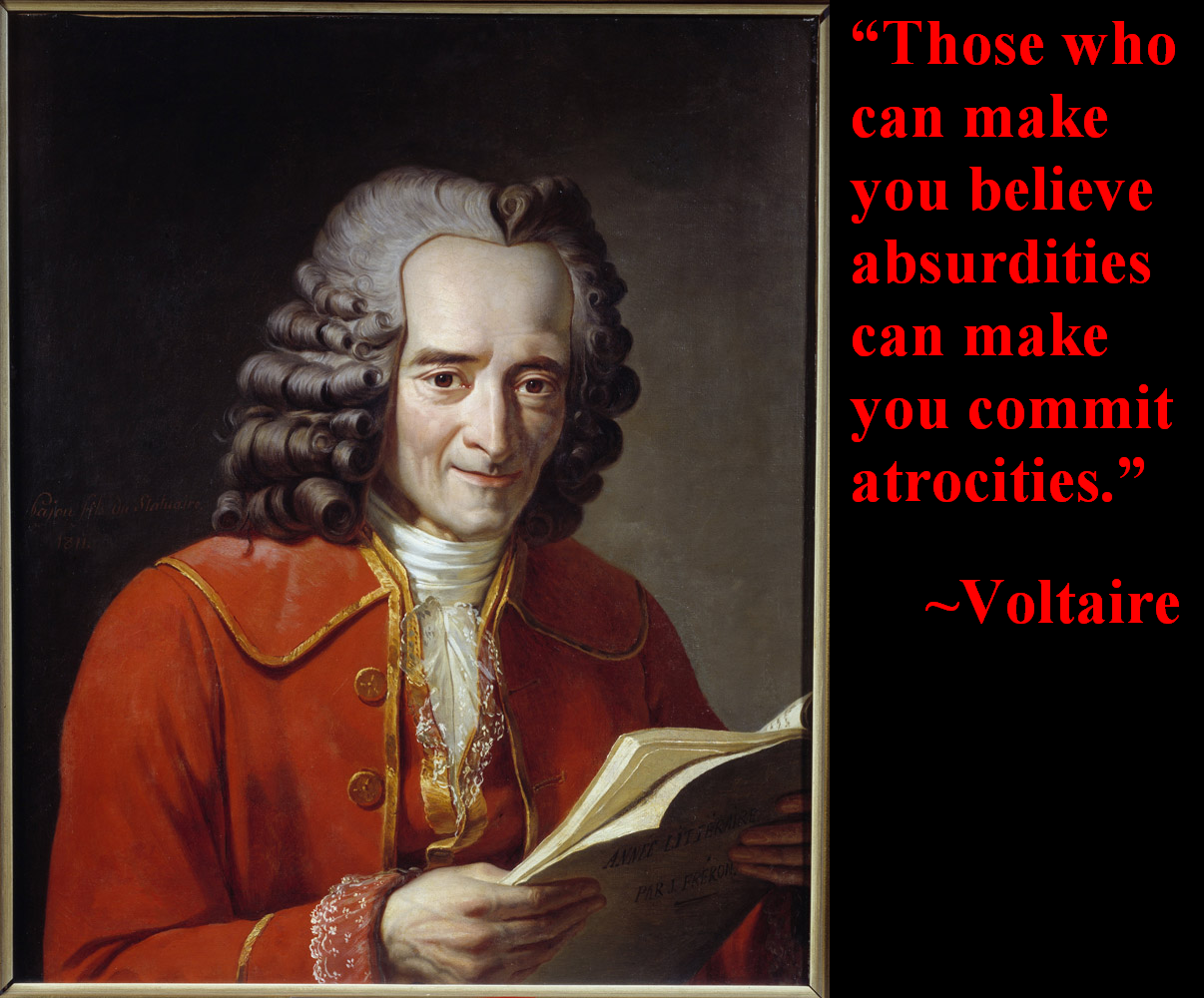
Examples abound. Here are two:

Absurdity #1:  Pure human races exist.

A resulting atrocity:  the Holocaust (~20 million people, including ~6 million Jews, killed by the Nazis in the 1930s and 1940s).

Absurdity #2:  Acts which are both suicidal and homicidal can be wonderful things, and can earn a person an eternal reward in paradise after death.

A resulting atrocity:  the destruction of the World Trade Center, and attacks on other targets, on September 11, 2001, which killed over three thousand people, including the hijackers themselves.

Please note that this list is far from complete. A complete list would fill several very large books. Beware of absurdities in your thinking, for they can actually be fatal.

“Antisemitism” has become an inherently confusing word. Here’s how to fix this problem.

symbols

When referring to the Holocaust, it never caused confusion to refer to Nazis as “antisemitic.” German is not a Semitic language, and the non-Semite Nazis were trying to exterminate an ethnoreligious group, the Jews, who are a Semitic people. In that context, the word “antisemitism,” in a European setting, is not difficult to understand. This is also true of antisemitism earlier in European history.

Decades later, and outside of Europe, however, the situation has changed, and the word “antisemitism” is now far less clear in its meaning. The one nation most closely identified with the Jewish people is Israel, and Israel is not in conflict with Germany. Israel is, of course, currently in an active conflict with an organization, Hamas, which has been firing rockets from nearby Gaza across the border, into Israel. In response, Israel has been retaliating, using even greater force than that wielded by Hamas. In this current conflict, there have been numerous deaths of noncombatants, including many children, in Gaza, but no deaths (so far) in Israel. For this reason, some people have raised their voices in criticism of the actions of the Israeli government in the current conflict. Predictably, but not logically, those who are criticizing Israel’s actions are now being accused of antisemitism.

When the word “antisemitic” gets thrown around, in the context of conflicts in the Middle East which involve Israel, it doesn’t help anyone understand anything. The word is actually an impediment to understanding. The reason for this is that “Semite” does not mean what many people think it means. For one thing, most Semites are not Jews.

“Semites” refers to a collection of ethnolinguistic groups — people who speak, or are descended from those who spoke, any of a large collection of languages known as the Semitic languages . . . and one of the Semitic languages is Arabic. Are Jews Semites? Yes, they are, but so are Arabs. The current conflict in the Middle East is a conflict between two different groups of people, both of whom are Semitic. To throw the emotionally-charged word “antisemitic” into the middle of the fray, therefore, makes no sense. It increases confusion, and clarifies nothing. The word also further enflames the emotions of those arguing and fighting, on both sides, in a situation where the exact opposite is needed.

It doesn’t help that many Westerners believe a fallacy related to Arabs, using “Arab” (which refers to an ethnic group) interchangeably with “Muslim,” which is not an ethnic term at all, but one that simply refers to anyone who practices the religion known as Islam. In reality, there are many Arabs who are not Muslims, and there are hundreds of millions of Muslims who are not Arabs. For example, consider the people who live in Iran. The governments of Israel and Iran are often hostile to each other, and Iran has very few Arabs, despite being a nation where an overwhelming majority practice Islam.

When Israel has conflicts with other nations (or organizations, for Hamas is not a nation) in the Middle East, those conflicts are political in nature, with religion playing a strong role as well. Israel is associated with the religion of Judaism (even though much of its Jewish population is only ethnically Jewish, not Jewish in the religious sense of the term), and is often in conflict with others in the Middle East who are associated with the religion called Islam. “Antisemitic,” used as a synonym for anti-Jewish bigotry, is an unfortunate misnomer, but there are alternatives which are better, in the sense that they are more specific, and therefore more clear. There is already a word in common use for fear and hatred of Islam and/or Muslims:  “Islamophobia.”  The corresponding term for fear and hatred of Judaism and/or Jews, including those who are Jewish only in the ethnic sense of the word, is “Judeophobia.” Most of the time, when people use the word “antisemitism,” they actually mean Judeophobia. Since Arabs are, themselves, a subset of the Semites, it would be illogical to refer to a specific person who is both an Arab, and a hater of Jews, as an “antisemitic Arab.”  To describe that person as a “Judeophobic Arab,” on the other hand, makes perfect sense.

Finally, it must be recognized that there are numerous people, within both Judaism and Islam, who do not have within them the blind, furious hatred of the other group that has caused so much death and destruction in the Middle East since the founding of the modern nation of Israel, in the years following World War II. I am referring, of course, to non-Islamophobic Jews, and non-Judeophobic Muslims. One does not often see them featured in the news, especially when conflicts such as the current one are raging, but such people do exist, and their existence should give all people who prefer peace over war hope for the future. May their numbers increase.