An Ethical Dilemma Involving a Polyhedral Crystal

I just ordered a crystal rhombcuboctahedron on eBay because I like its geometrical properties, despite the mystical claims in the item listing. I did so with the full knowledge and expectation that these claims are almost certainly false, because, well, they’re mystical claims.

Rhombicubocta

Here’s my ethical dilemma: would it be ethical to lab-test those claims, then post the results in the feedback I leave?

[Image created using Stella 4d, available at http://www.software3d.com/Stella.php. This isn’t a picture of the crystal on eBay; it is made of quartz, and not rainbow-colored. It is of the same shape, however.]

Is the Moon a Magnet for Ignorance?

is the moon

Google’s search-suggestions for “is the moon,” shown above, clearly indicate support for the “magnet for ignorance” conjecture.

My favorite one from this list: “is the moon real”? I’ve looked into this, and there are apparently quite a few people utterly convinced that the Moon is a hologram, created by NASA, for reasons I have not been able to discern.

A Tour of the Periodic Table of the Elements, Part 1

Periodic-Table-of-Elements 1st one with alkali metal and such

(click to enlarge)

In this, and the some upcoming posts, I’ll be showing you various collections of elements on the horizontally-extended version of the periodic table — one that includes the f-block elements in their proper place, rather than relegating them to two separate rows below the other elements. (I’m also suggesting the purple letters A – N for the usually-unrecognized groups in the f-block, and keeping the group numbers 1-18, with which many are familiar, for other groups).

For this first post, I’ll start with some sets of elements which are familiar to most who have studied the subject, plus some others which are much less well-known.

  • Light blue — the alkali metals.
  • Black background with red symbol and atomic number — hydrogen, which is definitely not an alkali metal, despite it sharing group 1 with them.
  • Dark blue — the alkaline-earth metals.
  • Dark yellow — the lanthanides.
  • Orange — these two elements are included with the lanthanides in some sources, and with the transition metals in others.
  • Bright pink — the actinides.
  • Light pink — these two elements are included with the actinides is some sources, and with the transition metals in others.
  • Red — the transition metals, also known as the transition elements, and d-block elements.
  • Light purple — group 13 is often called the “boron group,” but it also goes by other names, such as the “icosagens” and the “triels.”
  • Dark purple — group 14 is often called the “carbon group,” but it also goes by other names, such as “tetragens” and “crystallogens.” In semiconductor physics, these elements are referred to as group IV elements. 
  • Dark green — group 15 elements are referred to as the pnictogens, or nitrogen-group elements.
  • Bright yellow — bright yellow is used here for the chalcogens, also known as the group 16 elements, or oxygen-group elements.
  • Light green — the halogens.
  • Gray — the noble gases.

One Dozen Precious Metal Cubes: A Problem Involving Geometry, Chemistry, and Finance (Solution Provided, with Pictures)

The troy ounce is a unit of mass, not weight, and is used exclusively for four precious metals. At this time, the prices per troy ounce, according to this source for current precious metal prices, for these four elements, are:

  • Gold, $1,094
  • Palladium, $600
  • Platinum, $965
  • Silver, $14.82

(As a side note, it is rare for platinum to have a lower price per troy ounce than gold, as is now the case. I would explain the reasons this is happening, except for one problem: I don’t understand the reasons, myself, well enough to do so. Yet.)

A troy ounce equals 31.1034768 grams, but, for most purposes, 31.103 g, or even 31.1 g, works just fine.

Also, as you can see here, these “troy elements” are all in one part of the periodic table. This is related to the numerous similarities in these elements’ physical and chemical properties, which is itself related, of course, to the suitability of these four elements for such things as jewelry, coinage, and bullion.

1371846764_periodic_table_of_elements

To determine the volume of a given mass of one of these metals, it is also necessary to know their densities, so I looked them up, using Google (they are not listed on the periodic table above):

  • Gold, 19.3 g/cm³
  • Palladium, 11.9 g/cm³
  • Platinum, 21.46 g/cm³
  • Silver, 10.49 g/cm³

In chemistry, of course, one must often deal with elements (as well as other chemicals) in terms of the numbers of units (such as atoms or molecules), except for one problem: this is absurdly impractical, due to the outrageously small size of atoms. Despite this, though, it is necessary to count such things as atoms in order to do much chemistry at all, so chemists have devised a “workaround” for this problem: when counting units of pure chemicals, they don’t count such things as atoms or molecules directly, but count them a mole at a time. A mole is defined as a number of things equal to the number of atoms in exactly 12 grams of pure carbon-12. To three significant figures, this number is 6.02 x 10²³. To deal with moles, since atoms have differing masses, we need to know the molar mass (mass of one mole) of whatever we are dealing with to convert, both directions, between moles and grams. Here are the molar masses of the four troy-measured elements, as seen on the periodic table above, below each element’s symbol.

  • Gold, 196.97 g
  • Palladium, 106.42 g
  • Platinum, 195.08 g
  • Silver, 107.87 g

I’ve given these numbers  as the information needed to solve the following problem: rank one dozen precious metal cubes (descriptions follow) by ascending order of volume. There are three cubes each of gold, palladium, platinum, and silver. Four of the twelve (one of each element) have a mass of one troy ounce each. Another four each have a value, at the time of this writing, of $1,000. The last set of four each contain one mole of the element which composes the cube, and, again, there is one of each of these same four elements in the set.

If you would like to do this problem for yourself, the time to stop reading is now. Otherwise (or to check your answers against mine), just scroll down.

.

.

.

.

.

.

.

.

.

.

.

In the solutions which follow, a rearrangement of the formula for density (d=m/v) is used; solved for v, this equation becomes v = m/d. In order, then, by both volume and edge length, from smallest to largest, here are the twelve cubes:

Smallest cube: one troy ounce of platinum

One tr oz, or 31.103 g, of platinum would have a volume of v = m/d = 31.103 g / (21.46 g/cm³) = 1.449 cm³. A cube with this volume would have an edge length equal to the its volume’s cube root, or 1.132 cm. (This explanation for the calculation of the edge length, given the cube’s volume, is omitted in the items below, since the mathematical procedure is the same each time.)

Second-smallest cube: $1000 worth of gold

Gold worth $1000, at the time of this posting, would have a troy mass, and then a mass in grams, of $1000.00/($1,094.00/tr oz) = (0.914077 tr oz)(31.103 g/tr oz) = 28.431 g. This mass of gold would have a volume of v = m/d = 28.431 g / (19.3 g/cm³) = 1.47 cm³. A cube with this volume would have an edge length of  1.14 cm.

Third-smallest cube: $1000 worth of platinum

Platinum worth $1000, at the time of this posting, would have a troy mass, and then a mass in grams, of $1000.00/($965.00/tr oz) = (1.0363 tr oz)(31.103 g/tr oz) = 32.231 g. This mass of platinum would have a volume of v = m/d = 32.231 g / (21.46 g/cm³) = 1.502 cm³. A cube with this volume would have an edge length of  1.145 cm.

Fourth-smallest cube: one troy ounce of gold

One tr oz, or 31.1 g, of gold would have a volume of v = m/d = 31.1 g / (19.3 g/cm³) = 1.61 cm³. A cube with this volume would have an edge length of 1.17 cm.

Fifth-smallest cube: one troy ounce of palladium

One tr oz, or 31.1 g, of palladium would have a volume of v = m/d = 31.1 g / (11.9 g/cm³) = 2.61 cm³. A cube with this volume would have an edge length of 1.38 cm.

Sixth-smallest cube: one troy ounce of silver 

One tr oz, or 31.103 g, of silver would have a volume of v = m/d = 31.103 g / (10.49 g/cm³) = 2.965 cm³. A cube with this volume would have an edge length of 1.437 cm.

Sixth-largest cube: $1000 worth of palladium

Palladium worth $1000, at the time of this posting, would have a troy mass, and then a mass in grams, of $1000.00/($600.00/tr oz) = (1.6667 tr oz)(31.103 g/tr oz) = 51.838 g. This mass of palladium would have a  volume of v = m/d = 51.838 g / (11.9 g/cm³) = 4.36 cm³. A cube with this volume would have an edge length of  1.63 cm.

Fifth-largest cube: one mole of palladium

A mole of palladium, or 106.42 g of it, would have a volume of v = m/d = 106.42 g / (11.9 g/cm³) = 8.94 cm³. A cube with this volume would have an edge length of 2.07 cm.

Fourth-largest cube: one mole of platinum

A mole of platinum, or 195.08 g of it, would have a volume of v = m/d = 195.08 g / (21.46 g/cm³) = 9.090 cm³. A cube with this volume would have an edge length of 2.087 cm.

Third-largest cube: one mole of gold

A mole of gold,  or 196.97 g of it, would have a volume of v = m/d = 196.97 g / (19.3 g/cm³) = 10.2 cm³. A cube with this volume would have an edge length of  2.17 cm.

Second-largest cube: one mole of silver

A mole of silver, or 107.87 g of it, would have a volume of v = m/d = 107.87 g / (10.49 g/cm³) = 10.28 cm³. A cube with this volume would have an edge length of 2.175 cm.

Largest cube: $1000 worth of silver

Silver worth $1000, at the time of this posting, would have a troy mass, and then a mass in grams, of $1000.00/($14.82/tr oz) = (67.48 tr oz)(31.103 g/tr oz) = 2099 g. This mass of gold would have a volume of v = m/d = 2099 g / (10.49 g/cm³) = 200.1 cm³. A cube with this volume would have an edge length of  5.849 cm.

Finally, here are pictures of all 12 cubes, with 1 cm³ reference cubes for comparison, all shown to scale, relative to one another.
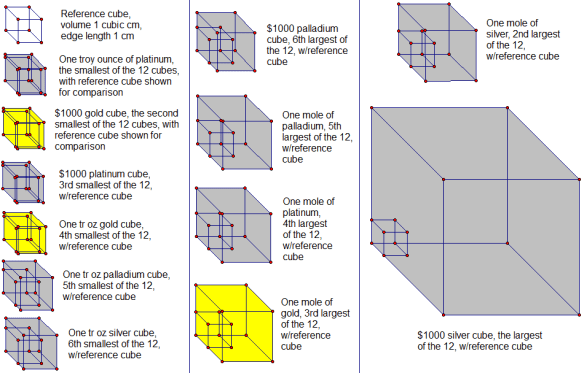
dozen cubes

A third of these cubes change size from day-to-day, and sometimes even moment-to-moment during the trading day, if their value is held constant at $1000 — which reveals, of course, which four cubes they are. The other eight cubes, by contrast, do not change size — no precious metal prices were used in the calculation of those cubes’ volumes and edge lengths, precisely because the size of those cubes is independent of such prices, due to the way those cubes were defined in the wording of the original problem.

The Physics of Cats, Copperheads, Centipedes, Catbounce, and Catbouncemax

catbouncemax

Definition of catbouncemax (shortened form of “maximum catbounce”): for any particular cat, its catbouncemax is equal to the takeoff kinetic energy of that cat if it suddenly and unexpectedly finds itself face-to-face with an adult copperhead snake.

I’ve actually seen this happen. Really. The cat reached a height I estimate as 1.4 meters.

Measured in joules, a cat’s catbouncemax can most easily be approximated by observing and estimating the maximum height of the cat under these conditions. For ethical and safety reasons, of course, one must simply be observant, and wait for this to happen. Deliberately introducing cats and copperheads (or other dangerous animals) to each other is specifically NOT recommended. Staying away from copperheads, on the other hand, IS recommended. Good science requires patience!

After the waiting is over (be prepared to wait for years), and the cat’s maximum height h, in meters, has been estimated, the cat’s catbouncemax can then be determined by energy conservation, since its takeoff kinetic energy (formerly stored as feline potential energy, until the moment the cat spots the copperhead) is equal to the gravitational potential energy (PE = mgh) of the cat at the top of the parabolic arc. In the catbounce I witnessed, the cat who encountered a copperhead (while walking through tall grass, which is why the cat didn’t see the snake coming) was a big cat, at an estimated mass of 6.0 kg. His catbouncemax was therefore, by energy conservation, equal to mgh = (6.0 kg)(1.4 m)(9.81 m/s²) = ~82 joules, which means this particular cat had 82 J of ophidiofeline potential energy stored, specifically for use in the event of an encounter with a large, adult copperhead, or other animal (there aren’t many) with the ability to scare this cat equally as much as such a copperhead. (I’m using a copperhead in this account for one reason: that’s the type of animal which initiated the highest catbounce I have ever witnessed, and I seriously doubt that this particular cat could jump any higher than 1.4 m, under any  circumstances.)

It should be noted that the horizontal distance covered by a catbounce is not needed to calculate a cat’s catbouncemax. However, this horizontal distance will not be zero, as is apparent in the diagram above. Why? Simple: cats don’t jump straight up in reaction to copperheads, for they are smart enough not to want to fall right back down on top of such a snake.

It is more common, of course, for cats to jump away from scary things which are less scary than adult copperheads. For example, there certainly exist centipedes which are large enough to scare a cat, causing it to catbounce, but with that centipede-induced catbounce being less than its catbouncemax. The following fictional dialogue demonstrates how such lesser catbounces can be most easily described. (Side note: this dialogue is set in Arkansas, where we have cats and copperheads, and where I witnessed the copperhead-induced maximum catbounce described above.)

She: Did you see that cat jump?!?

He: Yep! Must be something scary, over there in that there flowerpatch, for Cinnamon to jump that high. At least I know it’s not a copperhead, though.

She: A copperhead? How do you know that?

He: Oh, that was quite a jump, dear, but a real copperhead would give that cat of yours an even higher catbounce than that! The catbounce we just saw was no more than 75% of Cinnamon’s catbouncemax, and that’s being generous.

She: Well, what IS in the flowerpatch? Something sure scared poor Cinnamon! Go check, please, would you?

He: [Walks over from the front porch, where the couple has been standing this whole time, toward the flowerpatch. Once he gets half-way there, he stops abruptly, and shouts.] Holy %$#@! That’s the biggest centipede I’ve ever seen!

She: KILL IT! KILL IT NOW!

On Binary Planets, and Binary Polyhedra

Faceted Augmented Icosa

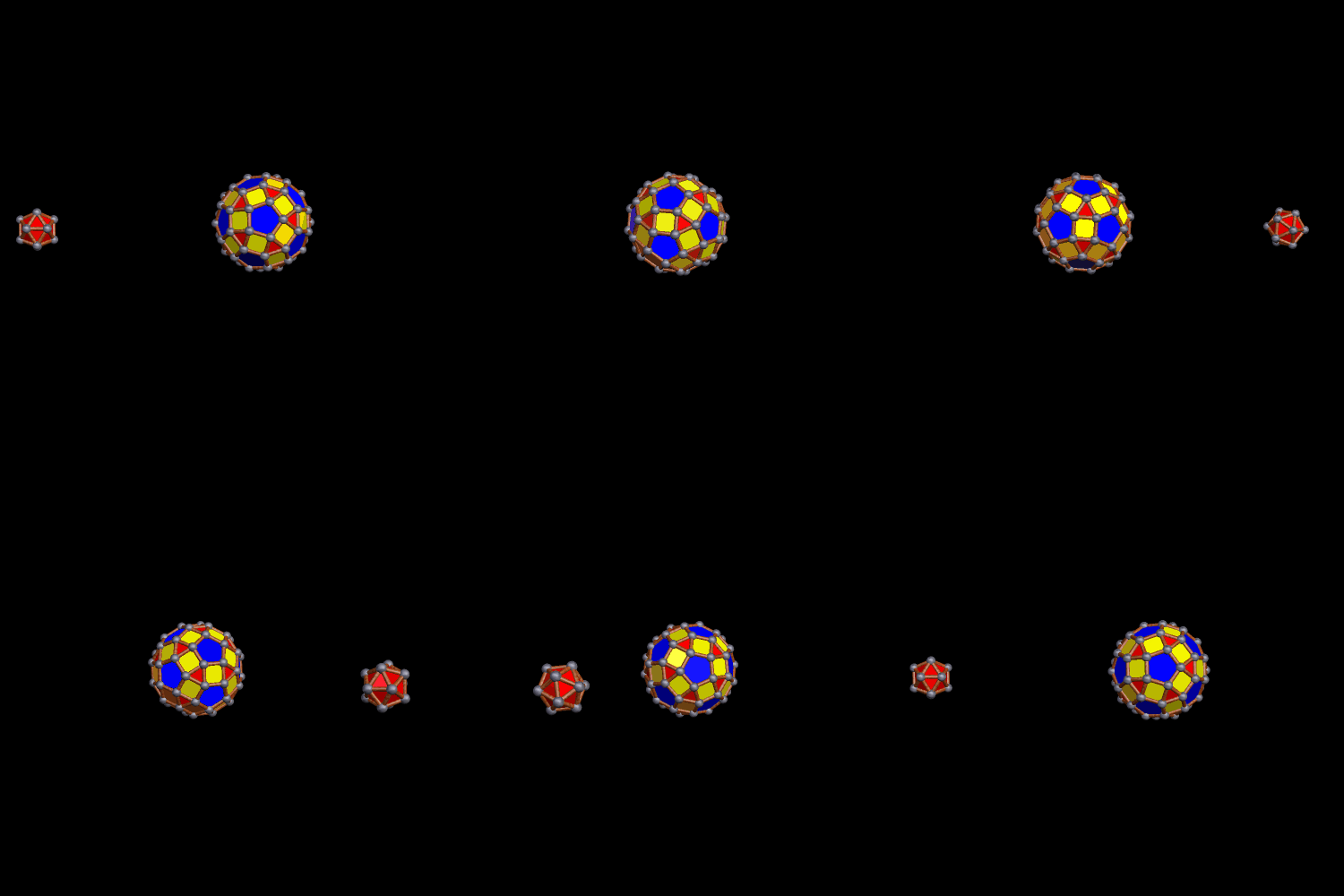
This image of binary polyhedra of unequal size was, obviously, inspired by the double dwarf planet at the center of the Pluto / Charon system. The outer satellites also orbit Pluto and Charon’s common center of mass, or barycenter, which lies above Pluto’s surface. In the similar case of the Earth / Moon system, the barycenter stays within the interior of the larger body, the Earth.

I know of one other quasi-binary system in this solar system which involves a barycenter outside the larger body, but it isn’t one many would expect: it’s the Sun / Jupiter system. Both orbit their barycenter (or that of the whole solar system, more properly, but they are pretty much in the same place), Jupiter doing so at an average orbital radius of 5.2 AU — and the Sun doing so, staying opposite Jupiter, with an orbital radius which is slightly larger than the visible Sun itself. The Sun, therefore, orbits a point outside itself which is the gravitational center of the entire solar system.

Why don’t we notice this “wobble” in the Sun’s motion? Well, orbiting binary objects orbit their barycenters with equal orbital periods, as seen in the image above, where the orbital period of both the large, tightly-orbiting rhombicosidodecahedron, and the small, large-orbit icosahedron, is precisely eight seconds. In the case of the Sun / Jupiter system, the sun completes one complete Jupiter-induced wobble, in a tight ellipse, with their barycenter at one focus, but with an orbital period of one jovian year, which is just under twelve Earth years. If the Jovian-induced solar wobble were faster, it would be much more noticeable.

[Image credit: the picture of the orbiting polyhedra above was made with software called Stella 4d, available at this website.]

The First High-Resolution Images from Pluto Have Arrived, and They Bring a Major Mystery: Where Are the Impact Craters?

pluto-observations-through-the-years

As new pics from the Pluto/Charon system become available, you can’t beat the image gallery at the New Horizons portion of NASA’s website to keep up with them, which is where I found this .gif file showing images of Pluto itself throughout the years. It culminates in the latest, and most detailed, image of any part of Pluto — a small portion of its surface. To see more of the latest pics, as they are released, I refer you to that web-page. NASA plans to keep it updated with the latest from the Pluto/Charon system, for months to come, as new images are transmitted, received, and processed.

The big surprise today is not the “heart of Pluto” that’s gotten so much press this week, but something newly discovered (and completely unexpected) with the latest small batch of new pics: on both Pluto and Charon, they can’t find a single impact crater. Not one. And that is just flat-out weird. Here, see for yourself (same image source): unexpected ice mountains, check; unexpectedly-smooth plains, check; craters — hey, the craters are missing!

nh-plutosurface

According to everything we know, impact craters should be there. The ice mountains and numerous plains are mysteries, also, but it is the lack of craters which really has scientists puzzled this morning. Everyone expected to see lots of impact craters, myself included. Small worlds, so far from the sun, should have frozen internally long ago, based on present models, making them geologically dead, and therefore unable to “erase” impact craters (seen on dozens of other planets, dwarf planets, satellites, and asteroids) with surface-altering geological activity. This mass-erasure-of-craters happens on a only a few other solid bodies in the solar system, such as Earth, and Jupiter’s moon Io — both larger, and much warmer, than anything in the Pluto/Charon system. Some scientists are already going public with conjectures for the energy source needed to keep Pluto and Charon crater-free. However, I have yet to read any such conjecture which I find convincing, which is why I am not including them in this post. (Such guesswork is easy to find, though, here, among other places.)

On the other hand, the scientific community has had very little time, yet, to explain this new puzzle; there might be a convincing explanation out there by this time next week — or this could persist, as one of many mysteries in astronomy, for decades. At this point, it is too early to even venture a guess regarding when, if ever, this mystery will be solved.

An Image, from Outside All of the Numerous Event Horizons Inside the Universe, During the Early Black Hole Era

late universe

This image shows exactly what most of the universe will look like — on a 1:1 scale, or many other scales — as soon as the long Black Hole Era has begun, so this is the view, sometime after 1040 years have passed since the Big Bang. This is such a long time that it means essentially the same thing as “1040 years from now,” the mere ~1010 years between the beginning of time, and now, fading into insignificance by comparison, not even close to a visible slice of a city-wide pie chart.

This isn’t just after the last star has stopped burning, but also after the last stellar remnant (such as white dwarfs and neutron stars), other than black holes, is gone, which takes many orders of magnitude more time. What is left, in the dark, by this point? A few photons (mostly radio waves), as well as some electrons and positrons — and lots — lots — of neutrinos and antineutrinos. There are also absurd numbers of black holes; their mass dominates the mass of the universe during this time, but slowly diminishes via Hawking radiation, with this decay happening glacially for large black holes, and rapidly for small ones, culminating in a micro-black-hole’s final explosion. Will there be any baryonic matter at all? The unanswered question of the long-term stability of the proton creates uncertainty here, but there will, at minimum, be at least be some protons and neutrons generated, each time a micro-black-hole explodes itself away.

Things stay like this until the last black hole in the cosmos finally evaporates away, perhaps a googol years from now. That isn’t the end of time, but it does make things less interesting, subtracting black holes, and their Hawking radiation, from the mix. It’s still dark, but now even the last of the flashes from a tiny, evaporating black hole has stopped interrupting the darkness, so then, after that . . . nothing does. The universe continues to expand, forever, but the bigger it becomes, the less likely anything complex, and therefore interesting, could possibly have survived the eons intact.

For more on the late stages of the universe, please visit this Wikipedea article, upon which some of the above draws, and the sources cited there.

Stephen Hawking, on the Reasons We Explore

hot

The source for this screenshot-image, and quote, is the congratulatory message from Stephen Hawking to the entire New Horizons team at NASA, regarding the historic achievement of the fly-by through the Pluto/Charon system, earlier today. All I did was take the screenshot, and then add the quote to it.

Here is the entire message, as NASA posted it to YouTube.

Testing a Climate Change Claim: Does Burning a Gallon of Gasoline Really Put Twenty Pounds of Carbon Dioxide Into the Atmosphere?

OLYMPUS DIGITAL CAMERA

OLYMPUS DIGITAL CAMERA

When I read, recently, that “every gallon of gas you save not only helps your budget, it also keeps 20 pounds of carbon dioxide out of the atmosphere,” (source) I reacted with skepticism. Twenty pounds? That seemed a bit high to me.

Just because it seems high, to me, though, doesn’t mean it’s wrong, any more than “about.com” putting it on the Internet makes the statement correct. No problem, I thought: I’ll just do the math, and check this for myself.

So, in this problem, we start with a gallon of gasoline. In units I can more easily work with, that’s 3.785 liters (yes, they rounded it incorrectly on the gas can shown above). Google tells me that the density of gasoline varies from 0.71 to 0.77 kg/L (reasonable, since it floats on water, but is still heavy to lug around), so I’ll use the average of that range, 0.74 kg/L, to find the mass of a gallon of gasoline: (3.785 L)(0.74 kg/L) = 2.8 kg.

Next, I need to find out how much of that 2.8 kg of gasoline is made of carbon. That would be an easy chemistry problem if gasoline were a pure chemical, but it isn’t, so I’ll estimate. First, I’ll ignore the elements which only make up a minor part of gasoline’s mass, leaving only hydrogen and carbon to worry about. Next, I consider these things:

  1. Alkanes larger than methane (major gasoline components), whether branched-chain or not, have slightly more than two hydrogen atoms for every carbon atom. This ratio doesn’t exceed three, though, and is equal to three only for ethane, which has too high a boiling point to remain in liquid form at typical temperatures and pressures, anyway.
  2. Cycloalkanes, another major component of gasoline, have exactly two hydrogen atoms for every carbon atom.
  3. Aromatic hydrocarbons can have fewer than two hydrogen atoms for every carbon atom, and these chemicals are also a major component of gasoline. For the simplest aromatic hydrocarbon, benzene, the H:C ratio drops to its lowest value: 1:1.

For the reasons above, I’m choosing two to one as a reasonable estimate for the number of atoms of hydrogen for every atom of carbon in gasoline. Carbon atoms, however, have twelve times the mass of hydrogen atoms. Gasoline is therefore ~12/14ths carbon, which reduces to ~6/7. I can now estimate the mass of carbon in a gallon of gasoline: (6/7)(2.8 kg) = 2.4 kg.

So how much carbon dioxide does that make? Well, first, does a car actually burn gasoline completely, so that every carbon atom in gasoline goes out the tailpipe as part of a carbon dioxide molecule? The answer to this question is simple: no.

However, this “no” doesn’t really matter, and here’s why. In addition to carbon dioxide, automobile exhaust also contains carbon present as carbon monoxide, unburned carbon, and unburned or partially-burned hydrocarbons. To have an environmental impact, though, it isn’t necessary for a given carbon dioxide molecule to come flying straight out of the tailpipe of one’s car. In our oxygen-rich atmosphere, those carbon atoms in car exhaust which are not yet fully combusted (to each be part of a carbon dioxide molecule) are quite likely to end up reacting with oxygen later on — certainly within the next year, in most cases — and the endpoint of carbon reacting with oxygen, once combustion is complete, is always carbon dioxide. What’s carbon monoxide, then? Well, one way to look at it is this: molecules of carbon monoxide are simply half-burned carbon atoms. When the other half of the burning (combustion) happens, later, carbon dioxide is the product. So, for purposes of this estimate, I am assuming that all 2.4 kg of carbon in a gallon of gasoline ends up as carbon dioxide — either directly produced by the car, or produced in other combustion reactions, later, outside the car.

The molar mass of elemental carbon is 12 grams. For oxygen, the corresponding figure is 16 g, but that becomes 32 g of oxygen in carbon dioxide, with its two oxygen atoms per molecule. Add 12 g and 32 g, and you have carbon dioxide’s molar mass, 44 g. Therefore, 12 g of carbon is all it takes to make 44 g of carbon dioxide; the rest of the mass comes from oxygen in the air. By use of ratios, then, I can now find the mass of carbon dioxide formed from burning a gallon of gasoline, with its 2.4 kg of carbon.

Here is the ratio needed: 2.4 kg of carbon / unknown mass of carbon dioxide produced = 12 g of carbon / 44 g of carbon dioxide. By cross-multiplication, and using “x” for the unknown, this equation becomes (12 g)(x) = (44 g)(2.4 kg), which simplifies to 12x = 105.6 kg, so, by division, x = 8.8 kg of carbon dioxide produced from one gallon of gasoline.

Each kilogram (of anything), near sea level on this planet, weighs about 2.2 pounds. This 8.8 kg of carbon dioxide, then, translated into “American,” becomes (8.8 kg)(2.2 pounds/kg) = 19.36 pounds. Given the amount of estimation I had to do to obtain this answer, this is close enough to twenty pounds for me to conclude that the statement I was examining has survived my testing. In other words, yes: burning a gallon of gasoline goes, indeed, put about twenty pounds of carbon dioxide into the atmosphere.

However, I’m not quite finished. Carbon dioxide is an invisible gas, making it quite difficult to picture what twenty pounds of it “looks” like. To really understand how much carbon dioxide this is, it would be helpful to know its volume. So I have a new problem: 8.8 kg of pure carbon dioxide is trapped, in a balloon, at standard temperature and pressure. What is the balloon’s volume?

To solve this problem, one needs the density of carbon dioxide under these conditions, which chemists refer to as “STP” (standard temperature and pressure). According to Google, the density of carbon dioxide at STP is about 1.98 kg per cubic meter. Since 8.8 kg / (1.98 kg/m³) = 4.44 m³, this means that a gallon of gasoline can produce enough carbon dioxide, held at STP, to inflate this balloon to a volume of 4.44 cubic meters. For the benefit of those who aren’t used to thinking in metric units, that volume equals the volume of a perfect cube with an edge length of ~5.4 feet. You could fit a bunch of people into a cube that large, especially if they were all on friendly terms.

Now, please consider this: all of that was from one gallon of gasoline. How many gallons of gas do you typically buy, when you fill up your car’s gas tank? Well, multiply by that number. How many times do you fill up your car, on average, in a year? Multiply again. Next, estimate the total number of years you will drive during your lifetime — and multiply again. You now have your own personal, lifetime carbon dioxide impact-estimate from just one activity: driving.

This may sound like a change of topic, but it isn’t: what’s the hottest planet in the solar system? Even though Mercury is much closer to the Sun, the answer is Venus, and there is exactly one reason for that: Venus has a thick atmosphere which is chock-full of carbon dioxide. In other words, yes, the planet nearest the Earth, and the brightest object in the sky (behind the Sun and the Moon), Venus, is one of the best warnings about global warming known to exist, and we’ve known this for many decades. One wonders if any theologian has ever speculated that the creator of the universe designed Venus this way, and then put it right there “next door,” on purpose, specifically as a warning, to us, about the consequences of burning too much carbon.

The science, and the math which underlies it, are both rock-solid: climate change is real. Lots of politicians deny this, but that’s only because of the combined impact of two things: their own stupidity, plus lots of campaign contributions from oil companies and their political allies. Greed and stupidity are a dangerous combination, especially when further combined with a third ingredient: political power. Voting against such politicians helps, but it isn’t enough. One additional thing I will do, immediately, is start looking for ways to do the obvious, in my own life: reduce my own consumption of gasoline. Since I’m putting this on the Internet, perhaps there will be others persuaded to do the same.

The truth may hurt, but it’s still the truth: the United States is a nation of petroleum junkies, and we aren’t just harming ourselves with this addiction, either. It’s time, as a people, for us to invent, and enter, fossil-fuel rehab.

[Image credit: “GasCan” by MJCdetroit – Own work. Licensed under CC BY 3.0 via Wikimedia Commons – https://commons.wikimedia.org/wiki/File:GasCan.jpg#/media/File:GasCan.jpg]