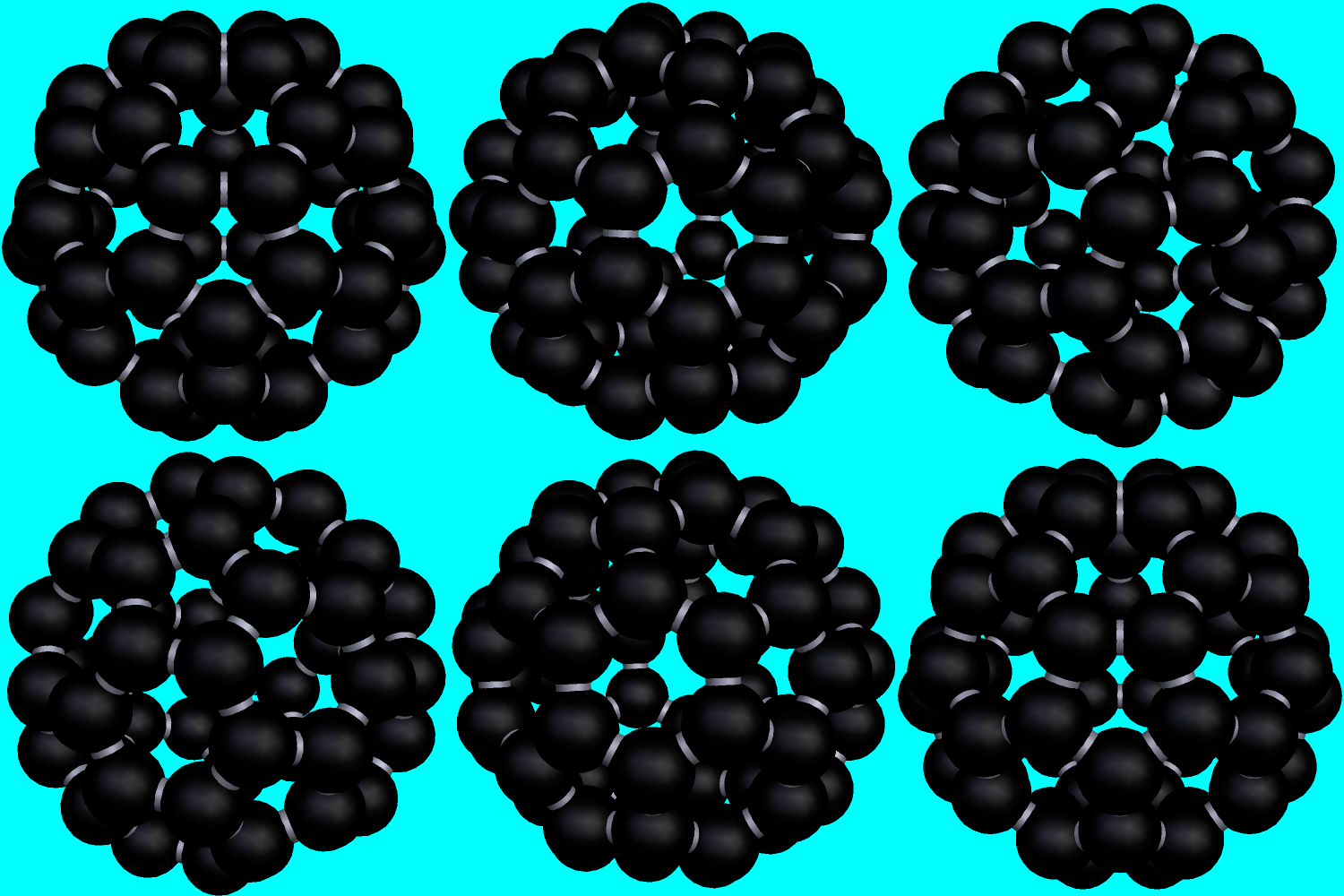
Buckminsterfullerene, a molecule made of 60 carbon atoms, and having the shape of a truncated icosahedron, is easily modeled with Stella 4d: Polyhedron Navigator (see http://www.software3d.com/Stella.php to try or buy this program). The first image shows the”ball and stick” version used by chemists who want the bonds between atoms to be visible.
The second model is intermediate between the ball-and-stick version, and the space-filling version, which follows it.
Here’s the “closely packed” space-filling version, taken to an extreme.
Which version better reflects reality depends on the certainty level you want for molecular orbitals. A sphere representing 99% certainty would be larger than one for 95% certainty.
When I am asked for my height, anywhere — especially at school — I answer the question honestly. I am 1.80 meters tall.
I also live in the USA, one of only three remaining countries (the other two holdouts are Liberia and Myanmar) which have stubbornly refused to adopt the metric system. However, I am every bit as stubborn as other Americans, but, on this issue, I choose to be stubborn in the opposite direction.
It should surprise no one who knows me well that my classroom, whether I am teaching science or mathematics, is, by design, an all-metric zone. After all, like >99% of people, I have ten fingers (assuming thumbs are counted as fingers), ten toes, and almost always use the familiar base-ten number system when counting, measuring, doing arithmetic, or doing actual mathematics. (Doing arithmetic is not the same thing as doing real mathematics, any more than spelling is equivalent to writing.) Using the metric system is consistent with these facts, and using other units is not.
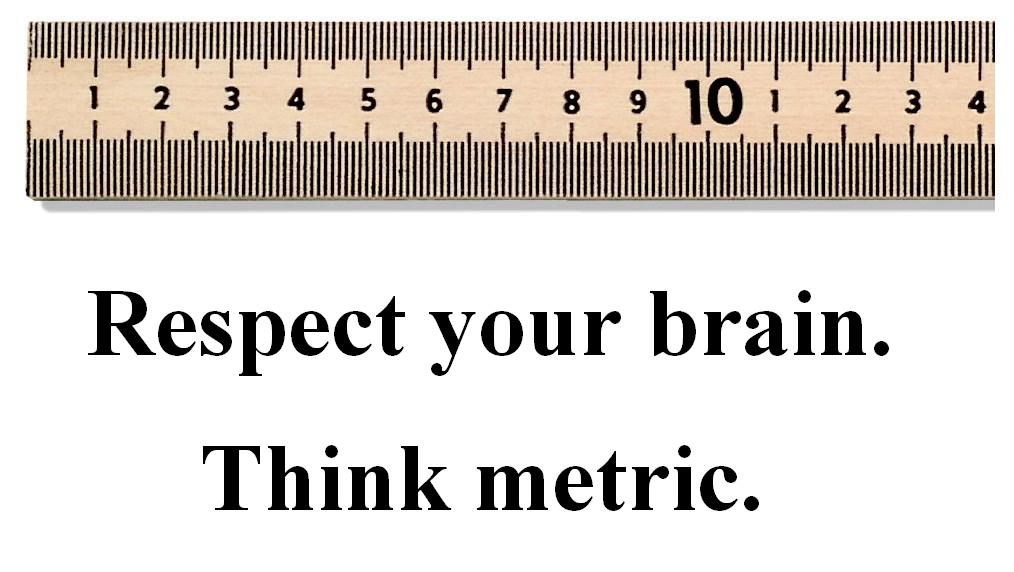
Admittedly, I do sometimes carry this to an extreme, but I do so to make a point. Metric units are simply better than non-metric units. Why should anyone need to memorize the fact that there are 5,280 feet in one mile? It actually embarrasses me that I have that particular conversion-factor memorized. By “extreme,” I mean that I have been known to paint the non-metric side of meter sticks black, simply to make it impossible for students in my classes to confuse inches and centimeters, and prevent them from measuring anything with the incorrect units.
To those who object that American students need to understand non-metric units, I simply point out that there are plenty of other teachers who take care of that. This is, after all, the truth.
Often, after giving my height as 1.80 meters, I am asked to give it in other units. Unless the person asking is a police officer (in, say, a traffic-stop situation), however, I simply refuse to answer with non-metric units. What do I say, instead? “I’m also 180 centimeters tall. Would you like to know my height in kilometers?”
If pressed on this subject in class — and it comes up, because we do lab exercises where the height of people must be measured — I will go exactly this far: I am willing to tell a curious student that there are 2.54 centimeters in an inch, 12 inches in a foot, and 3.28 feet in a meter. Also, I’m willing to loan calculators to students. Beyond that, if a student of mine really wants to know my height in non-metric units, he or she simply has to solve the problem for themselves — something which has not yet happened. I do not wish to tell anyone my height in feet and inches, for I do not enjoy headaches, and uttering my height, in those units I despise, would certainly give me one. Also, obviously, you won’t find my height, expressed in non-metric units, on my blog, unless someone else leaves it here, in a comment — and I am definitely not asking anyone to do that.
I might, just for fun, at some point, determine my height in cubits. For all I know, a person’s height, measured with their own cubits, might be a near-constant. That would be an interesting thing to investigate, and my students, now that I’ve thought about the question, might find themselves investigating this very issue, next week. The variability of cubits, from one person to another, makes them at least somewhat interesting. It also makes cubits almost completely useless, which explains why they haven’t been used since biblical times, but that’s not the point. One can still learn things while investigating something which is useless, if one is sufficiently clever about it.
Feet and inches, however, are not interesting — at all. They are obsolete, just as cubits are, and they are also . . . offensive. It is not a good thing to insult one’s own brain.
After accidentally misquoting Shakespeare, while watching these eggs boil (“Boil, boil, toil and trouble, fire burn and cauldron bubble”), I then correctly quoted Shakespeare at the eggs, by shouting, “You egg!” at them, as they boiled.
What . . . you’ve never talked to your food? If not, just try it some time, for it makes life more interesting. If you’re worried about people thinking you’re crazy, I have another quote, from the physicist Richard Feynman, for you to consider: “What do you care what other people think?”
Little seems to be going right today, for correctly quoting Shakespeare meant being, at the same time, mathematically incorrect. Twelve and one are, of course, not the same number, but I’m not willing to deliberately misquote Shakespeare, for that would be, well, wrong.
I was then asked, by someone who heard me, um, shouting at boiling eggs, exactly which of Shakespeare’s plays it is, in which the line “you egg” appears. Since I did not know the answer to this question, I immediately used this situation as an opportunity to test the alleged omniscience of Google, which I test, and re-test, frequently. (So far, Google always passes these experimental tests, but I will post an announcement here if this fact ever changes.) I also googled my earlier, failed attempt to quote Shakespeare, which is how I now know that I was misquoting him.
In case you’re wondering why I was fact-checking myself, here’s another Feynman quote, offered as explanation: “The first principle is that you must not fool yourself — and you are the easiest person to fool.” Those are words to live by — and I do.
Not only did Google know that the two-word quote I remembered (from 10th grade English class, over thirty years ago, simply because I found it funny) comes from Macbeth, Act 4, Scene 2, but it also, very helpfully, showed me the way to the YouTube video which you can see below.
For those few readers of my blog who have not already noticed this, I lead a strange life.
Of course, I certainly wouldn’t want a normal one, but, clearly, I don’t need to worry about that.
We’ve all seen labels like this, stuck to gasoline pumps. While filling up my car’s gas tank earlier today, I felt compelled to take a picture of this familiar label — because I suddenly realized that what this small sign actually means is that the alcohol content of the gasoline being sold (in an area where liquor sales are illegal, no less) might be as much as twenty proof.
Twenty proof gasoline. Twenty proof gasoline! One never thinks of it this way, but it is both mathematically and chemically accurate. There are many different alcohols, but the one people drink for purposes of intoxication, and the one found in this gasoline, are the exact same molecule: C2H5OH. I then realized that the people who design these labels are being sneaky with the wording on purpose, for they don’t put “contains alcohol,” or anything like that, on these stickers found on gas pumps all over the place.
The reason for use of the official, less-familiar chemical term “ethanol” then became both obvious, and horrifying, all at once. Gas pumps must be labeled this way because there are people out there who are so incredibly stupid that they would actually drink gasoline if they knew it contained, well, booze.
What’s more, there is an unwritten assumption in play here, and I think (or at least hope) it is a valid one: anyone sufficiently educated to know that “ethanol” and the “the alcohol people drink to get drunk” are synonyms is also, presumably, smart enough to know better than to drink gasoline. Drinking gasoline would, of course, be dangerous in the extreme. Even inhaling gasoline fumes is hazardous, but drinking the stuff would be far worse. Consuming enough of this ethanol-containing gasoline to actually get drunk would, in fact, very likely be fatal, due to the mixture of toxic hydrocarbons present, in addition to the alcohol. The most toxic component of gasoline with which I am familiar is benzene, a potent carcinogen. Benzene is really nasty stuff, if it somehow makes it into a human body.
So, for the record, do not drink the up-to-twenty-proof gasoline — even though that is an accurate way to describe it.
This is my twentieth year teaching, but only the first year when I have not taught at least one class in chemistry, and I miss it. One of my fondest memories of chemistry lab involves the one time I experimented with aqua regia — a mixture of acids which, unlike any single acid, can dissolve both gold and platinum, the “noble metals.” I had read a story of a scientist’s gold Nobel Prize being protected from the Nazis by dissolving it in aqua regia, and then recovering the gold from solution after World War II had ended. Having read about this, I wanted to try it myself, and also thought it would make an excellent lab for classroom use — if I could figure out how to recover the gold, and also learn what precautions would be needed to allow high school students to perform this experiment safely. For sensible and obvious reasons, I conducted a “trial run” without students present, but with another chemistry teacher nearby, since aqua regia, and the gases it produces when dissolving gold, are quite dangerous. Someone else has put a video on YouTube, showing aqua regia dissolving gold, so you can see something much like what I saw, simply by watching this video.
First, I obtained one-tenth of a troy ounce of gold, which cost about $80 at the time. I had read about the extreme malleability of gold, one of the softest metals, and wanted to see evidence for it for myself — so, before I prepared the the aqua regia, I used a hammer to try flattening the gold sample into a thin sheet. That didn’t work, but it didn’t take long for me to figure out why — I had accidentally bought gold coin-alloy, which is 10% copper, not pure gold. Since this alloy is far less malleable than pure gold, my attempt to flatten it had failed, but I also knew this would not pose a problem for my primary experiment — the one involving aqua regia. Also, I didn’t have another spare $80 handy, to purchase another 1/10 troy ounce of pure gold, so I proceeded to make, for the first time in my life, a small amount of aqua regia — Latin for “royal water.”
Unlike what is shown in the video above, I prepared the acid-mixture first, before adding the gold, using a slightly-different recipe: the traditional 1:4 ratio, by volume, of concentrated nitric acid to concentrated hydrochloric acid. Both these acids look (superficially) like water, but the mixture instantly turned yellow, and started fuming, even before anything was added to it. Wearing full protective gear, I watched it for a few minutes — and then, using tongs held by gloved hands, lowered my hammer-bashed sample of gold into the fuming, yellow mixture of concentrated acids.
It worked. It was a fascinating reaction, and a lot of fun to watch. At approximately the same time that the last of my gold sample dissolved, something occurred to me: I had failed to research how to recover the dissolved gold from the resulting solution! No problem, I thought — I can figure this out. (I am seldom accused of lacking self-confidence, even when I’m wrong.)
My first idea was to use a single-replacement reaction. Many times, I have had students extract pure silver from a solution of silver nitrate by adding a more-active metal, such as copper. The copper dissolves, replacing the silver in the silver nitrate solution, and silver powder forms, as a precipitate, on the surface of the copper. Thinking that a similar process could be used to precipitate out the gold from my gold / aqua regia mixure, I simply added come copper to the reaction beaker. The corrosive properties of my aqua regia sample had not yet been exhausted, though, and so the remaining aqua regia simply “ate” the copper. The result was a mess — I had only succeeded in turning an already-complicated problem into an even-more-complicated problem, by adding more chemicals to the mixture. More attempts to turn the gold ions back into solid gold dust, using other chemicals, followed, but all of them failed. Finally, I used a strong base, sodium hydroxide, to neutralize the still-acidic mixture, and then, disgusted by my failure to recover the gold, found a way to safely dispose of the mixture, and did so.
In retrospect, I think I know where I messed up — I should have neutralized the remaining acids in the mixture with sodium hydroxide first, before adding copper to cause the gold to precipitate out, in a no-longer-acidic solution of ions with much less hydronium present. That, I think, will work, and I do intend to try it sometime — after doing more research first, to increase my level of certainty, and also after waiting for the current price of gold to drop to less-expensive levels. Right now, after all, a tenth of a troy ounce of gold costs roughly $120, not a mere $80.
As for the lost $80, I’m not upset about that anymore. I definitely learned things while doing this, and now view the $80 spent as simply the cost of tuition for an educational experience.
Were nuclei of anticarbon-14 and oxygen-18 to collide (and their opposite charges’ attractions would help with this), what would happen? Well, if you break it down into particles, the anticarbon-14 nucleus is composed of six antiprotons and eight antineutrons, while the oxygen-18 contains eight protons and ten neutrons. That lets six proton-antiproton pairs annihilate each other, releasing a specific amount of energy, in the form of gamma rays, with that amount calculable using E=mc² and KE=½mv². The two excess protons from oxygen-18, however, should escape unscathed. In the meantime, eight neutron-antineutron pairs also are converted into a specific, calculable amount of gamma-ray energy, but with two neutrons surviving. Here’s the net reaction:
Two protons and two neutrons, of course, can exist as separate particles, two deuterons, a tritium nucleus and a neutron, or a single alpha particle.
Now, consider this: any physical process is, at least hypothetically, reversible. Therefore, it should be possible to bombard a dense beam of alpha particles with many gamma rays, each of a specific and calculable energy, and, rarely, the reverse reaction would occur, and anticarbon-14 and oxygen-18 nuclei would appear. Oxygen-18 is stable, but rare, so detection of it would be evidence that the reverse-reaction had occurred. Anticarbon-14, however, can logically being expected to decay to antinitrogen-14 via the antimatter version of beta-negative decay, which, it being antimatter, will result in the emission of an easily-detectable positron. It likely will not have time to do this, though, for carbon-14’s half-life (and anticarbon-14’s as well, one assumes) exceeds 5,000 years. The more likely scenario for the anticarbon-14 nucleus is that it will create a large burst of gamma rays when it encounters, say, a non-antimatter carbon atom — and these gamma rays would come from a different position than the ones bombarding the alpha particles, and can therefore be distinguished from them by determination of their direction.
Such a reverse-reaction would be quite rare, for it involves a decrease in entropy, violating the Second Law of Thermodynamics. However, the Second Law is a statistical law, not an absolute one, so it simply describes what happens most of the time, allowing for rare and unusual aberrations, especially on the scale of things which are extremely small. So, do this about a trillion times (or much more, but still a finite number of trials) and you’ll eventually observe evidence of the production of the first known anticarbon nucleus.
Also, before anyone points this out, I am well aware that this is highly speculative. I do make this claim, though: it can be tested. Perhaps someone will read this, and decide to do exactly that. I’d test it myself, but I lack the equipment to do so.
There is a chemical element, bismuth, which many people — even chemists — think has at least one stable isotope. However, the truth, discovered in 2003 (but still not well-known), is that it has no stable isotopes, but does have one with an extremely long half-life — so long that it, and other isotopes with similarly-long half-lives, are often deemed “effectively stable.” Bismuth is shown in green on the table, and its “effectively stable” isotope, bismuth-209, has a half-life of at least 1.9 x 10¹⁹ years. For comparison, it has “only” been ~1.38 x 10¹⁰ years since the Big Bang. Bismuth-209’s half-life is, therefore, over a billion times longer than the total amount of time which has existed, so far.
In addition, the yellow boxes indicate elements which have only radioactive and “observationally stable” isotopes. “Observationally stable” means that radioactivity (in some cases, even the spontaneous-fission variety), with an extremely long half-life, is predicted, or at least thought to be possible, but no actual decay has yet been observed — so the yellow elements’ perhaps-stable, perhaps-not isotopes are “on watch.” The red boxes, by contrast, are for elements which have been long-known to have no stable isotopes.
None of this takes into consideration the unresolved issue of hypothesized long-term proton decay. If protons turn out to be unstable, all atoms likely are as well, unless simply having them exist in atoms somehow stabilizes them, as is the case for neutrons, which decay in isolation, but do not in stable nuclei. This is an area of uncertainty — another way of saying that this is something which needs further study.
Most symbols for elements on the periodic table are easy to learn, such as those for carbon, oxygen, and nitrogen: C, O, and N. There are eleven “oddballs,” though, because their symbols originated in other languages (Latin, mostly), and do not match their English names. Here’s a list of them, by atomic number, with an explanation for each.
11. Na stands for sodium because this element used to be called natrium.
19. K stands for potassium, for this element’s name used to be kalium.
26. Fe stands for iron because this element was formerly named ferrum.
29. Cu stands for copper because it used to be called cuprum.
47. Ag’s (silver’s) old name was argentum.
50. Sn’s (tin’s) name used to be stannum.
51. Antimony’s symbol, Sb, came from its former name, stibium.
74. Tungsten, with the symbol W, was once called wolfram. In some parts of the world, it still goes by that name, in fact.
79. Gold (Au) was called aurum in past centuries.
80. Mercury’s (Hg’s) old name is impossible (for me, anyway) to say five times, quickly: hydrargyrum.
82. Lead (Pb) was once called plumbum because plumbers used it to weight the lower end of plumb-lines.
I think learning things is easier, with longer retention, if one knows the reasons behind the facts, rather than simply attempting rote memorization.
In elementary school, in the 5th grade, I managed to get in trouble for a “show and tell” project. As usual, getting in trouble was not my objective, but it happened anyway. This was decades before I learned I have Asperger’s, but, looking back, none of this would have happened were I not an “Aspie,” as we call ourselves.
This image, which I found here, is very much like the poster I made, by hand, and used for this project:
That was the “show” part of this “show and tell” project. For the “tell” part, I explained how nuclear chain reactions work, and then explained how nuclear bombs are made. It’s very simple: you have two slightly sub-critical masses of uranium-235 or plutonium-239, and physically bring them together, so that the total mass exceeds the critical mass. At that point: boom.
The hard part, of course, is actually obtaining the U-235 or Pu-239, for those aren’t things you can simply buy at the local hardware store. Ironically, I did know where to find both uranium and plutonium — at the very same university, about an hour away, where I’d spent far too much time conducting mostly-unsupervised experiments with both elements, along with lots of liquid mercury, before my tenth birthday. (I still suspect that all that radiation may have turned me into a mutant.) However, I also knew that the uranium and plutonium there would not have nearly enough of the correct isotope of either element, making this information irrelevant to my “show and tell” report, and so, for this reason, I did not tell them where to find the uranium and plutonium I had previously used for experiments.
I didn’t figure this out in class that day, since I’m not particularly good at “reading” emotions, facial expressions, and body language, but, apparently, I really upset, and scared, my teacher. This became apparent when she called my mother, and, later, my mother asked me to tell her what I’d done in school that day. Being excited about the “show and tell” presentation I’d given that day, I immediately told my mother all about it. When she told me the teacher had called her, concerned about me explaining to my class how to build atomic bombs, I was confused, since I didn’t understand, at all, why what I had actuallysaid posed any problem. To explain this to my mother, I simply said, “But, Mom, I didn’t tell the class where to actually get the uranium-235 or plutonium-239! I don’t know where to find those isotopes!”
This was enough to convince my mother that I had not, in fact, done anything wrong. She called the teacher back, and simply asked if I had, or had not, included that critical bit of information: where to find the actual fissionable material needed for a nuclear bomb to work. When the teacher replied that I had not done that, my mother’s response was both sensible, and logical: “Well, then, what’s the problem?”
—–
Postscript, for those who might be worried about the childhood experiments I mentioned above: at around age 40, I asked a physician about my worries regarding early exposure to mercury vapor and radiation. He told me that any problems I might have, as a result of such experiments, would have already showed up by then, and that I could, therefore, stop worrying about this. Thus reassured, I did exactly that.
I’m reading the book shown above for the second time, and am noticing many things that escaped my attention the first time through. The most shocking of these items, so far, is finding out that history’s first nuclear explosion almost occurred by accident, in Oak Ridge, Tennessee, during World War II. One person prevented this disaster, and that person was Richard Feynman, my favorite scientist in any field. If you’d like to read Feynman’s account of this, in his own words, it’s in the chapter “Los Alamos from Below,” which starts on page 107.
Feynman, a physicist, was one of many civilians involved in the Manhattan Project, doing most of his work in New Mexico. At one point, though, he obtained permission to visit Oak Ridge, in order to try to solve problems which existed there. These problems were caused by the American military’s obsession with secrecy, which was caused, in turn, by the fact that it was known, correctly, that at least one spy for the Nazis was among the people working on the Manhattan Project. The military’s “solution” to this problem was to try to keep each group of civilians working for them in the dark about what the other groups of civilians were doing. Most of them had no idea that they were working to develop a bomb, let alone an atomic bomb. In Tennessee, they thought they were simply working on developing a way to separate uranium isotopes, but did not know the underlying purpose for this research.
The military men in charge knew (because the physicists in New Mexico figured it out, and told them) a little bit about the concept of critical mass. In short, “critical mass” means that if you get too much uranium-235 in one place, a runaway chain-reaction occurs, and causes a nuclear explosion. The military “brass” had relayed this information to the civilian teams working in Tennessee, by simply telling them to keep the amount of U-235 in one place below a certain, specific amount. However, they lacked enough knowledge of physics to include all the necessary details, and they deliberately withheld the purpose for their directive. Feynman, by contrast, did not share this dangerous ignorance, nor was he a fan of secrecy — and, as is well known, the concept of respecting “authority” was utterly meaningless to him.
While in Tennessee, Feynman saw a large amount of “green water,” which was actually an aqueous solution of uranium nitrate. What he knew, but those in Tennessee did not, is that water slows down neutrons, and slow neutrons are the key to setting off a chain reaction. For this reason, the critical mass for uranium-235 in water is much less than the critical mass of dry U-235, and the “green water” Feynman saw contained enough U-235 to put it dangerously close to this lower threshhold. In response to this, Feynman told anyone who would listen that they were risking blowing up everything around them.
It wasn’t easy for Feynman to get people to believe this warning, but he persisted, until he found someone in authority — a military officer, of course — who, although he didn’t understand the physics involved, was smart enough to realize that Feynman did understand the physics. He was also smart enough to carefully listen to Feynman, and decided to heed his warning. The safety protocols were modified, as were procedures regarding sharing of information. With more openness, not only was a disaster in Tennessee avoided, but progress toward developing an atomic bomb was accelerated. It turns out that people are better at solving problems . . . when they know the purpose of those problems.
Had this not happened, not only would Eastern Tennessee likely have suffered the world’s first nuclear explosion, but overall progress on the Manhattan Project would have remained slow — and the Nazis, therefore, might have developed a controlled nuclear bomb before the Americans, making it more likely that the Axis Powers would have won the war. Richard Feynman, therefore, dramatically affected the course of history — by deliberately putting his disdain for authority to good use.




 RobertLovesPi.net