The Compound of the Dodecahedron and the First Stellation of the Icosahedron

compound of dodeca and ike's first stellation.gif

I made this using Stella 4d, available here.

A Transparent Rhombic Dodecahedron

hollow rd

Created using Stella 4d, a program available at this website: http://www.software3d.com/Stella.php.

A Peek Backwards, as Far Back as Possible

peek

Never before have I deliberately tried to recall my earliest memories. This morning, however, simply to see what might happen, I tried it. In my imagination, I returned to further back than I ever had gone before, to a period before I learned to communicate. In this early period, I could visualize things, with the imagery which appeared being geometric in nature. Later, I had to learn English, as a second language, to express the mathematical ideas in my head. My first word, according to my parents, described one of the two shining round things in the sky: “Moon.” I have always preferred moonlight to sunlight, for the intensity of direct sunlight is painful to me.

At least, that’s how I remember these things; I could be wrong about the earliest parts. All I know is that the image above popped into my head, when I tried to recall my oldest accessible memory. I then made the image above, in a short period of time, using Stella 4d, Polyhedron Navigator, available to try for free at this website. (I’ve used the program for over a decade, and find it an indispensable tool for geometrical investigations, such as this recreation of what I found in this morning’s early-memory-search.)

A Deck of Polyhedra

There are 52 rotating polyhedra below. Starting right now, 52 of anything can be called a “deck” of that thing. The derivation of this term is the the number of cards in a standard playing-card deck. The deck is the smaller “cousin” of the mole, or 6.02 x 10²³ of anything, from chemistry, as well as the “big brother” of the dozen, or twelve of anything. All three units are measures of specific quantities, and can be applied to any objects, at least in principle. One never encounters a mole of people because there aren’t that many of us, but a mole of people can still be imagined. The same thing applies to a deck of Earths.

This deck of virtual, rotating polyhedra was created using Stella 4d, a program you may purchase here. If you would like to see a larger image of any one of these polyhedra, simply click on it. 

494 Circles, Each, Adorning Two Great Rhombcuboctahedra, with Different (Apparent) Levels of Anxiety


Trunc Cubocta

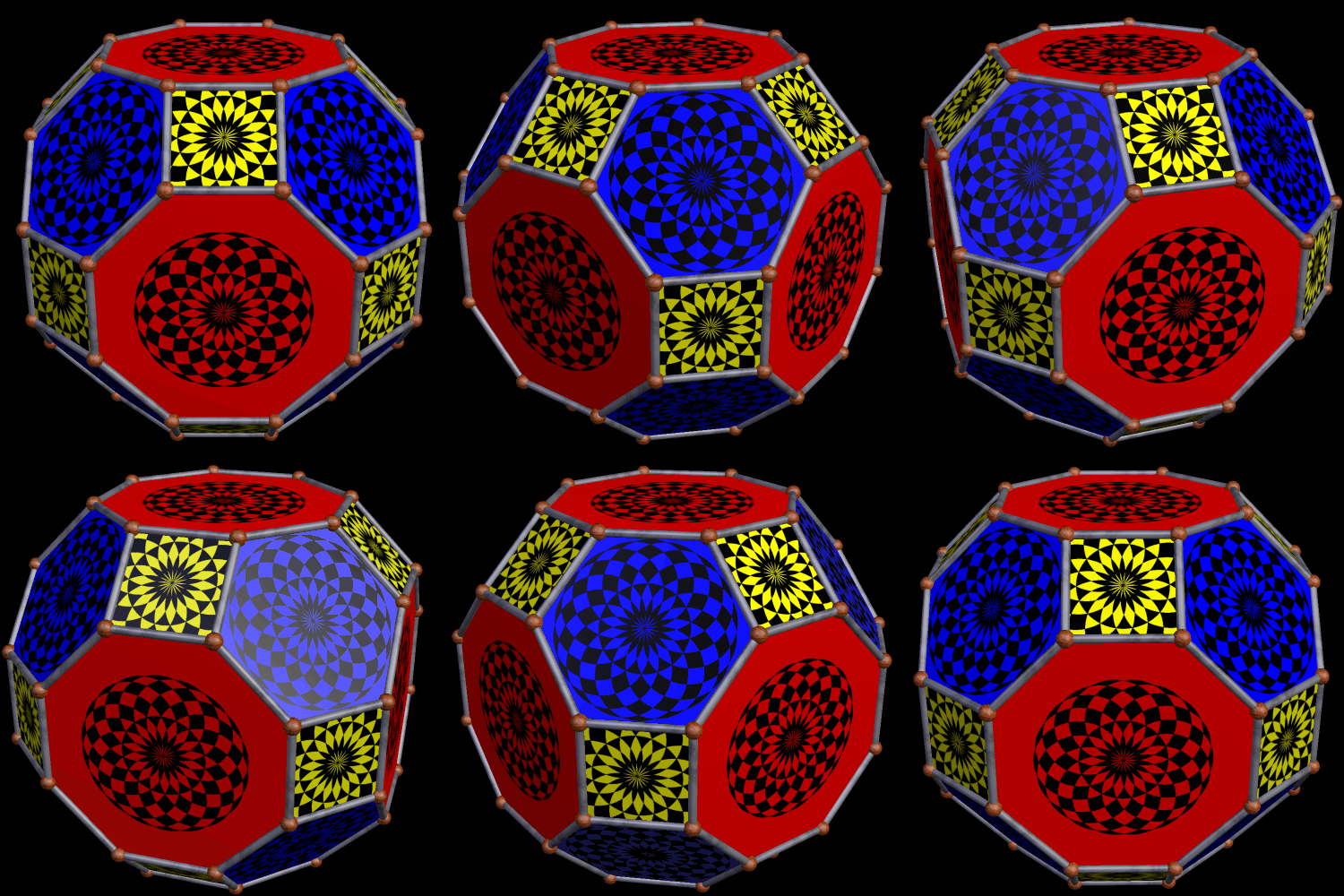
The design on each face of these great rhombcuboctahedra is made from 19 circles, and was created using both Geometer’s Sketchpad and MS-Paint. I then used a third program, Stella 4d (available here), to project this image on each of a great rhombcuboctahedron’s 26 faces, creating the image above.

If you watch carefully, you should notice an odd “jumping” effect on the red, octagonal faces in the polyhedron above, almost as if this polyhedron is suffering from an anxiety disorder, but trying to conceal it. Since I like that effect, I’m leaving it in the picture above, and then creating a new image, below, with no “jumpiness.” Bragging rights go to the first person who, in a comment to this post, figures out how I eliminated this anxiety-mimicking effect, and what caused it in the first place. 

Trunc Cubocta

Your first hint is that no anti-anxiety medications were used. After all, these polyhedra do not have prescriptions for anything. How does one “calm down” an “anxious” great rhombcuboctahedron, then?

On a related note, it is amazing, to me, that simply writing about anxiety serves the purpose of reducing my own anxiety-levels. It is an effect I’ve noticed before, so I call it “therapeutic writing.” That helped me, as it has helped me before. (It is, of course, no substitute for getting therapy from a licensed therapist, and following that therapist.) However, therapeutic writing can’t explain how this “anxious polyhedron” was helped, for polyhedra can’t write.

For a second hint, see below.

.

.

[Scroll down….]

.

.

Second hint: the second image uses approximately twice as much memory-storage space as the first image used.

A Music Video for “Ride Into the Sun,” by the Velvet Underground

This music video, for a Velvet Underground classic written by Lou Reed, John Cale, Sterling Morrison and Maureen Tucker, was made today — for a song originally recorded in 1969, the year after I was born. I used Windows Movie Maker to assemble it, and “painted” the preview-pic for the video, using MS-Paint. Other programs I used, for other images in the video, include Geometer’s Sketchpad, MS-Paint (again) and Stella 4d: Polyhedron NavigatorOf all these computer programs, my favorite is Stella 4d, which you may try for free at http://www.software3d.com/Stella.php.

On Therapeutic Writing, and Putting Hexakaidekaphobia in Remission

hexadeka

When my mother died, last November 16, I wrote an obituary for her, which I was then asked (unexpectedly) to read at her funeral, as one of two eulogies. This was one of the most difficult things I have ever done, but writing it did help me (somewhat) with the immediate problem I was having dealing with grief.

After the funeral, I felt numb much of the time, for months, until May 16 arrived — exactly six months after she died — at which point my tightly-controlled emotional state shattered, leaving me in worse shape (in some ways) than I was on, say, November 17 of last year. This was unexpected, and caused significant problems, including the development of monthly hexakaidekaphobia, a morbid dread and fear of the 16th day of every month. (The word is a modification of “triskaidekaphobia,” an irrational fear of the number thirteen).

June 16 was worse than May 16 — absolutely full of PTSD attacks. (I’ve had PTSD for most of my life; my mother’s death made it worse.) Fortunately, I don’t try to hide mental health problems, as I once did — I try to find the help I need, from physicians, to deal with such problems, and, when I find things that help me, I write about them. I also have long used recreational mathematics to help me feel better when depressed.

It was in this context that mid-July arrived. I went to sleep on July 15th with the knowledge that it was extremely important for me to find better coping mechanisms before the start of school in August. When I woke up on July 16, which could have been another horrific day of severe depression, anxiety, and other problems, I did not feel those negative emotions. This does not mean I had “gotten over” the facts that my mother did die, and that I miss her terribly. However, it did mean I was experiencing grief differently: I was feeling grief, rather than letting feelings of grief control me — and there is a huge difference between the two.

That morning, July 16, I knew what I needed to do as soon as I woke up: I needed to write. For me, that generally means blogging, and that’s what happened. This “therapeutic writing,” as I call it, was helpful enough on July 16 that I continued it the next day. When I next spoke to my doctors, I told them I was doing this, and why, and they agreed that such writing (like the “mathematical therapy” I have done for years) was an excellent, helpful activity. (This “check with professionals” step is essential, and I do not recommend attempting mental health therapy without the help of at least one licensed, qualified psychiatrist, and/or other type of therapist, such as a clinical psychologist.)

Of course, I could do this therapeutic writing in a spiral notebook, and keep it private; no writing has to go on the Internet. Why, then, do I choose to post such material where anyone can see it? I first explained why I blog about mental health issues in this post, but the short version is this: I hope that my openness on this subject can help reduce the social stigma which, unfortunately, still surrounds topics related mental health. This stigma is harmful because it keeps millions of people from seeking the professional help they need. I have also found it a personally liberating experience to come out of the “closet” on such issues, for, as with other metaphorical “closets,” it is the truth that closets are not good places for people to live their lives.

School starts on August 15 — only four days from now — and I’m going to do everything I can to make that day, the next day (the formerly-dreaded 16th of the month), and the rest of the days in the school year as good as they can possibly be for my students, as well as myself. I could tell I was on the right track when I decided to write about monthly hexakaidekaphobia early this morning, but in the past tense. Before I started writing, I “warmed up” by constructing the geometric art at the top of this post, which, if you examine carefully, you will see is based on — what else? — the number sixteen. In my case, at least, mathematical therapy and therapeutic writing go hand-in-hand, and this is what I am doing to try to leave my monthly hexakaidecaphobia in the past, where it belongs.

I still miss my mother. She was once, as I am, a science teacher, and was also involved in education in many other ways. She would want me to have good school days on August 16th, September 16th, and so on, as well as the days in-between — and, to properly honor her memory, and give my students the education they deserve, I am determined to do my best to do exactly that.

Zonohedra, Zonish Polyhedra, and Another Puzzle

In a recent post, I showed many images of zonohedra, then challenged readers to figure out, from the images, what zonohedra are: polyhedra with only zonogons as faces. Zonogons, I then explained, are polygons with (A) even numbers of edges, and with opposite edges always (B) congruent and (C) parallel. Here is another collection of zonohedra. (Individual images may be enlarged with a click.)

The next set of polyhedra shown, below, are not true zonohedra (as all the ones above are), but merely “zonish polyhedra.” From examination of the pictures above and below, can you figure out the difference between zonohedra and zonish polyhedra?

When you are ready to see the solution to the puzzle, simply scroll down.

.

.

.

.

.

.

.

.

.

.

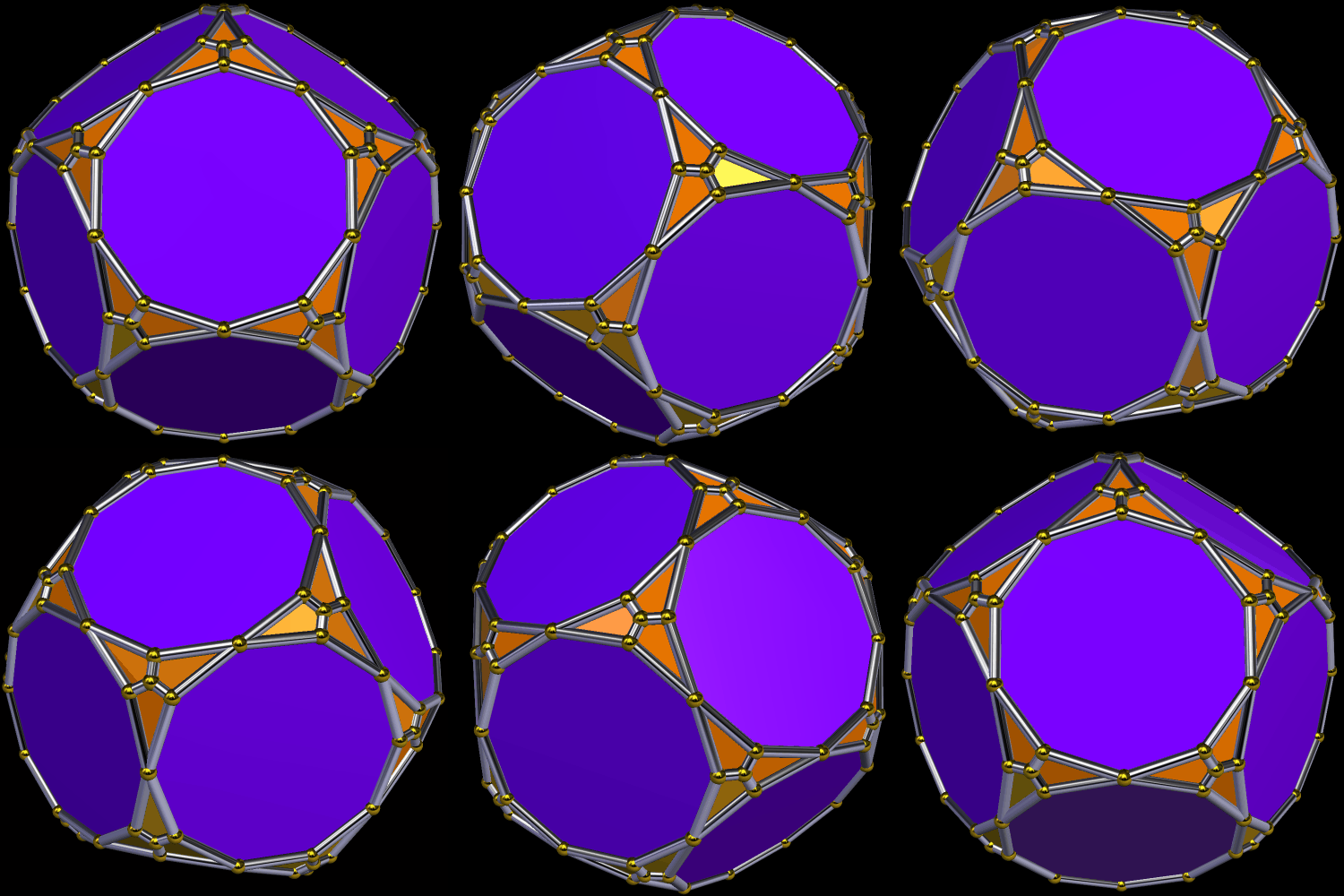
While zonohedra have only zonogons as faces, this restriction is “loosened” for zonish polyhedra. Such solids are formed by zonohedrifying non-zonohedral polyhedra, and letting at least some of the faces of the resulting polyhedra remain non-zonogonal. Zonish polyhedra  are called “zonish” because many (usually most) of their faces are zonogons, but not all of them — in each case, some non-zonogonal polygons (such as triangles and/or pentagons, with their odd numbers of edges) do appear. Non-zonogonal polygons are not required to have odd numbers of edges, of course: simply having opposite edges be parallel, but of different lengths, is enough to prevent a polygon (such as a hexagon, octagon, or decagon) from being a zonogon. 

~~~

Software credit: I used Stella 4d to make these images. This program may be tried for free at this website.

Some Zonohedra, and a Puzzle

Every zonohedron is a polyhedron, but not all polyhedra are zonohedra. Examples of zonohedra appear below. If you don’t already know what zonohedra are, can you figure out the definition from the examples shown, before reading the definition below the pictures?

Answer below (scroll down a bit):

.

.

.

.

.

.

.

Zonohedra are polyhedra with only zonogons as faces. A zonogon is a polygon with an even number of sides, and also with opposite sides congruent and parallel.

Software credit: I used Stella 4d to make these virtual, rotating zonohedra. This program may be tried for free at http://www.software3d.com/Stella.php.

Five Polyhedra Featuring Kites, as Well as Other Polygons, as Faces

90 faces 30 rhombi and 60 kites

Convex hull of trunc icosa and dual compound

octagons and kites

kites and pentagons

kites traps and pentagons

Software credit: I used Stella 4d (available at http://www.software3d.com/Stella.php) to create these polyhedral images.