Fractiles’ Mandala, Based on Angles of Pi/7 Radians

fractiles7withblackbackground

Although this was based on something I constructed using the Fractiles-7 magnetic tiling toy, I did not have enough magnetic pieces to finish this. The idea was, therefore, converted into a (non-Euclidean) construction using Geometer’s Sketchpad, and then refined using MS-Paint. The reason I describe this as a non-Euclidean construction is that an angle of pi/7 radians, such as the acute angles in the red rhombi, cannot be constructed using compass and unmarked straight edge: antiquity’s Euclidean tools. The other angles used are whole-number multiples of pi/7 radians, up to and including 6pi/7 radians for the obtuse angles of the red rhombi.

The yellow rhombi have angles measuring 2pi/7 and 5pi/7 radians, while the blue rhombi’s angles measures 3pi/7 and 4pi/7 radians. None of these angles have degree measures which are whole numbers. It is no coincidence that 7 is not found among the numerous factors of 360. It is, in fact, the smallest whole number for which this is true.

I have a conjecture that this aperiodic radial tiling-pattern could be continued, using these same three rhombi, indefinitely, but this has not yet been tested beyond the point shown.

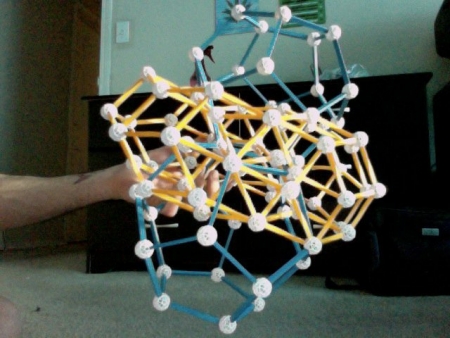
A Zome Torus, Before and After Adding Dodecahedra, As a Model for a Pulsar’s Accretion Disk and Radiation Jets

zome torus

I’ve been using Zometools, available at http://www.zometool.com, to build interesting geometrical shapes since long before I started this blog. I recently found this: a 2011 photograph of myself, holding a twisting Zome torus. While I don’t remember who was holding the camera, I do remember that the torus is made of adjacent parallelopipeds.

After building this torus, I imagined it as an accretion disk surrounding a neutron star — and now I am imagining it as a neutron star on the verge of gaining enough mass, from the accretion disk, to become a black hole. Such an object would emit intense jets of high-energy radiation in opposite directions, along the rotational axis of this neutron star. These jets of radiation are perpendicular to the plane in which the rotation takes place, and these two opposite directions are made visible in this manner, below, as two dodecahedra pointing out, on opposite sides of the torus — at least if my model is held at just the right angle, relative to the direction the camera is pointing, as shown below, to create an illusion of perpendicularity. The two photographs were taken on the same day. 

zome torus with dodecahedra 2011

In reality, of course, these jets of radiation would be much narrower than this photograph suggests, and the accretion disk would be flatter and wider. When one of the radiation jets from such neutron stars just happens to periodically point at us, often at thousands of times per second, we call such rapidly-rotating objects pulsars. Fortunately for us, there are no pulsars near Earth.

It would take an extremely long time for a black hole to form, from a neutron star, in this manner. This is because most of the incoming mass and energy (mostly mass, from the accretion disk) leaves this thermodynamic system as outgoing mass and energy (mostly energy, in the radiation jets), mass and energy being equivalent via the most famous formula in all of science: E = mc².

Four Sets of Five Circles On Each of the Faces of a Dodecahedron

Dodecahedron

After using Geometer’s Sketchpad and MS-Paint to make the image on the faces (seen alone in the last post), I then used Stella 4d: Polyhedron Navigator to project these images onto a red dodecahedron, and create this .gif. Stella is available, including as a free trial download, at http://www.software3d.com/Stella.php.

A Rhombic Mandala Based on Pi Over Nine

ninthsThe interior angles in these rhombi all measure π/9 radians, or some whole-number multiple of that amount, up to 8π/9 radians.

Spectral Golden Spiral II

Image

spectral golden spiral 2

Deliberately Difficult to Watch

difficult to watch

I’ve never tried this before: create a rotating polyhedral image which is difficult to watch, using disorienting effects, such as the rotation of the images of spirals on the rotating faces. The spiral is made of golden gnomons (obtuse triangles with a base:leg ratio which is the golden ratio). This image, alone and without comment, is shown in the previous post, and was made using Geometer’s Sketchpad and MS-Paint. In the preparation for this post, it was further altered, including the projection of it onto the faces of a great rhombicosidodecahedron, and creating this rotating .gif. This part of the process was performed using a program called Stella 4d: Polyhedron Navigator, available here. You be the judge, please: is it, in fact, difficult to watch? Did I accomplish my (admittedly rather odd) goal?

Spectral Golden Spiral

Image

Spectrral Golden Spiral

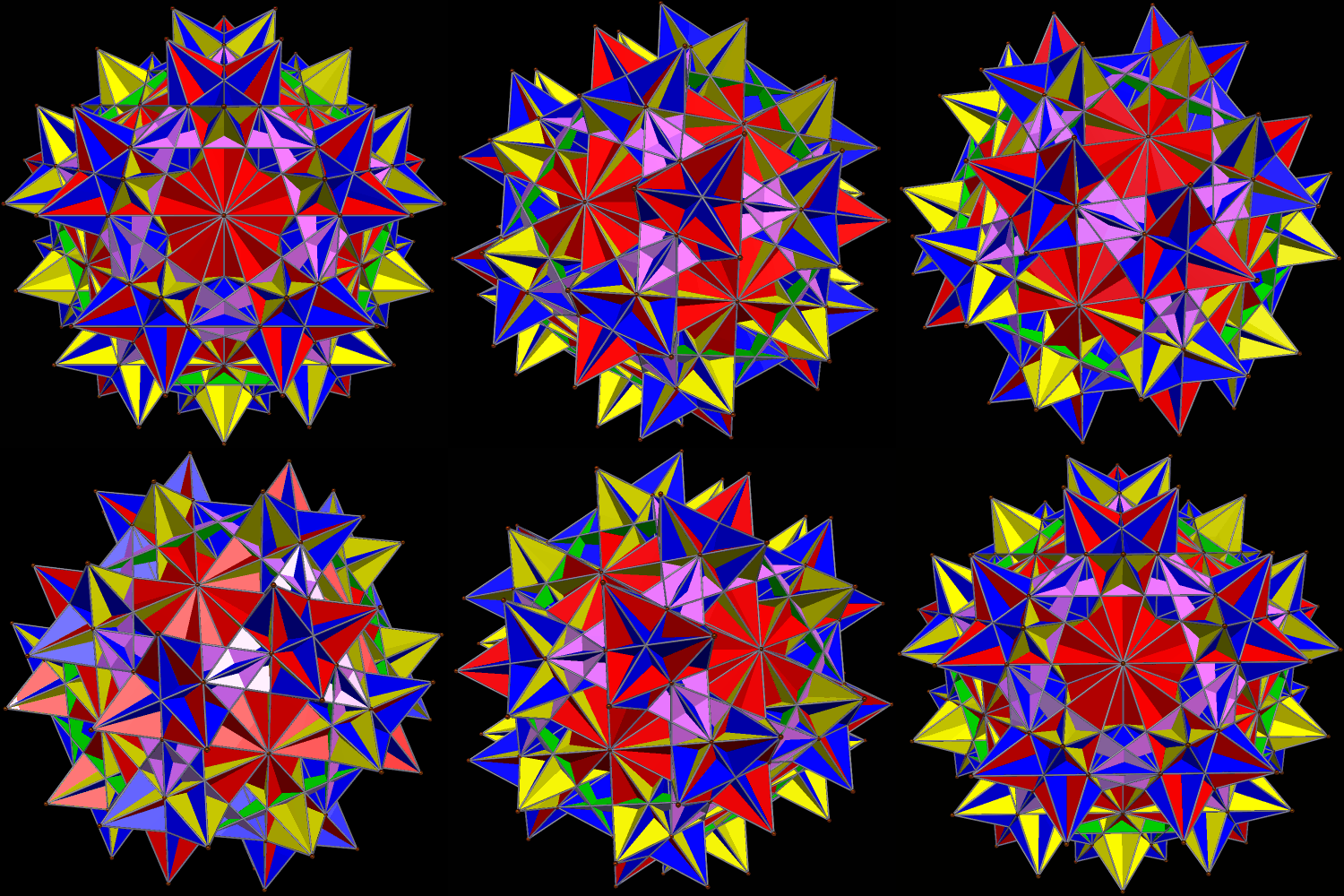
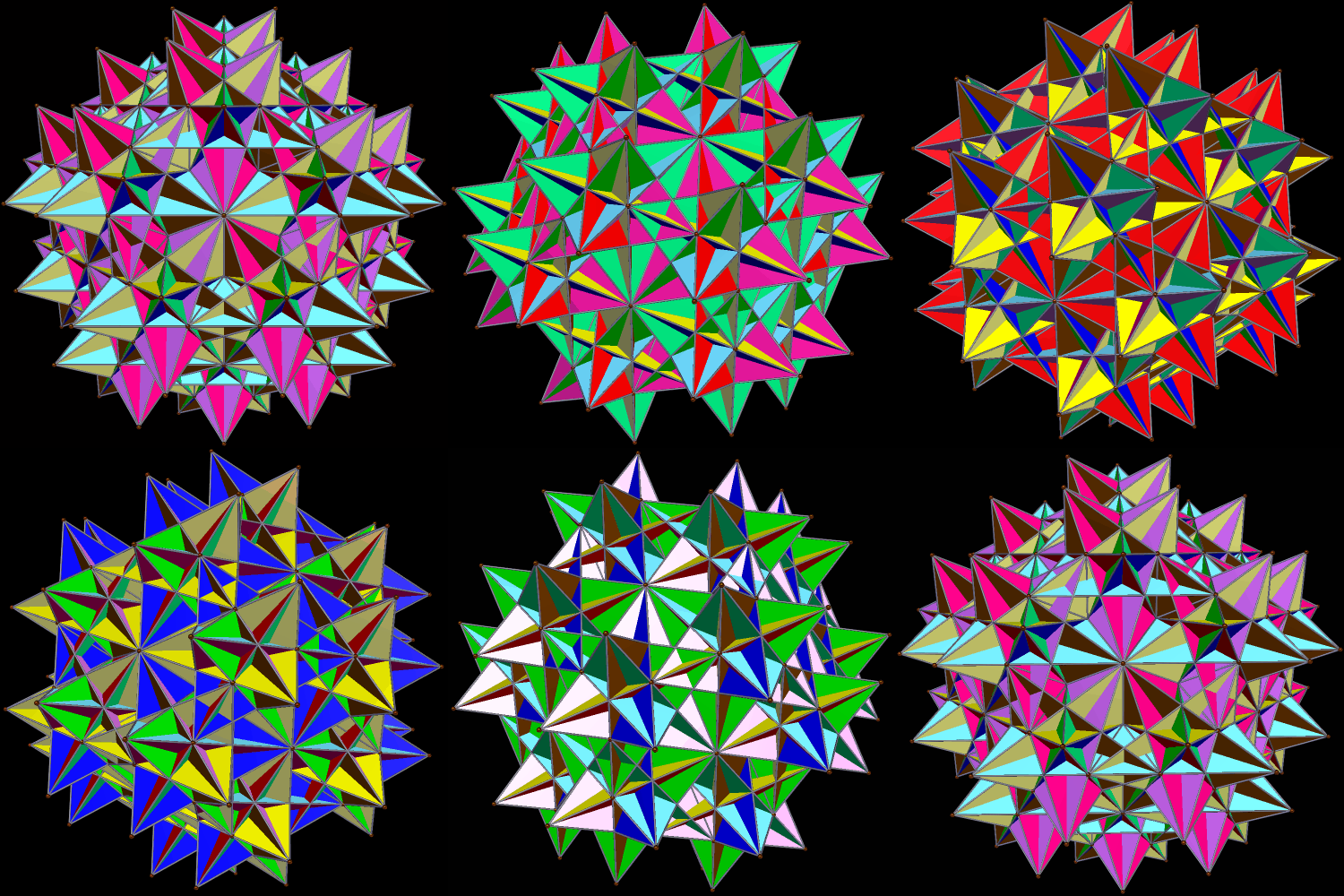
Two Views of an Icosahedron, Augmented with Great Icosahedra

If colored by face-type, based on face-position in the overall solid, this “cluster” polyhedron looks like this:

Augmented Icosa using grt icosas

There is another interesting view of this polyhedral cluster I like marginally better, though, and that is to separate the faces into color-groups in which all faces of the same color are either coplanar, or parallel. It looks like this.

Augmented Icosa using grt icosas parallel faces colored together

Both versions were created by augmenting each face of a Platonic icosahedron with a great icosahedron, one of the four Kepler-Poinsot solids. I did this using Stella 4d: Polyhedron Navigator, available here.

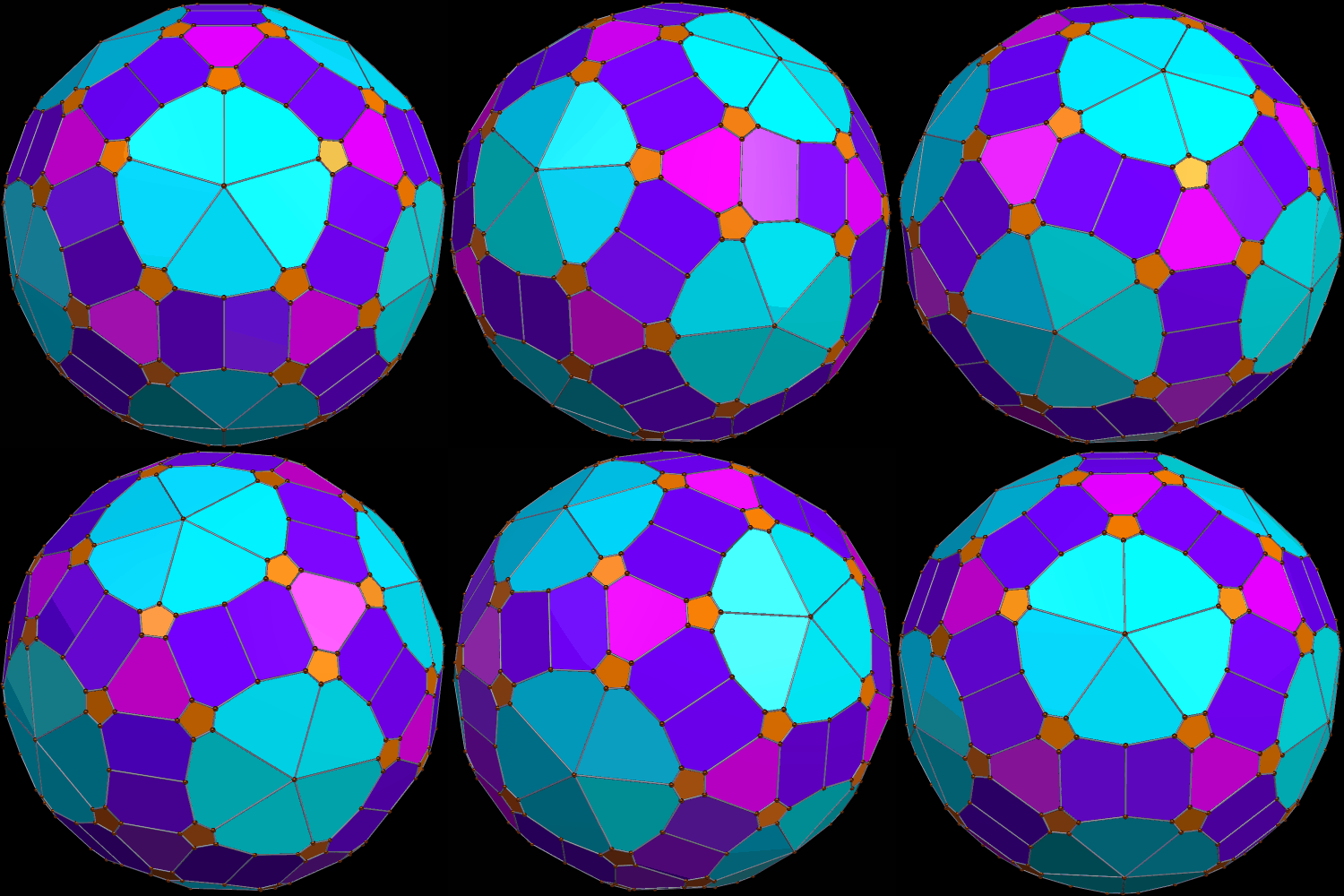
A Polyhedron with Exactly 200 Faces

200 faces 60 pentagons and 140 hexagons

Sixty of the faces of this polyhedron are pentagons (orange), and the other 140 are hexagons of three types (blue, pink, and purple). I made it using Stella 4d, a program available at http://www.software3d.com/Stella.php.

The “Trick Johnson” (?) — A Near-Miss Johnson Solid, Surrounded by Hilariously Mistranslated Japanese

I did not discover this polyhedron, although I wish I had, for it has quite a clever design.

The page where I found it (poorly-translated English version, where it’s called the “Trick Johnson,” whatever that means) is at http://www.geocities.jp/ikuro_kotaro/koramu/1053_g2.htm). I generally don’t repost much work by others here, but, for the “Trick Johnson,” I’m making an exception. By appearance, it’s a near-miss to the Johnson solids, based on combining characteristics of the dodecahedron, the snub cube, and the snub dodecahedron. It has chiral four-fold dihedral symmetry.

If you understand Japanese, I’m sure there’s a lot of interesting information at that linked page. If, on the other hand, you don’t, there’s still a good reason to follow that link: making fun of Google-Chrome’s built-in translator.

“Come very! It makes it the.” Say what?