It is unlikely that anyone knows how many types of superstitious nonsense exist, for counting them would be an enormous task, with no compelling reason to do it, and only a slim hope of actually finding them all. However, a given person will be more likely than other people to know about a particular type — if it is related to things the first person finds of interest. For example, a physician will be more likely to be aware of homeopathy, and the faulty ideas upon which it is based, than would a randomly-selected college-educated adult.
It won’t take long, reading this blog, for anyone to figure out that I have a strong interest in geometry. Were it not for this, I likely would be unaware of another type of superstitious nonsense: “Sacred Geometry,” which I cannot bring myself to type without quotation marks. If you google that term, you’ll quickly find an amazing number of websites devoted to that topic, with many extraordinary claims about certain polygons and polyhedra, but you won’t find more than miniscule amounts of logical reasoning on any of these sites, mixed in with large portions of utter nonsense.
Geometry is inherently interesting, and many geometrical shapes and patterns are aesthetically pleasing. However, to search for their mystical or spiritual qualities is to do nothing more, nor less, than to waste one’s time.

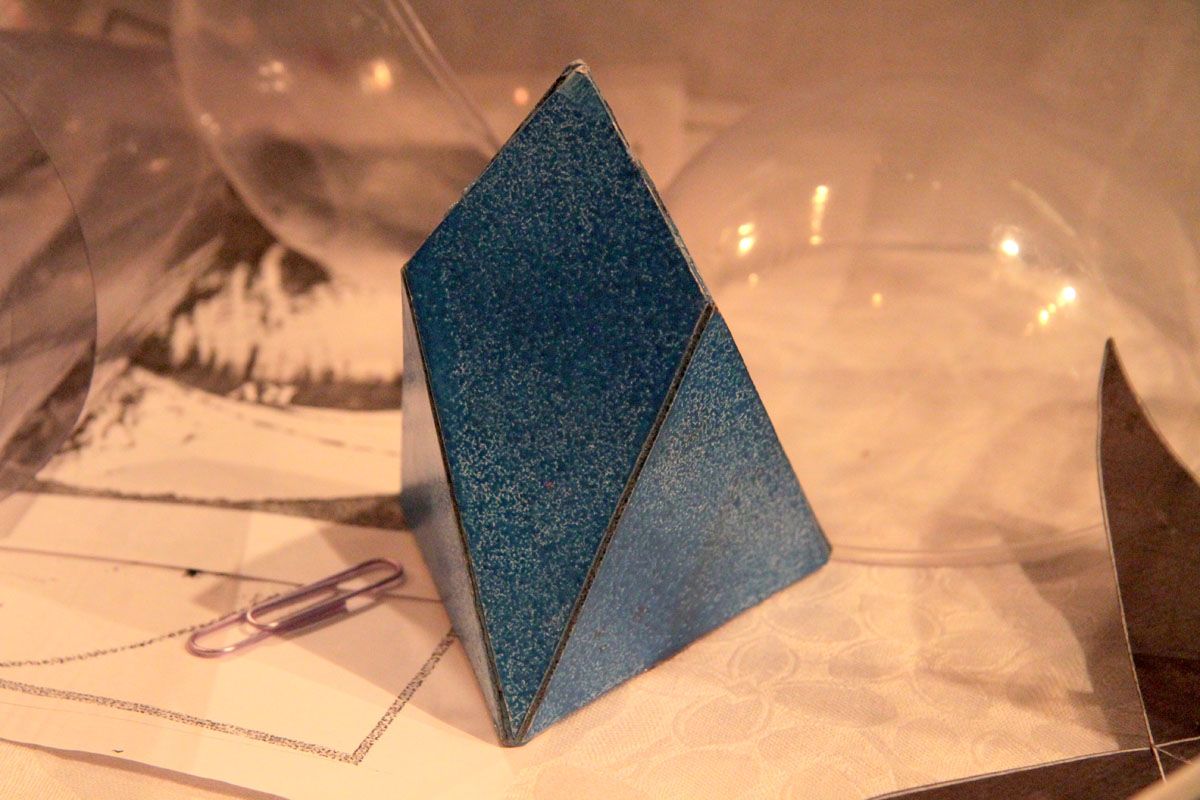
I did not create, nor discover, the figure above, but found this picture at http://earthweareone.com/a-new-form-has-been-discovered-in-sacred-geometry-meet-the-chestahedron/. It is described there as a polyhedron with seven faces (well, they call them “sides,” but they clearly mean faces) of equal area — three faces with four sides each, and four faces with three sides each. Knowing that, I tried to figure out exactly what the back side of the figure would look like, but the text at that website isn’t particularly helpful in that regard, being filled with claims, allegedly related to this shape, regarding the human heart as an “organ of flow,” not a pump (What’s the difference?); “the earth in its foundational form [as] not a sphere but rather [with] its basis [being] a ‘kind of tetrahedron'” (What?); and a (claimed) special relationship between this polyhedron, and the oh-so-profoundly-mystical Platonic Solids. If none of that makes sense to you, you are not alone. It doesn’t make sense.
I often use software called Stella 4d (which you may try at http://www.software3d.com/Stella.php) to investigate the geometric properties of polyhedra. Based upon comments about this polyhedron written by Stella 4d‘s author, Robert Webb, I was able to create the rotating virtual model below, with Stella, to help me understand what all the faces of the green polyhedron above look like, included those on the back side, as the figure is shown in the picture above. This polyhedron is similar to an octahedron, with a single face augmented by a tetrahedron, and with three pairs of coplanar equilateral triangles then fused into rhombi. Here is that figure:

This isn’t the exact polyhedron in the first picture, but is isomorphic to it. Vertices and edges are moved a bit, changing the size and shapes of the four-sided faces, as well as the dihedral angles between the triangular faces, until all faces are equal in area. This process turns the three rhombic faces into kites.
On the above-linked “Earth We Are One” website, where the “sacred geometry” of this polyhedron is “explained” (and where I found the non-moving first picture here), this is called a “Chestahedron.” While Stella can help someone understand the geometrical properties of the Chestahedron, it offers no information whatsoever about the spiritual or mystical properties of this polyhedron, nor any other. There’s a good reason for this, though: the complete lack of evidence that any such properties exist, for the Chestahedron, or, indeed, for any geometrical figure.
As for the people, whom I’m calling the “Sacred Geometricians,” who are pouring so much time and effort into investigations of these alleged non-mathematical properties of hexagons, pentagons, enneagons, many polyhedra, and other geometrical figures, I have three things to say to them:
- This isn’t ancient Greece, and you aren’t in the Pythagorean Society.
- That part of the work of the Pythagoreans had no basis in reality in the first place, anyway. Geometry, together with religion and/or mysticism, as it turns out, can be mixed — the Pythagoreans were correct, on this one point — but such mixtures are invariably incoherent and illogical, revealing the efforts to create them as activities which are both pointless, and useless. Just because two things can be blended does not imply that they should be blended.
- Please stop. You give me a headache.




 RobertLovesPi.net