Pythagorean and Fermatian Triples and Quadruples

Pythagorean triples are familiar to almost everyone who has studied mathematics:  whole numbers which serve as solutions to the Pythagorean Theorem, a² + b² = c². Examples include 3, 4, 5; as well as 5, 12, 13; and 8, 15, 17; and 7, 24, 25. It has been proven that there are infinitely many Pythagorean triples.

Fermatian triples, on the other hand, don’t exist, which humanity finally found out, definitively, when Andrew J. Wiles finally proved Fermat’s Last Theorem, in the mid-1990s. If they did exist, they would satisfy an + bn = cn, with n > 2, and all numbers involved being whole numbers. This “only” took over 300 years to prove, and will forever stand as one of the greatest achievements in number theory.

This morning, while driving to work (one must think about something while driving, right?), I started trying to find Pythagorean quadruples:  sets of four whole numbers which satisfy a² + b² + c² = d², which can be pictured as pairs of solutions to the Pythagorean Theorem, for right triangles in which the hypotenuse of one triangle is a leg of the next, and the triangles exist in perpendicular planes. It didn’t take me long to figure out that 3, 4, 12, 13 is a Pythagorean quadruple, based on this mental image:
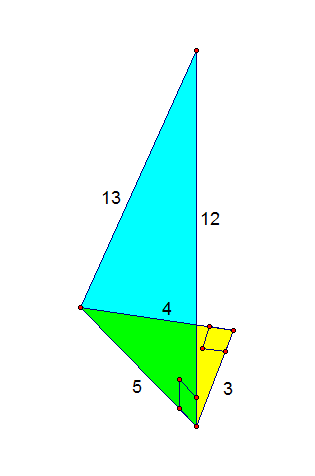
Pythagorean quadruple

The next logical step was to wonder . . . are there Fermatian quadruples? Those would be, of course, whole-number solutions to an + bn + cn = dn, with n > 2. However, I had to teach all day, and did not have the time, until after work, to indulge my curiosity on this subject.

Once the workday was over, I contemplated looking over lists of perfect cubes (since three as the exponent is the logical place to start looking), seeking three of them that would sum to a fourth, and quickly decided that was not the approach I wanted to use . . . because it sounded ridiculously tedious. Mathematics is supposed to be fun, after all, not an exercise in boredom. I therefore resolved to use a different approach, and wrote a short program, in BASIC, to check all sets of four numbers between one, and any number I chose, to seek exponent-three Fermatian quadruples. For the first trial run of this program, I considered checking all numbers between 1 and 100, but, since the program involves quadruple-nested loops, I decided I did not want to wait for my computer to check 100^4 = 100 million different combinations, so I made my first check with much more modest search parameters: only the numbers from one to ten. To my surprise, this search actually revealed two Fermatian quadruples.
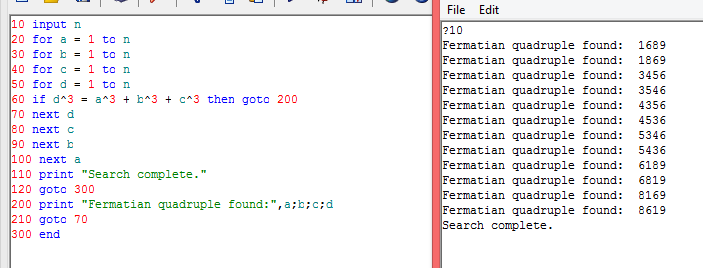
fermatian quadruple

The two Fermatian quadruples this search revealed are 1, 6, 8, 9 (since 1 + 216 + 512 = 729); and 3, 4, 5, 6 (since 27 + 64 + 125 = 216). With a more extensive search, I could easily find more, and I suspect there are infinitely many of them, as is the case with Pythagorean triples . . . but this is enough recreational mathematics, I think, for one day.

[Later edit — to see what happened the next day, with this idea, just check this post: https://robertlovespi.wordpress.com/2014/12/11/a-set-of-conjectures-sequels-to-fermats-last-theorem/.]

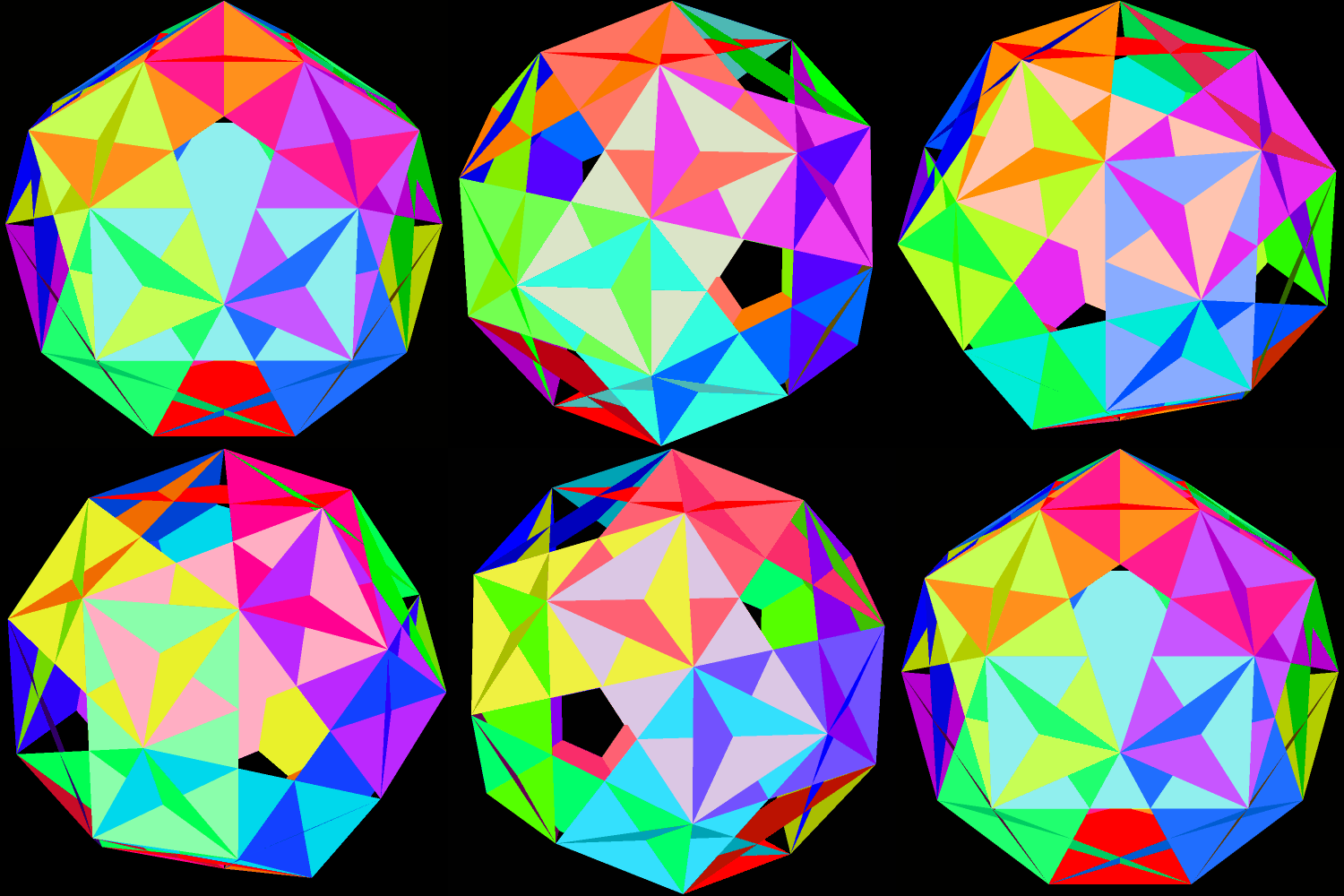
Thirty Golden Rectangles, Rotating About a Common Axis

The third image in the last post is a faceting of the icosidodecahedron. In that faceting, the faces used are equilateral triangles, star pentagons, and golden rectangles. To make these two new images, starting with that particular faceting of the icosidodecahedron, I rendered its triangles and star pentagons invisible, leaving only the thirty golden rectangles. It’s shown twice below, simply because I wanted to show it using two different coloring-schemes.

30 GOLDEN RECTANGLES

30 GOLDEN RECTANGLES RAINBOW

I would not be able to create images like this without the use of my favorite computer program, Stella 4d, written by a friend of mine who lives in Australia. You can try this program yourself, as a free trial download, at http://www.software3d.com/Stella.php.

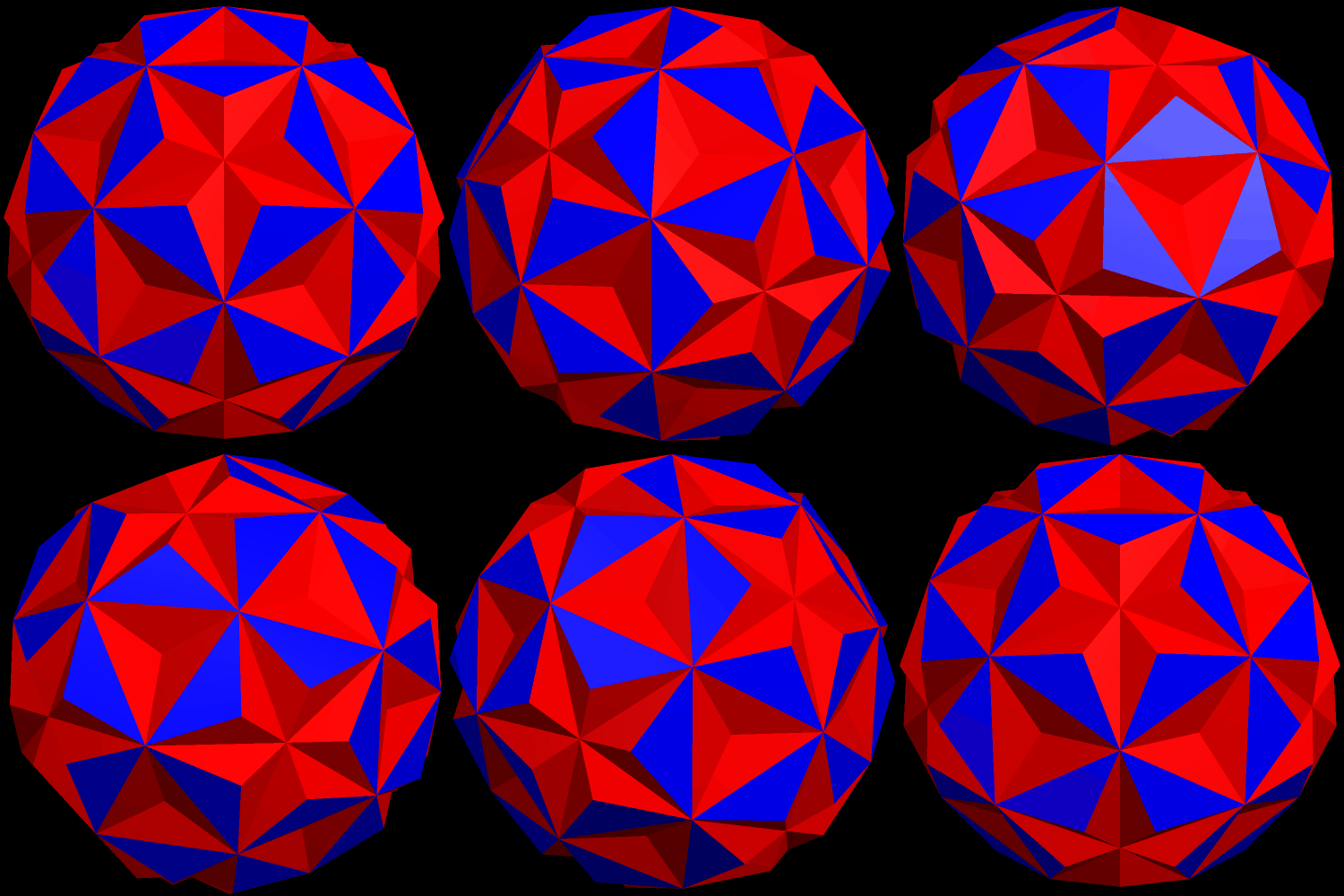
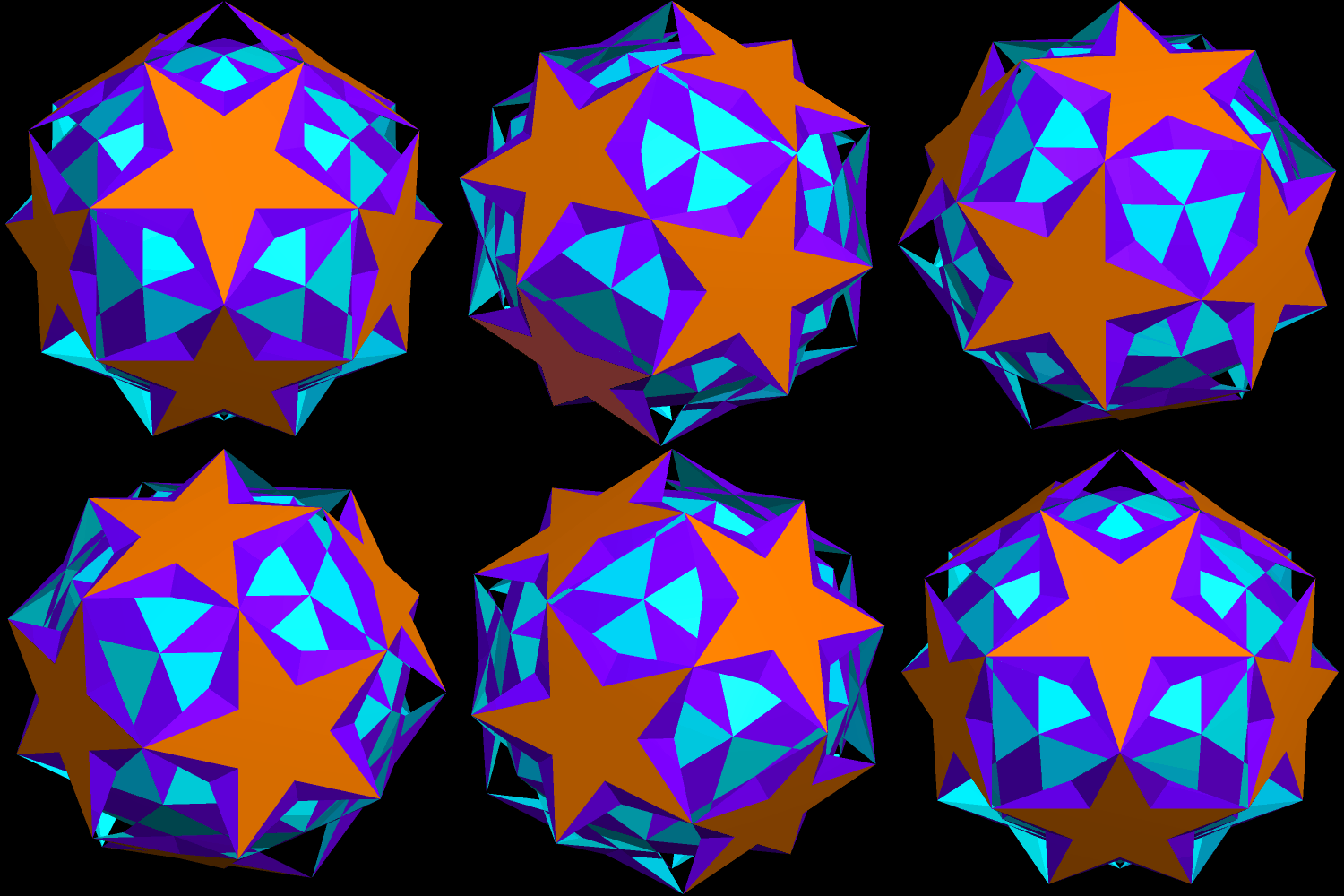
Five Variants of the Icosidodecahedron

a stellation of a faceted icosidodecahedron

another stellation of a faceted icosidodecahedron

Faceted Icosidodeca

Faceted Stellated Rhombic Triaconta

Stellated Faceted IcosidodecaI made all of these icosidodecahedron-variants using a program called Stella 4d: Polyhedron Navigator. It may be purchased, or tried for free (as a trial version), at http://www.software3d.com/Stella.php.

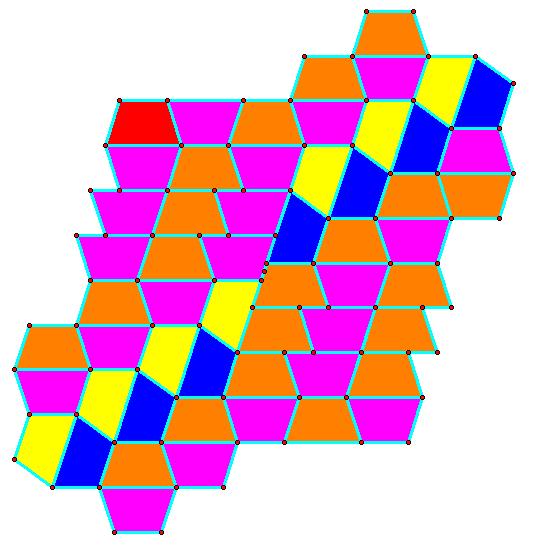
The Beginning of an Attempt to Create an Aperiodic Tessellation of Golden Trapezoids

beginning

I’m not sure where this is going next. It uses the trapezoids described at the end of the last post. It’s unfinished . . . but if I leave it here, I know I’ll be able to find it later.

Polygons Related to the Golden Ratio, and Associated Figures in Geometry, Part 2: Quadrilaterals

The golden ratio, also known as φ, has a value of [1 + sqrt(5)]/2, or ~1.61803. It is associated with a great many figures in geometry, and also appears in numerous other contexts. The most well-known relationship between a geometric figure and the golden ratio is the golden rectangle, which has a length:width ratio equal to the golden ratio. An interesting property of the golden rectangle is that, if a square is removed from it, the remaining portion is simply a smaller golden rectangle — and this process can be continued without limit.

golden rectangle

While the golden ratio is related to many polyhedra, this relationship does not always involve golden rectangles, but sometimes it does. For example, it is possible to modify a rhombicosidodecahedron, by replacing that figure’s squares with golden rectangles (with the longest side adjacent to the triangles, not the pentagons), to obtain a “Zomeball” — the node which is at the heart of the Zometool ball-and-stick modeling system for polyhedra, and other phenomena. The entire Zome system is based on the golden ratio. Zome kits are available for purchase at http://www.zometool.com, and this image of a Zomeball was found at http://www.graphics.rwth-aachen.de/media/resource_images/zomeball.png.

zomeball

In some cases, the relationship between a golden rectangle, and a polyhedron, is more subtle. For example, consider three mutually-perpendicular golden rectangles, each with the same center:

3 GOLDEN RECTANGLES

While this is not, itself, a polyhedron, it is possible to create a polyhedron from it, by creating its convex hull. A convex hull is simply the smallest convex polyhedron which can contain a given figure in space. For the three golden rectangles above, the convex hull is the icosahedron, one of the Platonic solids:

ICOSAl

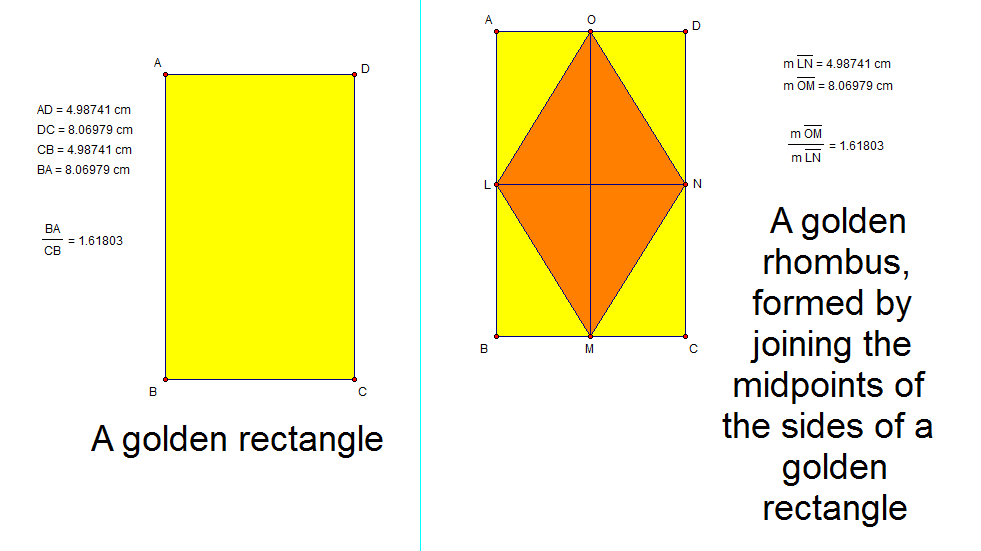
In addition to the golden rectangle, there are also other quadrilaterals related to the golden ratio. For example, a figure known as a golden rhombus is formed by simply connecting the midpoints of the sides of a golden rectangle. The resulting rhombus has diagonals which are in the golden ratio.

golden rhombus

One of the Archimedean solids, the icosidodecahedron, has a dual called the rhombic triacontahedron. The rhombic triacontahedron has thirty faces, and all of them are golden rhombi.

Rhombic Triaconta

There are also other polyhedra which have golden rhombi for faces. One of them, called the rhombic hexacontahedron (or “hexecontahedron,” in some sources), is actually the 26th stellation of the rhombic triacontahedron, itself. It has sixty faces, all of which are golden rhombi.

Rhombic Triaconta 26th stellation

Other quadrilaterals related to the golden ratio can be formed by reflecting the golden triangle and golden gmonon (described in the post right before this one) across each of their bases, to form two other types of rhombus.

rhombi for penrose tilings

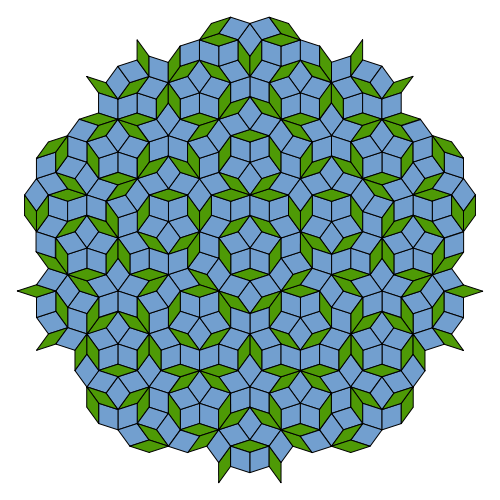
In these two rhombi, the golden ratio shows up as the side-to-short-diagonal ratio (in the case of the 36-144-36-144 rhombus), and the long-diagonal-to-side ratio (in the case of the 72-108-72-108 rhombus). These two rhombi have a special property:  together, they can tile a plane in a pattern which never repeats itself, but, despite this, can be continued indefinitely. This “aperiodic tiling” was discovered by Roger Penrose, a physicist and mathematician. The image below, showing part of such an aperiodic tiling, was found at https://en.wikipedia.org/wiki/Penrose_tiling.

500px-Penrose_Tiling_(Rhombi).svg

There are also at least two other quadrilaterals related to the golden ratio, and they are also formed from the golden triangle and the golden gnomon. The procedure for making these figures, which could be called the “golden kite” and the “golden dart,” is similar to the one for making the rhombi for the Penrose tiling above, but has one difference: the two triangles are each reflected over a leg, rather than a base.

kite and dart for for penrose tilings

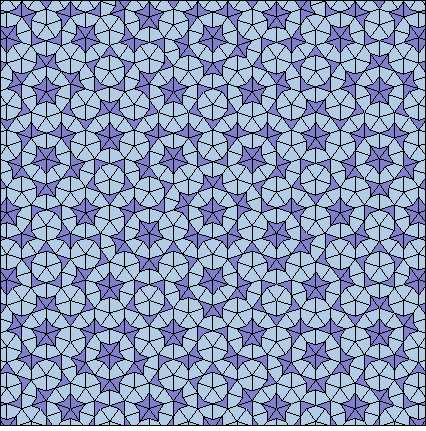
In the case of this kite and dart, it is the longer and shorter edges, in each case, which are in the golden ratio — just as is the case with the golden rectangle. Another discovery of Roger Penrose is that these two figures, also, can be used to form aperiodic tilings of the plane, as seen in this image from http://www.math.uni-bielefeld.de/~gaehler/tilings/kitedart.html.

kitedart

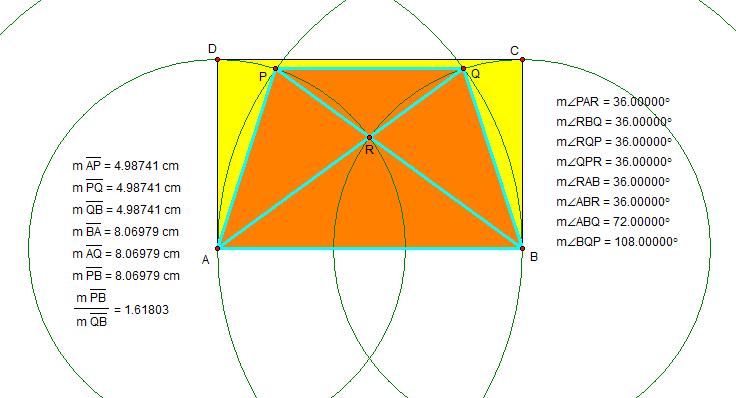
There is yet another quadrilateral which has strong connections to the golden ratio. I call it the golden trapezoid, and this shows how it can be made from a golden rectangle, and how it can be broken down into golden triangles and golden gnomons. However, I have not yet found an interesting polyhedron, not tiling pattern, based on golden trapezoids — but I have not finished my search, either.

golden trapezoid

[Image credits:  see above for the sources of the pictures of the two Penrose tilings, as well as the Zomeball, shown in this post. Other “flat,” nonmoving pictures I created myself, using Geometer’s Sketchpad and MS-Paint. The rotating images, however, were created using a program called Stella 4d, which is available at http://www.software3d.com/Stella.php.]

Polygons Related to the Golden Ratio, and Associated Figures in Geometry, Part 1: Triangles

golden triangles

There are two isosceles triangles which are related to the golden ratio, [1 + sqrt(5)]/2, and I used to refer to them as the “golden acute isosceles triangle” and the “golden obtuse isosceles triangle,” before I found out these triangles already have other names –the ones shown above. The golden triangle, especially, shows up in some well-known polyhedra, such as both the great and small stellated dodecahedron. The triangles which form the “points” or “arms” of regular star pentagons (also known as pentagrams) are also golden triangles.

These triangles have sides which are in the golden ratio. For the golden triangle, it is the leg:base ratio which is golden, as shown above. For the golden gnomon, this ratio is reversed:  the base:leg ratio is φ, or ~1.61803 — the irrational number known as the golden ratio.

The angle ratios of each of these triangles are also unique. The golden triangle’s angles are in a 1:2:2 ratio, while the angles of the golden gnomon are in a ratio of 1:1:3.

Another interesting fact about these two triangles is that each one can be subdivided into one of each type of triangle. The golden triangle can be split into a golden gnomon, and a smaller golden triangle, while the golden gnomon can be split into a golden triangle, and a smaller golden gnomon, as seen below.

golden triangles 2

This process can be repeated indefinitely, in each case, creating ever-smaller triangles of each type.

Polyhedra which use these triangles, as either faces or “facelets” (the visible parts of partially-hidden faces) are not uncommon, as previously mentioned. The three most well-known examples are three of the four Kepler-Poinsot solids. In the first two shown below, the small stellated dodecahedron and the great stellated dodecahedron, the actual faces are regular star pentagons which interpenetrate, but the facelets are golden triangles.

Small Stellated Dodeca

Great Stellated Dodeca

The next example is also a Kepler-Poinsot solid: the great dodecahedron. Its actual faces are simply regular pentagons, not star pentagons, but, again, they interpenetrate, hiding much of each face from view. The visible parts, or “facelets,” are golden gnomons.

Great Dodeca

For another example of a polyhedron made of golden gnomons, I made one myself — meaning that if anyone else has ever seen this polyhedron before, this fact is unknown to me, although I cannot rule it out. I have not given it a name. It has thirty-six faces, all of which are golden gnomons. There are twelve of the larger ones, shown in yellow, and twenty-four of the smaller ones, shown in red. This polyhedron has pyritohedral symmetry (the same type of symmetry seen in the seam-pattern of a typical volleyball), and its convex hull is the icosahedron.

36 golden gnomons

[Picture credits: to create the images in this post, I used both Geometer’s Sketchpad and MS-Paint for the two still, flat pictures found at the top. To make images of the four rotating polyhedra, I used a different program, Stella 4d: Polyhedron Navigator. Stella is available for purchase, with a free trial download available, at http://www.software3d.com/Stella.php.]

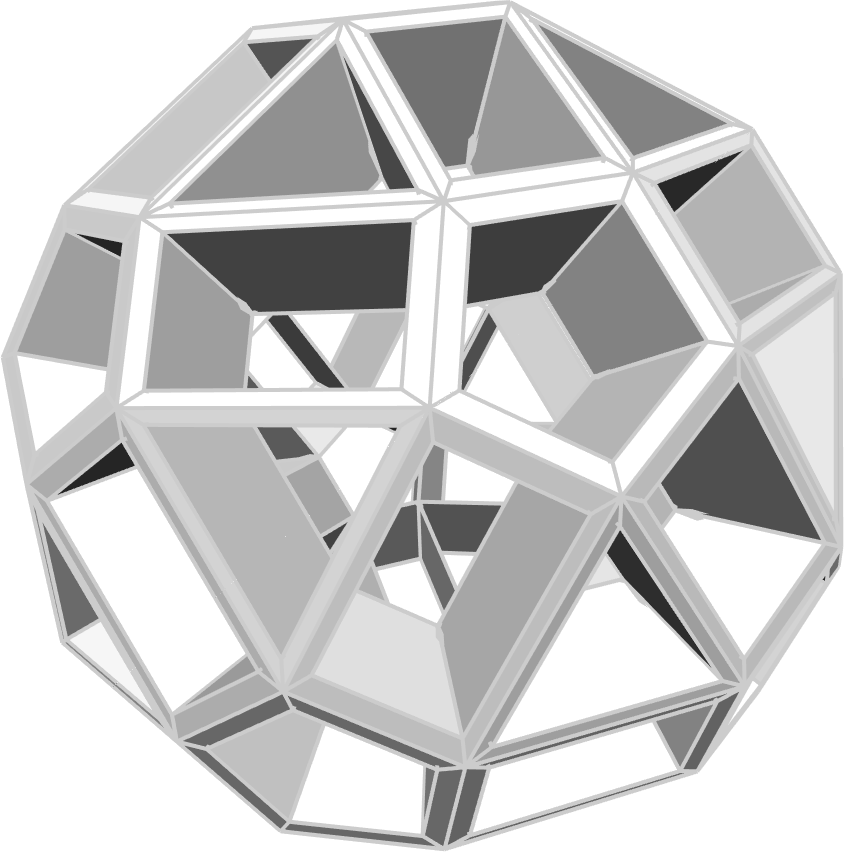
An Unusual Presentation of the Icosahedron/Dodecahedron Base/Dual Compound

Leonardo Icosahedron

In this model, the usual presentation of the icosahedron/dodecahedron dual compound has been altered somewhat. The “arms” of star pentagons have been removed from the dodecahedron’s faces, and the icosahedron is rendered “Leonardo-style,” with smaller triangles removed from each of the faces of the icosahedron, with both these alterations made to enable you to see the model’s interior structure. Also, the dodecahedron is slightly larger than usual, so that its edges no longer intersect those of the icosahedron.

This model was made using Stella 4d, software you can obtain for yourself, with a free trial download available, at http://www.software3d.com/Stella.php.

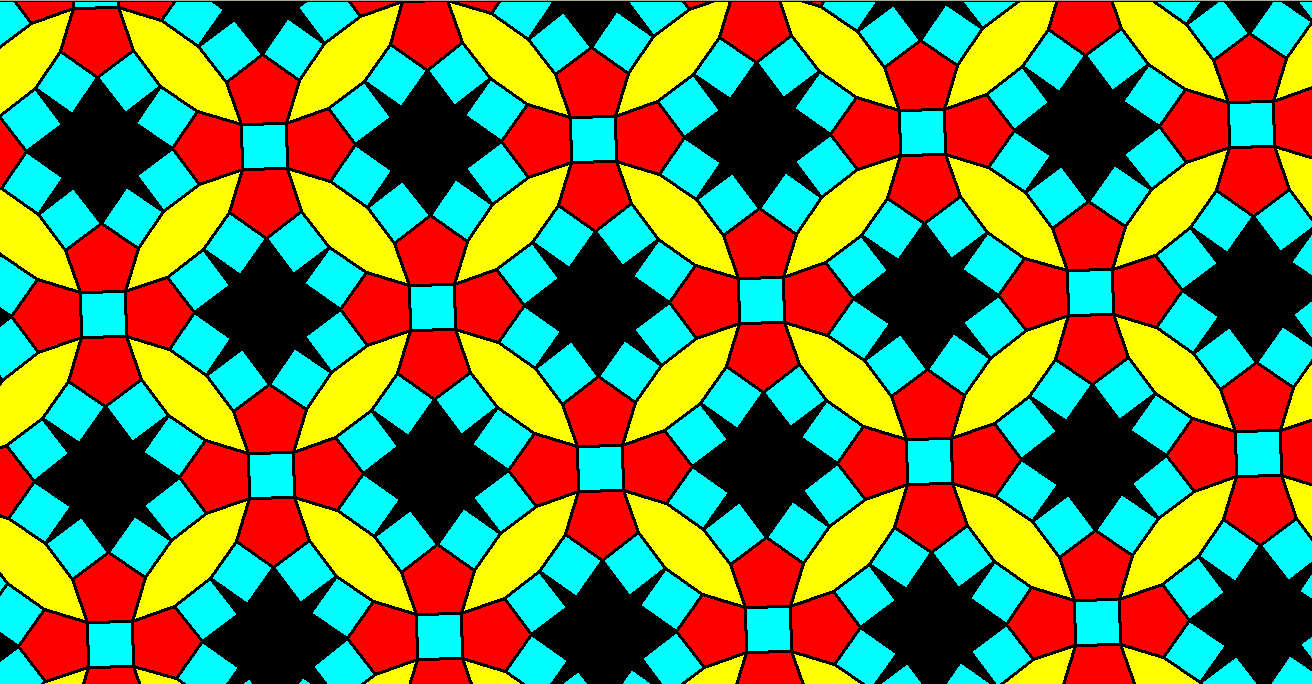
A Geometrical Tiling Featuring Regular Icosagons, Pentagons, and Squares; Equilateral Octagons; and Equilateral, Octaconcave Hexadecagons

tiling

The only reason I am calling this simply a geometrical tiling, rather than a tessellation, is that I want to recognize the regular icosagons (twenty-sided polygons) as part of the pattern — and the icosagons here overlap, violating the established rules for tessellations.

Three Variations of Kepler’s Stella Octangula

The Stella Octangula was the name Johannes Kepler gave, centuries ago, to the compound of two tetrahedra. Here are three variations on it, all created using Stella 4d, a program you may try at http://www.software3d.com/Stella.php.

stella octangular variantstella octangular variant anotherstella octangular variant third

A Rhombic Triacontahedron, Made of Icosidodecahedra

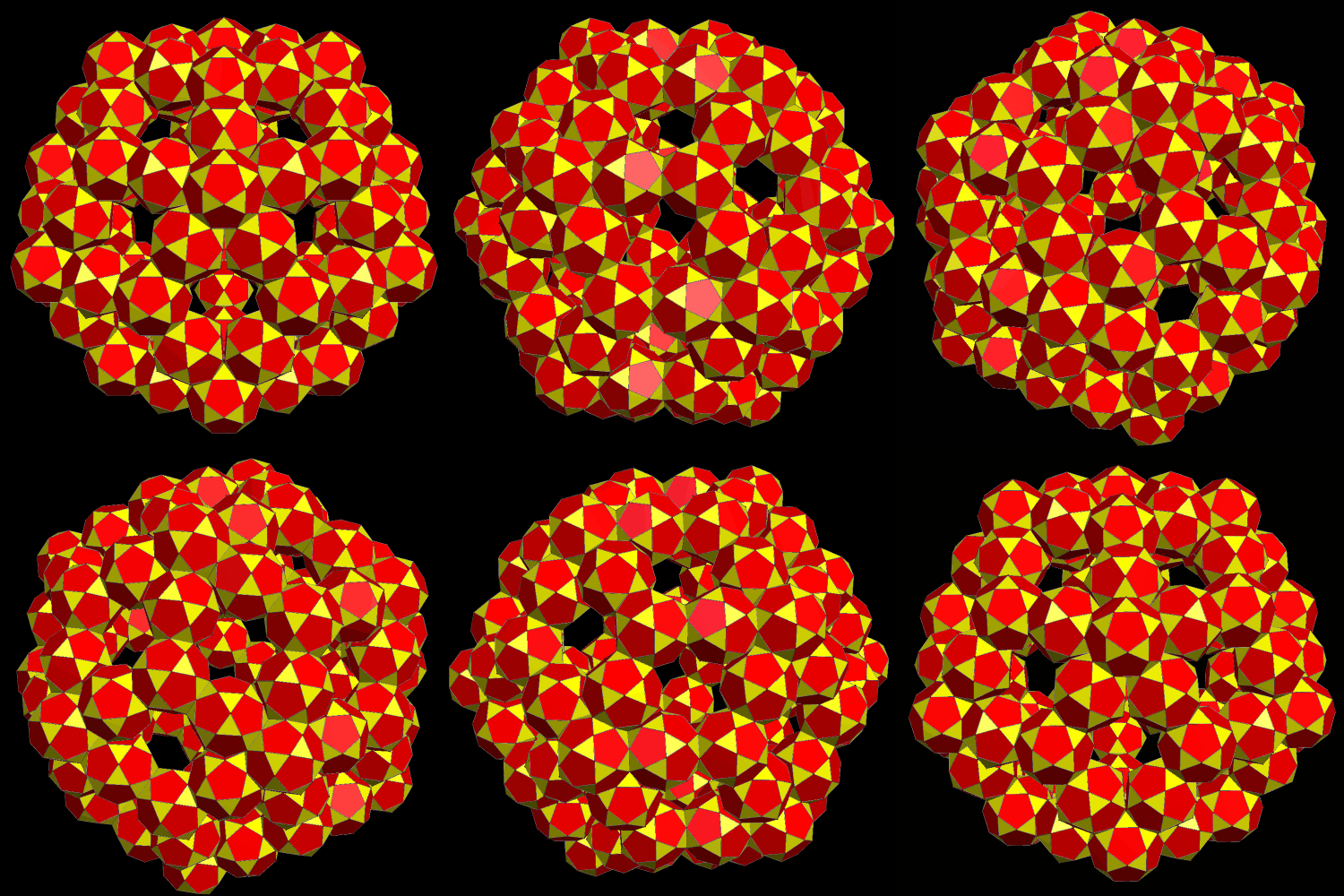
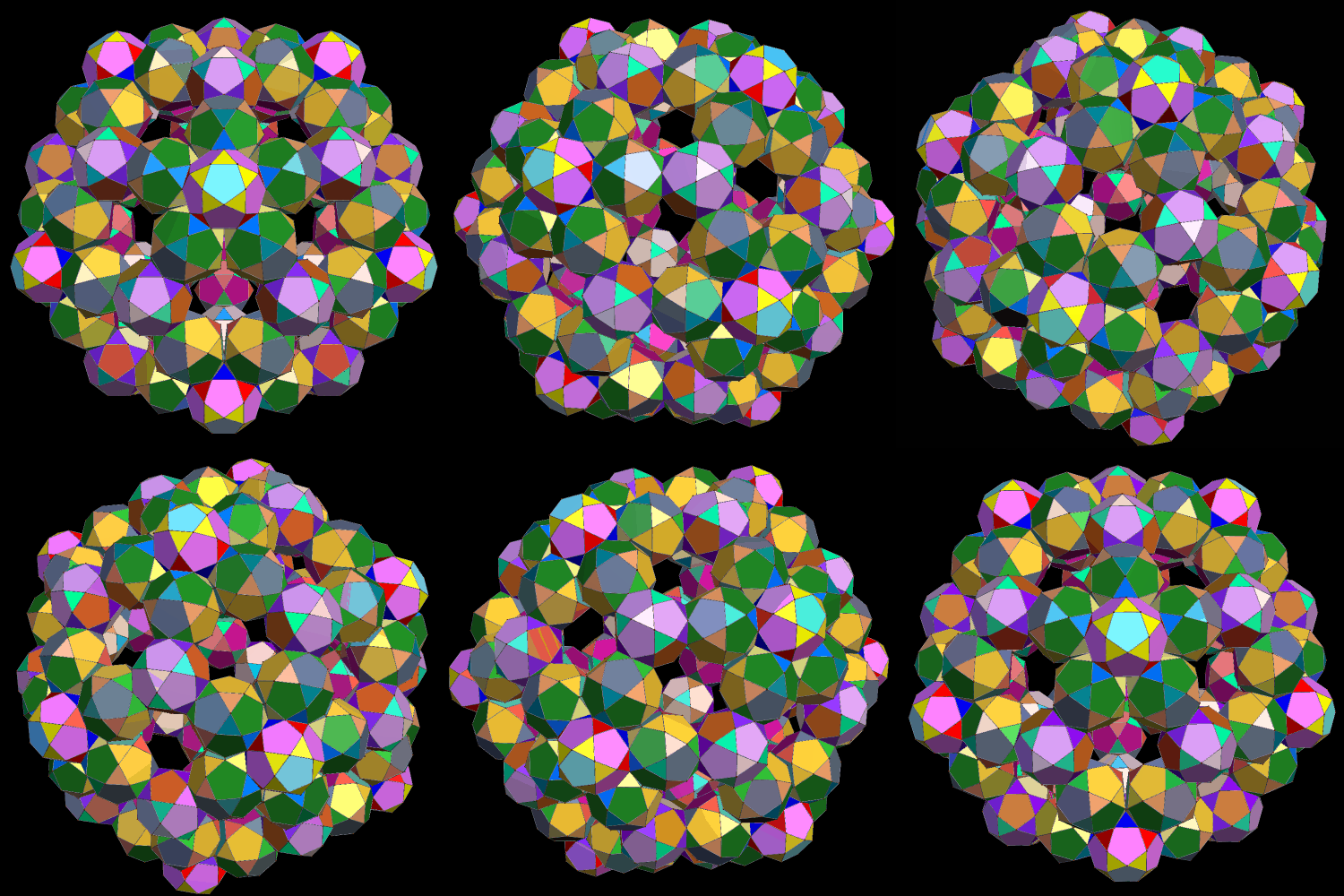
It turns out that it is possible to use multiple icosidodecahedra as building blocks to build that polyhedron’s dual, the rhombic triacontahedron. This construction appears below, in four different coloring-schemes.

Augmented IcosidodecaAugmented Icosidodeca2Augmented Icosidodeca3Augmented Icosidodeca4

These rotating virtual models were constructed using Stella 4d, a program available at http://www.software3d.com/Stella.php.