Spectral Dodecahedra

Stella 4d: Polyhedron Navigator has a “put models on vertices” function which I used to build this cluster of 101 dodecahedra. If you’d like to try this software for yourself, there is a free trial download available at http://www.software3d.com/Stella.php.

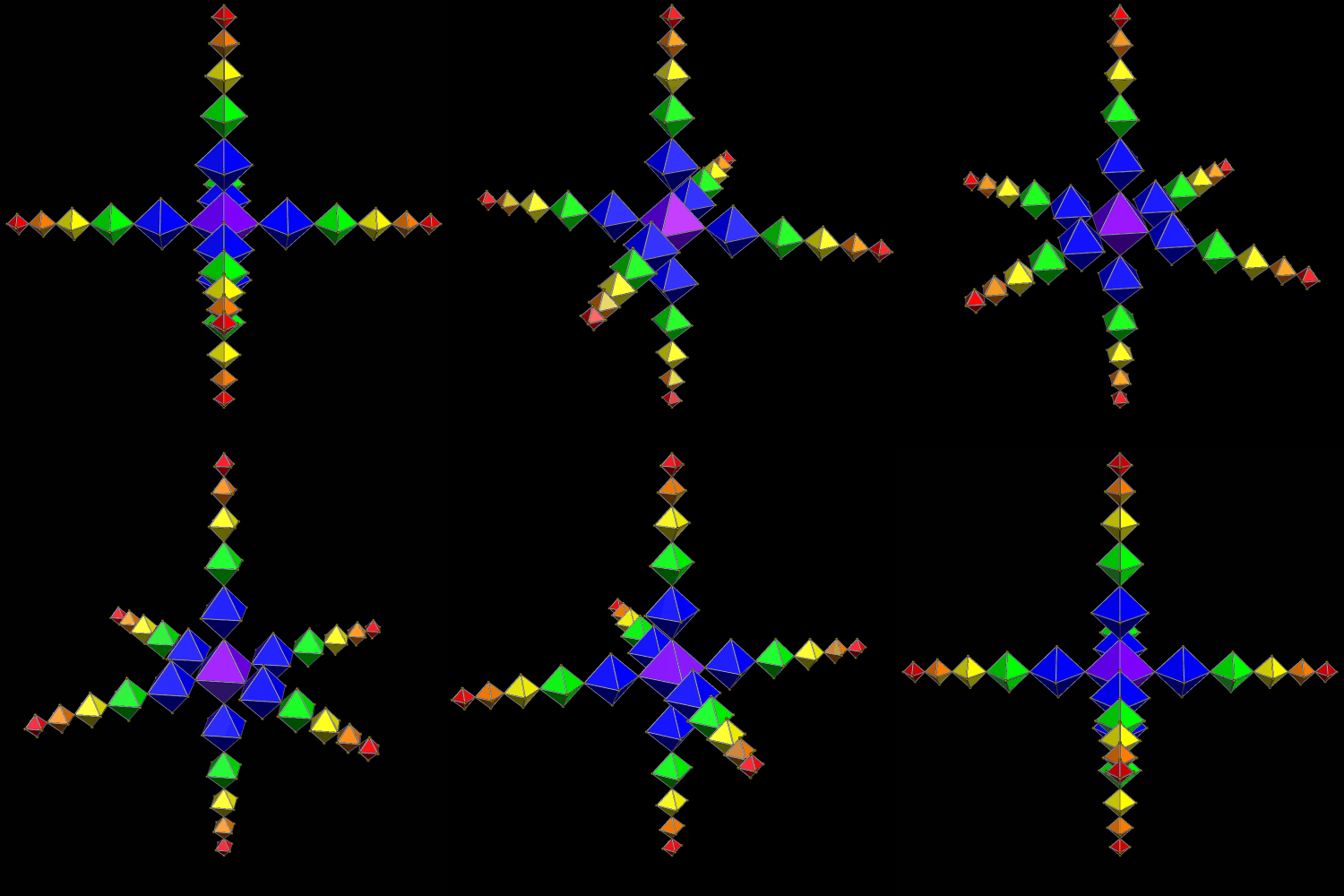
Spectral Octahedra

Stella 4d: Polyhedron Navigator has a “put models on vertices” function which I used to build this complex of octahedra. If you’d like to try this software for yourself, there is a free trial version available at http://www.software3d.com/Stella.php.

Spectral Tetrahedra

Stella 4d: Polyhedron Navigator has a “put models on vertices” function which I used to build this complex of tetrahedra. If you’d like to try this software for yourself, there is a free trial version available at http://www.software3d.com/Stella.php.

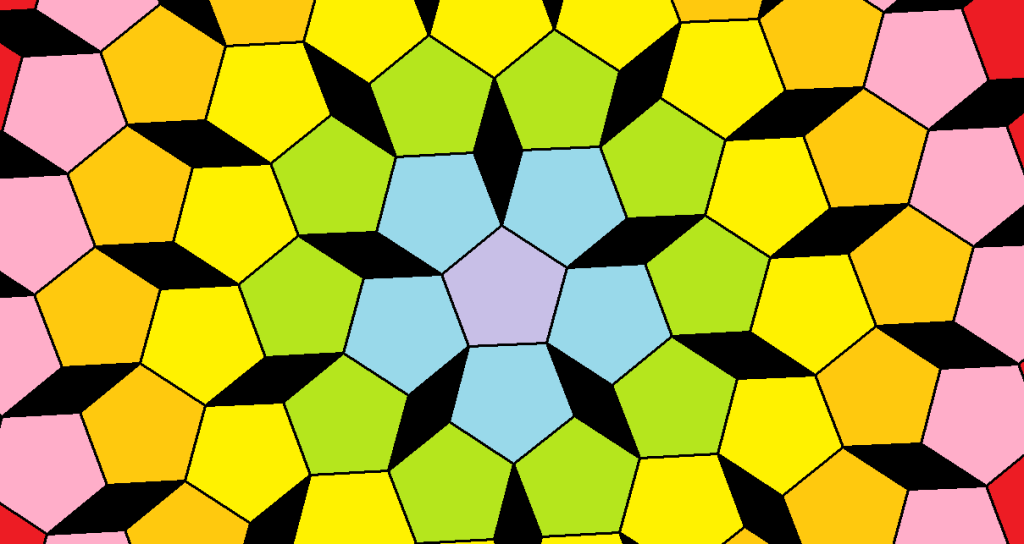
A Radial Tessellation of Regular Pentagons and Rhombi

Image

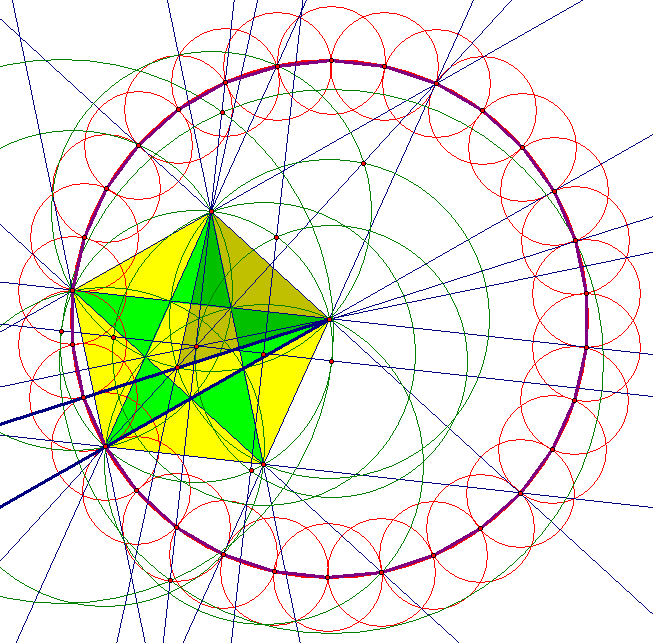
A Euclidean Construction of a Regular Triacontagon

Steps of this construction:

  1. Use the green circles and blue lines to construct the yellow pentagon, along with its green inscribed pentagram.
  2. Construct the equilateral triangle shown in gray. This is needed to obtain a twelve degree angle. The triangle is needed for its sixty degree angle, because 72 – 60 = 12. (The 72 degree angle is found inside the pentagon.)
  3. Identify the twelve degree angle shown in bold. A twelve degree angle is needed because 360 / 30 = 12.
  4. Use the red circles to complete the thirty sides of the regular triacontagon, which is shown with bold black segments, inscribed inside a large, bold, red circle.

Eyes

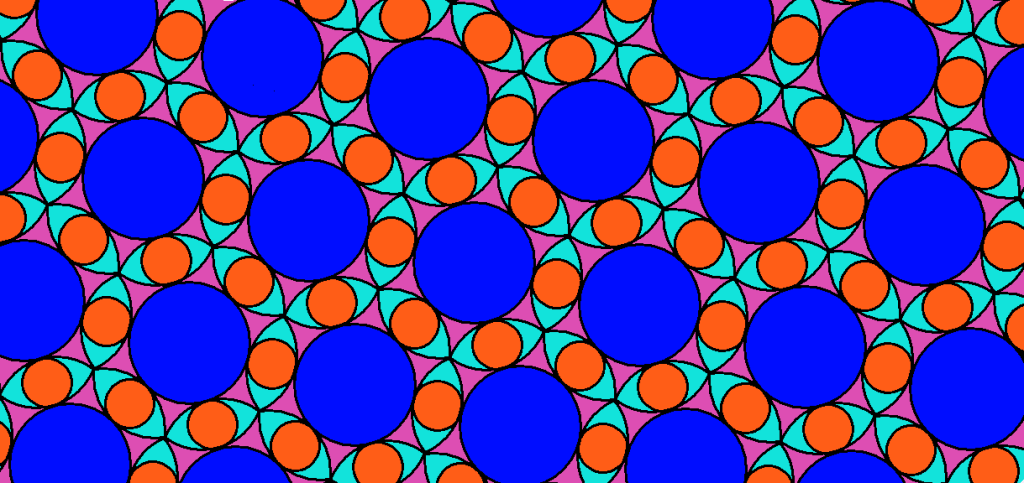
This collection of curves was built around a tessellation of the plane using regular hexagons. To make the second version, I inverted the colors, except for the black circles and arcs.

A Picture of Five

Image

A Parallelogram-Expanded Snub Dodecahedron

The snub dodecahedron may be thought of as a dozen regular pentagons, surrounded and separated by a sea of triangles. In this expansion of that Archimedean solid, thirty parallelograms are added to the mix, also surrounded by triangles. In the image above, coloring is by face type — for example, the yellow triangles are those triangles which share an edge with a pentagon. Other triangles have other colors.

The image shown below is of the same polyhedron, but with a different coloring-scheme. In it, all triangles are given the same color, even when their shapes are slightly different.

This polyhedron has an interesting all-pentagon dual, which is shown below. This dual has sixty each of both the small and large pentagons, for a total of 120 faces.

I used Stella 4d: Polyhedron Navigator to create these polyhedra, and to make these rotating images. This program may be tried for free at http://www.software3d.com/Stella.php.

An Embellished Icosahedron

Created using Stella 4d, which you can try for free at http://www.software3d.com/Stella.php.

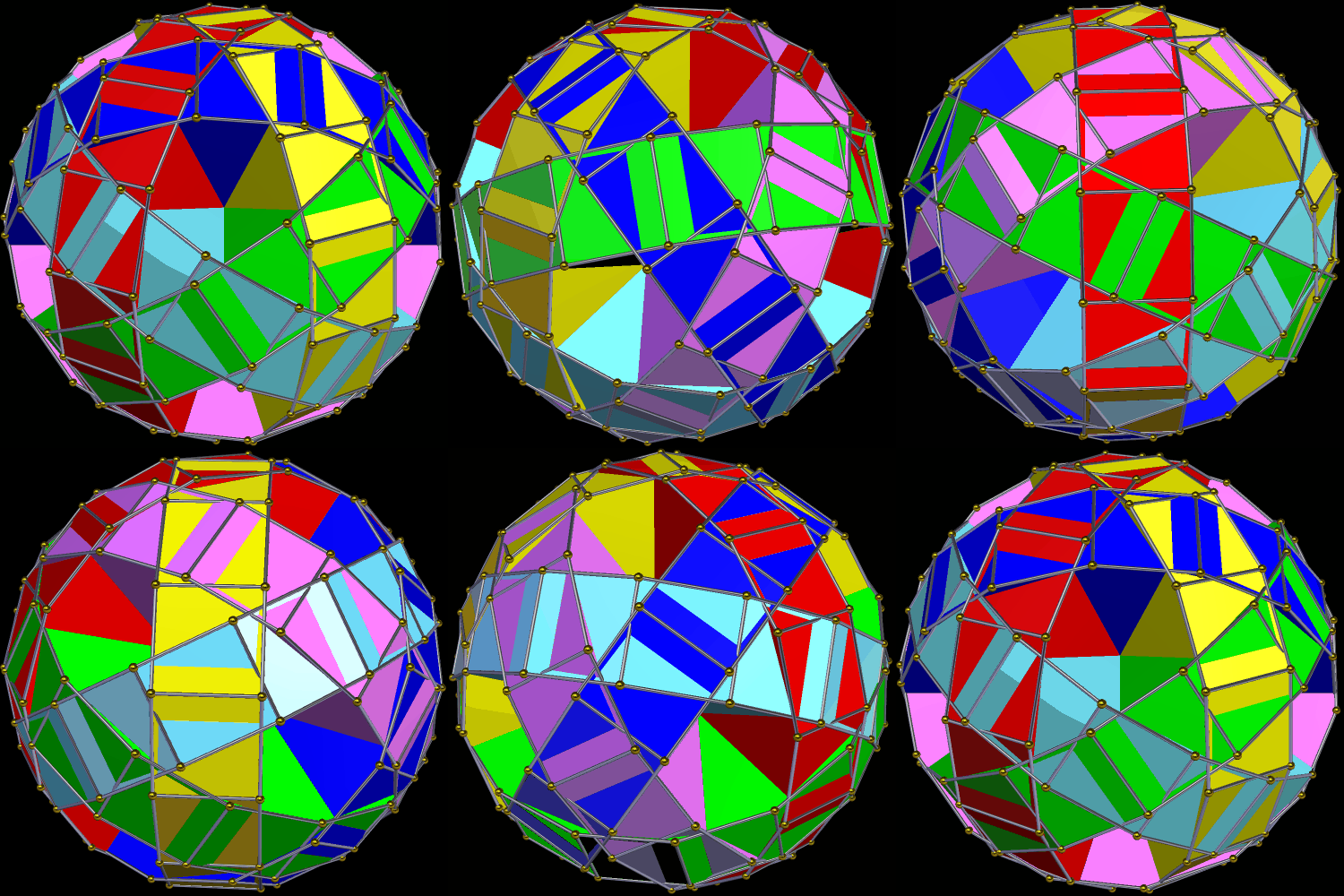
A Compound of Six Pentadecagonal Prisms

This chiral polyhedral compound was generated from a partial faceting of the polyhedron shown in the last post here, using Stella 4d‘s faceting function, plus its “try to make faces regular” operation afterwards. Making the six-prism compound in the first place was suggested by Tony Hartley, on Facebook, where I posted a link to that last post in a mathematical group for discussion. Thanks, Tony!

If you’d like to try Stella for yourself, the site to visit for a free trial download is http://www.software3d.com/Stella.php.