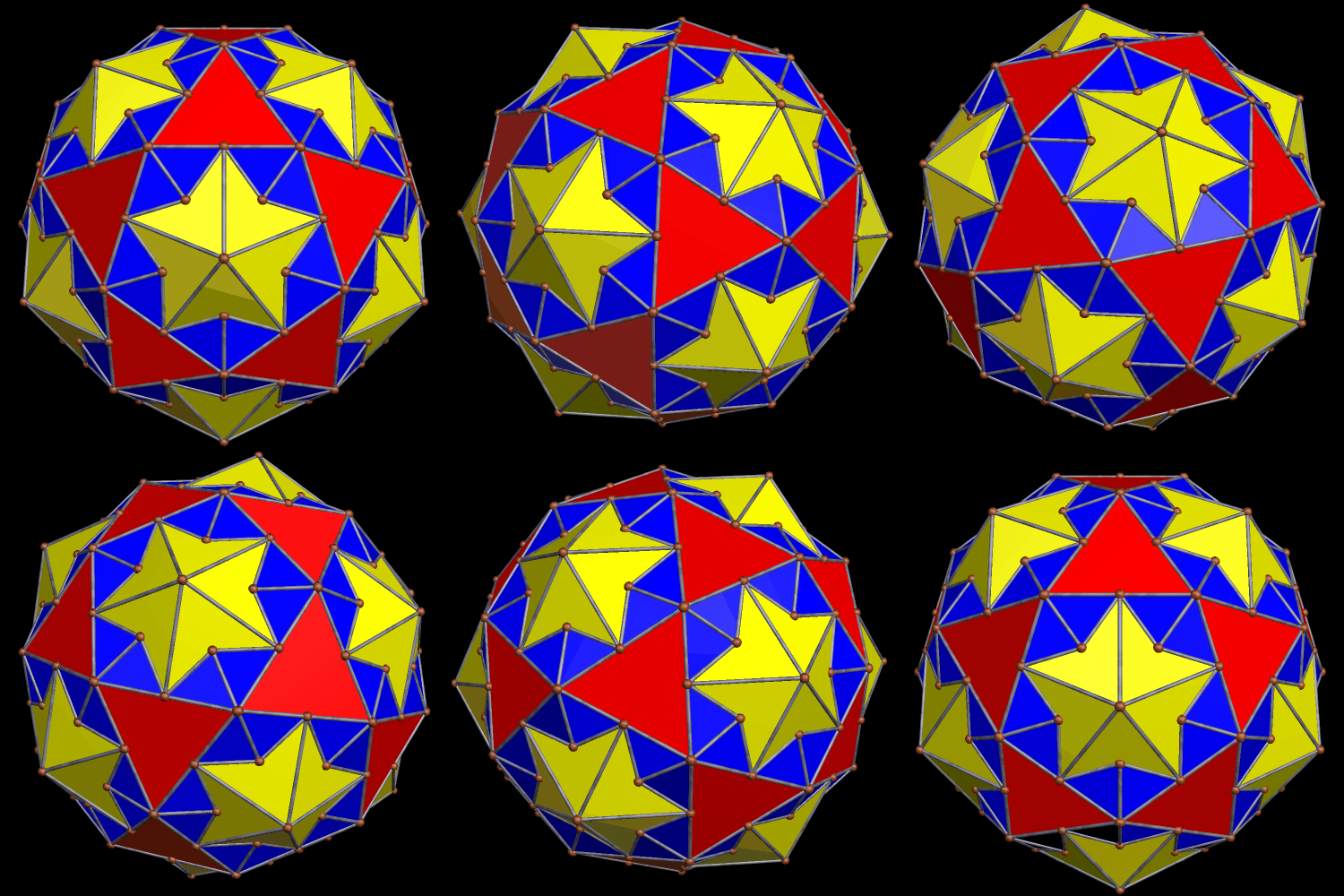
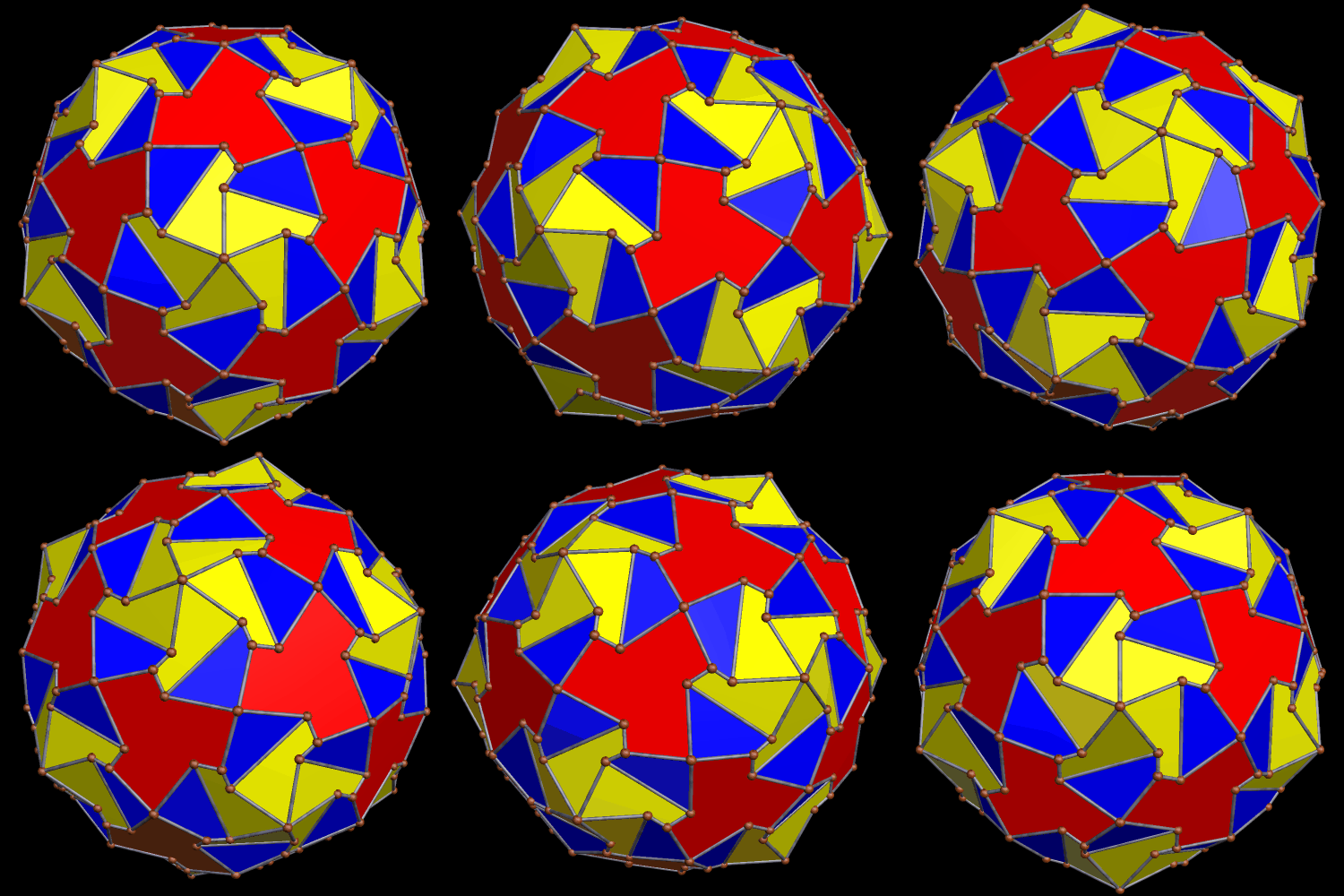
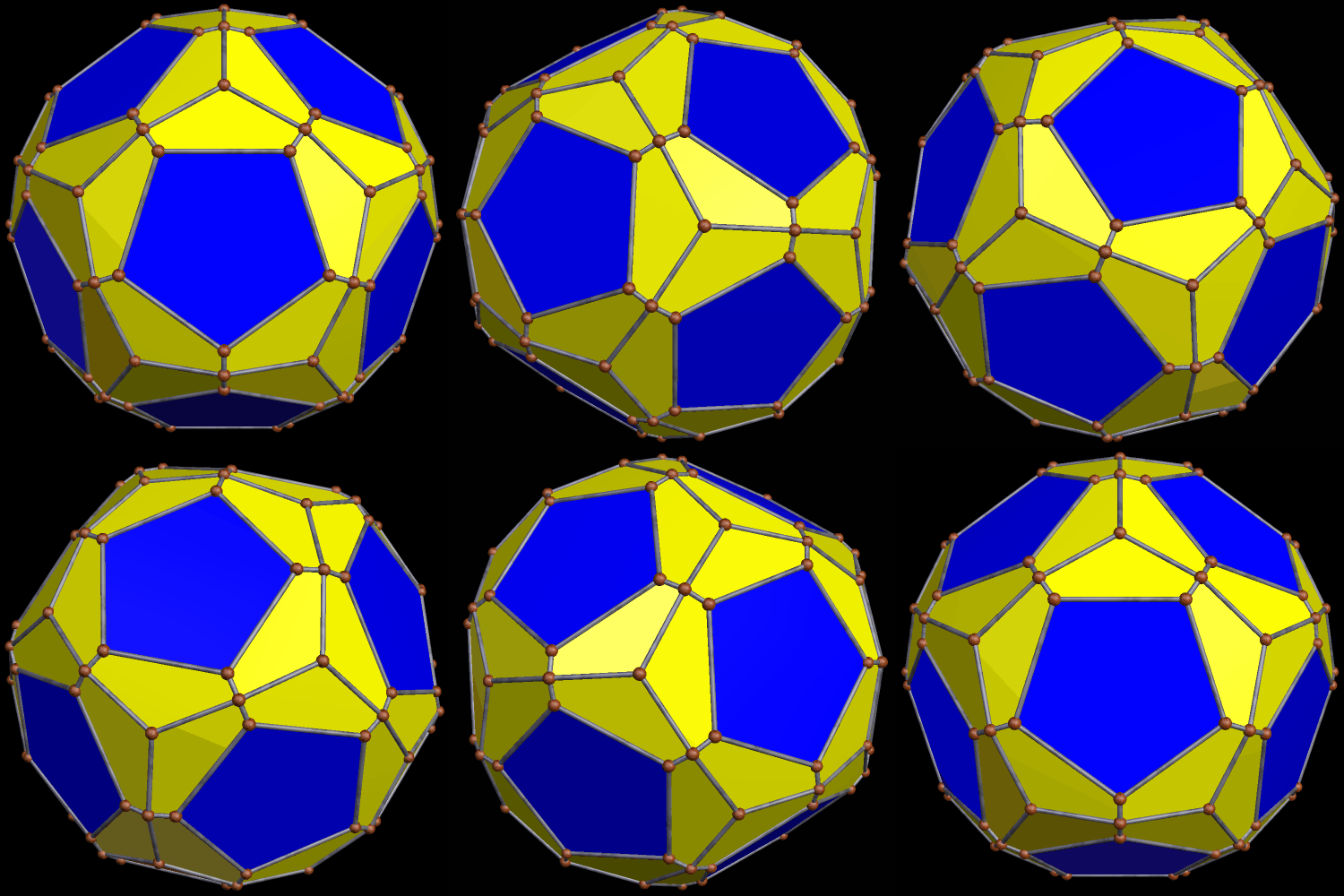
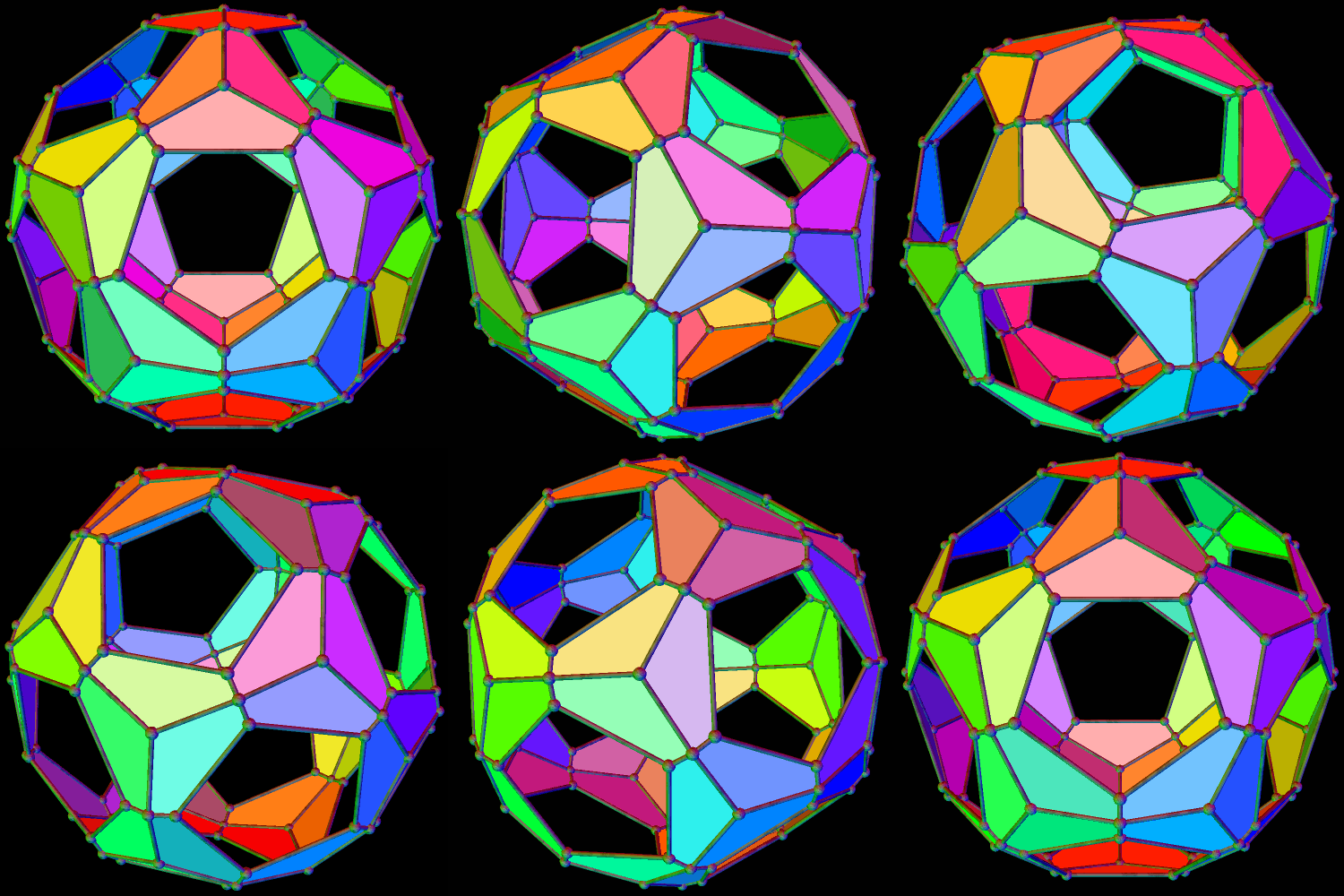
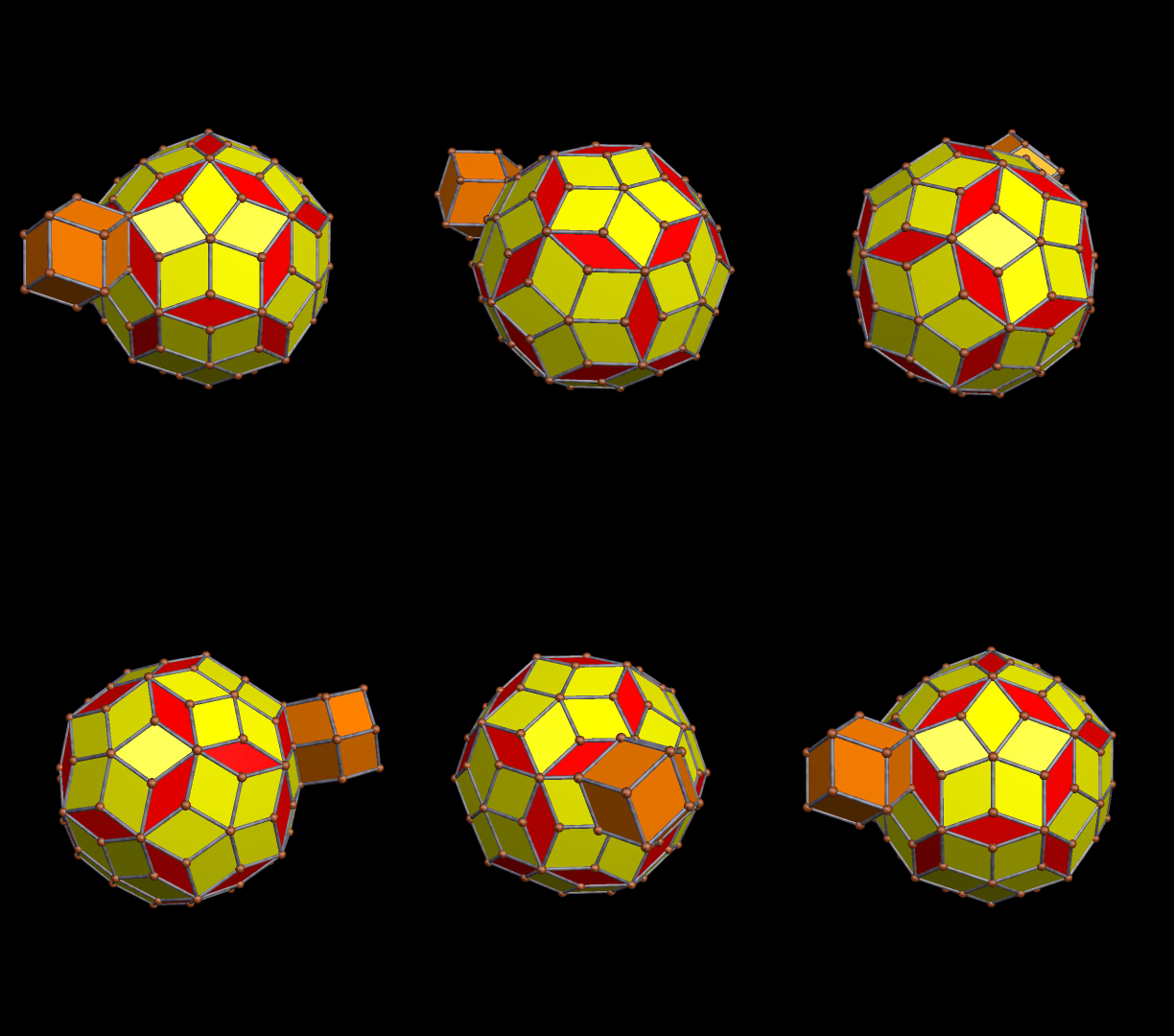
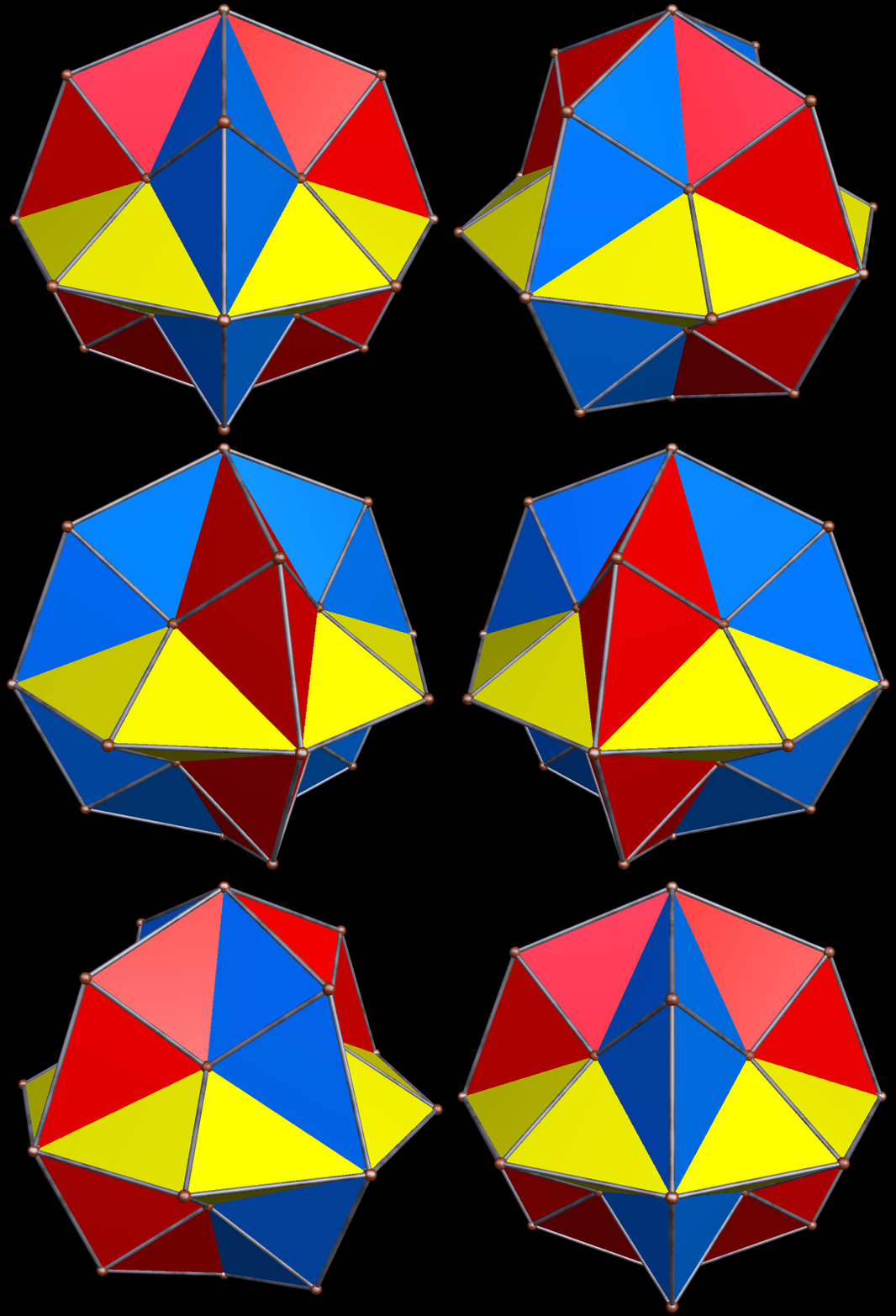
Compound of Three Octagonal Dipyramids

Yo color this thing as a compound

This compound was created using Stella 4d, software you can try here.

The Cone Problem (The Easier Sequel to the Hemisphere Problem)

cone

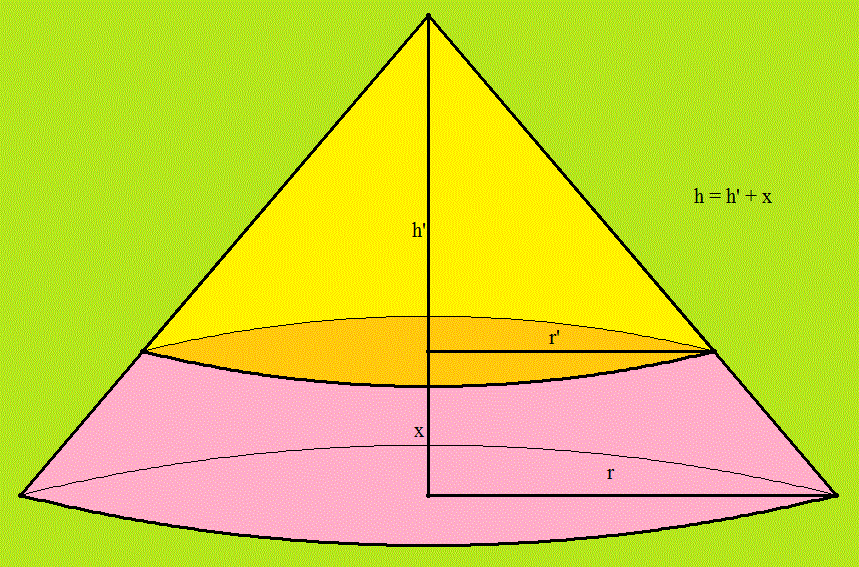
That hemisphere problem (see previous two posts) was quite difficult. I’m going to unwind a  bit with the much easier cone version of the same problem: at what height x above the ground, expressed as a fraction of h, must a cone of height h and radius r be cut, in order for the two pieces produced by the cut to have equal volume? The fact that a path down the lateral surface of a cone is a straight line, not a curve, should make this much easier than the hemisphere problem.

Since the volume of a cone is (1/3)πr²h, and the smaller cone created above the cut would be half that volume, it follows that

(1/3)πr²h = (2/3)π(r′)²h′                [equation 1]

By cancellation of (1/3)π, this equation becomes

r²h = 2(r’)²h’               [equation 2]

Also, based on divisions of the cone’s altitude, we know that

h = h′ + x                [equation 3]

Furthermore, since the problem asks that the height x be expressed as a fraction of h, we can let that fraction (a decimal between zero and one) be represented by f, so that

x = fh               [equation 4]

Also, by using similar right triangles’ corresponding legs, we know that

r/h = r′/h′                [equation 5]

which rearranges to

rh′ = r′h                  [equation 6]

There is a proportionality constant in play here, p, defined as the fraction of the length of one part of the larger cone which equals the length of the corresponding part of the smaller cone. As equations, then,

r′ = pr         and          h′ = ph              [equations 7a and 7b]

Also, because p is the fraction of h which is h′, and f is the fraction of h which is x, and h = h′ + x, it follows that

p + f = 1                  [equation 8].

Next, by substituting equations 7a and 7b into equation 2 for r′ and h′, we know that

r²h = 2(pr)²ph               [equation 9]

Which reduces to

1 = 2p³               [equation 10]

When equation 10 is solved for p, it becomes

p = (1/2)^(1/3)                [equation 11]

And, since equation 8 states that p + f = 1, it follows that f = 1 – p, and f is the fraction we seek. By substituting equation 11 for p in f = 1 – p, the following value for f can be determined:

f = 1 – (1/2)^(1/3)               [equation 12]

This leads to the following cleaned-up solution to the problem, shown in standard exact form, and with a decimal approximation as well.

f

The cut, therefore, should be made approximately 20.6% of the way from the bottom to the top of the full cone.

To check this answer, I need only find the volume of the smaller cone, times two, and show that it equals the value of the larger cone.

2(volume of smaller cone) = (2/3)π(r′)²h′ = (2/3)π(pr)²ph =

(2/3)πp³r²h = (2/3)π(cube root of ½)³r²h = (2/3)π(1/2)r²h = (1/3)πr²h,

which is the volume of the full cone, as it should be. The problem has now been solved, and the solution f (by way of p, which equals 1 – f, by a rearrangement of equation 8) has been checked.

Working Towards a Solution of the Hemisphere Problem

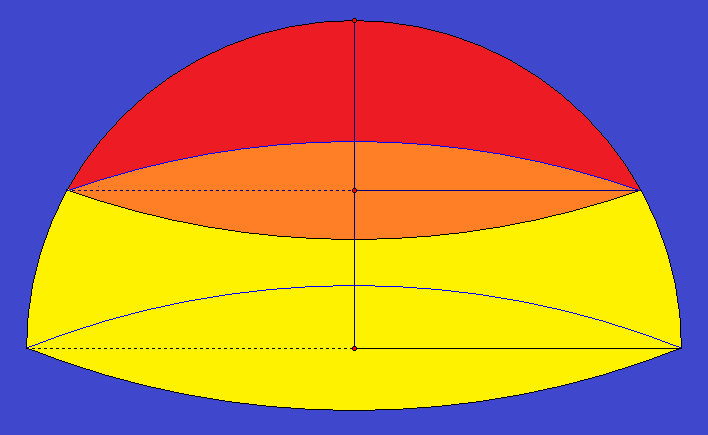
The hemisphere problem referred to here was described in the previous post. To reword it somewhat, consider this hemisphere, half of a sphere of radius r. The orange cross-section is a circle parallel to the hemisphere’s yellow, circular base.

hemisphere

We are to find the height of the yellow section with the orange circular top (which I shall call x), as a fraction of r, such that the yellow and red sections above have equal volumes.

Since the volume of a hemisphere is (2/3)πr³ (that’s half a sphere’s volume), each of these two sections must have half the hemisphere’s volume, or (1/3)πr³.

Moreover, the top (red) portion is a “spherical cap,” described here on Wikipedia, as was pointed out to me, by a friend, on Facebook. On that Wikipedia page, you can find this diagram, as well as the formula shown below for the volume of the purple spherical cap in the diagram.

spherical cap

spherical cap volume

Now, as our goal is to find x, as described at the top of this post, it important to remember that r = x + h, where r is the radius of the original sphere (and height of the hemisphere), h is the height of the spherical cap, and x is the height of the hemisphere, after the spherical cap is removed. We now have two expressions for the volume of the spherical cap: (1/3)πr³ (because it is a fourth of the volume of the original sphere), and (1/6)πh(3a² + h²) from the Wikipedia article on the spherical cap (so all of this assumes, then, accuracy in that Wikipedia article). Setting them equal to each other,

(1/3)πr³ = (1/6)πh(3a² + h²)

Next, I’ll clean this up by multiplying left and right by 6/π, to cancel fractions and π from both sides.

2r³ = h(3a² + h²)

A right triangle exists in the blue-and-purple figure above, and the unlabeled leg is x, the problem’s original goal. I’ll add an “x” to this diagram.

spherical cap with xUsing this right triangle, and the Pythagorean Theorem, it can be seen that a² = r² – x². Also, since r = x + h, it follows that h = r – x. By substitution for a and h, then,

2r³ = h(3a² + h²)

becomes

2r³ = (r – x)[3(r² – x²) + (r – x)²], which then distributes to

2r³ = (r – x)(3r² – 3x² + r² – 2rx + x²), which expands as

2r³ = 3r³ – 3rx² + r³ – 2r²x + rx² -3r²x  + 3x³ – r²x + 2rx² – x³, which simplifies to

0 = 2r³ – 6r²x + 2x³, which becomes, by division:

0 = r³ – 3r²x + x³.

I’m trying to find x, as a fraction of r, meaning that x = kr, and I want k. On that basis, I’ll now substitute kr for each x in the last equation above.

0 = r³ – 3r²(kr) + (kr)³, which then becomes

0 = r³ – 3kr³ + k³r³, or

3kr³ = r³ + k³r³, and then dividing by r³ yields

3k = 1 + k³, which can be rearranged to

3k – k³ = 1, which factors,on the left side, to yield

(k)(3 – k²) = 1.

For k and (3 – k²) to have a product of one, they must be reciprocals. Therefore, 1/k = 3 – k². I can then graph y = 1/k, as well as y = 3 – k², and find the solution by seeing where the graphed functions intersect above the k-axis, with a “k” value between zero and one, since no value of k less than zero or greater than one would make sense, as a solution to the original problem. (I’ll be using k coordinates, and a k-axis, in place of the usual x coordinates and x-axis.) Here’s the initial graph:

graph1

The only intersection in the specified range of zero to one is between point A and point B, so I brought them together, as closely as I could get Geometer’s Sketchpad to let me.

graph2

With points A and B almost on top of each other, k = 0.34958 by one equation, and k = 0.34820 by the other. To two significant figures, then, I can conclude that the horizontal cut in the original problem should be made 35% of the way from the base of the hemisphere to the hemisphere’s top.

Using a graphing calculator, a more precise answer of 0.34729636 was obtained. I’d still like to have an exact answer, but this will do for now.

—-

Later addition: a helpful reader led me to a Wolfram Alpha site where I could get an exact answer, as well as a decimal approximation with a greater degree of precision. In the pic below, I have omitted the two solutions of the third-order polynomial which are not the one solution of interest. Here’s the one which is:

wolfram

Now, however, I have another mystery: how can an exact answer, with all those imaginary units in it, have a real-only approximation? To this question, at least for now, I don’t even have the beginnings of an answer.

—-

Even later post-script: I have been assured by friends on Facebook that the imaginary units in the above exact solution somehow cancel, although I must concede that I still do not see how, myself. I’ve also been shown another way to express the solution, for 2sin(π/18) is also ≈ 0.3472963553338606977034333. This surprised me, due the the lack of any explicit appearance by a π/18 (= 10°) angle in the original problem, and the fact that no trigonometric functions were used to solve it.
The Hemisphere Problem (See Next Post for the Solution)

hemisphere

A hemisphere rests with its circular base on a horizontal, level surface, and is to be cut into two pieces of equal volume. If the hemisphere’s radius is r, at what fraction of r above the floor should the horizontal cut be made?

[Solution in next post: https://robertlovespi.wordpress.com/2015/04/06/working-towards-a-solution-of-the-hemisphere-problem/]

What Are Chiral Polyhedra? An Explanation, with Examples

Convex hhgfull

Two polyhedra are shown in this post — one which is chiral, and a similar one which is not. The non-chiral polyhedron in this pair is above. Its mirror-image is not any different from itself, except if you consider the direction of rotation.

The similar polyhedron below, however, features an overall “twist,” causing it to qualify as a chiral polyhedron. In its mirror-image (not shown, unless you use a mirror to make it visible), the “twisting” goes in the opposite direction. The direction of rotation would be reversed as well, of course, in a reflected image.

Codjfhnvexsdjag hhgfull

Multiple terms exist for mirror-image pairs of chiral polyhedra, the most well-known of which are the snub cube ansd snub dodecahedron, two of the thirteen Archimedean Solids. Some prefer to call them “enantiomers,” but many others prefer the more familiar term “reflections,” which I often use. I’ve also seen such polyhedra referred to as “left-handed” and “right-handed” forms, but I avoid these anthropomorphic terms related to handedness, simply because, if there is an established rule which would let me know whether any given chiral polyhedron is left- or right-handed, I’m not familiar with it. (Also, polyhedra do not have hands.) I could not, therefore, tell you if the example shown above would be correctly described as left- or right-handed — either because no such rule exists, or there is such a rule, but it is unknown to me. If the latter, I would appreciate it if someone would provide the details in a comment.

Both images above were created with Stella 4d, software you can try, for free, right here.

A Message to Trigonometricians, Regarding Placement of Exponents

trig

Two Versions of a 72-Pentagon Polyhedron

Here’s the first one:

72 pentagons

To make the next one, I rendered the twelve regular pentagons invisible, and put the remaining sixty faces in “rainbow color mode,” using Stella 4d, software you can try at this website.

72 pentagons rainbow

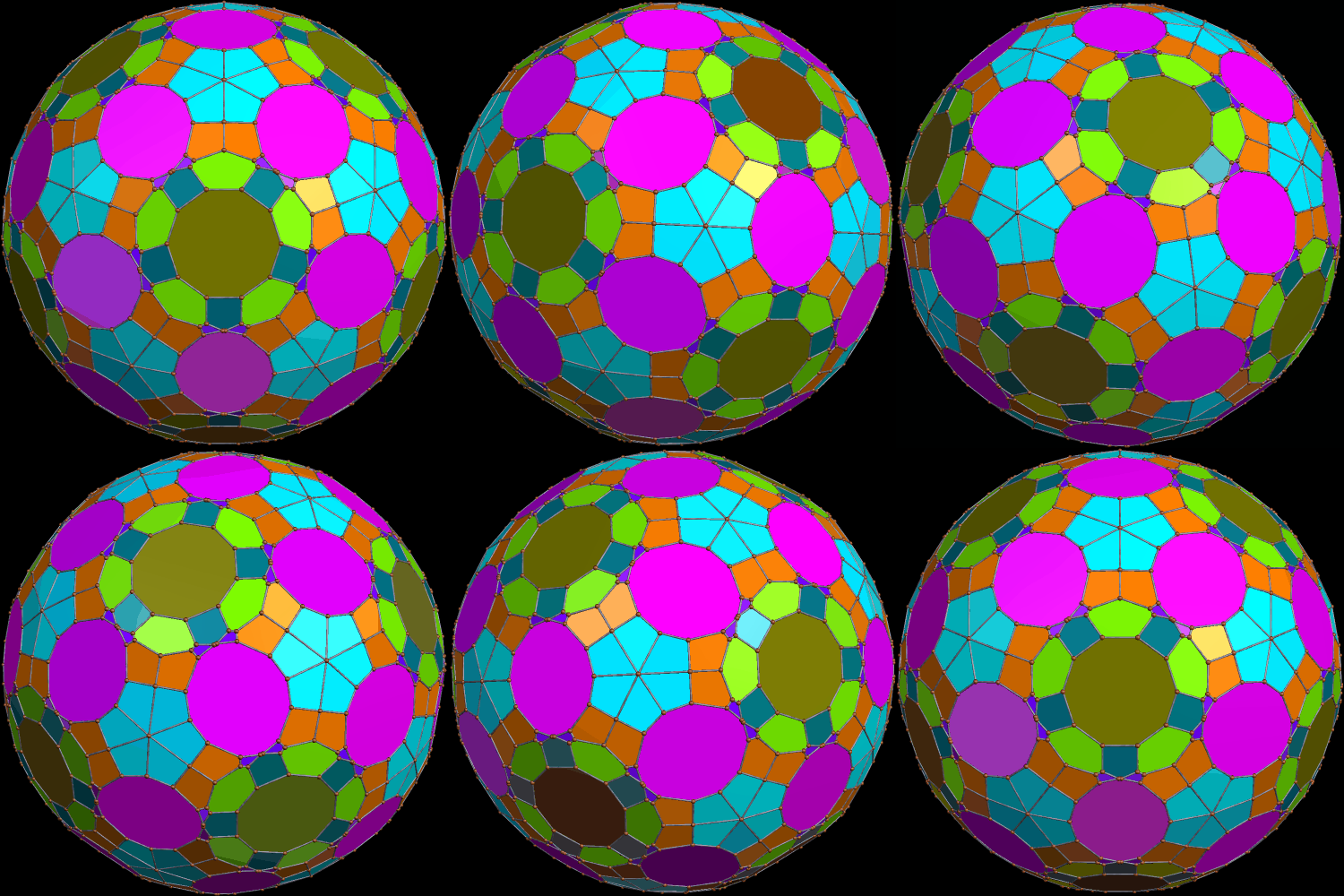
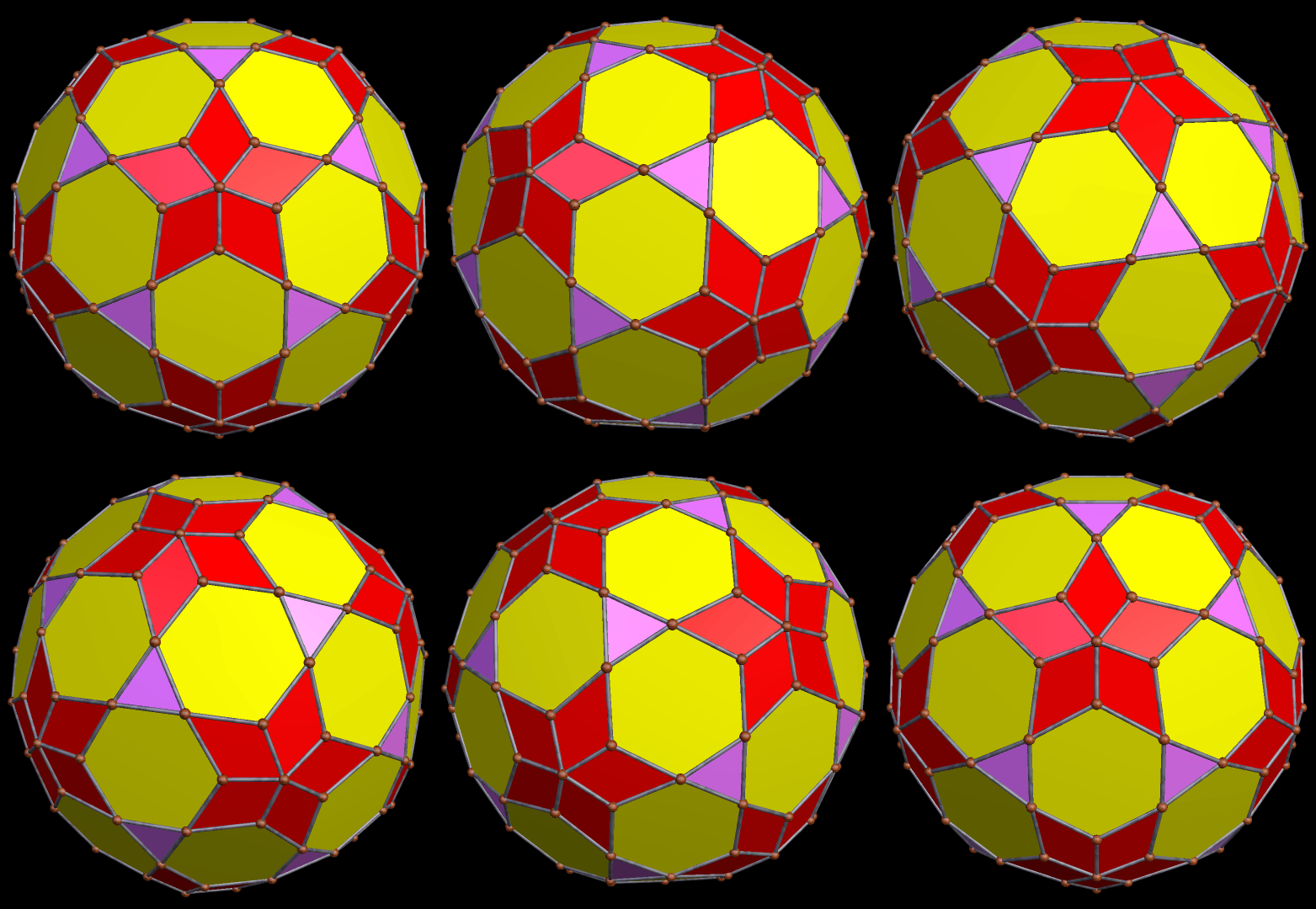
A Polyhedron with 520 Faces

520 faces

I made this with Stella 4d, software you can try for free here.

Using the Rhombic Dodecahedron and the Rhombic Enneacontahedron to Create a “Near Near-Miss” to the Johnson Solids

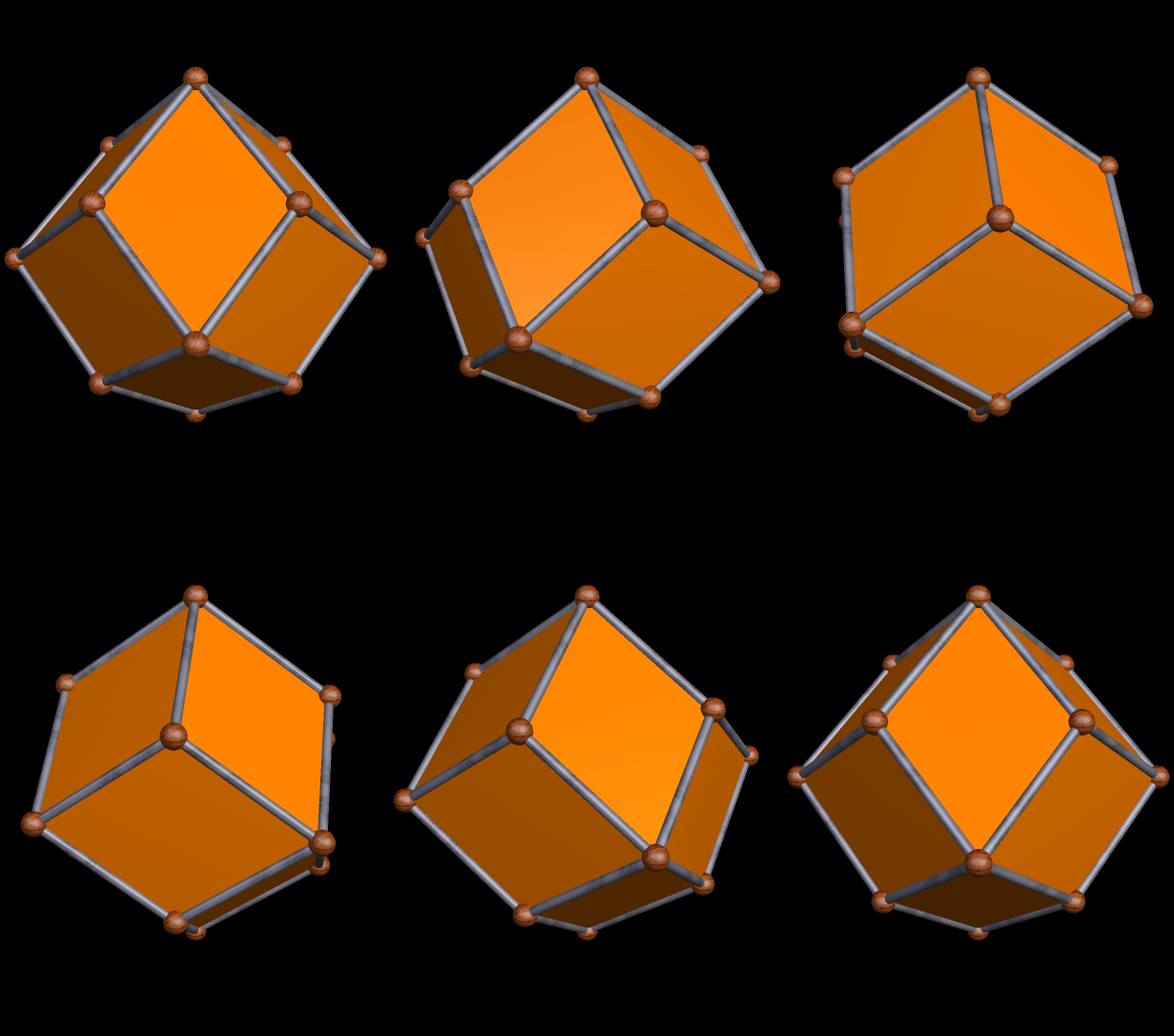
This is the rhombic dodecahedron, the dual of the Archimedean cuboctahedron.

Rhombic Dodeca

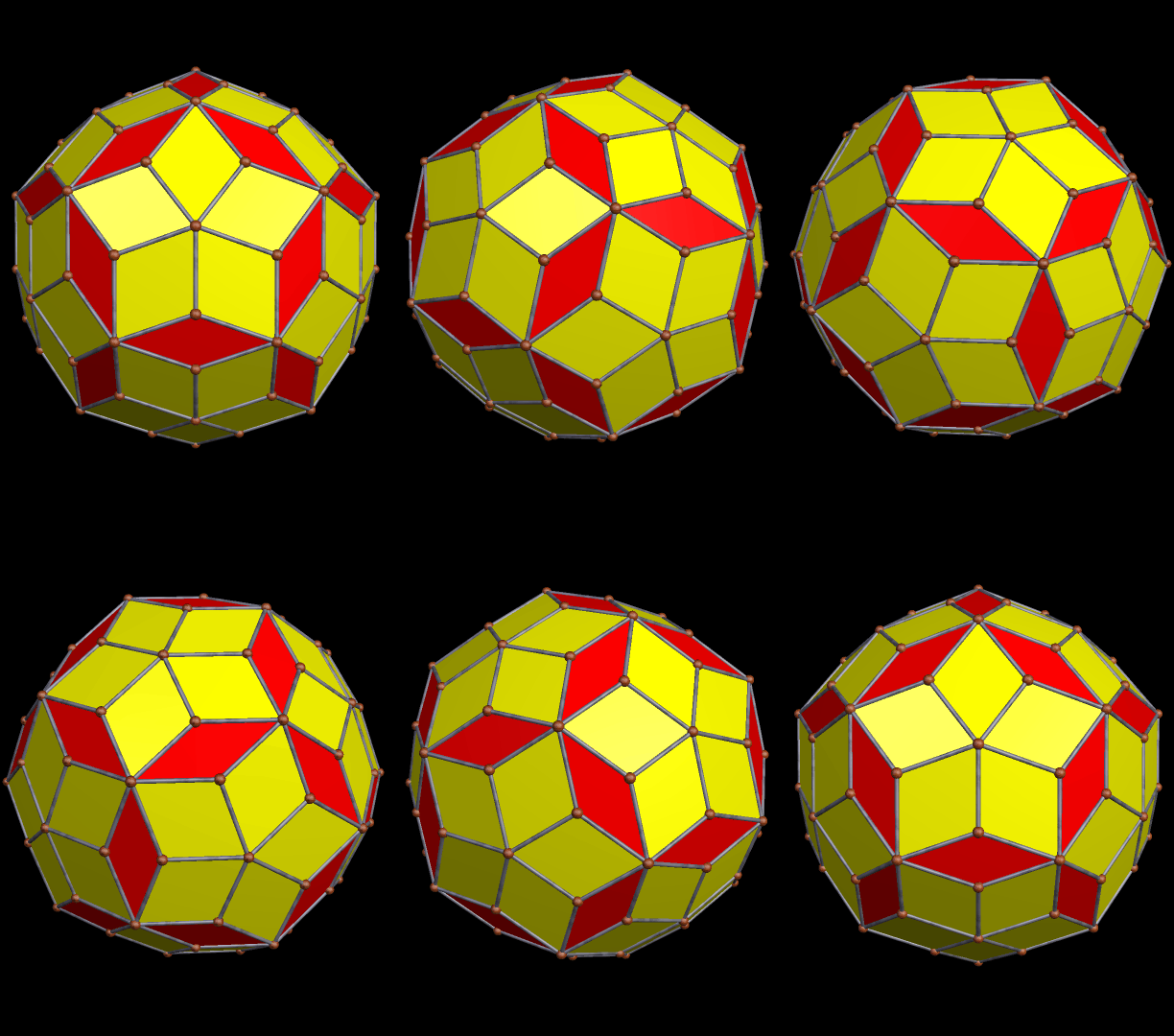
While the rhombic dodecahedron has 12 faces, there are many other polyhedra made entirely out of rhombi, and most of them have more than twelve faces. An example is the rhombic enneacontahedron, which has two face-types: sixty wide rhombi, and thirty narrow ones. It is one of several possible zonohedrified dodecahedra.

Zonohedrified Dodeca

As the next figure shows, the wide rhombi of the rhombic enneacontahedron have exactly the same shape as the rhombic dodecahedron’s faces, so the two polyhedra can be stuck together (augmented) at those faces. These wide rhombi have diagonals with lengths in a ratio of one to the square root of two.

Zonohedrified Dodeca with RD

The next picture shows what happens if you take one central rhombic enneacontahedron, and augment all sixty of its wide faces with rhombic dodecahedra.

Augmented Zonohedrified Dodeca

Since this polyhedral cluster in non-convex, it can be changed by creating its convex hull, which can the thought of as pulling a rubber sheet tightly around the entire polyhedron. Here’s the convex hull of the augmented polyhedron above.

Convex hull of RD-augmented REC

The program I use to make these rotating images, Stella 4d (which you can try here), has a function called “try to make faces regular.” If applied to the convex hull above, this function leaves the triangles and pentagon regular, and makes the octagons regular as well. However, the rhombi become kites. The rectangles merely change, getting slightly longer, while rotating 90º, but they do remain rectangles.

convex hull of RD-augmented REC after TTMFRegular worked on the octagons

After creating this last polyhedron, I started stellating it. After stellating it eight times, I obtained this polyhedron:

8th

Once more, I applied the “try to make faces regular” function.

Unnamed after TTMFR

This polyhedron has five-valent vertices where the shorter edges of the kites meet. These are also the vertices of pentagonal pyramids which use kite-diagonals as base edges. By using faceting (the inverse operation of stellation), I next removed these pyramids, exposing their regular pentagonal faces.

Faceted Poly

In this polyhedron, all faces are regular, except for the red triangles, which are isosceles. (There are also triangles — the pink ones — which are regular.) Each of these isosceles triangles has ~63.2º base angles, and a ~53.6º vertex angle, with legs just under 11% longer than the base. This is a judgement call, for “near-miss” to the Johnson solids has not been precisely defined, but I see an ~11% edge-length difference as too great for this to be classified as a “near-miss,” even though I would love to claim discovery of another near-miss to the Johnson solids (if it even turns out I am the first one to find this polyhedron, which may not be the case). It is close to being a near-miss, though, so it belongs in the even-less-precisely defined group of polyhedra which are called, quite informally, “near near-misses.”

For the sake of comparison, here is a similar polyhedron (included in Stella 4d‘s enormous, built-in library of polyhedra) which is recognized as a near-miss to the Johnson solids. (I do not know the name of the person who discovered it, or I would include it here — I only know it wasn’t me.) It’s called the “half-truncated truncated icosahedron,” and its longest ledges are just over 7% longer than its shorter edges, with the non-regularity of faces also limited to isosceles triangles. However, this irregularity appears in all of the triangles in the polyhedron below — and in the “near near-miss above,” the irregularity only appeared in some of the triangular faces.

Half-trunc Trunc Icosa

Icosidodecahedral Stained Glass

icosidodecahedral stained glass

Polyhedra are one of the areas (there are at least a few others) where the fields of mathematics and art intersect. Stella 4d, the program I used to make this image, is a great tool for the exploration of this region of intersection. This software may be tried for free right here.