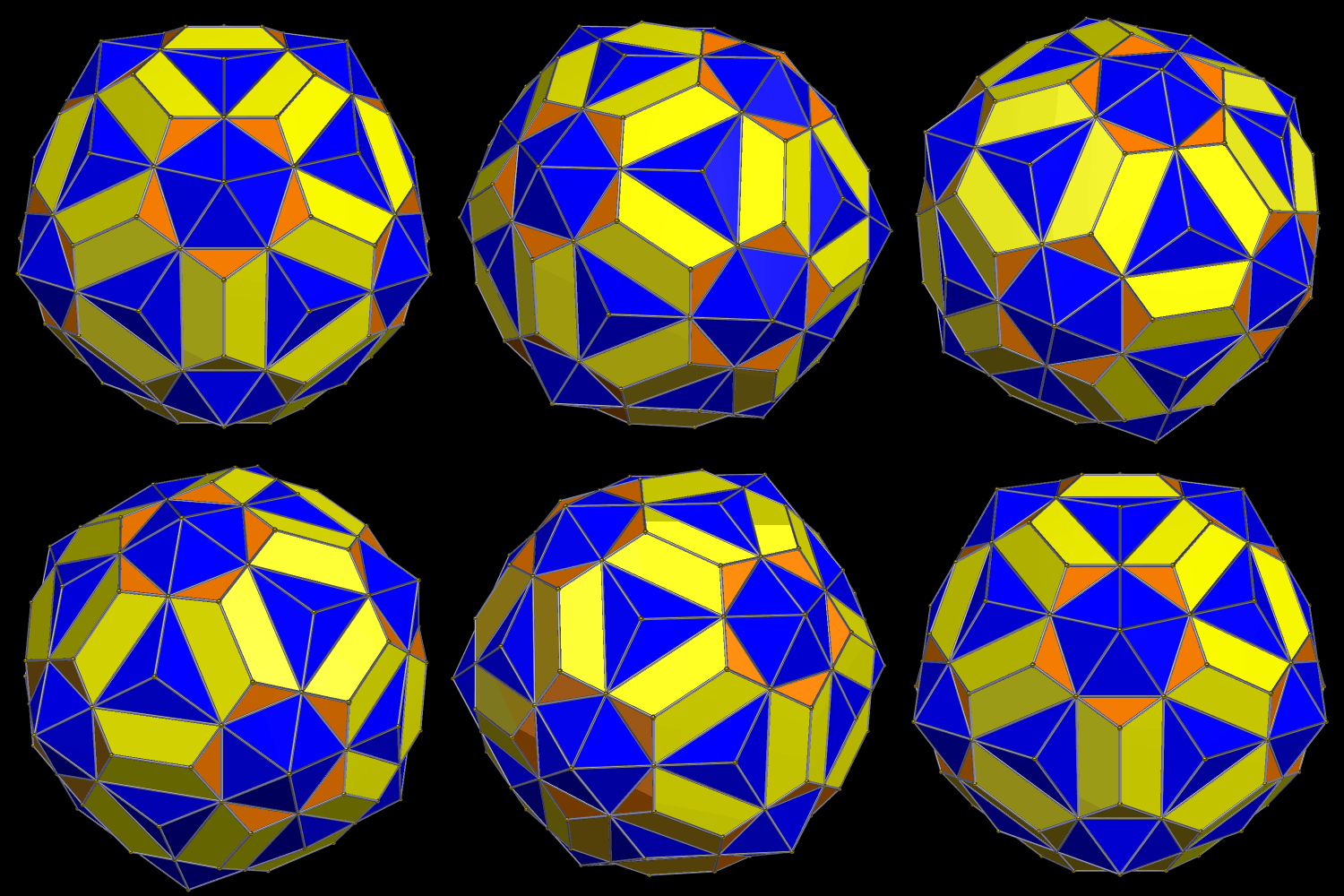
Complexes of 61 Small Stellated Dodecahedra Each, Shown with Three Different Coloring Schemes

spectral small stellated dodecahedra

spectral small stellated dodecahedra 61

spectral small stellated dodecahedra rb

I made these .gifs using Stella 4d: Polyhedron Navigator, which you can try for free at this website.

Two Versions of Mandalas Centered on Regular Octadecagons

18

18b

A Compound of the Rhombic Triacontahedron and a Truncation of the Icosahedron

Stellated Dual Morph 50.0%

In the compound above, the yellow hexagons are not quite regular, which is why I’m calling the yellow-and-orange polyhedron a truncation of the icosahedron, rather than simply the truncated icosahedron. I stumbled upon it while playing with Stella 4d, which you may try for free at http://www.software3d.com/Stella.php.

Cubes Made of Lux Blox

What is a cube? That’s a simple question, and I thought it had a simple answer . . . until I took on the project of building cubes with Lux Blox. Lux can be bought at this website, but one thing you won’t find there, or in shipments of Lux, are directions. This was a little frustrating at first, but I understand it now: the makers of Lux don’t want directions getting in the way of customers’ creativity.

A cube has six square faces. This is the six-piece Lux model based on that statement.

20200510_161402_resized

This first cube model is interesting, but it is also severely limited. Lux Blox connect at their edges, and all edges in this model are already used, joining one face to another. The model has no openings where more can be attached, and added to it.

Next, I made a cube out of Lux Blox which is open, in the sense that more Lux Blox can be attached to it. It also has an edge length of two.

20200510_161427_resized

Besides the openness of this model to new attachments, it also has another characteristic the smaller cube did not have: it can be stretched. If you take two opposite corners of this model and gently pull them away from each other, here’s what you get:

20200514_125856

Stretching a cube in this manner creates a six-faced rhombic polyhedron known as a parallelopiped.

The third cube model I’ve built of Lux Blox uses Lux Trigons in addition to the normal square-based Lux Blox.

20200510_161458_resized

In this model, the black pieces in the center are the Lux Trigons — twelve of them, occupying the positions of twelve of the twenty faces of an icosahedron. The other eight faces are where the orange triangles (or triangular prisms, if you prefer) are attached. The orange triangles mark the eight corners of a cube. This model has pyritohedral symmetry — the symmetry of a volleyball — as I hope this last picture, a close-up of this third type of cube, helps to illustrate.

20200510_161506_resized

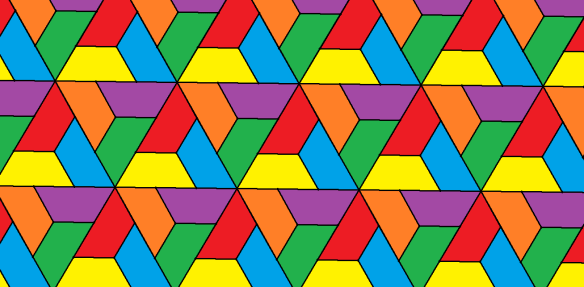
Tessellation of Isosceles Trapezoids

Image

isos trap tess

By Request, A Geodesic Polyhedron

Geodesic Icosa freq 4

This is a frequency-4 geodesic icosahedron, made by request using Stella 4d, which you can try for yourself, free, at this website.

Twenty Hexagons, Each Adorned with Images of Hexagon the Cat

Hexagons

I made this using Stella 4d: Polyhedron Navigator, a program you can try for free at this website. It shows Hexagon the Cat riding in circles on the twenty hexagonal faces of a rotating truncated icosahedron. We don’t know of a cat named Pentagon, so I hid the twelve pentagonal faces.

A Cuboctahedron Made of Lux Blox

This cuboctahedron has an edge length of two. If you’d like to compare it to a Lux model with a edge length of one, just check the post right before this one. Lux Blox are fun to build with, and are sold online at http://www.luxblox.com.

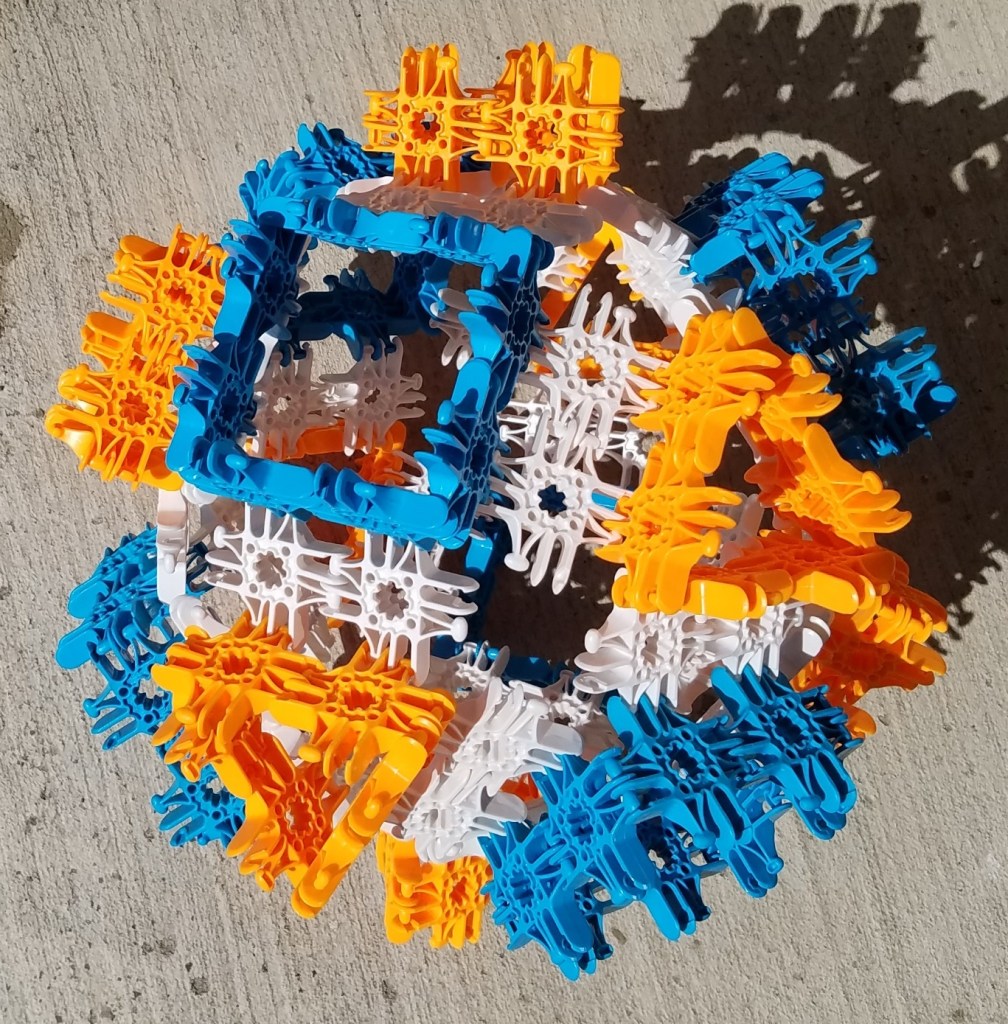
A Truncated Icosahedron Made of Lux Blox

This particular truncated icosahedron has an edge length of one. I may build one with a longer edge length at some point; this would have the effect of shrinking the white edges, and magnifying the orange and blue faces, as fractions of the overall model. The individual Lux square pieces are identical, except for their color.

If you’d like to try Lux Blox for yourself, the site to visit is http://www.luxblox.com.

Expanding the Truncated Icosahedron, Using Augmentation with Prisms

Here’s my starting point: the truncated icosahedron, one of the thirteen Archimedean solids.

Next, each face is augmented by a prism, with squares used for the prisms’ lateral faces.

The convex hull of the polyhedron above yields what can be called an expanded truncated icosahedron, as shown below:

Could these faces be made regular, and the polyhedron still hold together? I checked, using Stella 4d‘s “try to make faces regular” function. Here’s the result:

As you can see, the faces of this polyhedron can be made to be regular, but this forces the model to become non-convex.

To try Stella for yourself, for free, just pay a visit to http://www.software3d.com/Stella.php. The trial version is a free download.