 The interior angles in these rhombi all measure π/9 radians, or some whole-number multiple of that amount, up to 8π/9 radians.
A Rhombic Mandala Based on Pi Over Nine
1
The interior angles in these rhombi all measure π/9 radians, or some whole-number multiple of that amount, up to 8π/9 radians.
To begin this experiment, I first purchased two refrigerator-sized Fractiles-7 sets (available at http://fractiles.com/), and then, early on a Sunday, quietly arranged these rhombus-shaped magnets on the refrigerator in our apartment (population: 4, which includes two math teachers and two teenagers), using a very simple pattern.
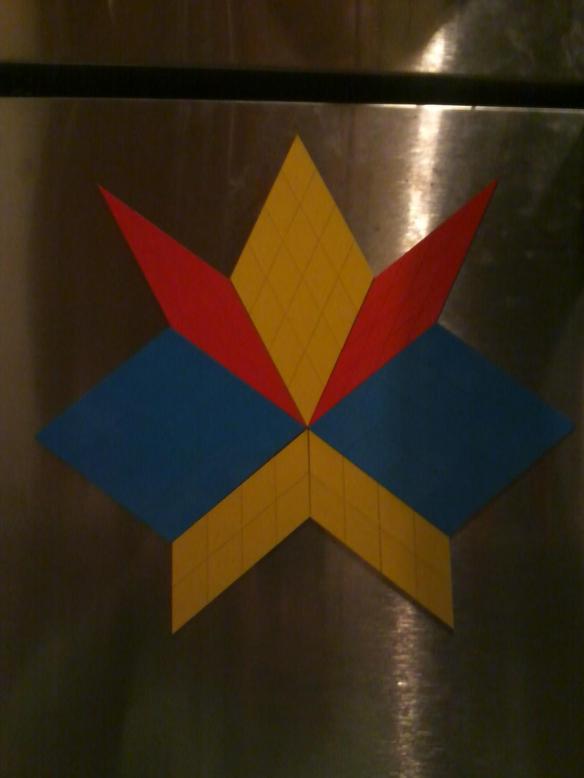
Here’s a close-up of the center. There are 32 each, of three types of rhombus., in this double-set, for a total of 96 rhombic magnets, all with the same edge length.

The number of possible arrangements of these rhombi is far greater than the population of Earth.
The next step of the experiment is simple. I wait, and see what happens.
It should be noted that there is a limit on how long I can wait before my inner mathematical drives compel me to play with these magnets more, myself — but I do not yet know the extent of that limit.
Someone found this, and “liked” it, in my old Facebook pictures. I had forgotten all about it, until this happened. It is a mandala, made of rhombi, with nine-fold symmetry, made in 2010 with Geometer’s Sketchpad — two years before I started this blog.


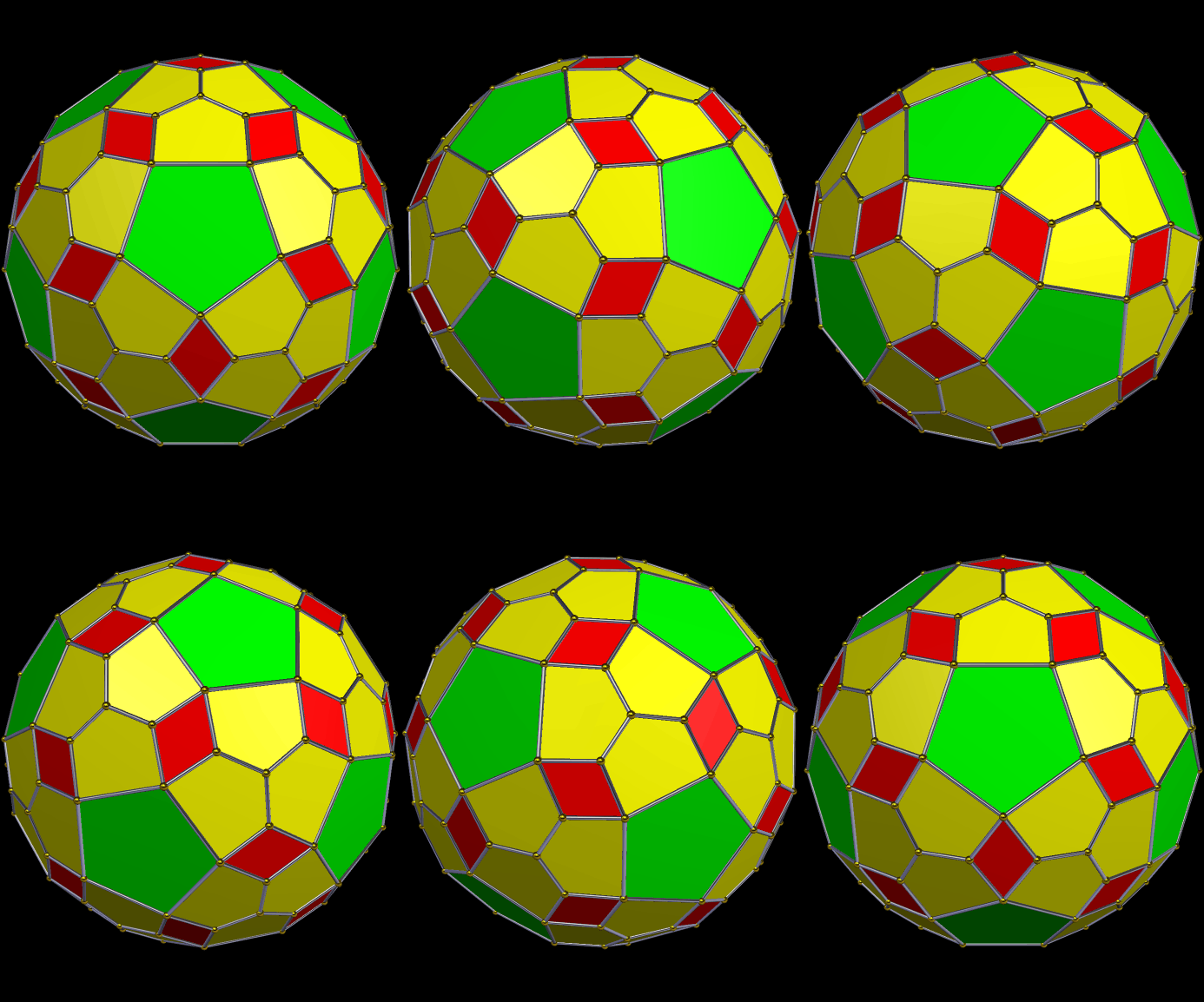
I made this with Stella 4d, a program you can find at http://www.software3d.com/Stella.php.


I used Stella 4d to make this image, and you can find that program at http://www.software3d.com/Stella.php.

I created this using Stella 4d: Polyhedron Navigator, a program you can find at http://www.software3d.com/Stella.php.
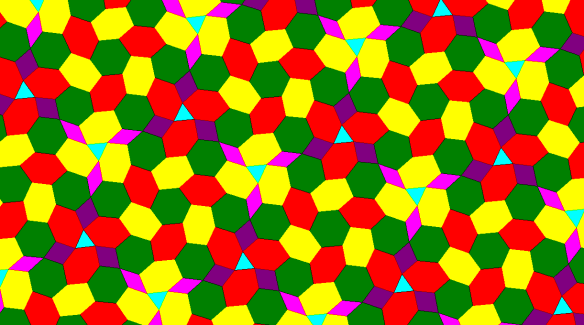
In this chiral tessellation, the blue triangles and green hexagons are regular. The yellow hexagons are “Golden Hexagons,” which are what you get if you reflect a regular pentagon over one of its own diagonals, then unify the two reflections. The pink and purple quadrilaterals are two types of rhombi, and the red hexagons are a third type of equilateral hexagon. All of the edges of all polygons here have the same length.
There are three different types of points of three-fold rotational symmetry repeated here. Two of these types are centered in the middle of blue triangles, while the third is centered in the middle of some of the green hexagons — specifically, the ones surrounded only by alternating red and yellow hexagons.
When I try to generate the mirror-image of this tessellation, it overloads Geometer’s Sketchpad, and crashes the program. However, inverting the colors of the same reflection, in MS-Paint, to make a color-variant, is easy:

 RobertLovesPi.net