How To Make Tic-Tac-Toe Interesting

Image

How To Make Tic-Tac-Toe Interesting

Tic-tac-toe, played by the traditional rules, is so simple a game that few people with two-digit ages ever play it — just because it’s boring. It is so simple a game, in fact, that chickens can be trained to play it, through extensive operant conditioning. Such chickens play the game at casinos, on occasion — with the rules stating that if the game ends in a tie, or the chicken wins, the human player loses the money they paid to play the game. If the human wins, however, they are promised a large reward — $10,000, for example. Don’t ever fall for such a trick, though, for casinos only use chickens that are so thoroughly trained, by weeks or months of positive reinforcement, negative reinforcement, and punishment, that they will not ever lose. You’d be better off simply saving the same money until it’s cold, and then setting it on fire, just for the heat. At least that way you’d be warm for a little while, and that certainly beats the humiliation of being beaten, at any game, by a literal bird-brain.

With a small, simple alteration, though, tic-tac-toe can actually become a worthwhile, interesting game, even for adults. I didn’t invent this variation, but have forgotten where I read about it. I call it “mutant tic-tac-toe.”

In this variation, each player can choose to play either “x” or “o” on each play — and the first person to get three “x”s or three “o”s, in a row, wins the game. That’s it — but, if you try it, you’ll find it’s a much more challenging game. I am confident chickens will never be trained to play it successfully.

Consider the board pictured above, which happens to match a game I lost, to a high school student, earlier today. Red (the student) moved first, starting with the “o” in the center. I was playing with a blue marker, and chose to play an “x” in a corner spot. This was a mistake on my part, for the student’s next move — another “x,” opposite my “x,” effectively ended the game. I had to play next — passing is not allowed — and my playing an “x” or an “o,” in any of the six open spaces, would have led to an immediate victory by the student. If you study the board, you’ll see why this is the case.

Mutant tic-tac-toe is a great activity for semester exam week, at any school. Students who finish final exams earlier than their classmates can be taught the game quickly and quietly, and then they’ll entertain themselves with this game, rather than distracting students who are still working on their tests. What’s more, students have to really think to play this version of the game well, especially when they first learn it — and isn’t getting students to think what education is supposed to be all about, anyway?
The Beauty of Uselessness

Image

The Beauty of Uselessness

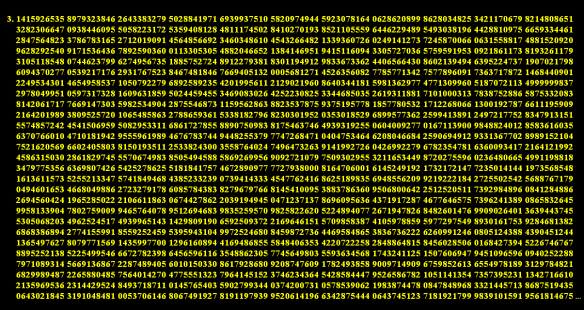
Given the name of this blog, and the familiarity of the number pictured above, I’m sure you recognize it as the beginning of my favorite number, pi. On various websites, you can find far more digits than are shown above. However, just the digits shown in the top row here are greater in number than that needed for any real-world, practical application. Is pi useful? Is mathematics itself useful? Of course they are . . . but those questions miss the point entirely.

Every teacher who has been in the field for long has heard the complaint, disguised as a question, “What are we ever going to use this for?” Unfortunately, most school systems, as well as teacher-training programs, have chosen to respond to this well-known complaint by repeatedly telling teachers, and teachers-in-training, that it is of extreme importance to show students how the curriculum is “relevant,” and adjust curricula to make them more so. This usually boils down, of course, to trying to convince students that learning is important because, supposedly, education = a better job in the future = more money. Sometime this “equation” works, and sometimes it does not, but it always misses a key point, one that should not be left out, but too often is.

It is a fallacy that learning has to have a practical application to be a worthwhile endeavor. There’s more to life than the fattening of bank accounts. Sadly, many of those making decisions in education do not realize this. Their attempts to reduce education to a strictly utilitarian approach are causing great harm.

This scenario has happened many times: a mathematician discovers an elegant proof to a surprising theorem, a physicist figures out something previously unknown about the nature of reality, or a researcher in another field does something comparable, and someone then asks them, “But what can this be used for?” On occasion, tired of hearing this utilitarian refrain, such researchers give unusually honest responses which surprise and confuse many people — such as, “Someone else might, at some point, find a practical application for this . . . but I sincerely hope that never happens.” Such a response is rarely understood, but it makes the person who says it feel better to vent some of their frustration with those who are obsessed with tawdry, real-world applications for everything.

Many humans — and this is a terrible shame — live almost their entire lives like rats in mazes, running down passages and around corners, chasing tangible rewards — cheese for the rats, or the ability to buy, say, a fancy new car, in the case of the people. People shouldn’t live like lab rats . . . and, unlike lab rats, we don’t have to. People are smart enough to find higher purposes in life. People can, in other words, find, understand, and appreciate beauty — in things which are useless, in the sense that they have no useful applications. We can appreciate things that transcend mere utility, if we choose to do so.

Much of life is utterly banal, for a great many people. They wake up each day, work themselves into exhaustion at horribly boring jobs, go home, numb themselves with television, massive alcohol consumption, or other hollow pursuits, fall asleep, and then get up and repeat the process the next day . . . and then they finally get old and die. Life can be so much more than that, though, and it should be.

The researchers I described earlier aren’t doing what they do for money, or even the potential for fame. Are such things as mathematics and physics useful? Yes, they are, but that isn’t why pure researchers do them. The same can be said for having sex: it’s useful because it produces replacement humans, but that isn’t why most people do it. People have sex, obviously, because they enjoy it. In simpler terms: it’s fun. Most people understand this concept as it relates to sex, but far fewer understand it when it relates to other aspects of life, particularly those of an academic nature.

Academic pursuits are of much greater value when the motivation involved is joy, and the fun involved, rather than avarice. As scrolling through this blog will show you, I enjoy searching for polyhedra which have not been seen before. I certainly don’t expect to get rich from any such discoveries I make in this esoteric branch of geometry, which is itself one subfield, among many, in mathematics. I do it because it is fun. It makes me happy.

Much of life is pure drudgery, but our lives can be enriched by finding joyous escapes from our routines. An excellent way to do that is to learn to appreciate the beauty of uselessness — uselessness of the type that elevates the human spirit, in a way that the pursuit of material goods never can.

This is the approach we should encourage students to have toward education. Learning is far too valuable an activity to be limited, in its purpose, to the pursuit of future wealth. It’s time to change our approach.

My Students’ Painting of the Periodic Table of the Elements

Image

My Students' Painting of the Periodic Table of the Elements

This is my last year teaching at my current school — I’ll be transferring to another school in the same district in the Fall. To create a farewell gift to the school where I have taught for the last three years, I brought a lot of paint and other art supplies from home, bought more when they ran out, and let my students (who are enrolled in Chemistry and Physical Science) paint a large painting of the periodic table on two large wooden boards, each measuring 4′ by 6′. In the Fall, the plan is for the painting to be mounted on the wall of the science wing of my current school, in a location to be chosen by my current department chair, a personal friend of mine.

I think my students did a very good job — better than this picture I took with my cell phone reveals, just due to camera-quality. I am proud of them.

Only Nine School Days Left This Year

Image

Only Nine School Days Left This Year

Due to an unusual amount of Winter weather this school year, the school year where I teach has been extended to June 6, creating what many are calling “the school year that will not end.” It will end, of course, but the already-long wait for Summer vacation is getting to many of us — students, parents, teachers, and administrators alike.

The countdown is now at nine school days left: four next week, and five the week after that. In honor of this point in the countdown, I created this image based on the number nine, using Geometer’s Sketchpad and MS-Paint.

Countdown

Image

Countdown

Eighteen more days of school. Eighteen more days of school. Eighteen more days of school. Eighteen more days of school. Eighteen more days of school. Eighteen more days of school. Eighteen more days of school. Eighteen more days of school. Eighteen more days of school. Eighteen more days of school. Eighteen more days of school. Eighteen more days of school. Eighteen more days of school. Eighteen more days of school. Eighteen more days of school. Eighteen more days of school. Eighteen more days of school. Eighteen more days of school.

Can a Public School Student Read a Bible in Class?

Image

Can a public school student read a Bible in class?

Yes, but not loudly, waving it around, while I am explaining the safety protocols for laboratory use of silver nitrate in chemistry class.

It’s dangerous stuff, as you can see here: http://www.sciencelab.com/msds.php?msdsId=9927411.

Did this actually happen? Of course — I don’t think I could make up a story like that. It happened in a different class than the one I am teaching this year, though. The student’s name is being withheld, to protect his identity (and my job).

Which State Is South of Arkansas?

Image

Which State Is South of Arkansas?

This really happened, in a geography class I took, long ago, in an Arkansas elementary school.

Teacher: “Which state is south of Arkansas?”

Me: “There are six: Oklahoma, Missouri, Tennessee, Mississippi, Louisiana, and Texas.”

Teacher: “No, Robert, that’s wrong.”

Me: “No, YOU’RE wrong. I’m right, and I’ll prove it.” I then got up, walked to the large classroom map of Arkansas, and ran my finger downwards on the map, six times, along the arrows you see above, while shouting, “South! South! South! South! South! South!” It’s true: from some point in Arkansas, you can travel, due South, into some part of any of the six adjacent states.

The teacher called my mother. Her response? “What’s the problem? He was RIGHT, wasn’t he?”

Every American Who Is Old Enough Remembers 9/11/2001

Here’s the main thing I remember about that day. I was teaching 9th graders when the attacks occurred.

Student, 12 years ago today: “Mr Austin! Mr. Austin! Turn on the TV! Someone just flew an airplane into the World Trader Center!”

Me: “Yeah, RIGHT.” I was finally convinced to turn it on — just in time to see the second plane hit the other tower.

I don’t think I’ll ever live THAT one down. I had to spend the rest of the workday trying to reassure my students that Mayflower, Arkansas had zero strategic importance, and that they could relax about their fears of their small town being the next target. This was not easy.

The boiling anger set in after I no longer had to take care of students, and remained with me for days. Many (or most) Americans experienced this same emotion.

On Calculator Use and Abuse

Image

Calculator_casio (1)

Calculators are important tools.

Well, so are guns.

Everyone acknowledges that, if guns are going to be used at all, certain safety precautions are essential. While it generally is not a matter of life and death, the same thing is true of calculators.

I have seen — multiple times — students multiply or divide some number by one, using a calculator, and then be genuinely surprised when they got the same number with which they started. I have also seen a bright student calculate the mass of an atom, and get an answer larger than the mass of the earth. When I informed him of this, his reaction was predictable: “But that’s what the calculator says!”

These are examples of calculator abuse. Aside from avoiding errors, such as the “planetary atom,” it’s also important not to abuse calculators because such an act is insulting to one’s own brain.

Some people treat calculators as if they are omniscient and infallible. They aren’t. They’re small, simple, narrowly-focused computers. The human brain is also a computer, but a far more advanced one. The calculators are our tools, not the other way around.

Here are some tips to prevent calculator abuse:

1. Know how to do arithmetic without a calculator. If you don’t know, learn.

2. Use calculator-free mathematics when appropriate. If you need to know what six times eight is, for example, it insults your own brain to consult a calculator. Don’t do it!

3. Calculator-free mathematics is not to be called “mental math,” for the simple reason that ALL math is mental. Also, if you ever meet anyone claiming to have invented that insipid phrase, kick that person immediately.

4. If you have contact with children, promote the use of calculator-free math to them. This is most important, of course, for parents and teachers. It is no service to a child to raise them to be dependent on a calculator.

5. Finally, when you do use a calculator, don’t be too trusting of the little thing. Check your answers, constantly, by using estimation. Say, for example, you’re multiplying 109 by 36. That’s “a bit over a hundred” times “a bit under forty.” Since forty hundreds is four thousand, the answer has to be in the ballpark of 4,000 — and if a calculator disagrees, the calculator is wrong, probably because a human pressed at least one incorrect button. You will press incorrect buttons on occasion — we all do — and it’s important to have a method in place to detect such errors. This estimation-method is both simple and effective.

All these principles boil down to this: be smarter than your calculator. They aren’t actually very intelligent, so this is neither difficult, nor unreasonable.

An Alternative Explanation for ADD and ADHD

ADD and ADHD are being treated, mostly in children too young to give informed consent themselves, with powerful, addictive, dangerous stimulants. How dangerous? Children have died because of such drugs as Ritalin and its relatives, all of which are amphetamines (feel free to check that with Google). Amphetamines are, of course, commonly known as speed. A large experiment is being conducted with many of America’s youth, with no control group, and woefully inadequate safety protocols.

The ADD/ADHD genes have not been found, nor has the virus, bacteria, nor parasite. Either the cause of ADD and ADHD is very good at hiding, or there simply isn’t one. Serious consideration is due to whether the term “disorder” actually applies to these conditions.

Consider this alternative explanation to the “disease model.” Humans evolved with certain characteristics related to paying attention, which is an obvious survival trait. One can try to pay attention to the myriad things going on, which I call a “wide focus,” or one can tune out most things to focus on one particular thing — a “narrow focus.”

I naturally have a narrow focus, and it takes considerable effort (and is exhausting) to widen it for sustained periods. There’s evidence on this blog:  all those geometrical patterns I like to make require intense concentration, for substantial periods, on a single activity. If ADD is real, I have its opposite.

By contrast, those who have a wide focus are more likely to notice, say, an approaching attacker than I am. Therefore, wide-focus attention is an even better survival trait that merely paying attention, or at least it has been for most of human history. Noticing lots of things, though, makes one naturally distractable, and that doesn’t mesh well with the expectations modern schools have for students — so a lot of students end up labeled and drugged, simply because they are more adapted to certain un-schoollike environments than is the average person. The natural environment in which our species evolved is, of course, nothing like school. If I were alive in the Stone Age, that wouldn’t remain true for long; some sabre-tooth tiger would easily catch me while I was drawing triangles in the dirt with a stick.

The people with a wide focus aren’t sick. There’s nothing wrong with them — except that a characteristic of theirs is not liked by many in education, who then encourage parents to turn to the medical profession — simply to alleviate conflict, in many cases, despite the very real risks to the students who are drugged, often against their will.

Evolution is a natural part of the universe. School, on the other hand, is a human invention. If there is a mismatch, as there often is, where, then, truly lies the disorder? In the students . . . or in the schools themselves?