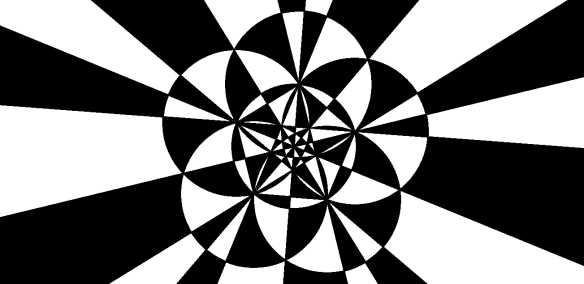
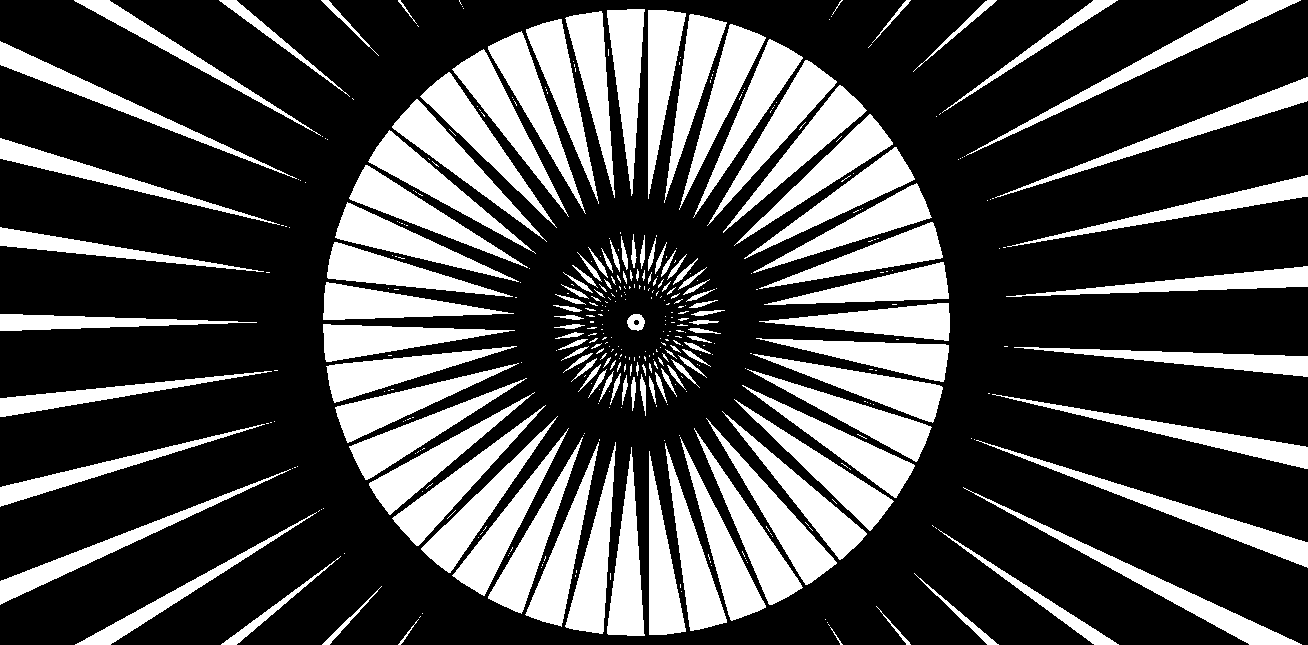
For some reason, I like having my age be a prime number of years. Today, I turn 47, so I get to have a prime-number-age for a whole year now. This hasn’t happened since I was 43, so I made this 47-pointed star to celebrate:
I also make birthday-stars for composite-number ages as well, just because it’s fun, and you can find at least two others on this blog, on January 12, in past years. Also, I wouldn’t want to have to wait until I’m 53 (my next prime age) to make another one of these.
At the moment, I certainly don’t feel 47. There are times when I feel twenty-two . . .
There are also times when I feel six.
At the moment, however, I feel about thirty. For that reason, I put the 47-pointed stars on the thirty faces of a rotating rhombic triacontahedron, because (a) it’s my birthday, (b) I want to, and (c) I can.
Image/music credits:
I created this using Geometer’s Sketchpad and MS-Paint.
“When Yer Twenty-Two,” by The Flaming Lips, via a YouTube posting.
Two panels from a Calvin and Hobbes cartoon, by Bill Watterson. (Calvin is perpetually six years old.)
Created using the image at the top of this post, and the program Stella 4d: Polyhedron Navigator, which is available here.
In the image above, which I stumbled upon using Stella 4d (available here), the tetrahedra are elongated. If they are regular, instead, the same arrangement looks very different:
Each pair is a different color. Because these decagons intersect in space, but do not meet at edges, they do not form a true polyhedron. They are merely a symmetrical configuration of twelve decagons in space, surrounding a central point.
I made this out a “true polyhedron” by hiding all the other faces from view. Before the hiding and recoloring of faces, this looked this way (you can click on it to enlarge it):
Some polyhedral compounds are well-known, such as the compound of five cubes, while others are less famous. I had never heard of this compound before building one today (virtually, not as a physical model). However, a quick Google-search told me that I was not the first person to discover it.



 RobertLovesPi.net