A Tessellation Featuring Regular Heptagons

Image

Tessellation Featuring Regular Heptagons

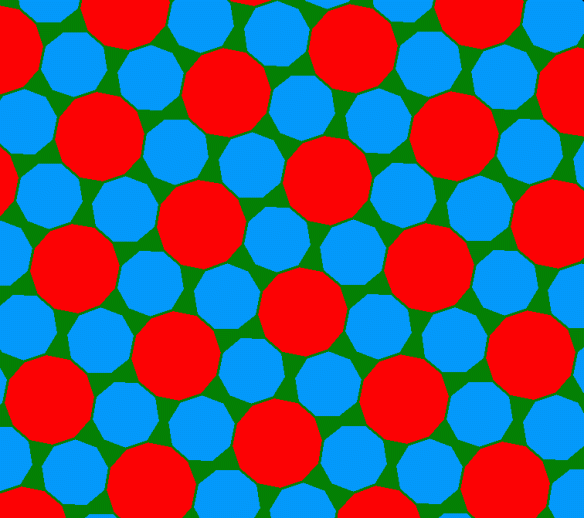
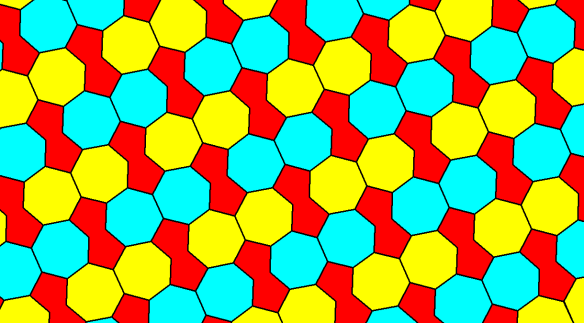
Regular heptagons, of course, can’t tile a plane by themselves. Of all tessellations of the plane which include regular heptagons, I think this is the one which minimizes between-heptagon gap-size (the parts of the plane outside any heptagon). However, I do not have a proof of this. The shape of each of the polygons which fill the “heptagon-only gaps” is a biconcave, equilateral octagon. With these octagons, this is a tessellation, but without them, it wouldn’t fit the definition of that term.

[Later edit:  on Facebook, a friend showed me two others with smaller gap-sizes. In other words, the conjecture above has now been shown to be wrong.]

A Close-Packing of Space, Using Three Different Polyhedra

Image

A Close-Packing of Space, Using Three Different Polyhedra

This is like a tessellation, but in three dimensions, rather than two. The pattern can be repeated to fill all of space, using cubes (yellow), truncated octahedra (blue), and great rhombcuboctahedra, also known as truncated cuboctahedra (red).

Software credit: see www.software3d.com/stella.php to try or buy Stella 4d, the software I used to create this image.

A Space-Filling Pair of Polyhedra: The Cuboctahedron and the Octahedron

Image

A Space-Filling Pair of Polyhedra:  The Cuboctahedron and the Octahedron

There are only a few polyhedra which can fill space without leaving gaps, without “help” from a second polyhedron. This filling of space is the three-dimensional version of tessellating a plane. Among those that can do this are the cube, the truncated octahedron, and the rhombic dodecahedron.

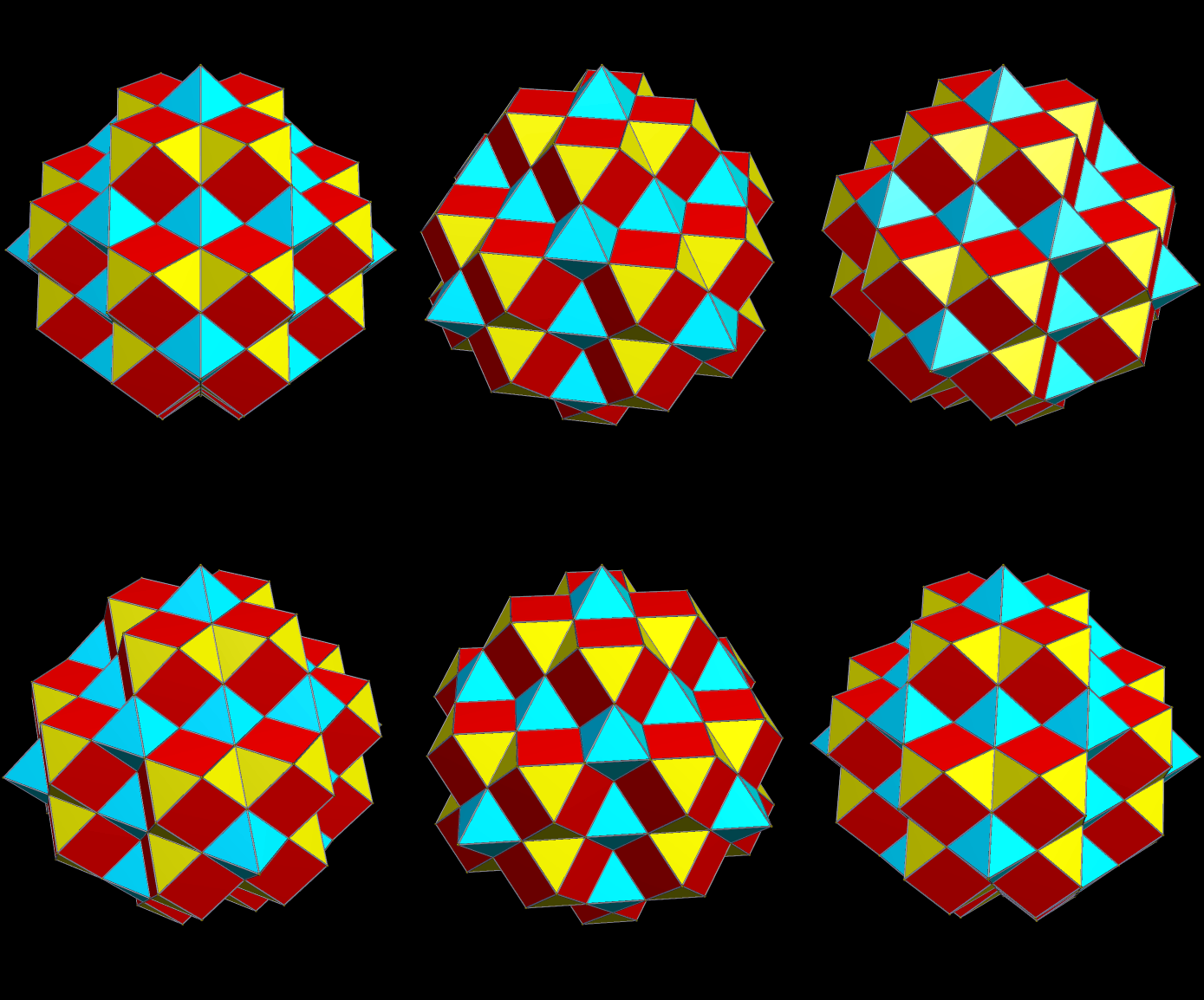
If multiple polyhedra are allowed in a space-filling pattern, this opens new possibilities. Here is one: the filling of space by cuboctahedra and octahedra. There are others, and they are likely to appear as future blog-posts here.

Software credit: I made this virtual model using Stella 4d, polyhedral-manipulation software you can buy, or try as a free trial download, at http://www.software3d.com/Stella.php.

A Tessellation of Regular Polygons for the New Year MMXIV

Image

A Quasi-Regular Tessellation for the New Year MMXIV

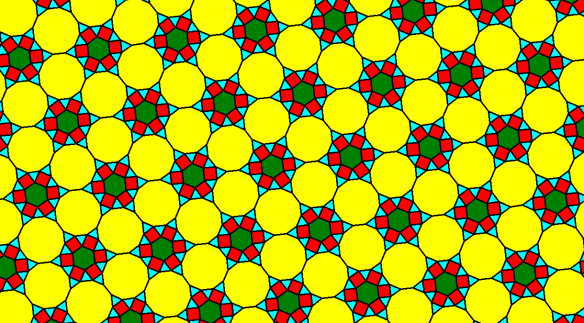
All of the polygons in this tessellation are regular. There are only three regular tessellations, and they use, respectively, equilateral triangles, squares, and regular hexagons to tile a plane. There is also a set of eight semi-regular (or Archimedean) tessellations, which you may see here. Archimedean tessellations include more than one type of polygon, but they are vertex-transitive, meaning that each vertex has the same set of polygons surrounding it.

This is a tessellation of regular polygons, but it lacks vertex-transitivity, so it cannot be called a semi-regular (or Archimedean) tessellation. In other words, in this tessellation, there is more than one type of vertex.

There are many such tessellations with an indefinitely repeating pattern. Has this particular one been seen before? I do not know the answer to this question — but if you do, please let me know, in a comment.

Tessellation Using Regular Nonagons and “Snowflake” Dodecagons

Image

The “snowflake” dodecagons are equilateral, and resemble star hexagons — but the resemblance is close, not exact.

Factors of Twelve

Image

The Prime Factorization of Twelve

A Radial Tessellation Featuring Regular Decagons, Regular Pentagons, and Golden Hexagons

Image

Radial Tessellation Featuring Decagons, Pentagon, and Golden Hexagons

As you can see, this can be continued indefinitely from the center.

Tessellation Featuring Dodecagons II

Image

Tessellation Featuring Dodecagons II

Tessellation Featuring Dodecagons

Image

Tessellation Featuring Decagons

Bowtie Tessellation

Image

Bowtie Tessellation