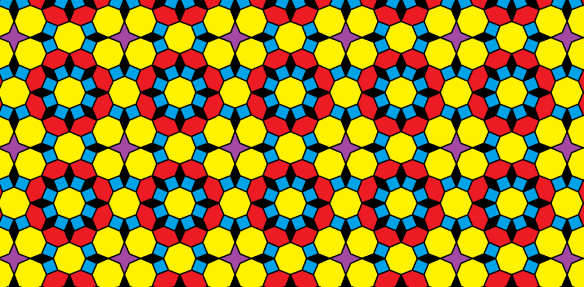
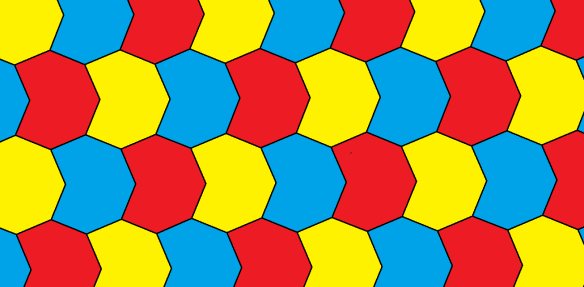
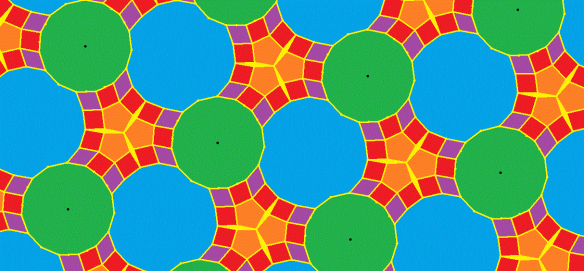
A Tiling of a Plane, Using Diconcave Octagons, Rhombi, and Two Types of Kites

Image

kites of two types and rhombi and diconcave octagons

Fractiles’ Mandala, Based on Angles of Pi/7 Radians

fractiles7withblackbackground

Although this was based on something I constructed using the Fractiles-7 magnetic tiling toy, I did not have enough magnetic pieces to finish this. The idea was, therefore, converted into a (non-Euclidean) construction using Geometer’s Sketchpad, and then refined using MS-Paint. The reason I describe this as a non-Euclidean construction is that an angle of pi/7 radians, such as the acute angles in the red rhombi, cannot be constructed using compass and unmarked straight edge: antiquity’s Euclidean tools. The other angles used are whole-number multiples of pi/7 radians, up to and including 6pi/7 radians for the obtuse angles of the red rhombi.

The yellow rhombi have angles measuring 2pi/7 and 5pi/7 radians, while the blue rhombi’s angles measures 3pi/7 and 4pi/7 radians. None of these angles have degree measures which are whole numbers. It is no coincidence that 7 is not found among the numerous factors of 360. It is, in fact, the smallest whole number for which this is true.

I have a conjecture that this aperiodic radial tiling-pattern could be continued, using these same three rhombi, indefinitely, but this has not yet been tested beyond the point shown.

Beginning the Fractiles-7 Refrigerator Experiment

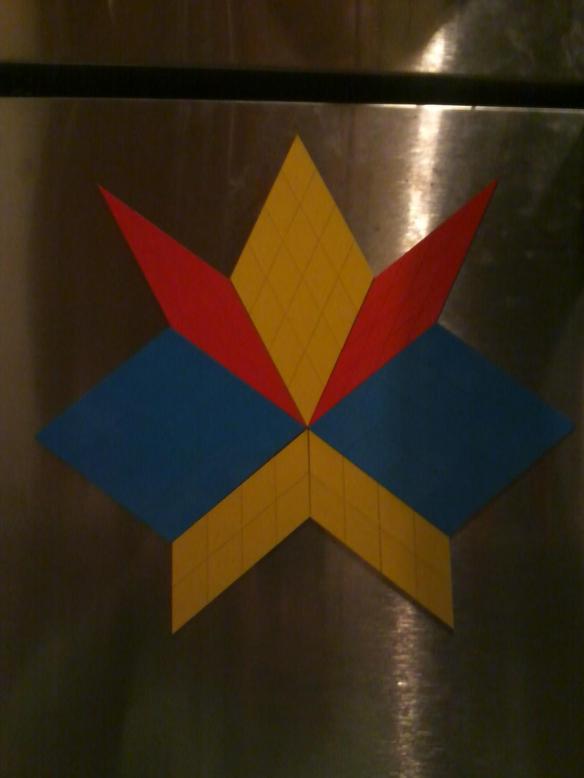
To begin this experiment, I first purchased two refrigerator-sized Fractiles-7 sets (available at http://fractiles.com/), and then, early on a Sunday, quietly arranged these rhombus-shaped magnets on the refrigerator in our apartment (population: 4, which includes two math teachers and two teenagers), using a very simple pattern.

160207_0000

Here’s a close-up of the center. There are 32 each, of three types of rhombus., in this double-set, for a total of 96 rhombic magnets, all with the same edge length.

160207_0001

The number of possible arrangements of these rhombi is far greater than the population of Earth.

The next step of the experiment is simple. I wait, and see what happens.

It should be noted that there is a limit on how long I can wait before my inner mathematical drives compel me to play with these magnets more, myself — but I do not yet know the extent of that limit.

Two Color-Patterns of a Tessellation Using Squares, Rhombi, Equilateral Hexagons, Tetraconcave Octagons, and Regular Octagons

new tessnew tess 2

Octagons Can Tile a Plane III

Unlike my previous octagon-tiling discoveries (see previous post), this is a chiral, radial tessellation, with the colors chosen to highlight that fact.

tessoct radial

Octagons Can Tile a Plane II

In April 2014, I found a tessellation of the plane which uses two kinds of octagons — both types equilateral, but only one type regular.

Now, I have found two more ways to tessellate a plane with octagons, and these octagons are also equilateral. However, in these new tessellations, only one type of octagon is used. One of them appears below, twice (the second time is with reversed colors), and the other one appears, once, in the next post.

tessoct

tessoct 2

Sprawling Golden Tiling, in Progress

Image

sprawling golden tiling

Two Colorings of a Tessellation Featuring Regular Polygons with 24 Sides

tess24tess24b

Tessellation Featuring Regular Pentagons and Regular Pentadecagons

tess new

Other polygons included in this tessellation include several types of rhombi, as well as triconcave octadecagons. The pattern is chiral, but the chirality is subtle. (Hint: look near the pentagons.)

Awake

Image

awake