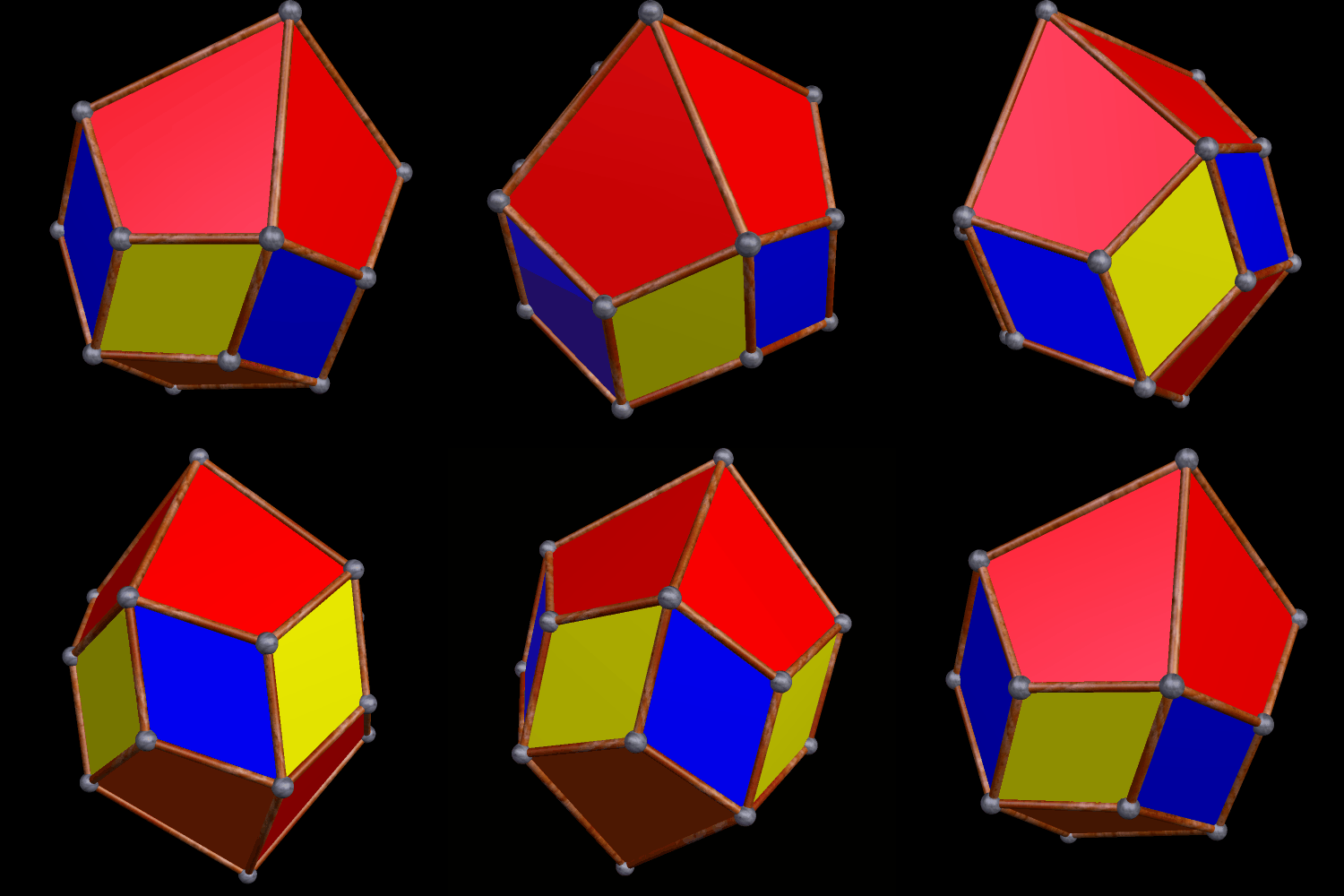
Five Polar Polyhedra

Most polyhedra I post have cuboctahedral, tetrahedral, or icosidodecahedral symmetry, or some pyritohedral or chiral variation of one of these symmetry-types. These, however, are exceptions. I call them “polar polyhedra” because they each have an identifiable “North Pole” and “South Pole,” which are, in three of these five images, at the ends of their axes of rotation.

cub isomorph polar and chiral Compound of enantiomorphic pair

polar and chiral cubic isomorpth

Dual Morph 50.0%

polar polyhedrarhombus-elongated trapezohedron with n = 4

These rotating images were created using Stella 4d, software you may try for yourself, right here.

Richard Feynman Explains When Rules Are Wrong

Image

richard-feynman quote

Richard Feynman, on Uncertainty in Science

Image

richard-feynman quote

On Teaching Students with Asperger’s Syndrome


teaching Aspies

Teaching students with Asperger’s Syndrome is a challenge. As a teacher who also has Asperger’s, I have some suggestions for how to do this, and wish to share them.

  1. Keep the administrators at your school informed about what you are doing.
  2. Know the laws regarding these matters, and follow them carefully. Laws regarding confidentiality are particularly important.
  3. Identify the special interest(s) of the student (these special interests are universally present with Asperger’s; they also appear, sometimes, with students on other parts of the autism spectrum). Do not expect this/these special interest(s) to match that of anyone else, however — people with Asperger’s are extremely different from each other, just as all human beings are. As is the case with my own special interests in mathematics and the “mathy” sciences, it’s pretty much impossible to get students with Asperger’s to abandon their special interest — and I know this because I, quite literally, cannot do much of anything without first translating it, internally, into mathematical terms — due to my own case of Asperger’s. Identifying the special interest of a student with Asperger’s requires exactly one thing: paying attention. The students themselves will make it easy to identify their special interest; it’s the activity that they want to do . . . pretty much all the time.
  4. Find out, by carefully reading it, if the student’s official Section 504 document, or Special Education IEP, permits item #5 on this list to be used. If it doesn’t, you may need to suggest a revision to the appropriate document. (Note: these are the terms used in the USA; they will be different in other countries.)
  5. Of things done in class which will be graded, if the relevant document permits it, alter them in such a way as to allow the student to use his or her special interest to express understanding of the concepts and ideas, in your class, which need to be taught and learned. This is, of course, the most difficult step, but I cannot overemphasize its importance.
  6. Use parental contact to make certain the parent(s) know about, and agree with, the proposed accommodations/modifications. (504 students get accommodations, while special education students receive modifications. Following both 504 plans, and Special Education IEPs, is not optional for teachers — it is an absolute legal requirement, by federal law, and the penalties for failure to do so are severe. It is also, of course, the ethical thing to do.)
  7. Do not make the mistake of punishing any student for behavior related to a documented condition of any kind, including Asperger’s Syndrome.

The Tragedy of Modern American History

usa outline map

The tragedy of modern American history: we fought our bloodiest war to date, and ended slavery, in the 1860s. Race, a difficult issue in the USA, to say the least, could have started to become less of an issue — at that point.

But . . . this didn’t happen. Instead, the “Jim Crow” era began, and, as a nation, we foolishly let it run for roughly another century before fixing that, and even then, we’ve left large parts of this problem unfixed, to this day — such as the problems that underlie high-profile police-brutality cases, which usually involve Black men being clobbered, to, or near, the point of death — by alleged “public servants,” who do a great disservice to the actual men and women of honor (yes, they do exist) who wear police uniforms. It is the fault of these “criminal cops” that police officers are not widely trusted, nor liked, in many African American communities.

All this, and Americans actually wonder why such things as an academic achievement gap still exist? Hint: DNA has absolutely nothing to do with it. The cause of this “gap” is easy to see: entrenched, pervasive racism, and the perfectly-understandable reaction to it, from a population with every reason to be utterly sick of being treated as less than fully human.

It’s 2015: well into the 21st Century. This situation is both absurd, and shameful.

Daredevil Fan-Fiction: Why Did Matt Murdock’s Mother Leave His Father?

150926_0000

I will start with an introduction, to set the context of this story.

In the issue of Superior Iron Man shown above (#4, published in 2015), Tony Stark, also known as Iron Man (having had a “moral inversion,” or good/evil reversal), is the villain of the story, while Matt Murdock, also known as Daredevil, is the hero. It isn’t a typical comic book, for, in this story, the bad guy wins. Stark uses advanced technology to overpower Murdock, and then this happens, near the end of the issue.

150926_0001

In the next panel, Matt wakes up, in a hospital, with no memories of the conflict with Stark.

150926_0002

It is important to note that, earlier in this multi-issue story, which begins in Superior Iron Man #1, Stark restores Murdock’s ability to see. Realizing that the price of this is far too high, Murdock deliberately shuns this “gift” from Stark, and voluntarily allows his blindness to return.

Now that the stage is set, on to the fan-fiction, which takes place, mostly, in the mind of Matthew Murdock, who is also an attorney, in-between the two panels shown above.

~~~

Matt Murdock was blinded in a childhood accident, so he is used to darkness — but the darkness now enveloping him is far emptier than usual. His enhanced senses are gone. Hearing nothing, smelling nothing, tasting nothing, feeling nothing, and his “radar-sense” gone, he is now blind — really blind. Deprived of all sensory input, he also has no idea what is going on. However, he can think, and can also remember.

The first thing he remembers is a single name: STARK!

That name triggers a recent memory: the brief, recent period where one of Tony Stark’s inventions restored his sight. For a time — an unknown amount of time — he simply watches, as if watching a TV show, the things he saw during this short time. The show plays itself out, as if on a large screen. His anger at Stark forgotten, Matt watches the show of his recent memories, as one might passively watch a movie. He feels he is floating, in a void, as he watches. As this “movie” plays, there is a sudden freeze-frame: the pictures stop moving. Context is immediately forgotten. All he sees is a single image, which is what he happened to be looking at when the “movie” of his recent memories was suddenly, and unexpectedly, put on “pause.”

150926_0004

A jar of peanut butter? Why did the images freeze at this spot? What’s going on? Did I see this in a store? Did I see it in my home? Where did I . . . ?

Daredevil is popularly-known as “The Man Without Fear,” but he’s always known that this description is inaccurate. For example, he fears the possibility of those he loves getting injured, or killed, by any of his numerous enemies, because of his exploits as a costumed hero — for that has already happened to him, more than once. He also realizes that he fears something else, but only if he sees it: peanut butter.

Peanut butter? Why that, of all things?

An earlier, strongly-repressed, memory then surfaces, and a great many things fall painfully into place for Matthew Murdock.

Oh, no . . . anything but this . . . . 

He is no longer seeing recalled memories from a few days ago, but from early childhood — before the accident that blinded him. He was very young, had a bad head cold, and could smell nothing, explaining why the smell of peanut butter never triggered this memory before.

Young Matthew looks around. He sees the kitchen of his childhood home. His parents, Jack and Margaret Murdock, are still together. He is wearing the clothes of a toddler, because that is what he was at this time. He’s on top of a counter in the kitchen, having climbed up there, using chairs to make a crude “staircase.” And there, on the floor, is a five-pound jar of peanut butter, surrounded by shards of broken glass. 

Matt, as a toddler, had only been looking for some cookies. He had not meant to knock his father’s gigantic glass jar of peanut butter off the counter, but the deed was done. The jar was broken, and could not be unbroken. There was broken glass in the peanut butter now; it could not safely be eaten. His family didn’t have much money, for his father’s career as a professional boxer was going nowhere, and his mother only made a little money, at the elementary school down the street, working as a substitute teacher. “Battlin’ Jack” Murdock, whom the adult Matt Murdock had idolized for years, was eating as much peanut butter as he could, simply to gain weight, and protein, in the hopes that this would, somehow, make him a better boxer.

The crash of the glass jar hitting the floor echoed throughout the family’s small Hell’s Kitchen apartment. With his earliest memories now unlocked, he knew what was coming next. Matt tried desperately to stop the memory-playback.

He failed, and his mind filled with fear.

Loud footsteps . . . Dad? No! Please, please don’t . . . I don’t need to see this happen again . . . not again . . . . never again . . . .

“MATT!” His father had just burst into the room, having heard the crash. He saw the broken jar of peanut butter on the floor. His son started to cry, afraid of what he knew, in hindsight, was about to happen. “You clumsy little %$#@! Do you have any idea how much that jar COST me?” An incoherent, deep-voiced, roar of rage followed — and the noise from his father seemed louder than anything the adult Murdock had ever heard, even from his arch-enemy, Wilson Fisk, the Kingpin of Crime, and even with his enhanced senses taken into account.

Matt’s father, already drunk, in the middle of the afternoon, kept yelling at his son: “I’ll KILL you for this, you worthless little son of a &*%$#!!”

And, with that, the enraged “Battlin’ Jack” Murdock grabbed his only son, by both shoulders, with his son facing him, and started shaking him as hard as he could. Young Matt’s head flopped back and forth, rapidly, just like a worn-out rag doll. Matt heard a sharp “crack!” sound from one of the bones in his neck. The shaking continued.

The adult Matt Murdock then remembered a legal case he had refused to take, over ten years earlier, defending a man who was then put on trial for murdering his son via shaken baby syndrome, which can kill children up to the age of three. Later, he learned the man had not only been convicted, but eventually put to death — the last legal execution in the state of New York, for killing his 2½-year-old son. He remembered smiling when he learned of this, but had not known, at the time, why this news had made him happy.

Now, all at once, he knew.

Luckily for Matt, the toddler, help was on the way. School had been dismissed, and his mother, Margaret Murdock, was just arriving home. She walked in on the most horrible scene she had ever witnessed: her husband attacking their only child.

She didn’t hesitate, and had, fortunately for her young son, entered the apartment unseen by “Battlin’ Jack.” She ran at her husband, a trained boxer, jumped onto his back, and began clawing at her husband’s face with every ounce of strength she could find, screaming as she did so. Not only that, but it worked — she saved her son’s life. 

“You rotten little %$#@*! This is all YOUR fault!” She had saved Matt, but only by getting her husband to redirect his fury at the only other target available — herself. This was not the first time Jack Murdock had beaten his wife, but it was the worst beating she ever took from him, and it was also the last such beating.

This was the last time Matt Murdock ever saw his mother — and, until many years later, as an adult, this was also the last time Matt heard her voice. Unknown to her son, or her monster of a husband, she escaped, to a shelter for battered women at a nearby church, but was unable to take young Matthew with her — her husband changed the locks after she left, and she was not able to gain access to him, in order to rescue him. She did, however, make contact with a friend who worked with New York’s Child Protective Services agency, and begged her friend for her help. She was (incorrectly, she later found out) told that, with no hard evidence available, there was no point in calling the police: an arrest of Jack Murdock would be, she was informed, impossible. However, she did convince her friend to have CPS keep an eye on the situation, for years, in order to ensure her son’s safety.

The toddler Matt, of course, knew none of this. In fact, even as an adult, he never did find out about the CPS-monitoring which his mother had arranged, for his protection.

As his mother was savagely beaten, young Matt laid limp, on the floor, his neck forming a very odd-looking angle, as the result of the trauma he had suffered. He could not move, nor could he speak, for he was in shock for over an hour. He could, however, see and hear. He heard his mother crying, and screaming, as her husband continued to beat her. He saw two of his mother’s bloody teeth fly across his field of vision. He heard some of her bones break, but could not turn his head to see which ones the monster of their lives had broken. He saw a calendar on the wall, and his adult self did the math, and figured out how old he had been when this happened: two and a half years old.

This was now Matt Murdock’s earliest memory — but not for long. The weapon Tony Stark had designed, built, and used against him was programmed to seek out (and record) a person’s most traumatic, but still repressed, memory, and then force them to relive it, vividly, and, next, allow that person to suppress the memory once again — and then keep going, wiping out all memories for several days before the device was activated. When Matt Murdock awoke in the hospital, he remembered nothing about either the conflict with Stark, or with his father. However, Tony Stark examined the recorded data about Murdock’s childhood, and filed it away, in case he ever decides to use it. And, of course, Matt Murdock’s earliest memory is not gone, but merely repressed. If Stark’s technology ever fails, which is certainly possible, these memories could always come back.

Tony Stark now understands Matt Murdock’s prime motivation for putting on a devil costume (despite the fact that he is Catholic), going out almost every night, and selectively beating only those people who seriously deserve to be beaten, and Stark enjoys knowing that he is the only person in the world with this information, to use however he sees fit, at any time.

150926_0003

~~~

CREDITS

I took the picture of the jar of peanut butter myself. All other images in this post are from Superior Iron Man #4, published by Marvel Comics, written by Tom Taylor, penciled by Yildiray Cinar, and with cover art created by Mike Choi. For other credits, I refer you to this comic book.

The “fuzziness” of the comic book images is deliberate, and done with the intent of avoiding copyright infringement, while leaving the dialogue readable.

While writing this short story, I made every effort to keep it consistent with the decades-long story of Matt Murdock / Daredevil, a work which has involved dozens of talented people. Without their work to build on, I could not have written this story.

The information in this story regarding shaken baby syndrome is factual, as of the date of publication. A search of medical sources with Google will reveal that it does kill large numbers of babies, as well as children up to age three. Everyone needs to know this: shaking can kill babies and young children. In this story, Matt Murdock survived. In real life, the author of this short fan-fiction story also survived; it is my earliest clear memory. Not everyone survives shaken baby syndrome: 25% of us die, and of those who survive, 80% have to deal with permanent damage.

Obviously, I’m among those who survived, but I’m also among the 80% of survivors with permanent damage. PTSD doesn’t just “wear off” once you get it, either . . . or at least, I haven’t found a cure for mine yet.
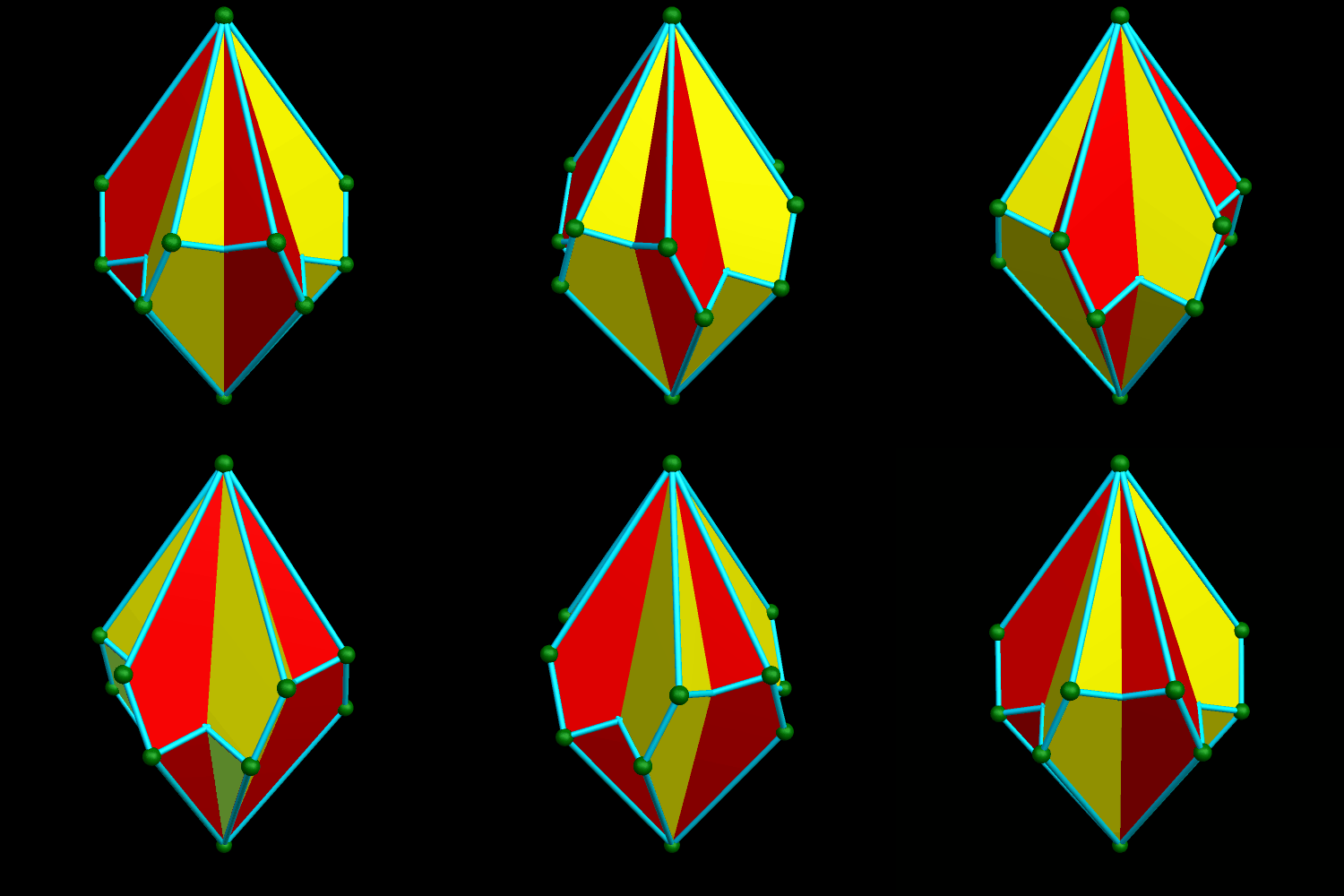
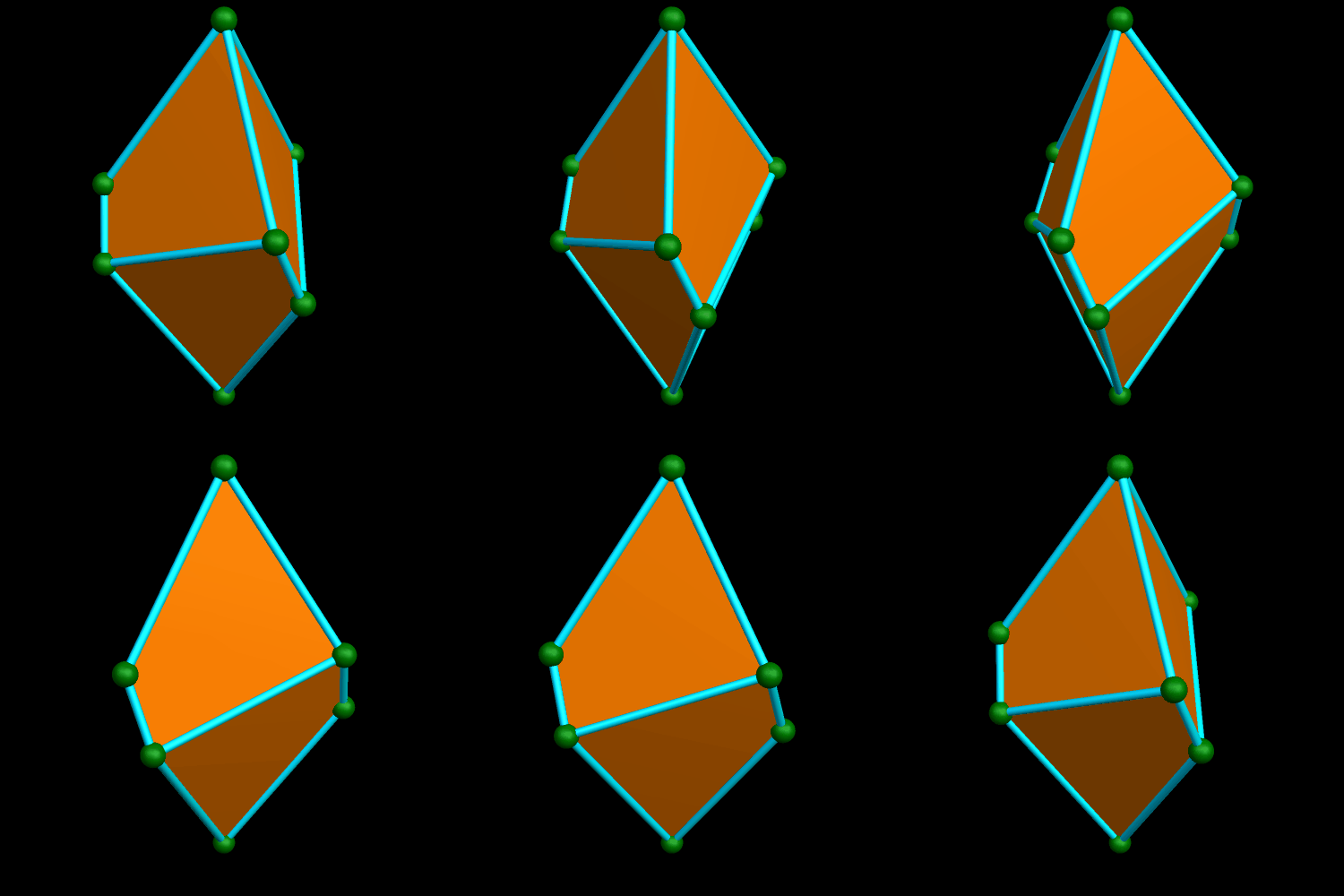
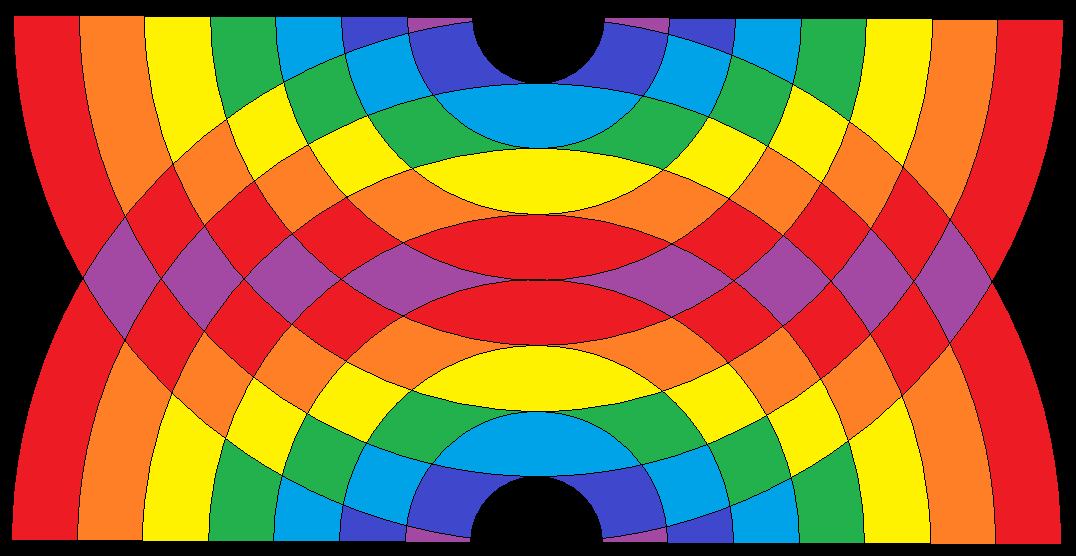
Reflected Rainbows

Image

complicated

My Mental Jukebox

NOTES

My mental jukebox’s default setting is “on,” which is nice. Usually, I can even consciously choose what to listen to, and it doesn’t cost me a cent.

A Plea for Consistency in the Use of Numerical Prefixes

consistency

First, let’s face facts: the numerical prefixes currently in use, in English, are a horrible mess. Most of the ones used with polyhedra, for example, such as tetra- (4) and penta- (5), are derived from Greek. For polygons, however, a four-sided figure is usually called a quadrilateral, with “quad-” derived from Latin, just as it is in “quadrillion,” or “quadruplets.” Why use two prefixes for the number four? It would be more consistent (and therefore better), since four-faced polyhedra are called tetrahedra, for four-sided polygons to be called tetragons, just as we call five-sided polygons pentagons. Consistency improves comprehension, simply by reducing the number of prefixes one needs to understand, and can therefore aid in both teaching and learning. Inconsistency, though, has the opposite effect, and that benefits no one.

The Greek-based prefix for 5, “penta-,” has a Latin-based rival, also: “quint-,” as in quintuplets, or the number quintillion. It doesn’t make sense to use two different prefixes for the same thing, for both English, and mathematics, are complicated enough without adding unnecessary complications. The necessary complications are quite enough!

My preference is for Greek-based prefixes, for two reasons: (1) more of them are in use than their Latin counterparts, and (2) the Latin-speaking Romans appropriated ideas from the ancient Greeks, not the other way around.

Even the number one is not immune from this problem. For one, we use “mono-,” “uni-,” “un-,” “uni-,” “en-, “and “hen-,” all to mean “one,” and each has at least a slightly different derivation. Examples include “monomer,” “monologue,” “unicycle,” “undecillion,” “undecagon,” “endecagon,” and “hendecagon,” the last three of which all name the same polygon. (Also, these last three prefixes are for 11, actually, formed by combining a prefix for the one with the Greek-based “deca-” prefix for ten. Combinations of prefixes will be addressed later.) I call 11-sided polygons “hendecagons,” for both prefixes in that word are derived from Greek.

Prefixes for the number two are also unnecessarily numerous, as well as ambiguous. “Bi-” is used in “bicycle,” “binary,” and “billion,” but that’s a horrible idea, since “bi-” is also used, in some cases, for ½. This shows up, for example, in chemistry: the bulk of a carbonic acid molecule, if fully ionized, is called the carbonate ion. However, if it is only half-ionized, it is often called the bicarbonate ion, as in sodium bicarbonate, better-known as baking soda. In chemistry, “di-” is used for two, as in carbon dioxide, a molecule containing two oxygen atoms. “Do-” and “duo-” are also both used for the number two, with the first derived from Greek, and the second from Latin. When combined with the Greek prefix for ten, to make twelve, these prefixes appear in words such as “dodecagon,” “dodecahedron,” and “duodecimal.” I find the word “duodecimal” particular irritating, for it combines Greek and Latin prefixes in a single word. If one person had deliberately designed this entire system, with the goal of causing confusion, it would have taken a lot of work to invent a system more confusing than the one we actually use.

If, for ½, we only used “bi-,” that would be nice, but that isn’t what we do. Half a circle is a semicircle, and then half a sphere is a hemisphere. Since it originates from Greek, my preference is for “hemi-.”

At least three’s prefix is usually consistent, with “tri-” being all-but-universal. The only exception I know of appears when “tri-” is combined with “deca-,” to create a prefix for thirteen, and the Greek work for “and,” which is “kai,” often appears with it, as in triskaidecaphobia, the fear of the number thirteen — in this word, “tri-” is modified to “tris-.” However, a thirteen-sided polygon is simply called a “tridecagon,” with no “s” attached to “tri-,” and the “kai” omitted.

I don’t actually care if we use “kai,” or not, in numerical prefixes, but we should pick one or the other, and stick with it. It makes no sense that a fifteen-sided polygon is usually called a “pentadecagon,” while sometimes called a “pentakaidecagon.” Why do we not simply choose just one?

Six and seven are similarly troublesome. The numbers “sextillion” and “septillion,” as well as the month of September, all use Latin-derived prefixes for these numbers. I prefer the Greek-derived prefixes used with polygons and polyhedra: “hexa-,” and “hepta-.” With eight, though, as in the case of three, English-speakers lucked out, with “octopus,” “octillion,” “octagon,” and “octahedron” all starting with the same three letters.

With nine, however, our system falls apart again. In high school, geometry students are taught the Latin-prefix-containing word “nonagon” for a nine-sided polygon, and “November” contains yet another Latin-based prefix meaning nine. (It was named the ninth month, rather than the eleventh, because the start of each new year was marked with the first day of Spring in ancient times, rather than the first day of January.) A professional mathematician, however, is more likely to call a nonagon an “enneagon,” for “ennea-” is derived from Greek, making “enneagon” consistent with its “neighbors,” the octagon and the decagon. Ten is not a problem, though, for the Greek-based “deca-” was simply appropriated by the Latin-speaking Romans, who named their tenth month December — using a prefix close enough to “deca-” that it is unlikely to cause confusion.

One numbers exceed ten, though, a new problem is encountered, in addition to the issue of whether or not we use “kai.” Numbers such as 12 and 24 require us to combine prefixes, but there is no consistency in the order in which this is done. For example, a twelve-faced polyhedron is a “dodecahedron” — using a prefix for two, followed by a prefix for ten: the smaller number, and then the larger number. We continue this practice with words such as “pentadecagon,” already described above. Then, however, we have this thing, the dual of the snub cube:

Penta Icositetra

The faces of this polyhedron are 24 pentagons, and it isn’t the only well-known polyhedron with 24 faces, so “pentagonal” is part of this polyhedron’s name, which makes sense. However, if its name followed the pattern in the paragraph above, that would make it a “pentagonal tetraicosahedron,” or perhaps a “pentagonal tetrakaiicosahedron” — the smaller “tetra-,” meaning “four,” would come before the larger “icosa,” meaning twenty. At least both these prefixes originated in the Greek language, but, for mysterious reasons, the prefixes are put in the reverse order, relative to the order used for the dodecahedron: it is called the “pentagonal icositetrahedron.” Polyhedral names are hard enough to learn without arbitrary switches between “smaller, then larger,” and its opposite, “larger, then smaller.” We should choose a method, one or the other, and then stick to it.

[Note: the rotating polyhedron above was created using Stella 4d, software you can buy, or try for free, at this website.]

In chemistry, naming-disputes (what to call a newly-synthesized element, for example) are settled by the IUPAC: the International Union of Pure and Applied Chemistry. I know of no organization with a corresponding role in the field of mathematics, but, if one were created, perhaps that would help get this mess cleaned up.

On John Lennon’s 1971 Song, and Song Title, “How Do You Sleep?”

This is one of the most vicious, cutting songs ever written. Here is a video for it, so you can hear it for yourself, and see the things to which the song refers.

https://www.youtube.com/watch?v=coeW1GJJ6Qs

It was, of course, written targeting one specific person, but it isn’t difficult to listen to it, and think of other people to whom this question could — and perhaps should — be asked. In other words, there is no reason, in today’s world, to limit this song to merely being an “attack song” against Paul McCartney, although that was certainly John Lennon’s intent when he wrote it.

When anyone does horrible things — far worse than anything McCartney ever did — this song’s title makes a good question one could ask them: how do you sleep?

After thinking about it, I have come up with five possible answers.

  1. Some people lack a conscience, and so are untroubled by guilt — ever — no matter what they do.
  2. Delusional people can do horribly evil things, but be convinced that they are moral, righteous, and doing what they should be doing. If you have never encountered such behavior, consider yourself fortunate.
  3. Sometimes, people are simply ignorant of how harmful their actions have been. One cannot feel guilty over harm one does not know one caused.
  4. Even those who are tormented by their own consciences, and past actions, can still sleep with the aid of sedatives, whether over-the-counter, or prescribed. This is risky, of course, and should only be done under the care, and following the instructions, of a physician. (Yes, I am aware that illegal drugs — or legal ones that aren’t considered medicines, such as alcohol — can also be used for this purpose, but that’s even more risky, and I wish to make it perfectly clear that I strongly advise against doing that.)
  5. Narcolepsy.

If you can think of any others, please leave them in a comment.