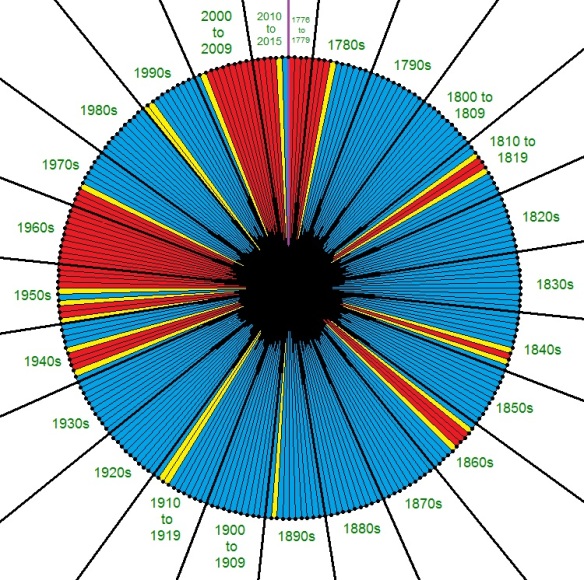
The yellow years are ones in which the USA was getting into or out of major wars — or both, in the case of the brief Spanish-American War. The red years are war years, and the blue years are years of (relative) peace.
The sectors are each bounded by two radii, and a 1.5° arc. The current year is omitted intentionally because 2016 isn’t over yet, and we don’t know what will happen during the rest of it.
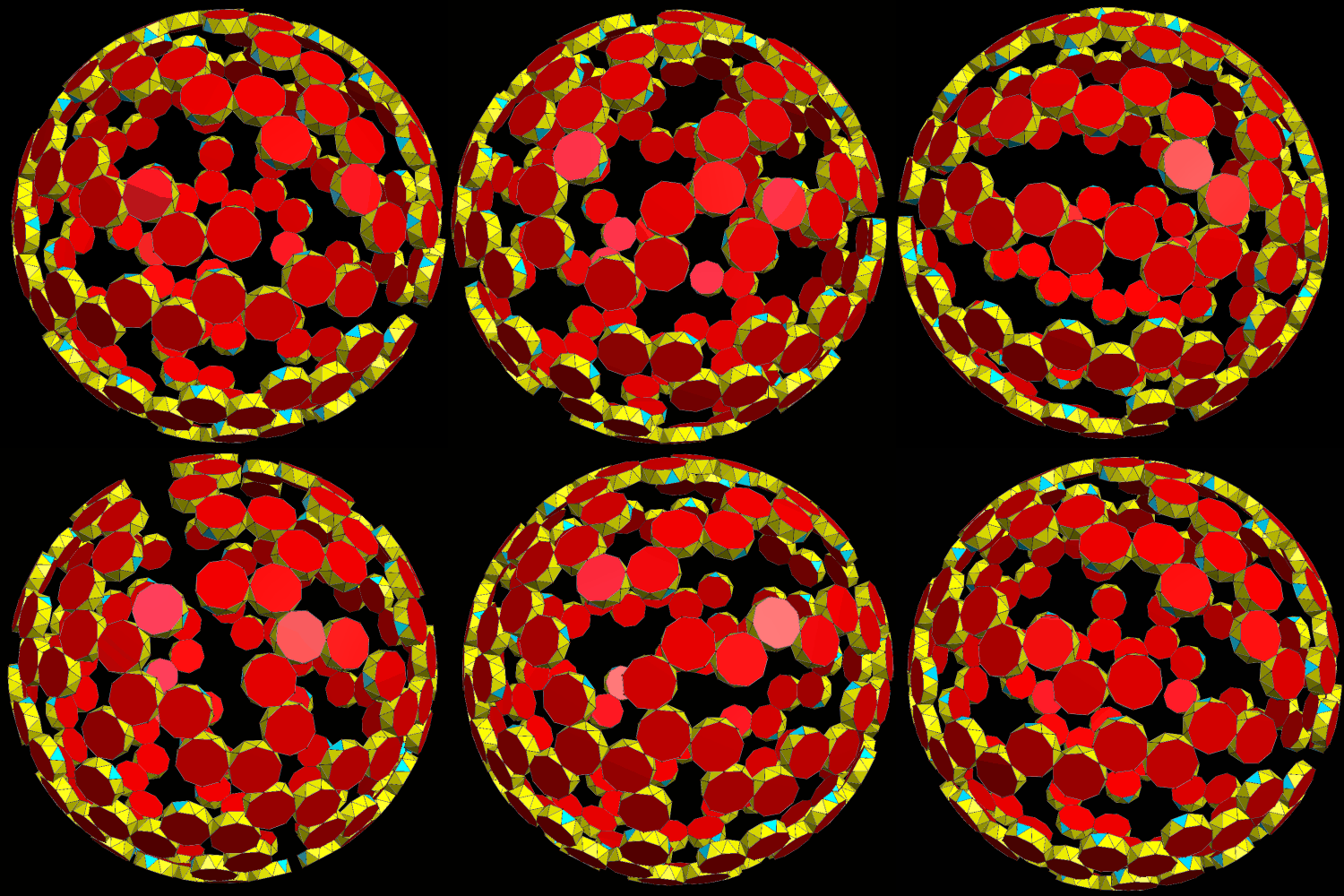
The images above all show a particular faceting of the rhombicosidodecahedron which, to my surprise, is hollow. It has the vertices of a rhombicosidodecahedron, but two different face-types, as seen in the smaller pictures: yellow hexagons, and red isosceles trapezoids. (To enlarge any image in this post, simply click on it.)
The dual of this polyhedron is even more obviously hollow, as seen below. Its faces, as seen in the still picture, are crossed hexagons — with edges which cross three times per hexagon, no less.
The software I used to make these polyhedra, Stella 4d, will return an error message if the user attempts to make a polyhedron which is not mathematically valid. When I’ve made things that look (superficially) like this before, I used “hide selected faces” to produce hollow geometrical figures which were not valid polyhedra, but that isn’t what happened here (I hid nothing), so this has me confused. Stella 4d (software you can buy, or try for free, here) apparently considers these valid polyhedra, but I am at a loss to explain such familiar concepts as volume for such unusual polyhedra, or how such things could even exist — yet here they are. Clarifying comments would be most appreciated.
Above is a dodecagonal antiprism, augmented by 24 more dodecagonal antiprisms. This was the starting point for making all the polyhedra below, using Stella 4d, software available here. Each of these smaller pictures may be enlarged with a click.
Before an undertaking as great as building a Dyson Sphere, it’s a good idea to plan ahead first. This rotating image shows what my plan for an enneagonal-antiprism-based Dyson Sphere looked like, at the hemisphere stage. At this point, the best I could hope for is was three-fold dihedral symmetry.
I didn’t get what I was hoping for, but only ended up with plain old three-fold polar symmetry, once my Dyson Sphere plan got at far as it could go without the unit enneagonal antiprisms running into each other. Polyhedra-obsessives tend to also be symmetry-obsessives, and this just isn’t good enough for me.
If we filled in the gaps by creating the convex hull of the above complex of enneagonal antiprisms, in order to capture all the sun’s energy (and make our Dyson Sphere harder to see from outside it), here’s what this would look like, in false color (the real thing would be black) — and the convex hull of this Dyson Sphere design, in my opinion, especially when colored by number of sides per face, really reveals how bad an idea it would be to build our Dyson sphere in this way.
We could find ourselves laughed out of the Galactic Alliance if we built such a low-order-of-symmetry Dyson Sphere — so, please, don’t do it. On the other hand, please also stay away from geodesic spheres or their duals, the polyhedra which resemble fullerenes, for we certainly don’t want our Dyson Sphere looking like all the rest of them. We need to find something better, before construction begins. Perhaps a snub dodecahedron? But, if we use a chiral polyhedron, how do we decide which enantiomer to use?
[All three images of my not-good-enough Dyson Sphere plan were created using Stella 4d, which you can get for yourself atthis website.]
For detailed information on this newly-discovered polyhedron, which is near (or possibly in) the “fuzzy” border-zone between the “near-misses” (irregularities real, but not visually apparent) and “near-near-misses” (irregularities barely visible, but there they are) to the Johnson solids, please see the post immediately before this one. In this post, I simply want to introduce a new coloring-scheme for the chiral tetrated dodecahedron — one with three colors, rather than the four seen in the last post.
In the image above, the two colors of triangle are used to distinguish equilateral triangles (blue) from merely-isosceles triangles (yellow), with these yellow triangles all occurring in pairs, with their bases (slightly longer than their legs) touching, within each pair. This is the same coloring-scheme used for over a decade in most images of the (original and non-chiral) tetrated dodecahedron, such as the one below.
Both of these images were created using polyhedral-navigation software, Stella 4d, which is availablehere, both for purchase and as a free trial download.
[Later edit: I have now found out I was not the first person to find what I had thought, earlier today, was an original discovery. What I have simply named the chiral tetrated dodecahedron has been on the Internet, in German, since 2008, or possibly earlier, and may be seen here: http://3doro.de/polyeder/.]
The images above show a new near-miss (to the Johnson solids) candidate I just found using Stella 4d, software you can try here. Like the original tetrated dodecahedron (a recognized near-miss shown at left, below), making this polyhedron relies on splitting the Platonic dodecahedron into four three-pentagon panels, moving them apart, and filling the gaps with triangles. Unlike that polyhedron, though, this new near-miss candidate is chiral, as you can see by comparing the left- and right-handed versions, above. The image at the right, below, is the compound of these two enantiomers.
Next are shown nets for both the left- and right-handed versions of the chiral tetrated dodecahedron (on the right, top and bottom), along with the dual of this newly-discovered polyhedron (on the left). Like the rest of the images in this post, any of them may be enlarged with a click.
A key consideration when it is decided if the chiral tetrated dodecahedron will be accepted by the community of polyhedral enthusiasts as a near-miss (almost a Johnson solid), or will be relegated to the less-strict set of “near-near-misses,” will be measures of deviancy from regularity.The pentagons and green triangles are regular, with the same edge length. The blue and yellow triangles are isosceles, with their bases located where blue meets yellow. These bases are each ~9.8% longer than the other edges of the chiral tetrated dodecahedron. By comparison, the longer edges of the original tetrated dodecahedron, where one yellow isosceles triangle meets another, are ~7.0% longer than the other edges of that polyhedron. Also, in the original, the vertex angle of these isosceles triangles measures ~64.7°, while the corresponding figure is ~66.6° for the chiral tetrated dodecahedron.
[Later edit: I have now found out I was not the first person to find what I had thought, earlier today, was an original discovery. What I have simply named the chiral tetrated dodecahedron has been on the Internet, in German, since 2008, or possibly earlier, and may be seen here:http://3doro.de/polyeder/.]
This happened near the end of Summer school, about four years ago. I haven’t been able to write about it until now, but my life is now separated into the unknowing part before this day, when I was so often angry without knowing why, and the part after I painfully found the truth which explains this anger.
The three-second video above was correct — for weeks afterwards, I couldn’t handle the truth, and was having one PTSD attack after another as a result. There was a break between Summer School and the resumption of the normal school year in the Fall, and that’s a good thing, because I had a lot of “repair work” to do before I was fit to be around large numbers of people again.
All of this followed what I refer to as a “proselytizing attack.” The person aggressively proselytizing to meat me was also a teacher, and the only thing he did right was to avoid this activity in the presence of students. In another religion, one inflicted on my family, by my father, when I was a teenager (Soka Gakkai, a variant of Buddhism), the technique he used is called shakabuku, which translates from the Japanese as “bend and flatten” — although this teacher was, of course, using a Christian version of shakabuku. My entire family was subjected to these efforts to “bend and flatten” us, during my father’s four or so years as a practicing Soka Gakkai member. Many years earlier, before I was born, he had actually been a minister in a certain Protestant Christian denomination. There were many other “religions of the year” my father dragged us to, as I was growing up. If one wishes to raise a skeptic, that method is quite likely to work, but I would hardly call it good parenting.
I tried to politely end these unpleasant after-school conversations, explaining to the other teacher that I only have two ways which work, for me, to gain confidence in ideas: mathematical proof, and the scientific method. What he was looking for was faith, a different form of thinking, and one which is alien to me — my mind simply will not “bend” in such a direction, which helps explain why proselytizing efforts of the “bend and flatten” variety never have the desired effect with me.
Polite efforts to end this rude behavior repeatedly failed. No one else was nearby at the moment I finally snapped — so I could say whatever I wanted to the other teacher, while remaining unheard by others.
“Listen,” I said, “do you really want to know how to get fewer atheists in the world? I can tell you exactly how to do that.”
He said that, yes, of course, he did want to know how to do this.
“Here’s how,” I said. “It’s simple, really. Just tell your fellow Christians to stop raping children!”
He had no reply, for, in the wake of such things as the Catholic Church’s pedophilia scandal, and similar scandals in other churches, there is no satisfactory reply to such a statement. The truth of it is self-evident (provided one does not generalize the statement to encompass all Christians, for that would clearly be false), and the message to stop the “Christian shakabuku” had finally penetrated this other teacher’s mental defenses. I then realized something that explained the intensity of my dislike for this man: he used a voice with a hypnotic quality, a trick my father also used to influence, and manipulate, others.
I turned around, walked away, and he did not follow. I returned to my classroom, where I had work left to do, such as preparing for the next school day’s lessons, before leaving. I was also acutely aware that I was in far too heightened an emotional state to safely drive. Therefore, to calm down, I played the following song, at maximum volume, on repeat, perhaps a dozen times, scream-singing along with the vocals, as I prepared my classroom for the next day.
After venting enough fury to be able to safely drive home, I did so . . . and listened to this song some more, along with another song by Muse, the two of which I used to scream myself into exhaustion.
I finally collapsed into sleep, but it wasn’t restful, for I was too angry — for weeks — to ever reach deep sleep. I knew only dark, emerging memories and half-memories, as well as horrific dreams that temporarily turned sleep into a form of torture, rather than a healing process. Not being stupid, I got the therapy I obviously needed, after the proselytizing-attack, and my reaction to it, caused the truth to fall painfully into place. By the time the school year began, I could once again function.
My earliest memory is from age 2 1/2, and involves surviving an attack of a type that often kills infants and young children: shaken baby syndrome. This was described as the “story within the story” told, right here, in the context of Daredevil fan-fiction. It was bad enough when that memory surfaced, but this was even worse. The only “good” thing about what I had learned had been done to me was that it was before age 2 1/2, and, for this reason, could not become a “focused,” clear memory, as my recollection of the near-death-by-shaking is. Instead of sharp memories, I was getting imagery like this . . .
. . . But the intensity of my reaction left me with no doubt about what had happened, at an age when I was too young to defend myself, nor even tell anyone else.
Years later, I even abandoned the term “atheist,” choosing to simply use “skeptic” instead, a switch which angered far more people — atheists, of course — than I ever expected. I now realize a major reason I made that change, and it’s the fact that I have seen so many obnoxious atheists using “atheistic shakabuku” — and I am, for obvious reasons, hypersensitive to any form of shakabuku, whether it be religious or anti-religious. Humans are not meant to be painfully bent, nor flattened, and I want nothing to do with those who engage in such atrocious behavior. Whether they are religious, or not, no longer matters to me — what does mean something is, rather, their lack of respect for their fellow human beings.
To those who do engage in aggressive proseltyzing, I have only this to say: please stop. Even if you played no part in it, there is no denying that abuse, by religious authority figures, has happened to thousands, perhaps millions, of people — and one cannot know which of us have such traumatic events in our personal backgrounds. For this reason, no one knows what harm proselytizing might do to any given person.
[Note: absolutely none of this happened at my current school.]
These two polyhedra are the truncated tetrahedron on the left, plus at least one faceted version of that same Archimedean solid on the right. As you can see, in each case, the figures have the same set of vertices — but those vertices are connected in a different way in the two solids, giving the polyhedra different faces and edges.
(To see larger images of any picture in this post, simply click on it.)
The next three are the truncated cube, along with two different faceted truncated cubes on the right. The one at the top right was the first one I made — and then, after noticing its chirality, I made the other one, which is the compound of the first faceted truncated cube, plus its mirror-image. Some facetings of non-chiral polyhedra are themselves non-chiral, but, as you can see, chiral facetings of non-chiral polyhedra are also possible.
The next two images show a truncated octahedron, along with a faceted truncated octahedron. As these images show, sometimes faceted polyhedra are also interesting polyhedra compounds, such as this compound of three cuboids.
The next polyhedra shown are a truncated dodecahedron, and a faceted truncated dodecahedron. Although faceted polyhedra do not have to be absurdly complex, this pair demonstrates that they certainly can be.
Next are the truncated icosahedron, along with one of its many facetings — and with this one (below, on the right) considerably less complex than the faceted polyhedron shown immediately above.
The next two shown are the cuboctahedron, along with one of its facetings, each face of which is a congruent isosceles triangle. This faceted polyhedron is also a compound — of six irregular triangular pyramids, each of a different color.
The next pair are the standard version, and a faceted version, of the rhombcuboctahedron, also known as the rhombicuboctahedron.
The great rhombcuboctahedron, along with one of its numerous possible facetings, comes next. This polyhedron is also called the great rhombicuboctahedron, as well as the truncated cuboctahedron.
The next pair are the snub cube, one of two Archimedean solids which is chiral, and one of its facetings, which “inherited” its chirality from the original.
The icosidodecahedron, and one of its facetings, are next.
The next pair are the original, and one of the faceted versions, of the rhombicosidodecahedron.
The next two are the great rhombicosidodecahedron, and one of its facetings. This polyhedron is also called the truncated icosidodecahedron.
Finally, here are the snub dodecahedron (the second chiral Archimedean solid, and the only other one, other than the snub cube, which possesses chirality), along with one of the many facetings of that solid. This faceting is also chiral, as are all snub dodecahedron (and snub cube) facetings.
Each of these polyhedral images was created using Stella 4d: Polyhedron Navigator, software available at this website.




 RobertLovesPi.net