The secret to “thinking outside the box” is to never have your thinking put in a box in the first place. Thanks, Mom. This would not have happened to me without you making it happen, and I only just now figured this out.
The secret to “thinking outside the box” is to never have your thinking put in a box in the first place. Thanks, Mom. This would not have happened to me without you making it happen, and I only just now figured this out.

An interesting phenomenon in physics, and physics education, is the simplicity of symmetric situations, compared to the complexity of similar situations which are, instead, asymmetrical. Students generally learn the symmetrical versions first, such as this static equilibrium problem, with the hanging masses on both left and right equal.

The problem is to find the measures of the three angles shown above, with values given for all three masses. Here is the setup, using physical objects, rather than a diagram.
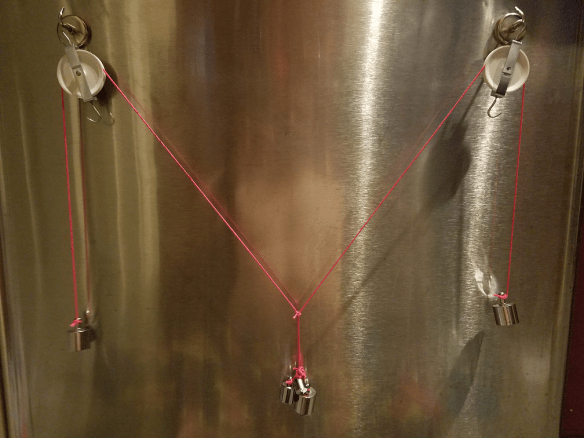
The masses on the left and right are each 100 g, or 0.100 kg, while the central masses total 170 g, or 0.170 kg. Since all hanging masses are in static equilibrium, the forces pulling at the central point (at the common vertex of angles λ, θ, and ρ) must be balanced. Specifically, downward tension in the strings must be balanced by upward tension, and the same is true of tension forces to the left and to the right. In the diagram below (deliberately asymmetrical, since that’s coming soon), these forces are shown, along with the vertical and horizontal components of the tension forces held in the diagonal strings.

Because the horizontal forces are in balance, Tlx = Trx, so Mlgcosλ = Mrgcosρ — which is not useful now, but it will become important later. In the symmetrical situation, all that is really needed to solve the problem is the fact that the vertical forces are in balance. For this reason, Tc = Tly + Try, so Mcg = Mlgsinλ + Mrgsinρ. Since, due to symmetry, Ml = Mr and λ = ρ, Mr may be substituted for Ml, and ρ may be substituted for λ, in the previous equation Mcg = Mlgsinλ + Mrgsinρ, yielding Mcg = Mrgsinρ + Mrgsinρ, which simplifies to Mcg =2Mrgsinρ. Cancelling “g” from each side, and substituting in the actual masses used, this becomes 0.170 kg = 2(0.100 kg)sinρ, which simplifies to 0.170 kg = (0.200 kg)sinρ, then 0.170/0.200 = sinρ. Therefore, angle ρ = sin-1(0.170/0.200) = 58°, which, by symmetry, must also equal λ. Since all three angles add up to 180º, the central angle θ = 180° – 58° – 58° = 64°. These answers can then be checked against the physical apparatus.
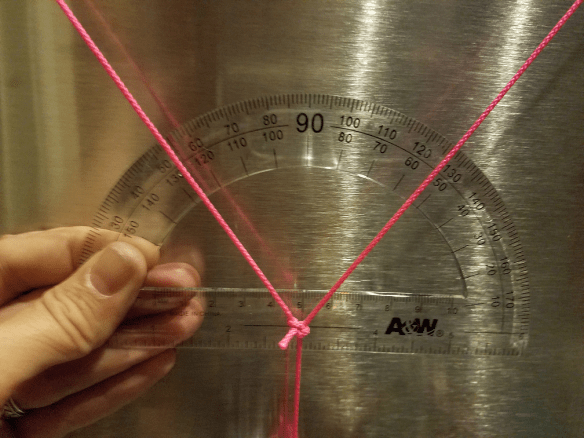
When actually checked with a protractor, the angles on left and right are each about 53° — which is off from the predicted value of 58° by about 9%. The central angle, of course, is larger, at [180 – (2)53]° = 74°, to make up the difference in the two smaller angles. The error here could be caused by several factors, such as the mass of the string itself (neglected in the calculations above), friction in the pulleys, or possibly the fact that the pulleys did not hang straight down from the hooks which held them, but hung instead at a slight diagonal, as can be seen in the second image in this post. This is testable, of course, by using thinner, less massive string, as well as rigidly-fixed, lower-friction pulleys. However, reducing the error in a lab experiment is not my objective here — it is, rather, use of a simple change to turn a relatively easy problem into one which is much more challenging to solve.
In this case, the simple change I am choosing is to add 50 grams to the 100 g already on the right side, while leaving the central and left sides unchanged. This causes the angles where the strings meet to change, until the situation is once more in static equilibrium, with both horizontal and vertical forces balanced. With the mass on the left remaining at 0.100 kg, the central mass at 0.170 kg, and the mass on the right now 0.150 kg, what was an easy static equilibrium problem (finding the same three angles) becomes a formidable challenge.
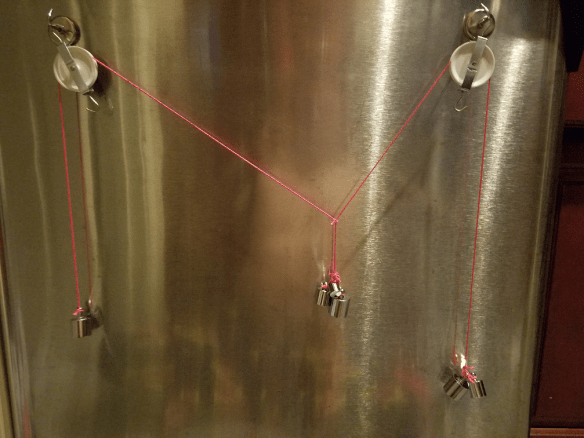
For the same reasons as before (balancing forces), it remains true that Mlgcosλ = Mrgcosρ (force left = force right), and, this time, that equation will be needed. It also remains true that Mcg = Mlgsinλ + Mrgsinρ (downward force = sum of the two upward forces). The increased difficulty is caused by the newly-introduced asymmetry, for now Ml ≠ Mr, and λ ≠ ρ as well. It remains true, of course, that λ + θ + ρ = 180°.
In both the vertical and horizontal equations, “g,” the acceleration due to gravity, cancels, so Mlgcosλ = Mrgcosρ becomes Mlcosλ = Mrcosρ, and Mcg = Mlgsinλ + Mrgsinρ becomes Mc = Mlsinλ + Mrsinρ. The simplified horizontal equation, Mlcosλ = Mrcosρ, becomes Ml²cos²λ = Mr²cos²ρ when both sides are squared, in order to set up a substitution based on the trigonometric identity, which works for any angle φ, which states that sin²φ + cos²φ = 1. Rearranged to solve it for cos²φ, this identity states that cos²φ = 1 – sin²φ. Using this rearranged identity to make substitutions on both sides of the previous equation Ml²cos²λ = Mr²cos²ρ yields the new equation Ml²(1 – sin²λ) = Mr²(1 – sin²ρ). Applying the distributive property yields the equation Ml² – Ml²sin²λ = Mr² – Mr²sin²ρ. By addition, this then becomes -Ml²sin²λ = Mr² – Ml² – Mr²sin²ρ. Solving this for sin²λ turns it into sin²λ = (Mr² – Ml² – Mr²sin²ρ)/(-Ml²).
Next, Mc = Mlsinλ + Mrsinρ (the simplied version of the vertical-force-balance equation, from above), when solved for sinλ, becomes sinλ = (Mrsinρ – Mc)/(- Ml). Squaring both sides of this equation turns it into sin²λ = (Mr²sin²ρ – 2MrMcsinρ + Mc²)/(- Ml)².
There are now two equations solved for sin²λ, each shown in bold at the end of one of the previous two paragraphs. Setting the two expressions shown equal to sin²λ equal to each other yields the new equation (Mr² – Ml² – Mr²sin²ρ)/(-Ml²) = (Mr²sin²ρ – 2MrMcsinρ + Mc²)/(- Ml)², which then becomes (Mr² – Ml² – Mr²sin²ρ)/(-Ml²) = (Mr²sin²ρ – 2MrMcsinρ + Mc²)/(Ml)², and then, by multiplying both sides by -Ml², this simplifies to Mr² – Ml² – Mr²sin²ρ = – (Mr²sin²ρ – 2MrMcsinρ + Mc²), and then Mr² – Ml² – Mr²sin²ρ = – Mr²sin²ρ + 2MrMcsinρ – Mc². Since this equation has the term – Mr²sin²ρ on both sides, cancelling it simplifies this to Mr² – Ml² = 2MrMcsinρ – Mc², which then becomes Mr² – Ml² + Mc² = 2MrMcsinρ, and then sinρ = (Mr² – Ml² + Mc²)/2MrMc = [(0.150 kg)² – (0.100 kg)² + (0.170 kg)²]/[2(0.150 kg)(0.170 kg)] = (0.0225 – 0.0100 + 0.0289)/0.0510 = 0.0414/0.510 = 0.812. The inverse sine of this value gives us ρ = 54°.
Having one angle’s measure, of course, makes it far easier to find the others. Two paragraphs up, an equation in italics stated that sinλ = (Mrsinρ – Mc)/(- Ml). It follows that λ = sin-1[(Mrsinρ – Mc)/(- Ml)] = sin-1[(0.150kg)sinρ – 0.170kg)/(-0.100kg)] = 29°. These two angles sum to 83°, leaving 180° – 83° = 97° as the value of θ.
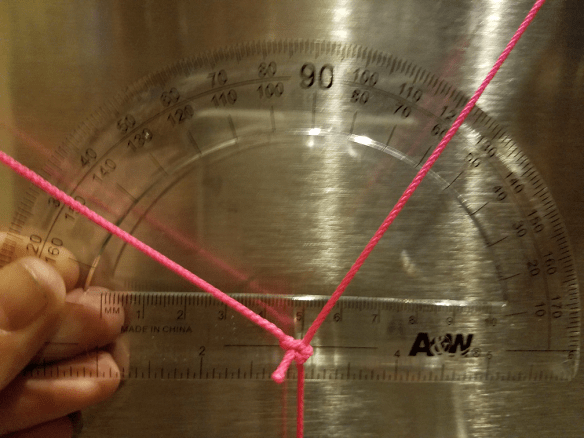
As can be seen above, these derived values are close to demonstrated experimental values. The first angle found, ρ, measures ~58°, which differs from the theoretical value of 54° by approximately 7%. The next, λ, measures ~31°, also differing from the theoretical value, 29°, by about 7%.The experimental value for θ is (180 – 58 – 31)° = 91°, which is off from the theoretical value of 97° by ~6%. All of these errors are smaller than the 9% error found for both λ and ρ in the easier, symmetrical version of this problem, and the causes of this error should be the same as before.

Iron Man, Daredevil, Spider-Man, Captain America, and Wolverine each have a favorite food, a favorite beverage, own one pet, and have a single hobby. Based on the clues which follow, find out these things:
Here are the clues. Answers will be revealed in the comments, but only after someone solves the puzzle (to avoid spoiling anyone’s fun).
The first person to leave the solutions in the comments wins bragging rights.
[Source of image: http://www.hdwallpaperpc.com/show-wallpaper/Spider_man_DareDevil_Iron_Man_Captain_America_Wolverine_Black_43340.html].
To begin this experiment, I first purchased two refrigerator-sized Fractiles-7 sets (available at http://fractiles.com/), and then, early on a Sunday, quietly arranged these rhombus-shaped magnets on the refrigerator in our apartment (population: 4, which includes two math teachers and two teenagers), using a very simple pattern.
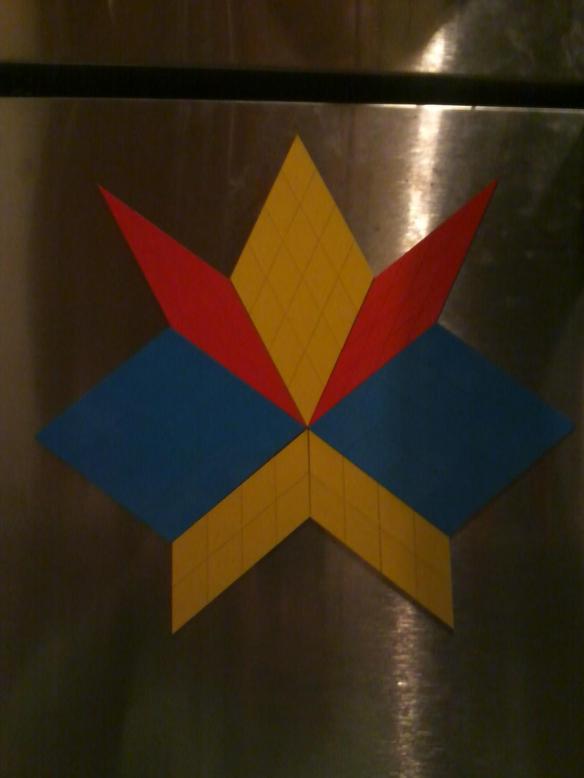
Here’s a close-up of the center. There are 32 each, of three types of rhombus., in this double-set, for a total of 96 rhombic magnets, all with the same edge length.

The number of possible arrangements of these rhombi is far greater than the population of Earth.
The next step of the experiment is simple. I wait, and see what happens.
It should be noted that there is a limit on how long I can wait before my inner mathematical drives compel me to play with these magnets more, myself — but I do not yet know the extent of that limit.

As a teacher, I have had variants of this conversation many times. The specific details, however, are fictional, for this changes, somewhat, each time it happens.
…At least I try. Also, sometimes, the educational outcome is better than in this fictionalized example.
[Image source: http://www.decorationnako.tk/birthday-cake/]

Soon, the Arkansas Democrat-Gazette will run my mother’s obituary. However, it would not be right for me to allow the obituary they print to be her only one.
Mom’s name when she was born, on January 4, 1942, was Mina Jo Austin. Later, she was known professionally as Mina Marsh. However, I chose to legally change my last name to her maiden name, in 1989, after my parents divorced. I did this so that I could have a last name I associated only with my good parent, for I only had one — the one now in this hospice room with me, as I write this, with little time remaining to her.
This is an old photograph of her, and her two younger sisters, taken when my mother was a teenager.

Her father, whom I knew (all too briefly) as “Daddy Buck,” taught her many things, very early in life, just as Mom did, much later, for me. He taught her about justice, and its opposite, using as one example of injustice the internment camps for Japanese-Americans which were then operating, here in Arkansas, when my mother was a little girl. Even in the wake of Pearl Harbor, and in complete disagreement with the masses, my grandfather thought it an obscenity that people had been herded into these camps simply because of their ethnicity, and, in a world where evil does exist, he decided his daughter needed to know about it. Only with knowledge of evil can one stand up to it, oppose it, and speak truth to it, even when that evil is mixed with power, as happens all too often. He instilled in her a strong sense of justice, and taught her courage, at the same time.
Mom started college at Harding University, in Searcy, Arkansas, and demonstrated her courage, and refusal to tolerate injustice, there, during the 1960 presidential election campaign. The assembled students of Harding were told, in chapel, that it was their duty, as Christians, to go forth on election day, and cast their votes for Richard Nixon, because allowing John F. Kennedy, a Catholic, to become president would be a horrible, sinful thing to do. She found this offensive, in much the same way that her father had found America’s treatment of Japanese-Americans offensive during World War II. On principle, therefore, she withdrew from Harding, and transferred to the University of Arkansas (in Fayetteville) to complete her college coursework. She also, later, left the denomination associated with Harding, eventually becoming a member of the Episcopal Church. I am grateful to her church here in Fayetteville, Arkansas, for the many comforts they have given her over the years. They even went so far as to raise the funds needed, in 2010, for her emergency transportation, by air, to a Mayo Clinic in Minnesota, where surgery was performed to save her from a rare adrenal-gland tumor called a pheochromocytoma. Without this help from them, her life would have been shortened by over five years.
Mom is survived by two children. I came along in 1968, and my sister (who had three children herself — my mother’s three grandchildren) was born the following year. Mom is also survived by three step-grandchildren, and two step-great-grandchildren. Mom began to teach both my sister and myself, as early as she could, what her father had taught her, early in life. Strangely enough, one of my earliest memories of her doing this also involved Richard Nixon, for the first news event I clearly remember seeing on television was Nixon’s 1974 resignation speech. At that young age, and with my parents clearly disgusted with America’s most disgraced president to date, I blurted forth, “I wish he was dead!” Mom wasn’t about to let that pass without comment, and did not. I remember the lesson she taught me quite well: there was nothing wrong with wishing for him to lose his position of power, as he was doing — but to wish for the man to die was to cross a line that should not be crossed. One was right; the other was wrong. It is my mother who taught me how to distinguish right from wrong. From this point forward, I now have a new reason to try, in every situation, to do the right thing: anything less would dishonor my mother’s memory.
It was around this time that my sister and I started school, and to say Mom was deeply involved in our experiences at school would be to understate the issue. In a conservative state where many schools openly (and illegally) do such insane things as teach young-earth Creationism in “science” classes, and anti-intellectualism is sometimes actually seen as a virtue, our entry into the school system was not unlike entering a battleground. At this time, education specifically designed for gifted and talented students simply did not exist in Arkansas. Mom had already had some teaching experience herself, although she had since moved on to other work. She was often appalled by the inane things that happened in our schools, when we were students, such as this from the fifth grade, and this (also from elementary school), and this especially-awful example from the seventh grade. Never one to tolerate injustice, Mom was deeply involved, from the beginning, in the formation of an organization called AGATE (Arkansans for Gifted and Talented Education), which fought a long, uphill, but ultimately successful battle to bring special programs for the education of gifted and talented students into the public schools of our state. She did this for her own two children, true — I consider forcing someone (who already understands it) to “practice” long division, year after year, to be a form of torture, and she was trying to save me from such torture — but she also did it for thousands of other Arkansas students, and tens of thousands have since benefited from her work in this area.

Mom was never content to fight in just one struggle at a time, for there is too much important work to do for such an approach. She was also a dedicated naturalist, a Master Gardener, and served as the Deputy Director of the Arkansas Natural Heritage Commission for 25 years, seeking ways to protect and preserve areas of natural beauty, and scientific significance, in our state. After retiring from that position, she later served on the board of directors of the Botanical Garden of the Ozarks, and also became the Development Director of the Ozark Natural Science Center.
My mother affected the lives of a great many people in her 73 years of life, including many who do not even know her name — but neither gaining credit, nor fame, was ever her goal. She will be deeply missed.
# # #
[About the rotating image: the picture of the banded agate, a reference to AGATE, the organization, on the faces of Mom’s dodecahedron, at the top of this post, came from here. The rotating dodecahedron itself, which the ancient Greeks associated with the heavens, was created using Stella 4d, software available at this website.]
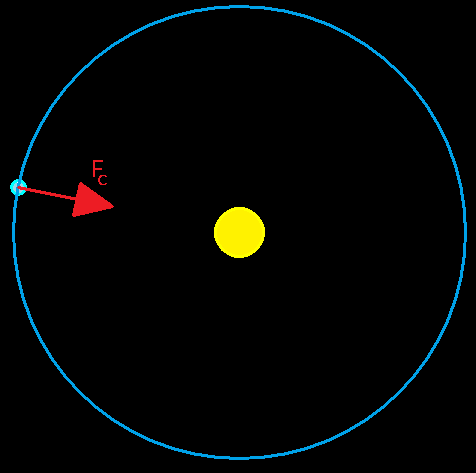
In the Summer of 2014, with many other science teachers, I took a four-day-long A.P. Physics training session, which was definitely a valuable experience, for me, as a teacher. On the last day of this training, though, in the late afternoon, as the trainer and trainees were winding things up, some of us, including me, started getting a little silly. Physics teachers, of course, have their own version of silly behavior. Here’s what happened.
The trainer: “Let’s see how well you understand the different forces which can serve as centripetal forces, in different situations. When I twirl a ball, on a string, in a horizontal circle, what is the centripetal force?”
The class of trainees, in unison: “Tension!”
Trainer: “In the Bohr model of a hydrogen atom, the force keeping the electron traveling in a circle around the proton is the . . . ?”
Class: “Electromagnetic force!”
Trainer: “What force serves as the centripetal force keeping the Earth in orbit around the Sun?”
Me, loudly, before any of my classmates could answer: “God’s will!”
I was, remember, surrounded by physics teachers. It took the trainer several minutes to restore order, after that.

I’ve been a fan of John Lennon for as long as I can remember, and October 9, his birthday, has always been a special day for me. In 1983, when I was a high school junior, celebrating his birthday changed from something I simply did, by choice, into what, at the time, I considered a moral imperative.
In October of ’83, I was a student — a junior — at McClellan High School in Little Rock, Arkansas, and October 9th happened to be the day that all juniors were, according to that school’s administration, required to take the ASVAB: the Armed Services Vocational Aptitude Battery. While this is a standardized test, it isn’t like other standardized tests — it is actually a recruitment tool for the United States military.
At the time, Ronald Reagan was president, and we were in one of the many scary parts of the Cold War, with the threat of global thermonuclear war looming over us at all times. If you are too young to remember the Reagan era well, it may be hard to understand just how real, and how scary, it was to grow up with a president who did such things as making “jokes,” like this, in front of a microphone:
Reagan made this extremely unfunny “joke” the next year, in 1984, but the climate of fear in which he thought such a thing would be funny was already firmly in place in 1983, and I was already openly questioning the sanity of our president. My own anti-war attitudes, very much influenced by Lennon and his music, were already firmly in place. For the few unfamiliar with it, here is a sample of Lennon’s music.
So here I was, a high school junior, being told I had to take a test, for the military, on John Lennon’s birthday. I reacted to this in pretty much the same way a devout Jew or Muslim would react to being told to eat pork chops: I absolutely refused to cooperate. “Blasphemy” is not a word I use often now, and it wasn’t then, either, but to cooperate with this would have been the closest thing to blasphemy which I was capable of understanding at that age (I was 15 years old when this happened).
The other juniors got up and shuffled off, like good, obedient soldiers, when the intercom told them to go take the ASVAB. I simply remained seated.
The teacher told me it was time to go take the ASVAB. I replied, calmly, that no force on earth could compel me to take a test for the military on John Lennon’s birthday. At that point, I was sent to the office. Going to the office posed no ethical nor moral dilemmas for me, for I wanted the people there to know, also, that it was wrong for them to give a test for the military on October 9, of all days.
The principal, a man already quite used to dealing with me and my eccentricities, knew it would be pointless to argue with me about the ASVAB. He simply showed me a chair in the main office, and told me I could sit there that day, all day, and I did. To the school, this might have been seen as a single day of in-school suspension, but I saw it for what it really was: a one-person, sit-down protest for peace, in honor of the greatest activist for peace the world has ever known. It was an act of civil disobedience, and I regret nothing about it.
I will be sharing this story with Lennon’s widow, Yoko Ono, a woman I very much admire, and the greatest living activist for peace in the world today. Yoko, I do hope you enjoy this story. You and John have done great things, and they will not be forgotten, as long as people remain alive to tell about them.
Peace to all.
[Credits: photo from rollingstone.com; videos from YouTube.]

Ordinarily, with Zometools, the compound of five cubes is an all-blue model. However, I wanted to build one in which each cube is a different color, so I made a special request to the Zometool Corporation (their website: http://www.zometool.com) for some off-color parts, to make this possible.
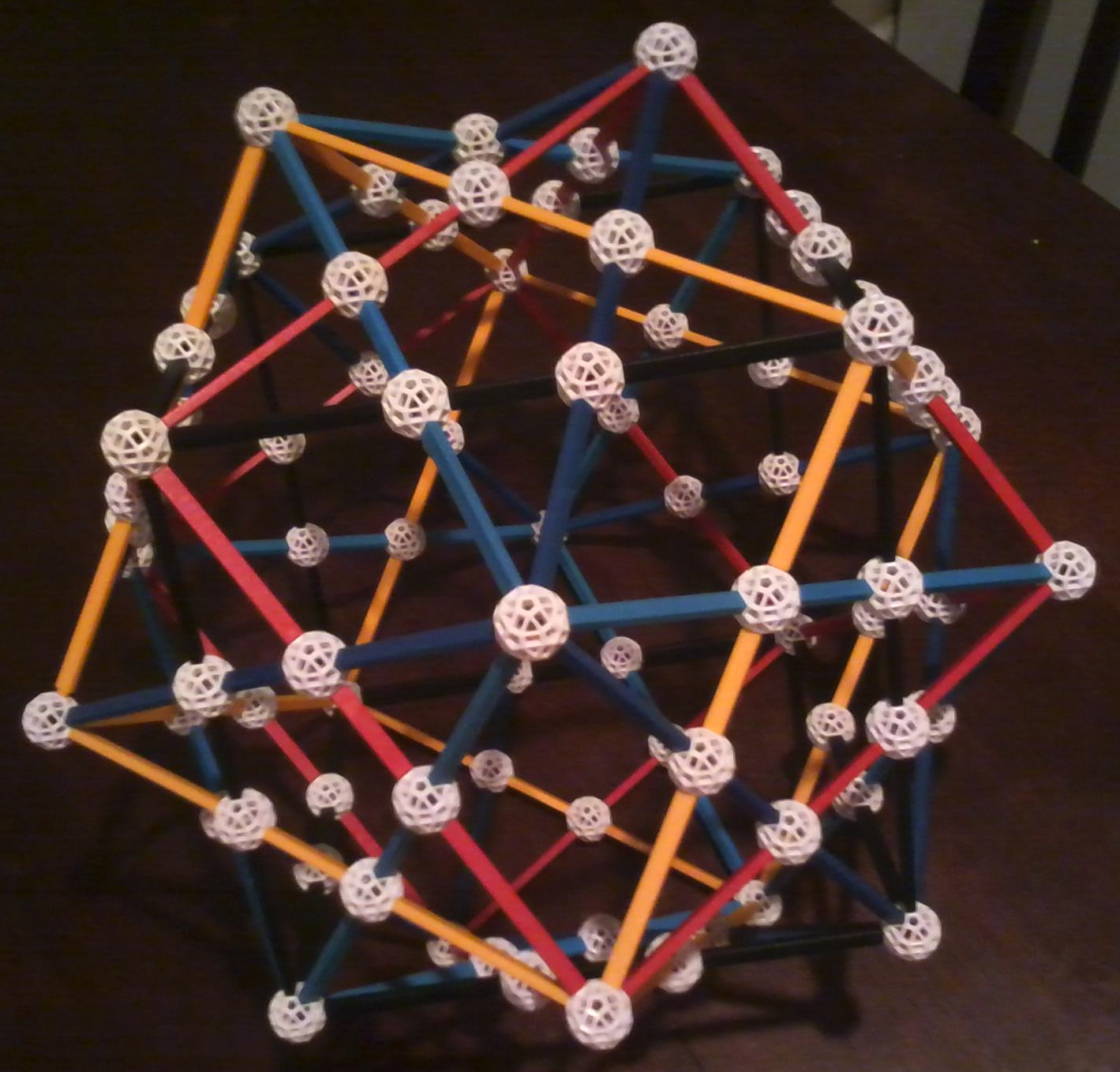
The five colors used in this model are standard blue, a darker shade of blue, red, yellow, and black.
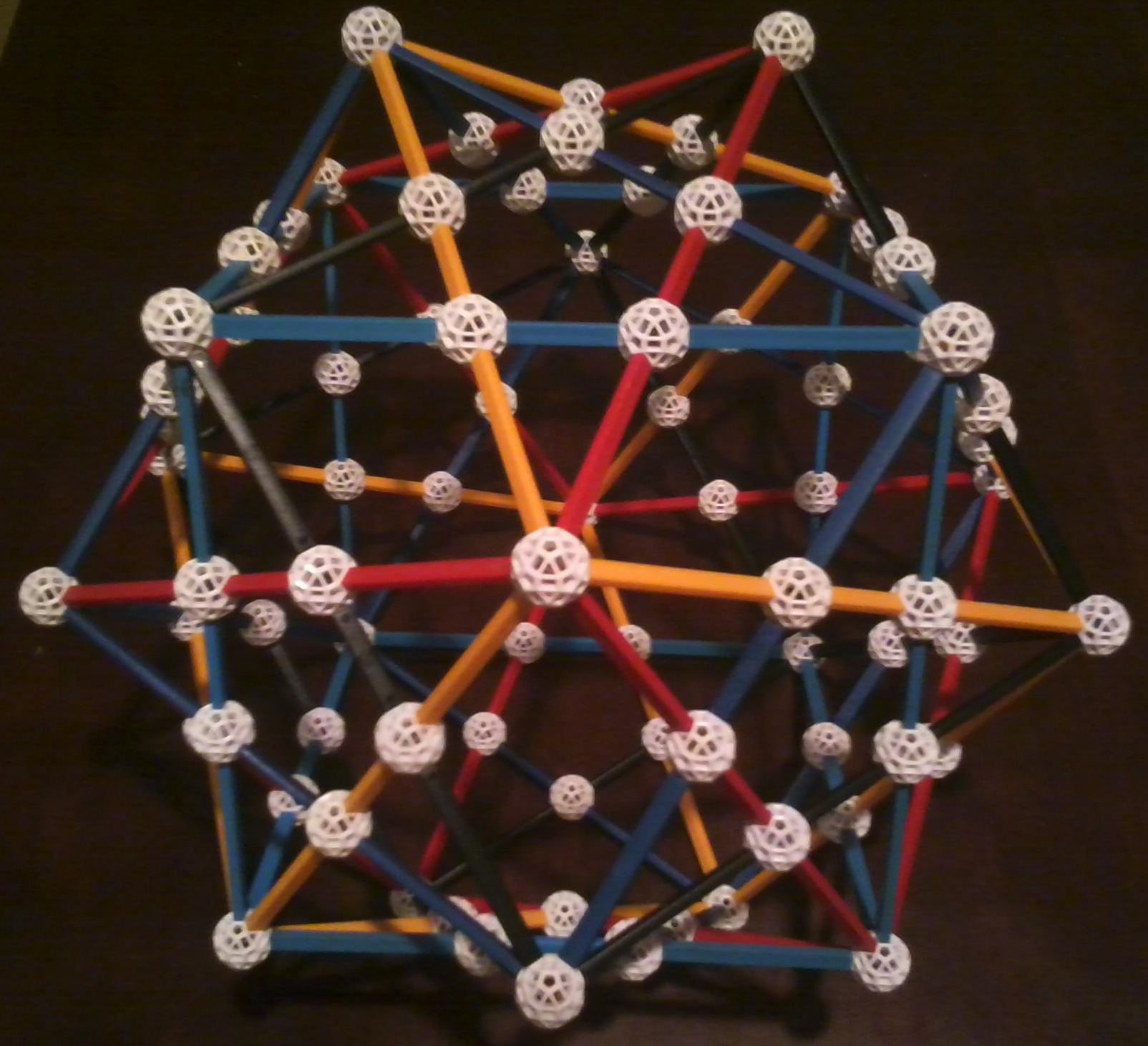
I also received the struts needed to build this model with one cube in white, so I will be making a second version of this soon. I didn’t want the Zomeballs used to match any strut color, though, so I will have to wait for the shipment of purple Zomeballs I ordered, today, to arrive, before I can build that model.
Zome is a fantastic tool to use for mathematical investigations, as well as education, and other applications as well. I recommend this product highly, and without reservation.
 RobertLovesPi.net